

Imagine sitting just feet away from your partner, yet feeling as though a vast, silent ocean sits between you. You want to reach out, but the fear of a misunderstanding keeps you silent, making you feel like you are walking on eggshells in your own living room. It's a lonely place to be, but these moments of distance don't have to define your future together. By practicing intentional communication exercises for couples, you can begin to bridge that gap and replace the tension with a sense of calm assurance.
We understand that you want to feel seen and heard without every conversation turning into a battle. It is possible to restore the emotional safety that once felt so natural. Effective communication is not about following a rigid script; it is about creating a secure base where both of you feel safe enough to be vulnerable. In this guide, you'll discover evidence-based communication exercises for couples designed to de-escalate conflict and deepen your intimacy. We will explore how to build a shared emotional language that transforms your interactions from sites of friction into opportunities for genuine connection and lasting trust.
Key Takeaways
- Identify the underlying dynamics, such as emotional flooding and the pursuer-distancer cycle, that often disrupt your connection.
- Explore proven communication exercises for couples that focus on 'turning toward' your partner to build a sturdy foundation of trust.
- Learn practical techniques to de-escalate tension and restore emotional safety during difficult conversations.
- Discover how to introduce new communication tools with compassion, ensuring you avoid the common pitfalls of timing and fatigue.
- Understand the signs that indicate when professional guidance is the most effective path forward for your unique relationship journey.
Understanding Why Couples Struggle to Communicate Effectively
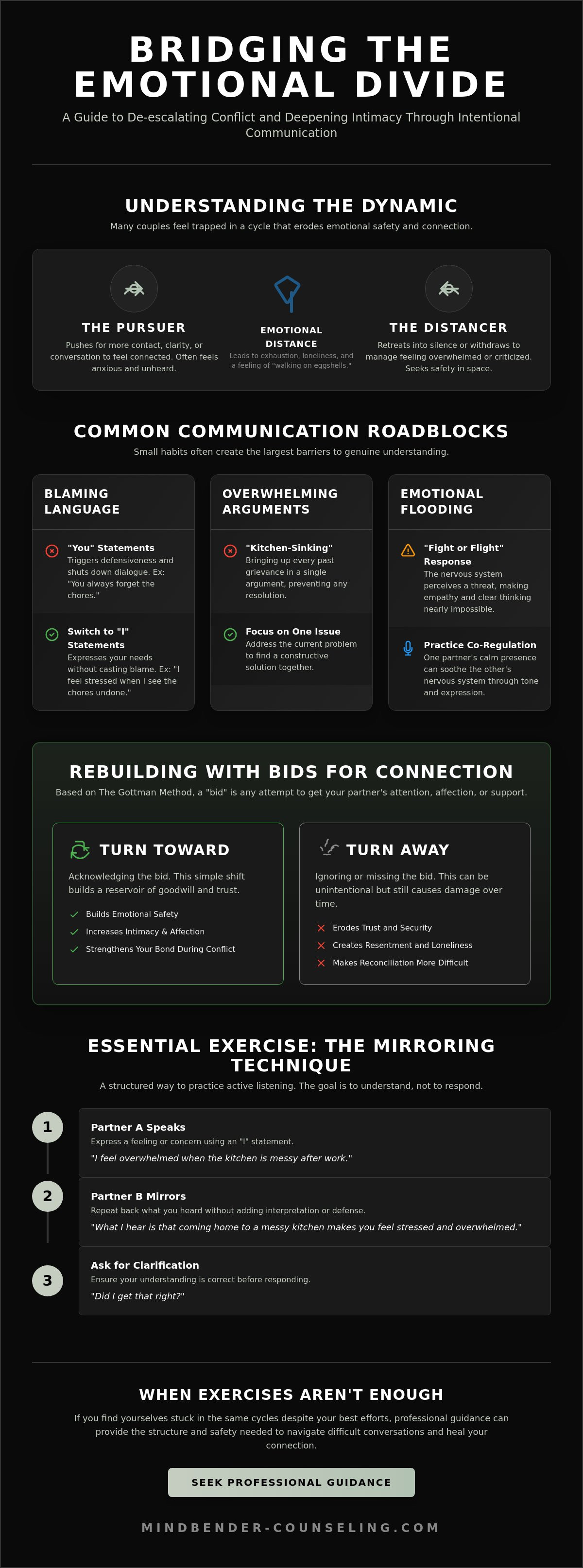
Healthy communication is often misunderstood as merely a way to swap information or coordinate schedules. In a thriving relationship, it serves as a vital bridge for emotional connection. When this bridge weakens, partners often find themselves stuck in the "pursuer-distancer" dynamic. One person may push for more contact or clarity while the other retreats into silence, creating a cycle that leaves both feeling exhausted and alone. This is where Interpersonal communication becomes more than a social skill; it becomes a lifeline for your bond.
Many couples describe a persistent feeling of walking on eggshells. This sensation isn't just about avoiding a loud argument; it's a clear signal that emotional safety has eroded. When safety is absent, your brain prioritizes protection over connection. You might find yourself venting your frustrations without a clear path toward a solution, which often leaves your partner feeling attacked rather than engaged. True resolution requires moving past the need to be "right" and focusing instead on how to heal the rift together. Integrating specific communication exercises for couples can help break these patterns by providing a structured way to listen and respond with intention.
The Role of Emotional Safety in Dialogue
When a conversation turns into a conflict, your nervous system can perceive a threat, triggering a "fight or flight" response. This biological reaction, often called emotional flooding, makes it nearly impossible to think clearly or feel empathy. Instead, you might resort to defensiveness or stonewalling as a way to protect yourself from further hurt. Emotional safety is the quiet assurance that you can be vulnerable with your partner without fear of judgment, rejection, or attack.
Common Communication Roadblocks
Small habits often create the largest barriers to understanding. "You" statements, such as "You always forget the chores," naturally trigger a partner's defenses and shut down productive dialogue. Switching to "I" statements allows you to express your needs and feelings without casting blame. Another frequent trap is "kitchen-sinking," where one person brings up every past grievance during a single argument. This overwhelms the conversation and prevents any single issue from being resolved. External pressures from work or parenting also bleed into your private life, making you less patient with the person you love most. Using communication exercises for couples helps you set boundaries around these stressors, ensuring your relationship remains a sanctuary.
The Evidence-Based Foundation of Relationship Exercises
Real change isn't built on willpower alone; it's rooted in proven psychological frameworks that prioritize long-term stability. The Gottman Method and Emotionally Focused Therapy (EFT) stand as the gold standards for modern relationship health because they address core attachment needs. These approaches move beyond surface-level advice to help you recognize "bids for connection." A bid is any attempt to get your partner's attention, whether through a look, a touch, or a question. By utilizing structured Gottman Institute communication exercises, you can learn to "turn toward" these bids rather than turning away or against them. This simple shift creates a reservoir of goodwill that protects your bond during harder times.
This process relies heavily on the neurobiology of co-regulation. When one partner remains calm and present, their nervous system literally helps soothe the other's. It's a biological exchange where safety is transmitted through your tone of voice and facial expressions. If you feel like these communication exercises for couples feel forced at first, remember that you're essentially learning a new language. It's normal to feel awkward. Just as a musician practices scales until they become second nature, these tools eventually become a natural part of your shared emotional life. Consistency is the key to moving from a state of defense to one of genuine openness.
The Power of Active Listening
Active listening requires you to listen to understand, not to respond. This is where the mirroring technique shines. By repeating what your partner said, you lower the perceived threat in their brain. For example, if your partner says, "I feel overwhelmed when the kitchen is messy after work," you might respond with, "What I hear is that coming home to a messy kitchen makes you feel stressed and overwhelmed. Did I get that right?" This simple act validates their reality, which immediately de-escalates the "fight or flight" response and allows for a productive resolution.
Building Emotional Intelligence (EQ) Together
Building emotional intelligence involves identifying the "softer" emotions, such as fear, shame, or sadness, that often hide behind anger outbursts. When you understand the root of your feelings, you can use a "softened start-up" to raise an issue without blame. This technique has a high success rate because it avoids triggering defensiveness from the start. During a heated discussion, "repair attempts" act as a vital release valve. A simple phrase like "I'm sorry, can I try that again?" can stop a spiral before it starts. If these patterns feel deeply ingrained, exploring evidence-based therapy can provide the personalized structure your relationship needs.
5 Essential Communication Exercises for Every Relationship Stage
Moving from understanding theory to practicing new habits is a courageous step toward healing. To help you get started, we've selected five high-impact communication exercises for couples that address different relational needs. These tools are designed to work at any stage, whether you're navigating a new situationship or a decades-long marriage. Before you begin, agree on a "no-blame" rule. These exercises are meant to be safe containers for expression, not opportunities to point out a partner's flaws. By focusing on your own experience, you invite your partner to listen without feeling the need to defend themselves.
The 10-Minute Daily Check-In
Job to be Done: Building a "team" mentality and co-regulation.
Set aside ten minutes every day where each of you has five minutes to speak without interruption. The key is to discuss external stressors, such as work challenges or family obligations, rather than relationship issues. Talking about the outside world first helps you view each other as allies against life's pressures. Resist the urge to offer solutions or "fix" the problem. Simply listen and validate your partner's feelings to build a foundation of mutual support.
The 'I Feel... When...' Script
Job to be Done: De-escalation and clear expression of needs.
This formula bypasses the brain's defensive response by focusing on your internal reality rather than your partner's actions. Use the structure: "I feel [Emotion] when [Specific Behavior] because [Impact]." This clarity helps your partner understand the "why" behind your request. These communication exercises for couples are most effective when they replace vague complaints with concrete observations. Consider these examples:
- Before: "You're always on your phone." After: "I feel unimportant when you look at your phone during dinner because I value our limited time to connect."
- Before: "You never help with the house." After: "I feel overwhelmed when the dishes are left overnight because I struggle to start my morning in a cluttered space."
- Before: "You’re always late." After: "I feel anxious when you arrive late without calling because I worry about your safety."
Extended Eye Contact and Non-Verbal Connection
Job to be Done: Restoring intimacy and biological bonding.
Sometimes, words aren't enough to bridge a gap. The "4-Minute Stare" involves sitting comfortably and maintaining eye contact for four minutes in silence. This exercise can feel awkward at first, but it triggers the release of oxytocin, the body's natural "bonding hormone." It forces a pause in the digital noise of modern life and requires you to truly see one another. For couples feeling a physical disconnect, follow this with a gentle touch or a hug. Physical contact acts as a powerful "reset button" for the nervous system, signaling that you're safe with one another.
To round out your practice, consider The Appreciation Exchange, where you each share three things you valued about the other that day. Finally, use The Stress-Reducing Conversation to practice active listening on a deeper level. These five tools, when used consistently, create a shared emotional language that can transform the way you relate to one another.
How to Implement These Exercises Without Feeling Overwhelmed
Introducing new habits into a relationship requires a delicate touch. Instead of suggesting communication exercises for couples during a heated argument, wait for a moment of quiet connection. You might say, "I value our relationship so much that I've been looking for ways we can feel even closer. Would you be open to trying something new with me?" This approach frames the practice as a shared investment in your future rather than a critique of your partner's current behavior. By inviting them into the process with compassion, you lower their defenses and build immediate trust.
Timing is just as important as the technique itself. Follow the "Time and Place" rule by avoiding these practices when either of you is experiencing H.A.L.T.: Hungry, Angry, Lonely, or Tired. In these states, your nervous system is already strained; this makes it difficult to access the empathy required for deep dialogue. Set realistic expectations for your first few attempts. You don't need to get it perfect to see progress. To maintain a sense of security, establish a "Safe Word" or a "Timeout" protocol. If one partner feels overwhelmed or flooded, they can use the safe word to pause the conversation immediately, allowing both of you to cool down before returning to the exercise.
Navigating Resistance and Skepticism
It's common to feel that using a script or a structured format feels "fake" or "unnatural." If your partner expresses skepticism, remind them that learning to connect is like learning a new language. You have to stumble through the grammar and vocabulary before you can speak fluently. Lead by example. When you consistently use these tools without demanding perfection from your partner, you create a safe environment for them to eventually join you. Your commitment acts as a steady anchor, encouraging them to move toward personal evolution alongside you.
Creating a Consistent Practice
For busy professionals in Arizona or Texas, finding time can feel like another chore on an endless list. However, integrating a "Ritual of Connection" into your week makes these moments non-negotiable. Whether it's a Sunday morning coffee or a Thursday evening walk, dedicate a specific block of time to your relationship. Just 15 minutes of intentional practice can save you hours of exhausting arguments later in the week. If you find that resistance persists or the same issues keep arising, reaching out for couples counseling can provide the professional facilitation needed to break the cycle and restore balance.
When Exercises Aren't Enough: The Role of Professional Counseling
While communication exercises for couples offer a powerful starting point for growth, there are times when self-directed practice reaches its natural limit. If you find that the same painful patterns repeat despite your best efforts, it doesn't mean your relationship is failing. It often indicates that the issues you're facing are rooted in deep-seated trauma, a history of betrayal, or complex life transitions that require a more specialized approach. In these instances, the presence of a neutral, professional third party becomes essential to break the cycle of gridlock and restore the emotional safety you both deserve.
Professional facilitation provides a structured environment where you can explore difficult topics without the fear of the conversation spiraling out of control. A therapist doesn't just offer advice; they act as a steady anchor and a catalyst for movement when you feel stuck. By applying evidence-based therapy, a counselor helps you navigate the "why" behind your reactions, allowing you to build a more solid internal foundation for your partnership. This expert guidance ensures that your efforts to connect are rooted in proven, reliable methods that lead to lasting change.
Signs You Need a Professional Facilitator
Gridlock is one of the clearest indicators that you need outside support. This occurs when you feel stuck in the same argument for months or even years, with neither partner feeling understood or willing to compromise. Other signs include the aftermath of infidelity, the strain of addiction, or the overwhelming weight of major life transitions. In these moments, a therapist acts as a skilled translator. When you and your partner can no longer hear each other through the noise of your own pain, the facilitator helps clarify your needs and feelings, ensuring that the dialogue remains productive rather than destructive.
Couples Counseling in Arizona and Texas
At Mindbender Counseling, we provide a supportive environment where you can explore these challenges with quiet confidence and optimism. Our practitioners utilize evidence-based therapy to help you apply the principles of connection in a way that's tailored to your unique history and goals. We understand the specific pressures facing professionals and families in Arizona and Texas, and we offer a streamlined, low-friction path to receiving personalized care. Whether you're seeking to rebuild trust after a crisis or simply want to deepen your intimacy, our compassionate approach ensures you aren't walking this path alone. You can strengthen your bond with professional couples counseling at Mindbender to begin your journey toward a restored and balanced relationship.
Taking the First Step Toward Lasting Connection
Building a shared emotional language is a journey that requires both patience and intentionality. By identifying common roadblocks like emotional flooding and implementing structured communication exercises for couples, you can begin to replace silence with genuine understanding. Whether you're practicing the 10-minute daily check-in or learning to use softened start-ups, every small effort strengthens the foundation of your relationship. These tools are designed to lower defenses and restore the emotional safety that allows your bond to thrive.
While self-guided practice is a powerful start, some hurdles require the steady hand of a professional guide. If you're ready to move beyond gridlocked issues and experience deep, personalized healing, we're here to support you. Our team provides compassionate, personalized care through evidence-based therapy techniques, offering licensed support for couples across Arizona and Texas. You deserve a relationship where you feel truly seen and heard by the person you love most.
Schedule a Couples Counseling Session with Mindbender to begin your transformation today. Your path toward a more peaceful and connected partnership is within reach, and we're honored to walk it with you.
Frequently Asked Questions
What are the best communication exercises for couples in a long-distance relationship?
The best communication exercises for couples in long-distance relationships prioritize intentional digital connection. Use structured tools like the Amora app for daily shared journaling or the Paired app for relationship quizzes to bridge the physical gap. These digital interventions create a consistent space for vulnerability. Schedule a weekly video date focused on emotional check-ins rather than logistical updates to maintain a sense of shared reality despite the miles.
How often should we practice these relationship exercises?
Consistency is more valuable than intensity when you're building new relationship habits. Aim to practice a brief 10-minute check-in daily to manage external stress and maintain a team mentality. Dedicate a longer block of time, perhaps 30 to 60 minutes once a week, for deeper practices like the Speaker-Listener technique. This steady rhythm creates a predictable sense of security and prevents small misunderstandings from snowballing into major conflicts.
What if my partner refuses to participate in communication exercises?
If your partner is hesitant, the most effective approach is to lead by example. You can begin implementing "I" statements and softened start-ups in your own speech without requiring them to follow a script. Often, when one partner shifts their communication style, the other naturally responds with less defensiveness. If the disconnect feels insurmountable, seeking individual counseling services can help you develop your own internal foundation and communication skills.
Can communication exercises help after infidelity?
Yes, these exercises are vital for rebuilding trust, but they often require professional facilitation in the wake of infidelity. After a major betrayal, structured techniques can help the hurt partner feel heard while the other practices accountability. Because these conversations are highly charged, working with a therapist ensures that the communication exercises for couples don't lead to further trauma. Professional support provides the safety needed to process deep pain and restore balance.
Are these exercises useful for couples who aren't 'fighting' but feel distant?
Absolutely, these tools are excellent for preventing "parallel lives" where you feel like roommates rather than partners. Exercises like the 4-Minute Stare or sharing daily appreciations help restore the emotional spark that can fade during busy seasons of life. You don't need to be in crisis to benefit from a stronger emotional language. Proactive practice builds an emotional bank account that protects your relationship against future stressors and stagnation.
How long does it take to see results from these exercises?
You may feel a sense of immediate relief after a single productive conversation, but lasting habit change typically takes several months of consistent practice. Most couples report a significant reduction in conflict frequency after three to six months of regular engagement with these tools. The goal is to move from forced scripts to natural, intuitive connection. Patience is essential as you unlearn old patterns and build a more resilient foundation together.
Is there a difference between marriage counseling and communication exercises?
Communication exercises are specific tools you use to build skills, while marriage counseling is the guided process of healing. Think of exercises as the homework that helps you practice what you've learned. A therapist provides the expertise to identify which exercises are best for your specific needs and helps you navigate the complex emotions that arise during practice. Counseling offers a deeper level of personalized care and professional facilitation.
What is the 'Speaker-Listener' technique and how do we use it?
The Speaker-Listener technique involves one person holding the "floor" while the other listens and then paraphrases what they heard. The Speaker uses "I" statements to share their perspective, while the Listener mirrors the message to ensure accuracy. This process continues until the Speaker feels fully understood before you switch roles. It's a powerful way to slow down a conversation and ensure that both partners feel heard without the interruption of defensiveness.


