

What if your time in therapy felt less like an aimless conversation and more like a structured map toward a resilient version of yourself? It's common to feel overwhelmed by the weight of modern stress, especially if previous attempts at healing left you wondering if you were actually making any progress. When you search for evidence-based individual therapy near me, you're looking for more than just a listening ear; you're seeking a professional partner who uses methods proven by research to create lasting change.
You deserve a therapeutic experience that offers a clear sense of order and measurable emotional growth. This guide explores how evidence-based care provides a research-backed path to mental wellness and how you can find the right specialist in Arizona or Texas. We will look at the specific benefits of clinical frameworks, explain how to verify a provider's expertise in 2026, and provide a roadmap for restoring a solid internal foundation to your daily life. By choosing a methodology rooted in science, you can move from feeling stuck to experiencing a sense of steady, internal stability.
Key Takeaways
- Understand how evidence-based practice integrates clinical expertise and scientific research to create a reliable foundation for your personal growth.
- Learn about proven modalities like Cognitive Behavioral Therapy (CBT) that offer structured, measurable tools for navigating modern stress.
- Discover how to find evidence-based individual therapy near me in Arizona and Texas by prioritizing state-licensed providers with local expertise.
- Gain insight into the collaborative intake process, where you'll work with a professional guide to set clear, research-backed goals for your wellness.
- Explore the benefits of a personalized therapeutic approach designed to restore your internal balance and build long-term emotional resilience.
What is Evidence-Based Individual Therapy? Moving Beyond Traditional Talk Therapy
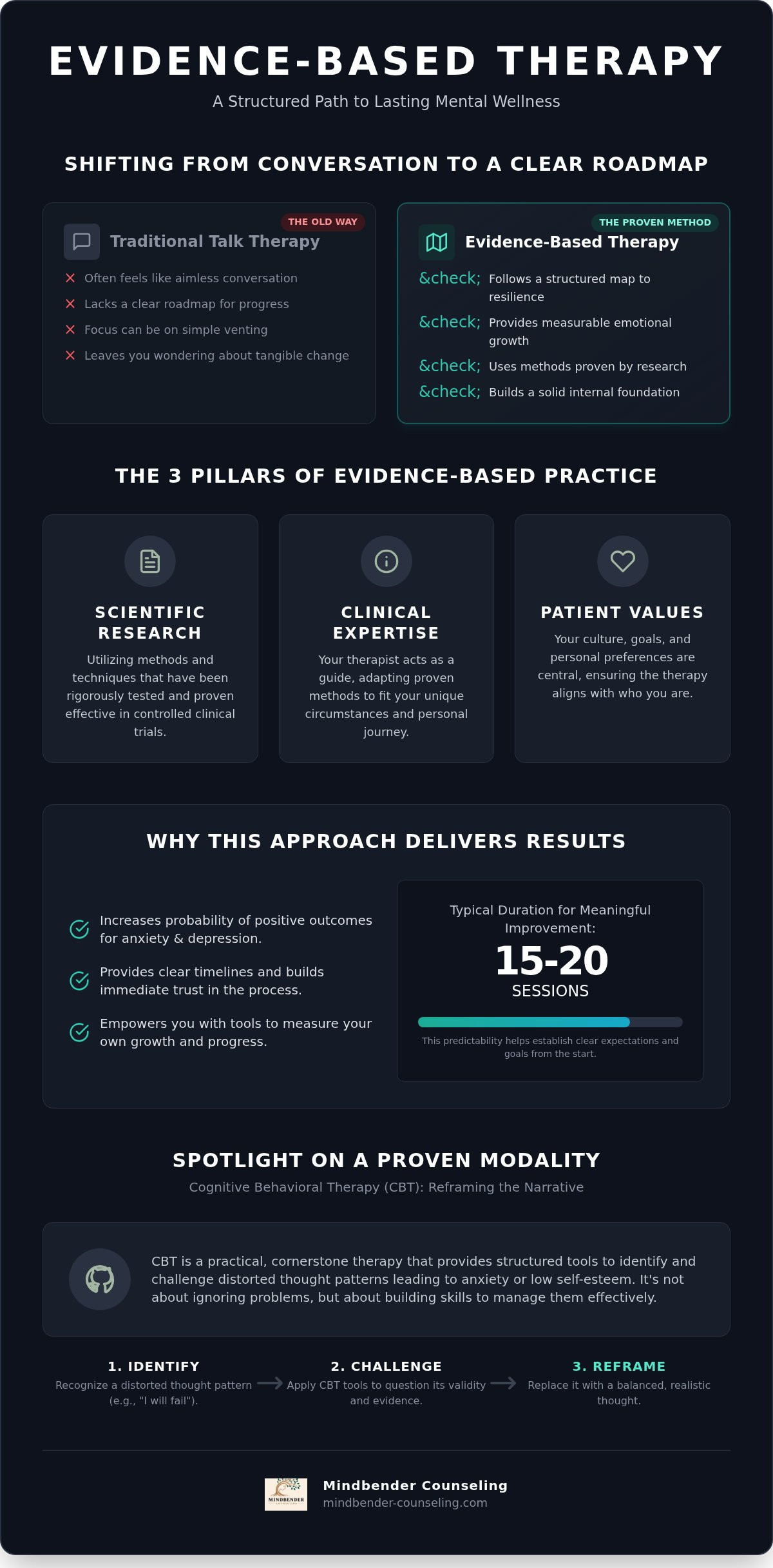
Many people begin their search for evidence-based individual therapy near me because they feel stuck in a cycle of talking without seeing tangible change. While traditional talk therapy has its place, it often lacks the roadmap needed to navigate complex emotional challenges. Evidence-based care shifts the focus from simple venting to strategic healing. It offers a structured framework that ensures your time in the therapist's chair leads to real-world resilience. Instead of just discussing your week, you're building a solid internal foundation using methods that have been rigorously tested and proven to work.
This approach acts as a safety net for anyone new to counseling. It removes the uncertainty of "trying out" different styles by relying on clinical protocols that have already helped thousands of others with similar struggles. By choosing a therapist who prioritizes these methods, you're not just hoping for the best; you're following a path paved with scientific data and clinical success. Evidence-based individual therapy is a collaborative, goal-oriented process rooted in psychological science.
The Three Pillars of Evidence-Based Practice
To understand how this helps you, it's useful to look at the core of Evidence-Based Practice (EBP). It isn't just about following a textbook; it's a dynamic integration of three essential elements:
- Scientific Research: This involves utilizing methods that have been proven effective in clinical trials. If a technique hasn't shown consistent results in a controlled setting, it doesn't make the cut.
- Clinical Expertise: Your therapist acts as a wise guide, using their deep experience to adapt these proven methods to your unique situation. They know how to pivot when a specific tool needs fine-tuning for your life.
- Patient Values: Your culture, personal goals, and individual preferences are the heartbeat of the process. Effective therapy only works when it aligns with who you are and what you value most.
Why Search for "Evidence-Based" Specifically?
When you focus your search on evidence-based care, you increase the probability of positive outcomes for conditions like anxiety and depression. These methods provide clearer timelines for your journey. For instance, research suggests that 15-20 sessions are typically needed to see meaningful improvement from therapy. This predictability helps lower your defenses and builds immediate trust in the process. You'll know what you're working toward and how you'll measure your progress along the way. This clarity is often the difference between feeling overwhelmed by stress and feeling empowered by your own growth.
Proven Therapeutic Modalities: Finding the Right Individual Therapy Program
Finding the right fit involves more than just selecting a name from a list. It's about matching your specific needs to a methodology that works. When you search for evidence-based individual therapy near me, you are prioritizing methods that have been vetted by the scientific community. These proven evidence-based therapies ensure that your sessions are productive and grounded in reality. For a deeper look at how these frameworks function, you can explore our resource on Understanding Therapy and Behavioral Therapy.
This structured approach provides a clear path forward. If you've felt that previous therapy sessions lacked direction, finding evidence-based individual therapy near me can offer the clarity you've been missing. These programs focus on measurable emotional growth rather than just talking through the week's events. By utilizing tools that have been tested in clinical trials, you can feel confident that your time is being used effectively to build a more stable future.
Cognitive Behavioral Therapy (CBT): Reframing the Narrative
CBT remains the cornerstone of modern care because it is exceptionally practical. It helps you identify distorted thought patterns that often lead to anxiety or low self-esteem. For example, if you find yourself overwhelmed by daily work stress, CBT provides tools to challenge the belief that one mistake equals total failure. This process isn't just about positive thinking; it is about accurate thinking. Your therapist might suggest actionable assignments between sessions. These tasks help you apply what you've learned to your life immediately, building a durable sense of resilience that lasts long after your session ends. You'll learn to catch negative thought loops before they spiral, allowing you to maintain a sense of calm even during challenging days.
Specialized Approaches for Personal Healing
While CBT is a powerful starting point, other specialized methods offer unique benefits. Dialectical Behavior Therapy (DBT) is particularly effective for those who feel frequently overwhelmed by intense emotions. It teaches you how to stay present and manage distress without losing your internal balance through four key areas: mindfulness, distress tolerance, emotional regulation, and interpersonal effectiveness. If you are seeking an individual therapy program that addresses deeper roots, trauma-informed care ensures that your past experiences are handled with the utmost sensitivity.
Acceptance and Commitment Therapy (ACT) further supports this by building psychological flexibility. It encourages you to stop fighting uncomfortable thoughts and instead accept them as part of the human experience, allowing you to focus your energy on what truly matters. Every journey is unique; this is why personalized interventions are essential for true healing. If you're ready to begin, you can learn more about our approach to tailored support and discover how these modalities can be adapted to your life.
Finding Quality Individual Therapy Near Me in Arizona and Texas
When you search for evidence-based individual therapy near me, you aren't just looking for a clinical service. You're looking for a professional who understands the specific environment you live in. Residents of Arizona and Texas face unique regional stressors, from the rapid urban growth of Phoenix and Houston to the isolation of rural border towns. A local therapist brings an understanding of these cultural nuances that a national provider might miss. As of 2026, the Counseling Compact has made it easier for licensed professionals in states like Arizona to offer care across state lines, but having a provider who is deeply rooted in your specific community remains a vital anchor for your healing journey.
State-specific licensing ensures that your therapist meets the rigorous ethical and educational standards required by the Arizona Board of Behavioral Health Examiners or the Texas State Board of Examiners of Professional Counselors. These boards protect you by verifying that your provider has the necessary training to deliver safe, effective care. Choosing a licensed professional means you're working with someone who is accountable to a high standard of practice and dedicated to your long-term wellness.
Evaluating Therapist Credentials in the Southwest
Understanding the alphabet soup of designations like LCSW (Licensed Clinical Social Worker), LPC (Licensed Professional Counselor), or LMFT (Licensed Marriage and Family Therapist) is a key step in your search. While their specific educational paths differ, each of these professionals is trained to provide high-quality mental health support. What matters most for your progress is ensuring they integrate the core components of evidence-based practice into their work. This means they are combining the latest research with their own clinical experience and your personal values. If you're finding a supportive individual therapist in Phoenix or Austin, don't hesitate to ask about their specific training in modalities like CBT or DBT during your first contact.
The Role of Telehealth in Accessible Care
Telehealth has transformed the way we access support, especially for busy professionals in Dallas or those living in more remote areas of West Texas. As of January 2026, Medicare and many private insurers have solidified permanent coverage for synchronous audio-video telehealth for behavioral health services. This shift ensures that high-quality care is no longer limited by your zip code. While national therapy apps offer convenience, a local provider often offers better continuity of care. They are familiar with local crisis resources and community support systems that a remote "app-based" therapist might not know exist.
To ensure you're finding a high-quality match, use this checklist when evaluating your search results:
- Verify that the therapist is licensed specifically in Arizona or Texas.
- Check if they explicitly mention evidence-based modalities like CBT or ACT on their profile.
- Confirm they use a secure, HIPAA-compliant platform for virtual sessions to protect your privacy.
- Ask how they measure progress to ensure your goals are being met over time.
- Inquire if they offer a brief initial consultation to see if their style feels like a supportive fit.
What to Expect: Your First Therapeutic Appointment and Beyond
Stepping into your first session can feel like a significant hurdle. When you finally schedule evidence-based individual therapy near me, it's natural to feel a mix of relief and nervous anticipation. You might worry about what to say or whether you'll be "good" at being a patient. Rest assured; there's no right or wrong way to show up. Your therapist is there to act as a steady anchor, facilitating a process that moves at a pace you can handle. Each 50-minute session typically follows a predictable rhythm: a brief check-in, focused work on your specific goals, and a gentle wrap-up to ensure you feel grounded before returning to your day.
The Intake Session: Laying the Foundation
Think of the intake session as a gentle invitation to share your story. During this first meeting, your therapist will ask about your personal history, current challenges, and what you hope to achieve. This isn't an interrogation; it's a discovery phase where you and your guide begin to build a shared language. The first session is a safe space for clarity, not a test of your mental health. By the end of this hour, you'll likely feel a sense of calm assurance as a structured plan begins to take shape. This collaborative foundation ensures that every future session has a clear purpose and direction.
Measuring Progress in Evidence-Based Care
One of the most reassuring aspects of this approach is that your growth isn't left to guesswork. Unlike aimless talk therapy, evidence-based individual therapy near me utilizes specific assessments to track your emotional evolution. Your therapist will periodically check in on your symptoms and goals to see what's working. Research indicates that many individuals see meaningful improvement within 15 to 20 sessions, though your timeline is always personalized to your unique needs.
As you meet your initial goals, your treatment plan will shift from acute support to long-term mental wellness maintenance. This transition allows you to practice your new skills with the knowledge that your therapist is still there to provide steady, unwavering support. You'll learn to recognize your own progress through tangible changes in your daily life, such as improved sleep, better boundaries, or a newfound sense of internal stability. If you're ready to experience this structured path to healing, schedule your individual counseling session today and take the first step toward lasting change.
Mindbender Counseling: Your Partner in Professional Individual Therapy
Choosing Mindbender Counseling means finding a bridge between clinical rigor and the compassionate support you deserve. When you search for evidence-based individual therapy near me, you aren't just looking for a set of techniques; you're looking for a partner in your personal evolution. Our practice is built on the belief that scientific methods like CBT and DBT are most effective when delivered in an environment of total safety and reliability. We serve residents across Arizona and Texas, ensuring that your path to wellness is as unique as your own story. We don't believe in one-size-fits-all solutions; instead, we offer a structured framework that adapts to the specific challenges you face in your daily life.
Our commitment to methods that actually work is what sets us apart. We understand that modern life brings a level of stress that can feel unrelenting. Whether you're navigating career pressure in Phoenix or relational shifts in Austin, our goal is to help you build a solid internal foundation. This approach moves you beyond the feeling of being stuck and toward a state of steady, quiet confidence. By focusing on individualized attention, we ensure that every minute of your session is an investment in your long-term stability.
A Compassionate Approach to Research-Backed Care
Our therapists prioritize a safe, non-judgmental space where you can explore your challenges without fear. We operate as a private practice because we believe you should be treated as a whole person rather than just a diagnosis code. This personalized focus is especially valuable for those in high-stakes environments, such as our dedicated mental health wellness for Arizona professionals. By avoiding the coldness of clinical jargon, we create a supportive partnership that facilitates real internal progress. You'll find that our sessions are both a sturdy anchor during difficult times and a catalyst for positive movement when you're ready to grow.
Getting Started with Mindbender Counseling
Taking the first step toward healing shouldn't feel like another source of stress. We've designed a simple, low-friction process to help you begin your journey toward evidence-based individual therapy near me. It starts with a brief consultation where we listen to your specific needs, history, and desired outcomes. We don't just assign you a name; we carefully match you with a licensed professional in Arizona or Texas who has the specific expertise to support your unique goals. This ensures that the therapeutic relationship is built on a foundation of trust and competence from day one.
Positive change isn't just a hope; it's a possibility that becomes more likely when you have the right tools and a wise guide by your side. The structured support we provide is meant to lower your defenses and allow for genuine healing to take place. If you're ready to move from feeling overwhelmed to feeling empowered, we invite you to reach out. Your journey toward a more resilient, balanced version of yourself is waiting, and we're here to walk that path with you.
Your Path to Lasting Emotional Stability
Finding the right support is a significant step toward reclaiming your sense of balance. As we've explored, effective care isn't about aimless conversation; it's about a structured integration of scientific research, clinical expertise, and your own personal values. By focusing on proven modalities like CBT and DBT, you ensure that every session contributes to measurable growth and a stronger internal foundation. When you prioritize finding evidence-based individual therapy near me, you're choosing a path that respects your time and honors your potential for change.
Mindbender Counseling acts as a wise guide for residents across Arizona and Texas, offering professional care that is both deeply compassionate and rooted in specialized techniques. We treat you as an individual rather than a diagnosis, tailoring our research-backed methods to fit your unique life circumstances. You don't have to navigate modern stress alone. A more resilient version of yourself is within reach through the right partnership and a commitment to proven methods.
Begin your journey to resilience with Mindbender Counseling today. We're here to provide the steady, unwavering support you need to restore your internal balance and move forward with confidence.
Frequently Asked Questions
What exactly does "evidence-based" mean in individual therapy?
Evidence-based practice means your care integrates the best available research with clinical expertise and your unique personal values. This triple-layered approach ensures your treatment isn't based on guesswork but on methods proven to work in rigorous clinical trials. When searching for evidence-based individual therapy near me, you're choosing a path that prioritizes scientific rigor alongside a deep respect for your specific goals and cultural background.
How do I know if individual therapy is better for me than couples counseling?
Individual therapy is the right choice if you want to focus primarily on your own internal growth, personal history, or specific symptoms like anxiety. While couples counseling addresses relational dynamics, individual sessions provide a private space to explore your own patterns and build a solid internal foundation. You can always engage in both if you feel that your personal healing and your relationship both require dedicated, professional attention.
Can I access evidence-based therapy if I live in a rural part of Texas or Arizona?
Yes, you can access high-quality care through secure telehealth platforms that bridge the distance for rural residents. As of 2026, permanent coverage for audio-video behavioral health services ensures that your location in West Texas or Northern Arizona doesn't limit your options. These virtual sessions maintain the same scientific standards as in-person visits, allowing you to receive structured support from the comfort and privacy of your own home.
What is the difference between a therapist and a counselor?
The terms are often used interchangeably in common conversation, but they both refer to licensed professionals trained to support your mental wellness. In states like Arizona and Texas, you might see titles like Licensed Professional Counselor (LPC) or Licensed Clinical Social Worker (LCSW). Both roles focus on providing structured, evidence-based interventions. What matters most is the provider's specific training in the modalities that best address your unique challenges and goals.
How long does it typically take to see results with evidence-based methods?
Many individuals begin to see meaningful, measurable improvement within 15 to 20 sessions of structured care. While every journey is unique, evidence-based methods provide clearer timelines because they follow proven protocols. Your therapist will use regular assessments to track your progress, ensuring that your treatment plan remains effective. This transparent approach helps you see exactly how your effort in therapy is translating into real-world resilience and emotional stability.
Is my private therapy session covered by my insurance provider?
Many insurance plans cover individual therapy, though coverage details like copays and deductibles vary significantly between providers. In 2026, average copays for those with met deductibles typically range from $20 to $50 per session. It's best to verify your specific benefits directly with your insurance company before your first appointment. Many therapists also offer sliding scale options or work with organizations like Open Path Collective to ensure care remains accessible for everyone.
What should I do if I don’t feel a connection with my first therapist?
You should feel empowered to discuss your concerns openly or seek a different provider who feels like a better fit. The therapeutic relationship is a vital component of your healing, and it's okay if the first person you meet isn't the right match. A professional therapist will understand this and can even help facilitate a referral. Finding someone who makes you feel seen and supported is essential for your long-term success.
How do individual therapy sessions help with work-related burnout?
Individual therapy helps you identify the specific thought patterns and boundary issues that contribute to exhaustion and cynicism. By using evidence-based individual therapy near me, you'll learn practical tools to manage stress and restore your internal balance. Your therapist acts as a wise guide, helping you develop a personalized plan to reclaim your energy. This structured support ensures you aren't just surviving your career but actually thriving within it.


