

What if the most important time to seek support isn't when your life is in a visible crisis, but when you are exhausted from holding it all together? You might feel that because you're still meeting your professional goals and maintaining your relationships, your internal struggle isn't "serious" enough for professional help. Many people wait until they reach a breaking point, yet the most transformative progress often happens when you address the high-functioning anxiety or emotional fatigue that others can't see. Understanding when to start individual therapy is less about measuring the severity of your pain and more about recognizing when your internal world has become louder than your external reality.
We believe that your feelings are worthy of attention long before they become unmanageable. In this guide, you'll learn to identify the subtle signals and life circumstances that indicate it's the right time to seek professional individual counseling. We provide a clear framework for deciding to book your first session and offer confidence that evidence-based therapy leads to tangible life improvements. Whether you're navigating modern stress in Arizona or Texas, you deserve a path toward restoration that feels as steady and grounded as the life you've worked so hard to build.
Key Takeaways
- Learn to identify the subtle internal shifts that signal when to start individual therapy, moving beyond the misconception that you must be in a visible crisis to seek support.
- Recognize the signs of emotional leakage and persistent fatigue that indicate your current coping strategies might need professional reinforcement.
- Understand the vital distinction between routine self-care and the intensive, objective intervention that professional counseling provides for long-term stability.
- Gain a practical framework for navigating the logistics of your first session, from assessing insurance coverage to setting meaningful personal goals.
- Discover how personalized, evidence-based care can restore your internal balance and help you navigate the unique pressures of modern life in Arizona and Texas.
Understanding the Threshold: When Is It Time to Start Individual Therapy?
Individual therapy is more than just a remedy for a clinical diagnosis; it's a collaborative partnership designed for personal growth and sustained mental wellness. You don't need a formal crisis to justify professional support. In fact, many people find that Understanding Psychotherapy as a tool for evolution rather than just a safety net changes their entire perspective on mental health. It's a space where you can examine your patterns without judgment and build a more resilient version of yourself.
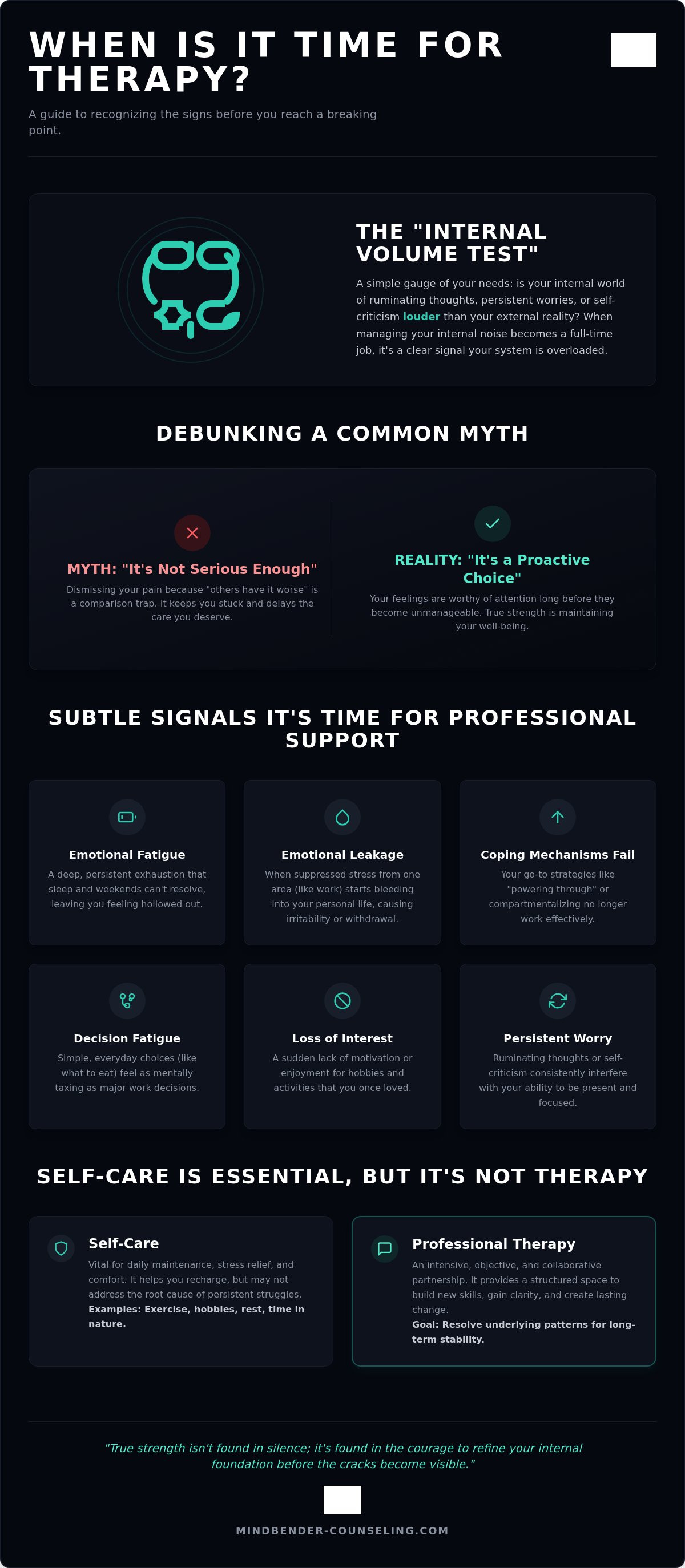
Consider the "Internal Volume Test." This is a simple, effective way to gauge your needs: is your internal world currently louder than your external reality? When ruminating thoughts, persistent worries, or self-criticism interfere with your ability to be present at dinner or focused at work, the volume is too high. You may still be functioning, but you aren't truly participating in your own life. If you find yourself constantly managing your internal noise just to get through the day, it's a clear signal that your system is working harder than it should have to.
Residents in Arizona and Texas often face a cultural premium placed on "toughing it out" and appearing unshakable. While resilience is a virtue, this specific brand of stoicism can inadvertently delay the healing process by framing vulnerability as a weakness. True strength isn't found in silence; it's found in the courage to refine your internal foundation before the cracks become visible to the outside world. Seeking help early isn't an admission of defeat; it's a strategic decision to maintain your well-being.
The Myth of the 'Serious Enough' Problem
We often dismiss our own pain because "others have it worse." This comparison is a trap that keeps you stuck in a cycle of diminishing your own needs and delaying the care you deserve. Waiting until you are completely overwhelmed or in a state of total burnout makes the recovery process significantly longer and more draining. You don't have to wait for a catastrophe to earn a seat in a therapist's office. Think of therapy as a proactive mental tune-up rather than a last-minute engine overhaul.
Therapy as a Proactive Choice
You don't wait until you're physically ill to go to the gym or hire a personal trainer. Similarly, individual counseling serves as a form of mental conditioning that prevents burnout before it takes root. Deciding when to start individual therapy is often most effective during periods of relative stability. This allows you to build a sturdy internal toolkit while you have the emotional bandwidth to practice new skills. Starting now ensures that when the next major life stressor arrives, you already have the balance and clarity needed to navigate it with confidence.
Identifying the Emotional and Behavioral Signals
While a crisis is a clear signal, the more common indicators are often quiet and persistent. You might find yourself experiencing a heavy sense of emotional fatigue that no amount of sleep or weekend getaways can resolve. This is different from physical tiredness; it's a depletion of your internal reserves that leaves you feeling hollowed out. Monitoring these Signs It's Time for Therapy helps you differentiate between a temporary slump and a deeper need for professional support.
Watch for "emotional leakage." This happens when the stress you've suppressed in one area, like a high-pressure project, starts bleeding into your personal life. You might find yourself snapping at a partner or withdrawing from friends without a clear reason. Decision fatigue is another subtle sign. If choosing what to eat for dinner feels as taxing as a corporate presentation, your mental bandwidth is likely overextended. When you're wondering when to start individual therapy, look at these small disruptions in your daily rhythm, including changes in appetite or a sudden lack of motivation for hobbies you once loved.
When Your Coping Mechanisms Stop Working
For many high achievers, "powering through" is a default setting. It works for a while, but eventually, the cost of maintaining that facade becomes too high. You might notice your healthy distractions, like a quick workout, have shifted into unhealthy avoidance, such as hours of mindless social media scrolling or overworking to avoid going home. When you start using work or digital noise as a numbing tool rather than a way to recharge, it's an invitation to seek a more sustainable path. Recognizing that your current strategies have reached their limit is a brave first step toward real change.
The Impact of Modern Stress on Professionals
Professionals in Arizona and Texas face unique challenges, from the isolation of remote work in sprawling suburbs to the rising cost of living in rapidly growing tech hubs like Austin or Phoenix. These pressures can make you feel like a passenger in your own life, simply reacting to demands rather than steering your own course. Utilizing counseling for work stress in Arizona can help you reclaim that sense of agency and prevent total burnout. If you're ready to move from surviving to thriving, exploring evidence-based therapy can provide the clarity you need to recalibrate your priorities and find your balance again.
Therapy vs. Self-Care: Knowing When You Need Professional Support
Self-care routines like morning walks, journaling, or meditation are essential for daily maintenance. They help you stay grounded and manage the surface-level fluctuations of a busy week. However, these practices aren't designed to resolve deep-seated patterns or process complex emotional weight. Think of self-care as the fuel that keeps your car running and therapy as the specialist who realigns the wheels. Knowing When to Seek Professional Support is about recognizing when your maintenance routine is no longer enough to keep you on the road.
Choosing when to start individual therapy often happens when you realize your internal foundation needs more than just a surface-level polish. While self-care is a solitary or lifestyle-based practice, evidence-based therapy is a specialized, interactive process. It provides a structured, safe environment that self-care routines simply cannot replicate. In this space, you can dismantle old habits and construct new, healthier ways of relating to yourself and others with the guidance of a professional who understands the mechanics of change.
The Limits of Venting to Friends
Your friends and family are vital to your well-being, but they are rarely neutral. Because they care about you, they have a vested interest in your choices and their consequences. This emotional proximity can create a "burden of care" where you feel guilty for sharing too much, or they feel pressured to give advice they aren't qualified to provide. Venting often reinforces existing negative loops because it focuses on temporary relief rather than structural resolution. In contrast, private therapy offers the benefit of a neutral, clinical perspective. A therapist doesn't need you to be "okay" for their own comfort; they are there solely to facilitate your growth and offer objective guidance.
When 'Self-Help' Books Aren't Enough
Many people try to read their way out of a struggle. While self-help books provide valuable intellectual insights, there is often a significant gap between knowing what you "should" do and actually feeling different. This is the difference between intellectual understanding and emotional integration. A book cannot see your blind spots or mirror your progress in real-time. Deciding when to start individual therapy is a move toward clarity that self-help alone cannot provide. Therapy is an active, two-way dialogue, not a passive intake of information. It allows for a personalized approach that tailors strategies specifically to your nervous system and life history. This real-time interaction is what turns knowledge into lasting, tangible change.
Preparing for Your Journey: Logistics, Insurance, and Finding a Provider
Once you've decided when to start individual therapy, the focus shifts from internal reflection to practical action. Moving through the logistics doesn't have to be overwhelming if you approach it with a structured plan. By organizing your search into manageable steps, you reduce the friction of starting and create a sense of order that supports your well-being before you even step into the office.
Start by assessing your financial landscape. Check your insurance coverage to see if they offer out-of-network benefits or if your plan falls under mental health parity regulations. If you prefer private pay for increased confidentiality, set a monthly budget that feels sustainable. Next, identify one primary goal for your first three months. Whether it's reducing the "internal volume" of your thoughts or setting better boundaries at work, having a clear objective helps you and your therapist stay focused. Research providers who specialize in your specific needs and always schedule a brief consultation. This initial call is your opportunity to gauge the therapeutic alliance and ensure the person's style resonates with your personality.
Finding the Right Fit in Arizona and Texas
Licensure titles can be confusing when you're searching for a provider in the Southwest. You'll likely see credentials like LPC (Licensed Professional Counselor), LCSW (Licensed Clinical Social Worker), or LMFT (Licensed Marriage and Family Therapist). While their educational backgrounds differ, all are trained to provide high-quality Individual Counseling Services. Choosing a local provider in Arizona or Texas is often beneficial because they understand the specific cultural and regional pressures you face, from the fast-paced corporate environments in Phoenix and Austin to the unique stressors of modern life in these rapidly growing states. Use your consultation to ask how they approach these regional nuances and how their experience aligns with your professional background.
Navigating the First Session Anxiety
It's completely normal to feel a surge of anxiety before your first appointment. You might worry about what to say or feel pressured to "perform" your trauma. Remember that the intake session is simply a conversation to gather history and establish a baseline. You don't need to bring anything other than your presence and perhaps a few notes about what you've been feeling lately. We recommend the "three-session rule": give yourself and the therapist three full appointments to build a rhythm. If you don't feel a sense of safety and professional "fit" by the end of that third session, it's okay to look for a different partner. Finding the right guide is essential for long-term progress, and a true professional will support your search for the best possible care.
Taking the First Step with Mindbender Counseling
Mindbender Counseling serves as a dedicated partner for adults in Arizona and Texas who are ready to move beyond simply "managing" their lives. We understand that the decision regarding when to start individual therapy is deeply personal. It often comes after months of trying to balance professional success with a quiet, persistent internal fatigue that feels invisible to the outside world. Our practice is built on the foundation of Evidence-Based Therapy, ensuring that every session is supported by proven psychological methods. We don't believe in a one-size-fits-all approach. Instead, we offer personalized interventions that respect your unique history and your specific vision for the future. We act as a sturdy anchor for your personal evolution, providing the stability you need to explore new ways of being without feeling overwhelmed by the process.
Personalized Care for Modern Challenges
We bridge the gap between rigorous clinical expertise and warm, empathetic support. Our practitioners provide a safe, non-judgmental space where you can finally dismantle the high-functioning facade and speak honestly about your internal reality. This environment of safety is essential for the restorative work required to heal from burnout and modern stress. While many of our clients begin their journey with individual sessions, they often discover that online couples counseling serves as a powerful complement to their personal growth. Strengthening your internal foundation often naturally leads to a desire for healthier, more transparent communication in your closest relationships. By addressing both the individual and the relational, we help you build a life that feels cohesive, authentic, and sustainable across every domain.
Your Invitation to Growth
The "right time" isn't a specific date on a calendar or a certain level of distress. It's simply the moment you decide to prioritize your own well-being over the demands of your schedule. We've designed our process to be as low-friction as possible for busy residents in Texas and Arizona. We know that your time is valuable, so scheduling a therapeutic appointment is a streamlined, predictable process. You don't have to wait for a crisis to justify this investment in yourself. Deciding when to start individual therapy is a proactive choice that signals you are ready to reclaim your agency and your peace of mind.
Our closing thought is a simple one: therapy isn't about being "broken." It's about becoming more "you." It's a process of stripping away the layers of modern stress and external expectations to find the steady, capable person underneath. When you are ready to take that first step, we're here to act as your professional facilitator and your guide toward a more balanced reality. You have already done the hard work of recognizing your needs; let us help you navigate the path toward the restoration you deserve.
Your Path Toward Internal Stability
Deciding when to start individual therapy is a significant act of self-advocacy. It signifies that you're ready to move beyond simply managing your stress and are prepared to build a more resilient internal foundation. Throughout this guide, we've explored how identifying the "internal volume" of your thoughts and recognizing the limits of routine self-care can provide the clarity needed to take that first step. You've also learned that professional support in Arizona and Texas is more accessible and personalized than ever, offering a neutral space to process the unique pressures of your modern life.
Our experienced providers at Mindbender Counseling are committed to offering compassionate, personalized care through evidence-based therapy techniques. We believe that your mental wellness is a proactive choice, one that leads to a more authentic and balanced reality. You don't have to navigate these challenges alone; we're here to serve as a steady anchor for your continued growth. Every step you take toward understanding your internal world is a step toward a more fulfilling external life.
Begin your journey toward clarity; schedule your first session with Mindbender Counseling today. You deserve a life where your internal world feels as grounded and secure as the one you've built on the outside.
Frequently Asked Questions
How do I know if my problems are 'serious enough' for therapy?
You don't need a visible crisis to qualify for professional support. If your internal world feels louder than your external reality or you're experiencing persistent emotional fatigue, your feelings are worthy of attention. Therapy is a proactive tool for personal growth rather than a last resort for catastrophes. Deciding when to start individual therapy is about prioritizing your well-being before a minor struggle becomes an unmanageable burden.
What is the difference between a therapist and a life coach?
Therapists are licensed mental health professionals trained to diagnose and treat clinical conditions using evidence-based methods. They focus on healing past wounds and regulating the nervous system to create long-term stability. Life coaches typically focus on future goal-setting and performance without the clinical training required to address deep-seated emotional patterns. While coaches provide motivation, therapists offer the clinical depth needed for structural internal change and healing.
Can I start individual therapy if I am already in couples counseling?
Yes, you can absolutely participate in individual therapy while attending couples counseling. These two forms of support often complement each other, as individual work allows you to focus on your personal growth and triggers without the presence of your partner. This personal work often improves the quality of your communication within the relationship. Many clients find that addressing their own internal balance makes them more present and effective partners during joint sessions.
How long does individual therapy typically last?
The duration of therapy depends entirely on your personal goals and the complexity of the challenges you're facing. Some individuals find significant relief and clarity within three to six months of consistent weekly work. Others choose to engage in long-term therapy for ongoing personal evolution and mental maintenance. Your therapist will work with you to establish a timeline that aligns with your specific needs and the progress you're making toward your objectives.
What should I expect during my very first therapy session?
Your first session is primarily a structured conversation to gather your history and define your primary goals. Your therapist will ask about what brought you in and what you hope to achieve in the coming months. You don't need to have all the answers or describe your history perfectly. It's a low-pressure opportunity for you to see if the therapist's style feels like a safe and supportive fit for your personal journey.
Is therapy covered by insurance in Arizona and Texas?
Many insurance plans in Arizona and Texas provide coverage for mental health services, though the specifics vary significantly by provider. As of July 2026, over 40 states have telehealth parity laws that may require insurers to cover remote sessions similarly to in-person visits. We recommend contacting your insurance company directly to verify your out-of-network benefits, deductibles, and any applicable copays before you schedule your first appointment to ensure financial clarity.
What if I don't 'click' with my first therapist?
It's perfectly acceptable to seek a different provider if you don't feel a strong therapeutic alliance after your initial meetings. Research suggests that the quality of the relationship between client and therapist is one of the most significant factors in successful outcomes. If you don't feel seen or understood after three sessions, it's a professional and healthy choice to explore other options until you find a guide who feels like the right fit.
How often should I attend sessions when I first start?
Most people start with weekly sessions to build momentum and establish a strong foundation for their therapeutic work. This consistency allows you to process information and practice new skills without losing the thread of your progress. Once you feel more stable and have reached your initial goals, you and your therapist might decide when to start individual therapy maintenance by moving to bi-weekly or monthly sessions to sustain your growth.


