
What if the most transformative moments of your relationship don't actually happen in a therapist's office? Many couples begin therapy feeling a heavy sense of exhaustion; they worry that sessions are becoming little more than "expensive venting" where progress stalls as soon as they reach the parking lot. You might feel like you're working harder than your partner, or perhaps you're simply tired of the same cycles repeating despite your best efforts. It's natural to want more than just a temporary reprieve from conflict. You deserve a clear path toward understanding how to get the most out of couples counseling so that every minute invested translates into a more secure, vibrant connection at home.
In this guide, we'll move beyond the basics to explore the specific mindsets and actionable strategies that transform standard sessions into a catalyst for lifelong relational growth. We'll show you how to master the "167-hour rule," ensuring the work you do together continues to flourish in your daily life. By focusing on practical communication tools and emotional safety, you'll learn how to bridge the gap between talking about change and actually living it. We'll preview the essential steps to build a foundation of mutual investment and measurable improvement that lasts long after your final session.
Key Takeaways
- Shift your focus toward nurturing your shared bond rather than attempting to fix your partner’s individual flaws.
- Learn how to get the most out of couples counseling by practicing radical honesty and listening for the underlying needs in every conversation.
- Apply the "167-hour rule" to ensure your therapeutic progress continues to grow during the time you spend outside the office.
- Don't let a temporary plateau discourage you; recognize that the U-shaped curve is a natural part of long-term relational healing.
- Work with an expert guide to build a stable foundation using evidence-based therapy tailored to your unique journey.
Shifting Your Perspective: From "Fixing a Partner" to "Nurturing the Bond"
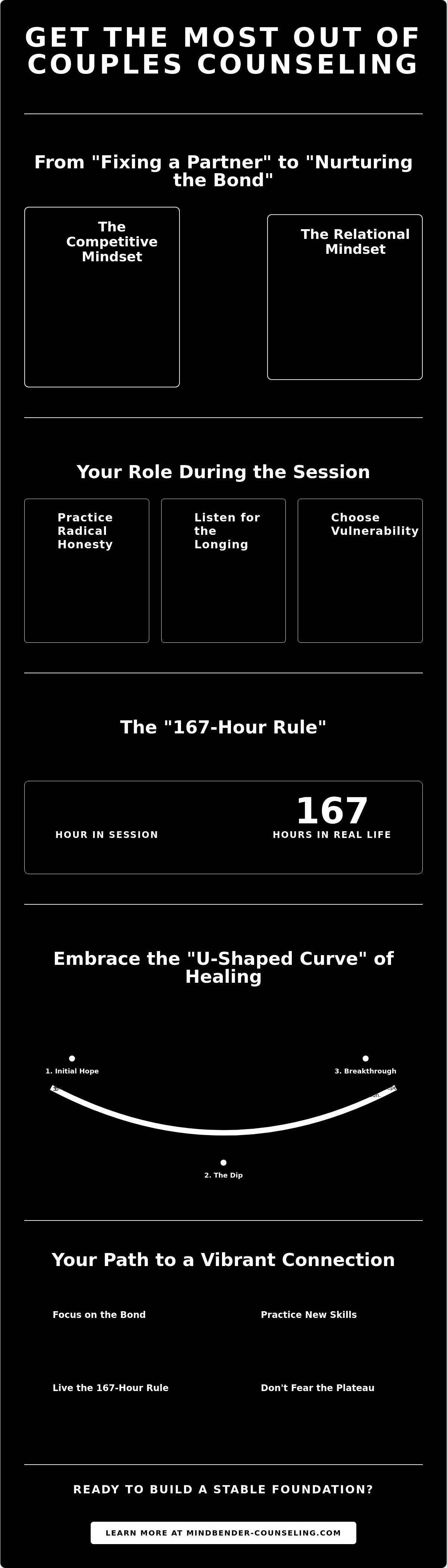
Entering therapy often feels like a last resort after years of accumulated tension. Many people arrive at their first session with a mental checklist of their partner's faults, hoping a professional will finally convince the other person to change. However, the secret to how to get the most out of couples counseling lies in a fundamental shift of focus. You aren't there to repair a broken person; you're there to heal a strained connection. This requires adopting what we call a "Relational Mindset," where the relationship itself is treated as the client. When you prioritize the health of the bond over the desire to be "right," you create the emotional space necessary for genuine healing to begin.
Evidence-based therapy is uniquely effective because it treats the partnership as a living system. Instead of focusing on isolated symptoms or individual personality flaws, it examines the repetitive cycles and communication patterns that keep you both stuck. Couples therapy provides a structured environment to observe these dynamics without the immediate pressure of an escalating argument. By taking individual accountability for your role in these patterns, you stop being a victim of the relationship's weather and start becoming an architect of its climate. This systemic approach ensures that changes are not just temporary fixes but are woven into the very fabric of your daily interactions.
The Goal of Therapy: Collaboration Over Competition
In many high-conflict relationships, conversations become a zero-sum game where one person's victory requires the other's defeat. Real progress begins when you realize that if one partner "wins" an argument, the relationship invariably loses. You'll learn to view your therapist as a skilled consultant for your "team" rather than a judge who hands down a verdict. This collaborative approach helps you transition from "I" statements that defend your position to "We" goals that protect your future. It's about moving away from competition and toward a shared mission of mutual support and understanding.
Preparing Your Mind for the First Session
Before you step into our Phoenix or Texas offices, take a moment for quiet, honest reflection. We invite you to consider not just what your partner does to upset you, but how you typically respond when you feel hurt or unheard. Setting realistic expectations is vital during this early stage. You should anticipate that the first 3-5 sessions will primarily focus on assessment, building safety, and identifying the core issues at play. The Relational Mindset is the shift from individual defense to mutual curiosity. By arriving with an open heart and a willingness to explore your own contributions to the dynamic, you set the stage for lasting transformation.
Mastering Active Participation During Your Counseling Sessions
While shifting your mindset creates the foundation, your active engagement during the hour determines the pace of your progress. Understanding how to get the most out of couples counseling requires viewing each session as a laboratory for new behaviors rather than a courtroom for past grievances. In this protected space, you have the rare opportunity to practice radical honesty under the guidance of a professional who ensures the conversation remains productive. Your therapist may facilitate "enactments," which are real-time exercises where you practice speaking directly to your partner about difficult topics while receiving immediate feedback on your tone and body language.
One of the most profound skills you can develop is the ability to "listen for the longing." Behind almost every complaint is a deeply held wish or a core need that hasn't been met. When your partner expresses frustration about household chores, they might actually be expressing a desire to feel supported and valued. By training yourself to hear the vulnerability beneath the anger, you stop reacting to the surface-level conflict and start responding to the person you love. This shift transforms the session from a series of complaints into a meaningful dialogue about connection.
Prioritizing Vulnerability Over Defense
Choosing vulnerability over defense is often the hardest part of the process. In the heat of a session, it's tempting to build a case for why you're right, but being right is frequently the enemy of being connected. You might wonder, is couples therapy right for you if the process feels this uncomfortable? The answer is often yes; growth typically happens at the edge of your comfort zone. Staying present when you hear difficult feedback allows you to process information without the usual walls of resentment, creating a bridge back to your partner.
Using "I" Statements to Express Core Needs
Refining your communication through "I" statements is a cornerstone of evidence-based therapy. Instead of saying, "You never prioritize me," try saying, "I feel lonely and I miss our time together." This simple shift turns an accusation into an invitation for connection. Your counselor will help you peel back the layers of "secondary" emotions like anger to reach "primary" emotions like fear or sadness. Once these core needs are exposed, you can begin to build a bridge between your intent and the actual impact on your partner. This level of active participation is exactly how to get the most out of couples counseling, turning every session into a stepping stone for lasting change.
The 167-Hour Rule: Maximizing Growth Between Sessions
If you want to understand how to get the most out of couples counseling, look at your calendar. There are 168 hours in a week, and only one of them is typically spent in the therapist's office. This is the core of the "167-Hour Rule." Real transformation doesn't just occur during your appointment; it thrives in the moments between sessions when you choose to apply new insights. Think of your counseling hour as a training ground where you learn the movements, while the rest of your week is the actual performance. By viewing "therapeutic homework" as a gentle invitation to connect rather than a burdensome chore, you turn your home into a space for active healing.
Creating "Safe Zones" is a practical way to implement these changes. Designate a specific time or a comfortable corner of your home where you both agree to practice new communication skills without distractions. In these zones, the focus remains on curiosity and support rather than solving every problem at once. It's also vital to notice small wins. When your partner uses a softer tone or stops to listen during a busy morning, acknowledge it. These positive shifts are the building blocks of a new, healthier dynamic. Recognizing these moments provides the emotional fuel needed to keep moving forward.
Turning Insights Into Everyday Habits
In the heat of a disagreement, it's easy to forget everything discussed in your last session. To stay on track, create simple reminders or "cues" that prompt you to use your tools. This might be a shared keyword or a physical touch that signals a need to slow down. Building "rituals of connection," such as a ten-minute morning coffee together or a focused check-in at night, provides the stability your relationship needs to grow. Lasting change is the result of small, consistent actions repeated over time.
Managing Setbacks Without Losing Hope
Progress is rarely a straight line. You might find yourselves slipping back into old, defensive patterns, especially during stressful weeks. It's important to view these moments not as failures, but as data points for your next meeting. Whether you are attending sessions in our Arizona or Texas offices, you can use these "home failures" as opportunities for deconstruction. Learning how to get the most out of couples counseling involves mastering the art of the repair. When a fight happens, use your learned tools to apologize and reconnect quickly, preventing the conflict from hardening into long-term resentment.
Navigating the Plateau: What to Do When Progress Feels Slow
It's common to feel a surge of frustration when, after a month of consistent sessions, you find yourselves in the middle of a familiar argument. You might ask yourself if the investment is truly worth it. This phase is often referred to as the "messy middle" or the U-shaped curve of therapeutic progress. Initially, there's a peak of hope as you begin the process. However, as you start to deconstruct long-standing patterns and address suppressed emotions, things can feel temporarily more difficult. This dip isn't a sign that you're failing; it's a sign that you're finally touching the core issues that need healing.
Learning how to get the most out of couples counseling means staying the course during these quieter periods of growth. If you feel stuck, communicate this directly to your counselor. A professional therapist isn't a mind reader, and your feedback is a vital data point. Discussing your frustrations allows you to re-evaluate your goals together, ensuring the roadmap still aligns with your current relational needs. Sometimes, a simple adjustment in focus can reignite the sense of movement you felt in the beginning.
Identifying "Resistance" vs. "Wrong Fit"
It's helpful to distinguish between natural resistance to hard work and a genuine mismatch with a provider. Resistance often shows up as "forgetting" to do the between-session work or steering the conversation toward surface-level complaints to avoid deeper vulnerability. On the other hand, a "wrong fit" might feel like a lack of emotional safety or a sense that the therapist doesn't fully grasp your dynamic. At Mindbender Counseling, we prioritize personalized interventions to ensure our evidence-based therapy remains responsive to your specific evolution, helping you move through the "messy middle" with confidence.
Addressing Partner Reluctance Compassionately
One partner often feels more discouraged or "ganged up on" than the other during a plateau. If your partner is struggling, offer compassion rather than pressure. Celebrate the incremental progress you've made, such as a shorter recovery time after a conflict or a small moment of shared laughter. Reframing therapy as a proactive "wellness" practice helps lower the stakes. It's not just a crisis response; it's a way to build a sturdy foundation for your future together. If you feel your progress has stalled, our team is here to help you recalibrate. Connect with us for evidence-based therapy to rediscover your momentum and find a clear path forward.
Partnering with Mindbender Counseling for Lasting Relational Health
At Mindbender Counseling, we believe that understanding how to get the most out of couples counseling is only the first step; having a structured roadmap to guide your journey is what ensures you reach your destination. Our evidence-based therapy approach provides a clear framework for couples in Arizona and Texas who are ready to move beyond repetitive cycles and toward a more resilient connection. We don't just offer a space to talk; we provide a methodical path toward understanding the underlying dynamics that shape your relationship. By working with a guide who understands both the psychological complexities of intimacy and the unique local stressors you face, you gain a partner who is deeply invested in your long-term success. Professional practices often maintain this level of care by using specialized support like HPC Healthcare Partners to manage their administrative and billing needs, allowing clinicians to remain focused on client outcomes.
Every partnership has its own unique rhythm and history, which is why our therapeutic interventions are never one-size-fits-all. We take the time to understand the specific nuances of your dynamic, offering personalized tools that resonate with your lived experience. This tailored approach helps prevent the stagnation often felt in standard therapy. By focusing on the system of the relationship rather than individual blame, we help you cultivate a sense of calm assurance. This professional support acts as a catalyst for movement, allowing you to bridge the gap between where you are now and the vibrant future you envision together.
Our Commitment to Your Growth
We focus on building a sturdy anchor for your relationship, providing the stability you need to navigate life’s inevitable storms. This process isn't about abstract clinical theory; it's about delivering practical, everyday benefits that you can feel in your morning conversations and your evening check-ins. Our personalized interventions are designed to meet you exactly where you are, whether you're recovering from a significant breach of trust or simply looking to revitalize a connection that has grown quiet. We encourage a path toward both personal and relational evolution, helping you build a solid internal foundation that supports your growth as individuals and as a couple.
Get Started with a Couples Counseling Session
Taking the next step toward a healthier relationship shouldn't feel like a daunting task. We've created a low-friction path to help you begin your journey in Phoenix or across Texas with ease. You can start by exploring Mindbender Counseling’s couples services to see how our specific methodologies align with your needs. Whether you choose to meet in person or through our secure virtual platform, the goal remains the same: to provide you with the tools and support necessary for sustainable change. We invite you to view this not as a final attempt to fix what’s broken, but as a courageous first step toward the vibrant, secure connection you both deserve. Positive change is possible, and we're here to help you make it a reality. Mastering how to get the most out of couples counseling is a journey we are honored to walk alongside you.
Embracing the Journey Toward Lasting Connection
You've explored the essential shifts required to move from individual defense to mutual curiosity. By mastering the 167-hour rule and staying committed through the natural plateaus of growth, you are already laying the foundation for a more resilient partnership. Understanding how to get the most out of couples counseling is about recognizing that every small, consistent action you take between sessions is a building block for your shared future. Real change happens when you treat your relationship as a living system that requires steady, compassionate attention rather than just a problem to be solved.
Our team of compassionate, professional licensed therapists provides evidence-based therapy techniques tailored to your unique dynamic across Arizona and Texas. We offer the structured roadmap and expert guidance necessary to transform your connection into a sturdy anchor for your lives. When you're ready to turn these insights into measurable progress and lasting emotional safety, schedule your couples counseling consultation with Mindbender Counseling today. You possess the capacity for profound evolution, and we're here to support every step of your path toward well-being.
Frequently Asked Questions
How long does it typically take to see results from couples counseling?
Most couples begin to notice meaningful shifts in their communication and emotional connection within 8 to 12 sessions. While every relationship moves at its own pace, this timeframe allows you to establish a foundation of safety and begin deconstructing long-standing patterns. Consistency is the most vital factor in ensuring these early improvements translate into lasting, sustainable change.
What if my partner is reluctant to attend therapy with me?
It's helpful to frame the invitation as a desire for your own growth and a deeper connection rather than a way to "fix" your partner. Expressing your needs through "I" statements can lower their defenses and reduce the fear of being blamed or ganged up on. Often, a partner's reluctance fades once they realize the environment is one of support rather than judgment.
How often should we attend sessions to get the most benefit?
Attending sessions once a week is generally recommended to build and maintain the momentum necessary for growth. This regular rhythm ensures that the insights from one week are still fresh as you begin the next, helping you stay focused on your relational goals. As your bond strengthens and your tools become habits, you might transition to bi-weekly check-ins to monitor your progress.
Is couples counseling worth it if we are already considering divorce?
Counseling is incredibly valuable during this stage because it provides a structured space to gain clarity and process complex emotions. For many, it offers a path to rediscovering their connection; for others, it facilitates an amicable and respectful separation. Either way, the process helps you move forward with less resentment and a better understanding of your own needs.
Can we do couples therapy online if we live in different parts of Texas or Arizona?
Yes, you can access our evidence-based therapy through secure virtual sessions if you reside anywhere in Texas or Arizona. Online therapy provides the same level of professional care and emotional safety as our physical offices while offering the flexibility to meet your busy schedules. This ensures that distance is not a barrier to receiving the support your relationship deserves.
What should we talk about if we didn’t have any fights this week?
A week without conflict is the perfect time to focus on deepening your intimacy and discussing your long-term vision as a couple. Use these sessions to explore "rituals of connection" or to share appreciation for the small wins you've noticed in your daily routine. These peaceful moments are essential for learning how to get the most out of couples counseling by proactively strengthening your internal foundation.
How do we know if we have found the right couples therapist?
You've likely found the right match when both you and your partner feel equally heard, respected, and safe during your sessions. A skilled therapist acts as a wise and compassionate guide who remains neutral while still challenging you to grow. Trust your intuition after the first few meetings; you should feel a sense of calm assurance in the therapist's ability to facilitate your journey.
What happens if our therapist suggests individual counseling alongside couples sessions?
Individual sessions are often suggested to help each partner work on personal triggers or history that might be impacting the relationship dynamic. Strengthening your own emotional health allows you to show up more fully and authentically in your partnership. For those interested in how personal growth affects the wider family, click here to explore Tracy Kimberg's insights on how building your own self-esteem can even support your teenager's confidence. This dual approach is a powerful way to understand how to get the most out of couples counseling by fostering both personal and relational evolution simultaneously.


