

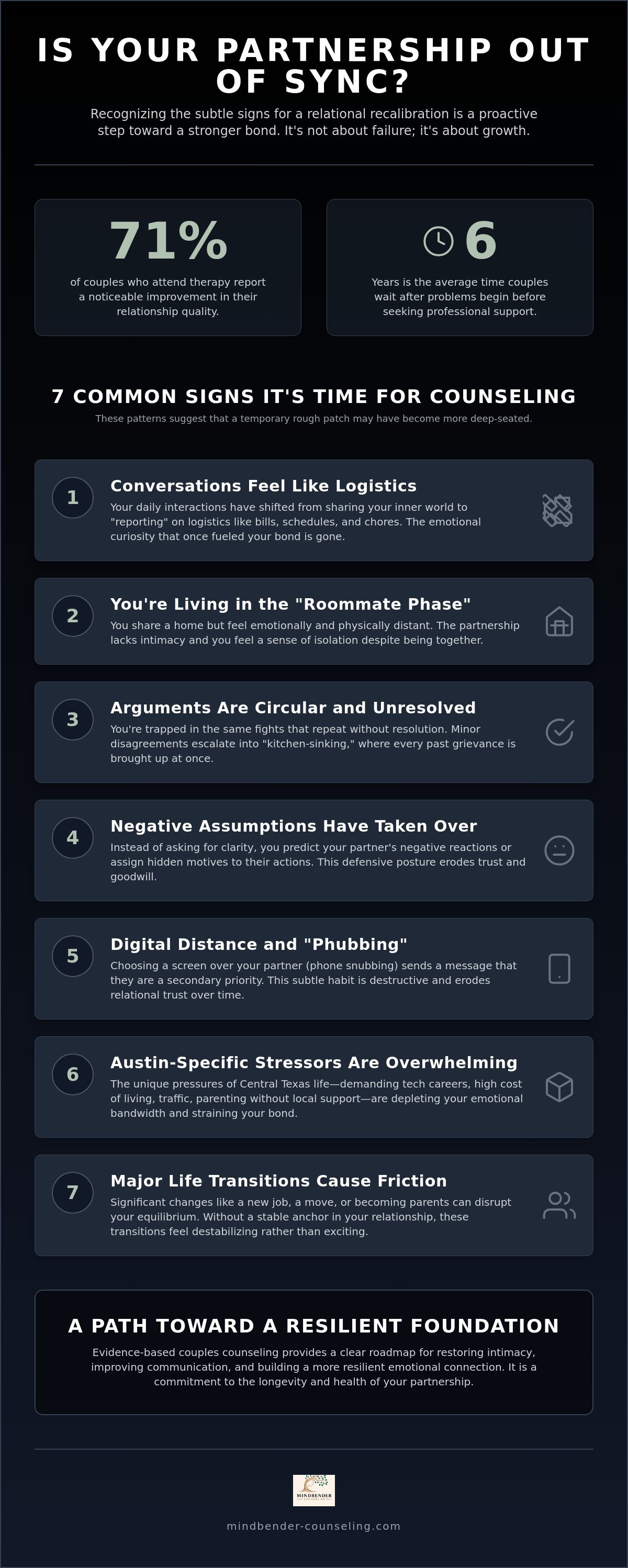
Did you know that 71% of people who attend couples therapy see a noticeable improvement in their relationship? In a city as fast-paced as Austin, it's easy to let the "roommate phase" settle in without realizing how much ground you've lost. Recognizing the subtle signs you need couples counseling Austin isn't about admitting failure. Instead, it's a courageous step toward a proactive recalibration for your partnership.
You likely understand the exhaustion of circular arguments that never reach a resolution or the quiet anxiety that hums in the background of your daily life. It's difficult when you feel like you're drifting apart even while sharing the same home. This guide explores the emotional and behavioral cues that suggest your relationship could benefit from professional, evidence-based support. We'll examine seven specific indicators and provide a clear path toward restoring your emotional bond, giving you the clarity needed to move forward with confidence and hope.
Key Takeaways
- Reframe your perspective on therapy by viewing it as a proactive tool for relational recalibration rather than a final effort to save a failing partnership.
- Identify specific signs you need couples counseling Austin to help you distinguish between a temporary rough patch and deep-seated patterns that require professional support.
- Recognize when your communication has shifted from emotional curiosity to mere logistical reporting, allowing you to break the cycle of unresolved circular arguments.
- Learn how to protect your bond from the unique stressors of Central Texas life, including the high cost of living and the challenges of parenting without a local support network.
- Discover how an evidence-based assessment can provide a clear roadmap for restoring intimacy and building a more resilient emotional foundation together.
Understanding the Shift: Why Couples Seek Counseling in Austin
Many people view therapy as a last resort, a final effort before a potential split. However, a more helpful and modern perspective sees it as a proactive tool for personal and partnership growth. We call this process "relational recalibration." It's about fine-tuning the mechanics of your connection before small misalignments become major fractures. Seeking professional support is an act of profound commitment. It shows you value the foundation you've built and want to ensure its longevity. Couples therapy provides a structured, safe space where you can explore these dynamics with a neutral and compassionate guide.
Living in Central Texas brings a unique set of challenges that can strain even the strongest bonds. While the city's rapid growth is exciting, the high-energy lifestyle often bleeds into our private lives. Between demanding tech careers in the Silicon Hills and the daily friction of traffic and rising costs, it's easy for couples to feel emotionally depleted. When your external environment is constantly shifting, your relationship needs to be a stable anchor. Identifying the signs you need couples counseling Austin allows you to address these environmental stressors before they erode your intimacy and shared joy.
The Difference Between a "Rough Patch" and a Pattern
It's natural to experience a "rough patch" during times of grief, job loss, or significant life changes. These periods are usually temporary and linked to specific external events. A pattern, however, is characterized by its persistence and predictability. You might find yourselves trapped in circular arguments that repeat the same themes without ever reaching a resolution. Research indicates that couples wait an average of six years after problems begin before seeking professional support. By the time they reach out, these patterns are often deeply ingrained. Recognizing the shift from a temporary struggle to a recurring cycle is the first step toward meaningful change.
Austin-Specific Stressors and Relationship Health
Career-driven burnout is a significant factor for many Austin residents. When you spend your day solving complex problems at work, you may have little emotional bandwidth left for your partner at the end of the day. This often leads to a lack of domestic intimacy and a sense of isolation within the home. If one partner is struggling with intense work-related stress, individual counseling for anxiety can be a powerful complement to couples work. Addressing your internal balance makes it much easier to show up fully for your relationship. Austin's rapid transformation can make life feel unpredictable; counseling helps you and your partner regain a sense of shared stability and purpose.
Communication Breakdowns: When Words No Longer Connect
Communication is the circulatory system of any partnership. When it begins to fail, the entire connection suffers from a lack of vital emotional oxygen. One of the primary signs you need couples counseling Austin is a shift from meaningful "talking" to mere "reporting." You might notice that your daily interactions have dwindled into a list of logistics: mortgage payments, school schedules, or grocery lists. While managing a household requires coordination, a relationship cannot thrive on administration alone. When you stop sharing your internal world, you lose the curiosity that once fueled your bond.
This lack of curiosity often leads to the dangerous habit of making negative assumptions. Instead of asking for clarity, you might find yourself predicting your partner's reactions or assigning hidden motives to their silence. This defensive posture frequently results in "kitchen-sinking." This happens when a minor disagreement about a current task suddenly includes a list of every unresolved wound from the last several years. Bringing up the past in this way halts any chance of current progress. Evidence-based therapy focuses on restoring active listening, a skill that ensures both partners feel truly seen and heard without the interference of past grievances.
The Rise of Digital Distance and "Phubbing"
In our tech-centric Austin environment, "phubbing"—or phone snubbing—is a subtle but destructive habit. When you choose your screen over the person sitting across from you, it sends a clear message that they are a secondary priority. This behavior erodes relational trust over time. Furthermore, the constant comparison to the curated lives of other couples on social media can create a sense of inadequacy. We help couples set firm digital boundaries to ensure that their time together remains sacred and free from the distractions of the Silicon Hills' digital noise.
Conflict Without Resolution: The Exhaustion of Circular Fighting
Many couples find themselves trapped in the "same fight" every Sunday night as the pressure of the upcoming week builds. These circular arguments are physically and emotionally exhausting because they never reach a point of resolution. Chronic conflict isn't just a mental strain; it takes a physiological toll on your body, often leading to increased stress hormones and decreased sleep quality. By applying therapy behavioral therapy techniques, you can identify the triggers of these cycles and learn to de-escalate before the argument spirals. If you are tired of the repetitive nature of your conflicts, you can reach out to our team to begin learning more effective ways to navigate disagreement.
The "Roommate Syndrome" and Emotional Disconnection
While loud arguments are distressing, the quiet absence of connection is often more concerning. This state is frequently referred to as "Roommate Syndrome." In this phase, you might function perfectly as a household team, managing chores and schedules with precision, yet feel a profound distance when the day ends. You've become efficient co-parents or co-habitants, but you've stopped being lovers. Recognizing when your bond has transitioned into a series of logistical hand-offs is one of the most critical signs you need couples counseling Austin. It is a signal that the emotional intimacy that once defined your partnership has been replaced by a functional but hollow routine.
A lack of physical intimacy or spontaneous affection is a core warning sign that your relationship requires recalibration. It's easy to blame a busy schedule, but the issue is often deeper than a lack of time. When you stop touching, kissing, or even holding hands, the emotional safety of the relationship begins to erode. This often leads to a "Quiet Exit," where one partner stops trying to engage or even bother to argue. Living parallel lives might feel peaceful because the fighting has stopped, but this silence is usually the sound of a couple drifting apart. This apathy is far more difficult to repair than active anger, as it represents a loss of investment in the shared future.
Loss of Shared Vulnerability and Playfulness
Date nights in downtown Austin should feel like a joy, not a chore. If you find yourself dreading these outings or struggling to talk about anything besides logistics, your foundational friendship needs attention. We focus on "turning toward" emotional bids, which are small attempts at connection. Counseling helps you recognize these moments, restoring the playfulness that originally brought you together.
The Danger of Emotional Withdrawal (Stonewalling)
Stonewalling is a psychological defense mechanism where one partner shuts down entirely to avoid conflict. It effectively kills intimacy. There is a vital difference between needing a brief moment to regulate your emotions and intentional emotional abandonment. Evidence-based therapy identifies these withdrawal patterns by analyzing your interaction styles and providing strategies to stay present even when conversations become difficult.
Navigating Major Life Transitions in Central Texas
Austin’s rapid evolution creates a unique set of pressures that can test the resilience of any relationship. The local housing market and rising cost of living often generate what we call "financial friction." This isn't just about the numbers in a bank account. It's about the sense of security and the shared vision you have for your future. When the dream of homeownership or stability feels like a moving target, it’s common for partners to project that frustration onto one another. These external pressures are significant signs you need couples counseling Austin because they require a high level of unified decision-making and emotional support.
The local tech sector also introduces specific stressors. Career shifts, intense project cycles, or the sudden reality of layoffs in the Silicon Hills can disrupt your domestic equilibrium. When one or both partners are in a state of professional flux, the relationship often bears the brunt of that anxiety. Many couples also find themselves navigating "New Parent Syndrome" without a local support network. Moving to Austin for work often means leaving behind extended family and long-term friends. Without that "village," the transition to parenthood can feel isolating and overwhelming. We often recommend pre-commitment counseling before major steps like moving in together or getting engaged to establish the communication tools needed for these inevitable life shifts.
Relocating to Austin: The "Trailing Spouse" Dynamic
Resentment can quietly build when one partner relocates to Central Texas primarily for the other’s career. This "trailing spouse" dynamic often involves a significant loss of social capital and professional identity. While one partner is busy integrating into a new office, the other may be struggling to find their footing in a city where they have no existing roots. We use therapeutic strategies to help couples acknowledge this sacrifice and work toward building a new, shared identity that honors both individuals' needs and aspirations.
Grief, Loss, and External Traumas
External traumas, such as the loss of a parent or a sudden health crisis, test the very foundation of your bond. During these periods of high stress, it is vital to learn how to "co-regulate." This means being able to soothe one another’s nervous systems rather than becoming a source of additional agitation. Understanding how does online couples counseling work can be particularly helpful during a crisis, as it provides the flexibility to receive support without the added stress of a commute. If you are currently navigating a difficult transition and feel your connection fraying, contact Mindbender Counseling to begin your journey toward relational growth.
How Mindbender Counseling Facilitates Lasting Change
Identifying the signs you need couples counseling Austin is a significant first step, but the true transformation begins when you engage with a structured, evidence-based process. At Mindbender Counseling, we don't believe in passive listening or vague advice. Instead, we act as your professional facilitators, using research-backed interventions to help you rebuild a solid internal foundation. Our approach is designed to move you from a state of reactive conflict to one of proactive growth. We provide the tools you need to recalibrate your relationship, ensuring that your connection remains a source of strength rather than a cause of stress.
Our work begins with a comprehensive assessment phase. During this time, we identify the unique relational patterns that have led to your current disconnection. We look beyond the surface level of your arguments to understand the underlying dynamics of your partnership. By pinpointing these specific triggers and cycles, we can create a roadmap for your emotional growth. This methodical approach ensures that our sessions are focused on actionable communication skills and meaningful, long-term outcomes for both you and your partner.
A Personalized Path to Relational Resilience
Austin is a city of innovators and individuals, and we recognize that a "one-size-fits-all" approach to therapy simply doesn't work here. Your relationship has its own history, values, and challenges. We strive to provide a personalized path that validates your individual needs while prioritizing the health of the relationship as a whole. Our clinical environment is designed to be a safe, non-judgmental space where you can be vulnerable without fear. We maintain a balance between being an authoritative resource and a compassionate partner in your personal evolution, helping you restore the balance that may have been lost during seasons of high pressure.
Starting Your Journey: What to Expect
Taking the first step can feel daunting, especially if one partner is "therapy-skeptical." We handle these situations with quiet confidence and compassionate engagement. We understand that it's common for one person to feel more hesitant about the process, and we treat every individual with fresh attention and care. Our goal is to lower your defenses and build immediate trust, creating an atmosphere of safety and reliability from the very first session. Whether you are seeking support in-person or through our flexible online options, we make the scheduling process low-friction and predictable. You don't have to navigate these challenges alone. Schedule a consultation with Mindbender Counseling today.
Reclaiming Your Connection Through Relational Recalibration
Choosing to address the signs you need couples counseling Austin is a profound investment in your shared future. We've explored how transitioning from logistical reporting back to emotional curiosity can dismantle the "roommate phase" and how navigating local stressors together builds lasting resilience. By choosing an evidence-based approach, you move beyond temporary fixes toward a personalized path of growth and stability. This process isn't about fixing what is broken; it's about fine-tuning your connection to withstand the pressures of a fast-paced city.
Mindbender Counseling provides a compassionate, professional clinical environment where your partnership is the priority. Our specialized interventions are tailored to the unique rhythms of Austin life, ensuring you have the tools to thrive in any season. We invite you to step into a space of safety and clarity where you can rebuild your friendship foundation with expert guidance. Begin your journey toward a stronger relationship with Mindbender Counseling. You don't have to navigate these challenges alone; a more resilient and connected future is within your reach.
Frequently Asked Questions
How do I know if we need couples counseling or individual therapy?
Couples counseling is the appropriate choice when the primary source of distress is the relationship dynamic itself. In these sessions, the relationship is the client, and the focus remains on how you interact and connect. Individual therapy is better suited for addressing personal history, trauma, or specific mental health conditions that exist independently of your partnership. If you find that your personal anxiety is spilling into your bond, you might choose to pursue both services concurrently.
What if my partner is refusing to go to couples counseling?
You cannot force a partner to attend, but you can begin the process of change on your own through individual counseling. Often, when one person shifts their behavioral patterns and learns new de-escalation skills, the entire relationship system begins to recalibrate. This positive change can sometimes make a hesitant partner more open to joining the process later. Taking the initiative to address your own contributions to the relationship shows a deep level of commitment.
How long does couples counseling typically take to see results?
The timeline for progress varies based on the complexity of your needs, but many couples experience a shift in their communication within 8 to 12 sessions. Research indicates that marriage counseling has a success rate of about 70%, with 90% of couples reporting improvements in their emotional well-being. Identifying the signs you need couples counseling Austin early can often lead to faster results, as you are addressing patterns before they become deeply entrenched over many years.
Is couples counseling in Austin covered by insurance?
Most health insurance plans do not cover couples counseling because it focuses on relational health rather than a diagnosable medical condition for an individual. However, some therapists can provide a "superbill" that you may submit to your provider for potential out-of-network reimbursement. Under the No Surprises Act, your therapist is required to provide a "Good Faith Estimate" that outlines the anticipated costs of your care before you begin your sessions.
Can couples counseling help if there has been an affair or infidelity?
Yes, professional support is often vital for navigating the complex trauma and broken trust that follows infidelity. Evidence-based therapy provides a structured, safe environment where you can process the pain and begin the slow work of repair. It offers a neutral space to explore the root causes of the breach while teaching you the specific skills needed to rebuild a foundation of honesty and emotional safety. Many couples find that this process eventually leads to a more resilient bond than they had before the crisis.
What is the difference between marriage counseling and couples therapy?
The terms are frequently used interchangeably, though they can have slightly different focuses depending on the clinician's approach. Marriage counseling often centers on resolving current, specific conflicts or life transitions. Couples therapy typically dives deeper into the underlying emotional patterns and psychological history that drive those conflicts. Both approaches aim to improve your connection and provide you with actionable tools for a healthier partnership.
How do we find the right couples therapist for our specific needs in Austin?
Look for a clinician who is licensed by the Texas Behavioral Health Executive Council (BHEC), such as a Licensed Marriage and Family Therapist (LMFT) or a Licensed Professional Counselor (LPC). These professionals have completed 3,000 hours of supervised clinical practice and have passed rigorous state exams. It is also beneficial to find a therapist who specializes in evidence-based modalities like the Gottman Method or Emotionally Focused Therapy (EFT). These methods are grounded in research and provide a clear roadmap for relational growth.
What happens during the very first session of couples counseling?
The initial session is primarily an assessment phase designed to build a sense of safety and understanding. Your therapist will gather history about your relationship, identify your primary goals, and observe how you currently communicate. It is a time for you to ensure that the therapist's style feels like a good fit for both of you. You will leave this first meeting with a clearer sense of the path forward and an initial plan for your relational recalibration.


