

What if the repetitive loops in your mind aren't permanent character traits, but simply well-worn paths that can be paved over with new, healthier habits? You might feel stuck in a cycle of anxiety or frustration, wondering why your brain defaults to the same negative reactions despite your best efforts to change. It's completely normal to feel overwhelmed by the alphabet soup of modern mental health care. When you're searching for therapy behavioral therapy often sounds like a clinical or cold concept, but it's actually one of the most compassionate and practical tools available for building a sturdy internal foundation.
We understand that the prospect of starting this journey can feel daunting, especially when you're trying to decode complex acronyms while seeking genuine relief. You deserve a clear path forward that doesn't feel like a medical experiment. This guide provides a structured, evidence-based blueprint for rewiring your reactions and building a more stable, fulfilling life. We'll explore the mechanics of how change actually happens and help you identify which approach fits your needs. Whether you're seeking support in Arizona or Texas, you'll find the clarity needed to choose a provider who treats you as an individual rather than a diagnosis.
Key Takeaways
- Learn the fundamental differences between insight-oriented discussion and the action-focused framework of behavioral work to better align your care with your personal objectives.
- Discover how functional analysis helps you identify the triggers behind your habits, allowing you to replace reactive cycles with intentional, healthy responses.
- Gain a clear understanding of specialized modalities like CBT and DBT to help you feel empowered when choosing the right path in your journey through therapy behavioral therapy.
- Prepare for your initial intake session by understanding the collaborative nature of the therapist-client relationship and how goal-setting creates a roadmap for progress.
- See how compassionate, evidence-based therapy provides a sturdy anchor for managing the specific lifestyle stressors common to those living in Arizona and Texas.
Defining Therapy and Behavioral Therapy: Beyond the Conversation
Many people view therapy as a passive experience, a place to simply recount the week's events and wait for a revelation to strike. While venting has its place in emotional release, Behavioral Therapy represents a shift from passive observation to active construction. It's a goal-oriented form of psychotherapy that focuses on the tangible mechanics of your daily life. When you're exploring therapy behavioral therapy, you aren't just seeking a listener; you're looking for a partner to help you map out the specific actions that lead to a more stable, fulfilling existence. This approach relies on evidence-based therapy to create predictable, measurable personal growth that you can actually feel in your day-to-day interactions.
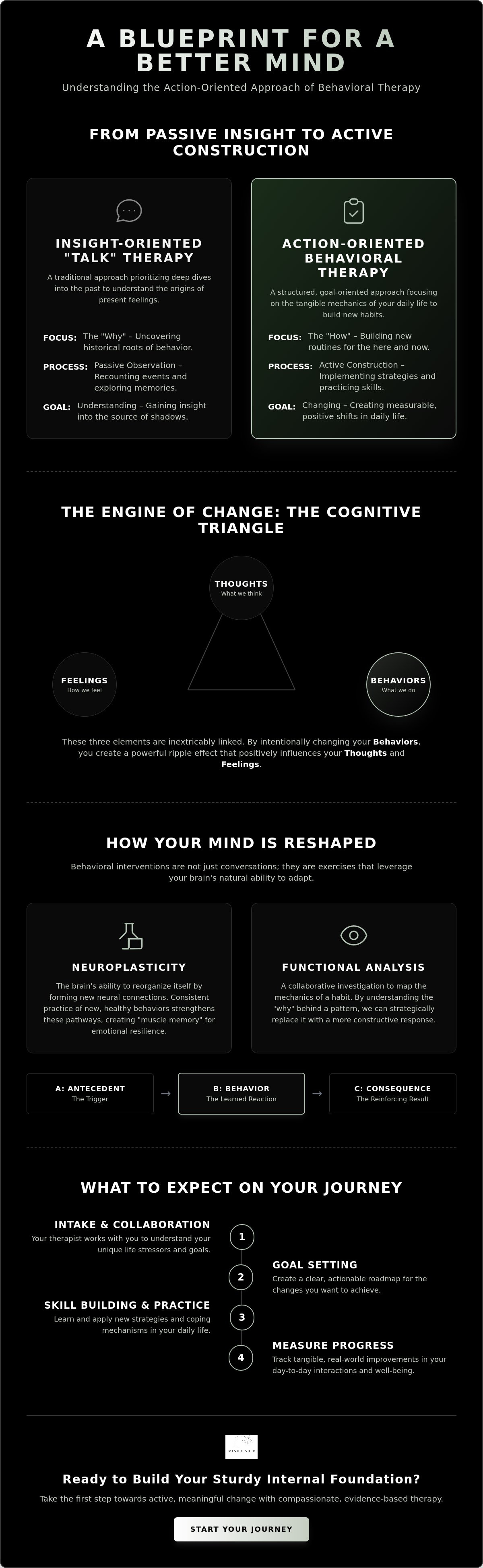
Traditional "talk therapy" often prioritizes insight, digging deep into the past to understand the origin of every shadow. Behavioral approaches take a different route. They are action-oriented. Instead of staying stuck in the "why," these methods prioritize the "how." How do we change the reaction you have when you're stressed? How do we build a routine that supports your mental health? This is achieved through the Cognitive Triangle, a concept that illustrates how our thoughts, feelings, and behaviors are inextricably linked. By changing one point of that triangle, usually the behavior, you naturally influence your thoughts and feelings, creating a ripple effect of positive change.
The Core Philosophy of Behavioral Change
At the heart of this approach is the empowering belief that most emotional responses are learned. If a habit or a reaction was learned over time, it can also be unlearned through intentional practice. This philosophy shifts the focus to the "here and now." While your history is a part of who you are, your current habits are what define your experience today. Our personal counseling services utilize these principles to help individuals establish a solid internal foundation. We focus on the present because it's the only place where you have the power to take action and see immediate results.
Why Behavioral Therapy is Not One-Size-Fits-All
A common misconception is that structured therapy feels robotic or lacks the warmth of traditional counseling. In reality, the structure provides the safety and predictability needed for deep, compassionate work. Interventions must be personalized to your unique life stressors. These methods aren't just for solo journeys; they are highly effective in both individual counseling services and couples counseling. Whether you're working through a personal hurdle or navigating a relationship, the focus remains on tailoring the blueprint to your specific environment. It's about finding balance and restoring your sense of agency through methods that respect your individual story.
The Mechanics of Change: How Behavioral Interventions Reshape the Mind
The human brain possesses a remarkable ability to reorganize itself by forming new neural connections throughout life. This biological phenomenon, known as neuroplasticity, is the engine behind sustainable emotional growth. When you engage in therapy behavioral therapy, you aren't just discussing your problems; you're actively participating in a process that physically reshapes how your mind processes information. By consistently practicing new ways of thinking and acting, you strengthen the neural pathways associated with resilience. Over time, these healthier responses become your new default, creating a form of "muscle memory" for your emotional well-being.
To begin this transformation, we utilize a process called Functional Analysis. Think of this as a collaborative investigation into the mechanics of your daily habits. We work together to identify the specific triggers that set a behavior in motion and the consequences that inadvertently keep that behavior alive. This clarity allows us to see that maladaptive patterns are learned responses that no longer serve your current goals. Once we understand the "why" behind a habit's persistence, we can design targeted interventions to replace it with something more constructive. This methodical approach ensures that your progress is rooted in logic and personalized care.
Practical application is the bridge between clinical insight and real-world change. This is why "homework" or out-of-session practice is a cornerstone of behavioral success. The growth you experience in a session is a seed, but it requires the water of daily repetition to take root. By applying these techniques in your actual environment, you prove to yourself that change is possible. If you're ready to start building these skills, our Individual Counseling Services provide a supportive space to begin your practice.
Identifying and Challenging Maladaptive Patterns
Our minds often rely on mental shortcuts called cognitive distortions. You might recognize these as "all-or-nothing" thinking or "catastrophizing," where you automatically assume the worst possible outcome. We help you spot these patterns in real-time, allowing you to challenge their accuracy. We also employ Behavioral Activation, a strategy designed to overcome stagnation. By intentionally scheduling small, manageable activities that bring a sense of accomplishment, you can break the cycle of low mood and build a stronger internal foundation for your future.
The Role of Emotional Regulation
Learning to manage intense physiological responses is vital for long-term stability. When stress hits, your body reacts with a racing heart or shallow breathing. Techniques for emotional regulation help you stay grounded, preventing these physical sensations from spiraling into panic. We may also use "exposure," a process of gradually facing fears to reduce the power of anxiety. These regulation skills are invaluable in couples counseling, where staying calm allows for clearer, more compassionate communication. Understanding the various Types of Behavioral Therapies can help you appreciate how these diverse tools work together to restore balance in your life.
Navigating Modalities: CBT, DBT, and Beyond
Choosing the right approach can feel like trying to find a specific destination without a map. While the underlying goal remains personal evolution, the specific techniques used in therapy behavioral therapy vary to meet different personality types and emotional needs. Understanding What is Behavioral Therapy in its various forms allows you to collaborate more effectively with your provider. Each modality offers a unique set of tools, ranging from logic-based restructuring to mindfulness-centered acceptance. This variety ensures that your care is as unique as your own life experience.
Cognitive Behavioral Therapy (CBT) and Dialectical Behavior Therapy (DBT) are two of the most widely recognized frameworks. While they share a behavioral foundation, they serve different purposes. CBT is often the first choice for those dealing with the heavy weight of anxiety or the fog of depression. It treats your thoughts as hypotheses that need to be tested against reality. In contrast, DBT was developed to help people who experience emotions with such intensity that traditional logic alone isn't enough to find stability. It provides a supportive bridge between where you are now and where you want to be.
When to Choose Cognitive Behavioral Therapy (CBT)
This modality is best for you if you appreciate a highly structured, logic-driven approach to problem-solving. It's particularly effective for managing specific phobias, social anxiety, or the relentless pressure of work-related stress. One of the staple tools in this practice is the "thought record." This exercise invites you to pause when you feel a shift in mood, write down the automatic thought that triggered it, and look for evidence that supports or contradicts that thought. It's a practical way to dismantle the cognitive distortions that can cloud your judgment and hinder your growth.
The Power of Dialectical Behavior Therapy (DBT)
If you find yourself navigating intense emotional swings or relationship volatility, DBT offers a steadying hand. It focuses on four key pillars: mindfulness, distress tolerance, interpersonal effectiveness, and emotional regulation. The core of this work is finding the "dialectical" balance between accepting who you are in this moment and acknowledging that you must change harmful behaviors to move forward. It's a powerful methodology for managing complex trauma and impulsive behaviors that might otherwise derail your progress, helping you build a more stable internal foundation.
ACT: Integrating Mindfulness and Action
Acceptance and Commitment Therapy (ACT) takes a slightly different path. Instead of trying to change or fight difficult thoughts, ACT teaches you to accept them as passing mental events. You learn to unhook from these thoughts so they no longer dictate your actions. Through "Values Clarification" exercises, you identify what truly matters to you. This clarity guides your behavioral choices, helping you build a meaningful and rich life even when difficult emotions are present. It's about moving toward your values with quiet confidence and a sense of purpose.
Preparing for Your Journey: What to Expect in Behavioral Therapy
The transition from understanding the theory of change to actually stepping into a session can feel like a significant leap. When you begin your search for therapy behavioral therapy, the first milestone is the intake session. This initial meeting is far from a cold clinical interrogation. Instead, it's a supportive space where you and your provider begin to map out your history and current challenges. You'll discuss what brought you here and what you hope to achieve, transforming vague feelings of unease into a structured plan for progress. This collaborative effort ensures that your treatment is built on a foundation of mutual respect and clear intentions.
Success in behavioral work depends heavily on the collaborative nature of the relationship. While the therapist brings clinical expertise in evidence-based methods, you remain the foremost expert on your own lived experience. You'll likely meet once a week for 45 to 60 minutes, a frequency that allows for steady momentum without feeling overwhelming. As you gain new skills, the focus shifts toward real-world application. The goal is to eventually become your own therapist, equipped with a toolkit that works just as well in your living room or office as it does in the consulting room. The therapeutic alliance is the strongest predictor of successful outcome, representing the bond of trust and shared goals between you and your guide.
Choosing the Right Behavioral Health Consultant
Finding a provider who resonates with you is essential for your growth. In Arizona and Texas, look for credentials such as Licensed Professional Counselor (LPC), Licensed Clinical Social Worker (LCSW), or a psychologist with a doctoral degree (PhD or PsyD). These designations ensure your provider has met rigorous state standards, including thousands of hours of supervised experience. Beyond the letters after a name, prioritize the "fit." You should feel safe enough to be vulnerable and heard without judgment. Choosing private therapy often provides a more personalized, discreet environment that helps lower your defenses and fosters deeper work. If you're ready to find that connection, you can schedule a consultation to explore your options.
Setting Realistic and Measurable Goals
One of the most empowering aspects of behavioral change is moving from broad desires to specific targets. Instead of a general goal like "I want to feel better," you might focus on "I want to attend one social event per week without leaving early." We use journals or digital assessment tools to track these shifts, providing tangible proof of your evolution. Remember that behavioral change is a steady climb rather than an overnight shift. Patience is your greatest ally as you rewire long-standing habits. By celebrating small victories, you build the confidence needed to tackle more complex challenges, eventually restoring the balance you seek.
Finding Your Anchor: Behavioral Therapy in Arizona and Texas
Living in rapidly expanding hubs like the Phoenix metro area or the Dallas Fort Worth metroplex offers incredible opportunity, but it also brings a unique set of lifestyle stressors. Between navigating long commutes and meeting the demands of high pressure careers, it's easy for your internal foundation to feel shaken. Finding the right therapy behavioral therapy provider shouldn't add to that burden. At Mindbender Counseling, we integrate Evidence-Based Therapy with a compassionate, local touch that recognizes the specific needs of our communities in Arizona and Texas. We provide a sturdy anchor in a fast paced world, ensuring that your journey toward well being is both structured and deeply supportive.
The need for accessible, high quality care in our region is clear. In Texas, the demand for psychologists is projected to increase by 65% by 2036, reflecting a growing awareness of the importance of mental health. Similarly, Arizona has seen a significant push for better access to care. We understand the regional landscape, including the protections provided by mental health parity laws. Whether it's the enforcement of Jake's Law in Arizona or the expansion of requirements through Senate Bill 636 in Texas, these regulations help ensure that your mental health is treated with the same seriousness as your physical health. We're here to help you navigate these resources while providing the individualized attention you deserve.
Tailored Support for Local Professionals and Couples
Professionals in cities like Phoenix or Dallas often face a delicate balancing act between professional ambition and personal peace. This pressure can leak into your home life, creating friction in your most important relationships. Our Couples Counseling focuses on resolving these conflicts through research backed interventions that improve communication and restore balance. We understand that your time is valuable. By using a structured approach, we help you and your partner identify the triggers of your disputes and replace reactive habits with intentional, supportive behaviors. Whether you're seeking Individual Counseling Services to manage work related anxiety or looking to strengthen your partnership, our methods are designed for measurable results in the real world.
Your Next Step Toward Emotional Growth
Choosing to start therapy is a proactive investment in your future self. It's a commitment to building the emotional resilience needed to navigate whatever challenges come next. We provide a calm, reassuring environment where you can lower your defenses and focus on your progress. The current landscape of mental health care in the Southwest is evolving, making it an ideal time to prioritize your internal stability. You can begin this process with a personalized consultation to determine the best approach for your unique situation. We invite you to reach out and discover how a dedicated guide can help you build a more stable, fulfilling life. Taking that first step is often the most significant part of the journey, and we're ready to walk alongside you.
Building a Foundation for Lasting Change
You now understand that your reactions aren't permanent fixtures of your personality, but patterns that can be reshaped through intentional practice. By leveraging the power of neuroplasticity and selecting the right modality for your needs, you move from a state of reactivity to one of calm, purposeful action. When you seek therapy behavioral therapy becomes a practical blueprint for this transformation, offering you the tools to dismantle cognitive distortions and regulate intense emotions.
Our licensed experts focus on measurable emotional growth, ensuring that every session brings you closer to the stability you deserve. We provide compassionate care for individuals and couples in AZ and TX, utilizing evidence-based techniques tailored to the specific rhythms of your life. We're committed to helping you restore balance and build a sturdy internal foundation that lasts long after your sessions end.
Schedule your personalized consultation with Mindbender Counseling today. You don't have to navigate this journey alone; we're here to act as your steady anchor as you step into a more resilient and fulfilling future.
Frequently Asked Questions
What is the main difference between behavioral therapy and regular therapy?
Behavioral therapy focuses on the "how" of change through action, while regular therapy often emphasizes the "why" through historical insight. When you engage in therapy behavioral therapy provides a structured framework to modify current habits rather than just discussing past origins. This action-oriented approach helps you build immediate stability by focusing on the link between your thoughts and your daily reactions.
How long does it usually take to see results from behavioral therapy?
Most people begin to notice measurable shifts in their reactions within 12 to 20 weekly sessions. Because this approach is goal-oriented, you'll track specific progress from the very first intake. The exact duration depends on your individual goals and the complexity of the patterns you're looking to rewire. Steady commitment to out-of-session practice often accelerates these positive outcomes.
Is behavioral therapy effective for anxiety and depression?
Behavioral methods are widely considered the gold standard for managing both anxiety and depression. By identifying cognitive distortions and using behavioral activation, you can break the cycle of low mood or persistent worry. These evidence-based techniques provide a sturdy anchor, helping you regain a sense of control over your internal environment and daily life.
Can couples benefit from behavioral therapy techniques?
Couples frequently use these techniques to improve communication and resolve repetitive conflicts. By viewing relationship issues as learned behavioral patterns, partners can work together to replace reactive arguments with intentional, supportive interactions. This structured approach is especially helpful for couples in high-pressure environments who need practical tools to restore balance in their partnership.
Do I need a specific diagnosis to start behavioral therapy?
You don't need a formal clinical diagnosis to benefit from these structured interventions. Many individuals seek support to improve their emotional resilience, manage work-related stress, or break habits that no longer serve their goals. Behavioral work is a proactive investment in your personal evolution, focusing on building a solid internal foundation regardless of whether you have a specific condition.
What happens if I don't feel a connection with my behavioral therapist?
It's vital to prioritize the therapeutic alliance, as feeling safe and understood is the strongest predictor of success. If you don't feel a genuine connection with your provider, it's perfectly acceptable to seek a different fit. A compassionate guide will understand this and may even help facilitate a transition to ensure you receive the personalized care you need to grow.
Is behavioral therapy covered by insurance in Arizona and Texas?
Most insurance plans in Arizona and Texas cover these services due to federal and state mental health parity laws. Arizona's Jake's Law and Texas's Senate Bill 636 ensure that mental health benefits are treated with the same priority as physical health services. You should verify your specific coverage with your provider or insurance carrier to understand your out-of-pocket costs and copays.
How much 'homework' is involved in behavioral therapy programs?
Homework usually consists of small, manageable tasks designed to bridge the gap between sessions and real-world application. You might spend ten minutes a day practicing a breathing technique, tracking a specific thought pattern, or trying a new communication style. These brief exercises are the seeds of change that allow your progress to take root in your actual daily environment.


