

What if the missing piece in your mental health journey isn't more talking, but a different kind of roadmap entirely? You might feel like you're spinning your wheels in sessions that feel supportive but don't lead to the tangible shifts you're looking for. It's exhausting to invest your time and resources into a process without seeing the measurable progress you deserve. Many people find themselves asking, "what is evidence based therapy," when they realize that intuition alone isn't enough to heal deep-seated anxiety or complex relationship patterns.
We understand that you want more than just a listening ear; you want a plan that works. This guide will help you discover the science of healing and learn how to identify the right evidence-based therapy methods for your personal or relationship goals. We'll demystify clinical terms like CBT and DBT so you can feel confident that your treatment plan is backed by rigorous research. We'll explore how these proven frameworks provide a clear path forward, ensuring you find a therapist who prioritizes your growth as much as your comfort. By the end of this article, you'll know exactly how to choose a professional who uses science to help you achieve lasting emotional and relational balance.
Key Takeaways
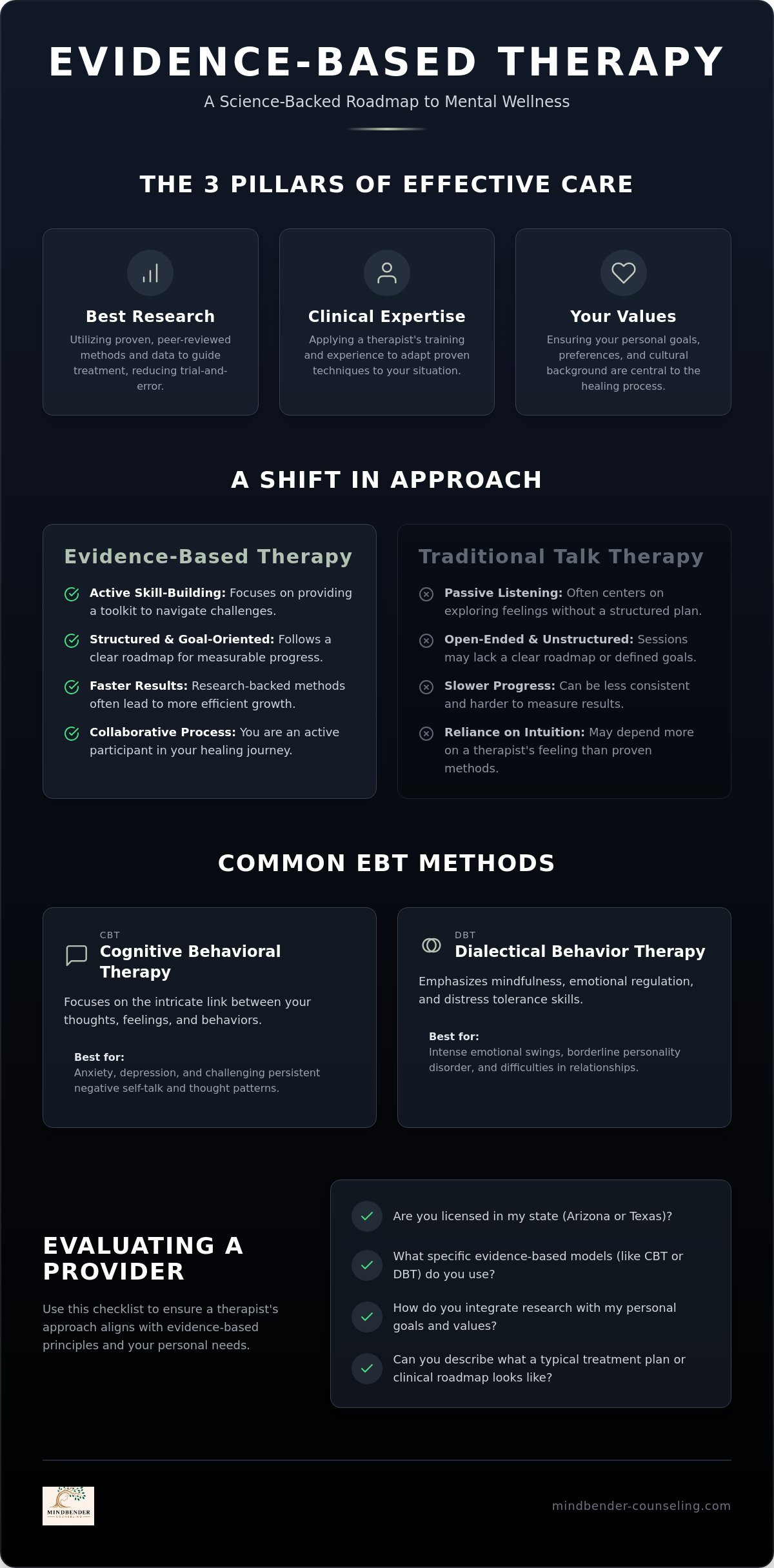
- Understand what is evidence based therapy by looking for the three pillars of care: the best available research, clinical expertise, and your unique personal values.
- Distinguish between traditional talk therapy and "active" models like CBT or DBT that focus on building specific skills for measurable emotional growth.
- Learn why research-backed care often leads to faster results and more consistent progress than open-ended sessions without a clear clinical roadmap.
- Use a practical checklist to evaluate a therapist's credentials and clinical approach so you can invest your time and resources with confidence.
- Discover how to find licensed providers in Arizona and Texas who balance clinical rigor with a compassionate, personalized approach to healing.
Beyond the Buzzword: What is Evidence-Based Therapy?
When you search for mental health support, you'll likely encounter the term "Evidence-Based Therapy" or EBT. It sounds clinical and perhaps a bit detached, but the reality is deeply human. At its core, what is evidence based therapy? It's a structured clinical decision-making framework designed to ensure you receive the most effective care possible. This approach is rooted in the broader tradition of Evidence-Based Practice, which first revolutionized medicine by prioritizing proven results over tradition or intuition.
In the counseling room, this means your therapist isn't just winging it or relying solely on their gut feeling. Instead, they operate within a model that integrates three vital pillars: the best available research, their own clinical expertise, and your unique patient values. Some people worry that this sounds like cookie-cutter therapy where everyone gets the same script. That couldn't be further from the truth. EBT is a collaborative process where science provides the map, but you and your therapist decide on the destination. This is why modern therapy behavioral therapy has become the gold standard in 2026; it offers a clear structure while remaining flexible enough to meet your specific needs.
The Science of Better Outcomes
Choosing a research-backed method significantly reduces the trial and error phase that often discourages people from staying in counseling. When a protocol is developed through peer-reviewed studies, it means it has been tested and refined to address specific challenges effectively. This commitment to scientific rigor is shared by other health disciplines; for instance, Benchmark Physio utilizes evidence-based clinical care to optimize patient recovery. Similarly, data allows mental health therapists to understand which techniques lead to the most significant shifts in mood or behavior. By staying current on this research, a therapist provides a safer environment because they use tools that have already proven their worth for thousands of others. It's about working smarter, not just harder, to reach your goals.
Why Your Values are a Core Pillar
A proven method only works if it resonates with your life. The third pillar of EBT ensures that your cultural background, personal preferences, and specific goals are at the center of every session. A strong therapeutic alliance is essential here. Your therapist uses their clinical expertise to adapt the science to fit your world. If a technique doesn't align with your values, it won't be effective. True evidence-based care honors your autonomy and ensures that the roadmap to healing is one you feel comfortable traveling. It's a partnership where your voice is just as important as the clinical data.
Comparing Common Evidence-Based Therapy Methods
The shift in modern mental health care has moved away from passive listening toward active, collaborative skill-building. When you explore what is evidence based therapy, you are looking at a framework where you aren't just an observer in your own healing. You are a participant. This active engagement is a hallmark of personal counseling services that prioritize your long-term resilience. Instead of just discussing the past, these models provide you with a toolkit to navigate the present. It's about building a solid internal foundation that lasts long after your final session.
Many practitioners follow evidence-based practices to ensure that every minute you spend in the office contributes to your progress. This structured approach is particularly effective when delivered through a dedicated individual therapy program tailored to your specific symptoms. By using a proven roadmap, you can move through the healing process with a sense of order and predictability.
CBT vs. DBT: Which Path is Right for You?
Cognitive Behavioral Therapy (CBT) is often the first method people encounter. It focuses on the intricate link between your thoughts, feelings, and behaviors. If you struggle with anxiety or persistent negative self-talk, CBT helps you identify and challenge those patterns. On the other hand, Dialectical Behavior Therapy (DBT) was designed for those who experience intense emotional swings and difficulty in relationships. DBT emphasizes mindfulness, distress tolerance, and emotional regulation. Choosing between them depends on your primary goals. If you need to reframe your perspective, CBT is a strong choice. If you need to find stability during an emotional storm, DBT offers the anchor you've been looking for.
Evidence-Based Approaches for Couples
Relational health also benefits from clinical rigor. Many couples find themselves stuck in "venting" sessions that don't lead to change. Utilizing behavioral therapy for relationship issues provides a different experience. Methods like the Gottman Method or Emotionally Focused Therapy (EFT) are built on decades of research into what makes relationships last. These tools help you break toxic communication cycles and rebuild a foundation of trust. They offer a clear roadmap for couples who want to stop arguing and start connecting again. If you're ready to see how these methods can change your life, you might consider reaching out to a licensed professional who specializes in these research-backed tracks.
The Benefits of Choosing Research-Backed Counseling
The true value of understanding what is evidence based therapy lies in the confidence it gives you as a client. When you step into a session, you aren't just hoping for a better week; you're following a plan designed to produce results. One of the most significant advantages is the concept of measurable progress. Instead of relying on vague feelings of "doing better," you and your therapist use clear benchmarks to track your growth. This visibility turns the abstract process of healing into something tangible. When you can see your anxiety scores dropping or your communication skills improving, you gain the emotional momentum needed to stay committed to the work.
Efficiency is another critical factor that sets research-backed care apart. Many people find that they reach their goals faster in these models than in open-ended talk therapy. Because the sessions are focused on specific outcomes, there's less time spent wandering through aimless conversation. This doesn't mean the sessions are rushed; it means they're intentional. The Association for Behavioral and Cognitive Therapies explains EBP as a way to ensure that your treatment is always moving toward a healthier baseline. Safety is equally paramount. These methods undergo rigorous testing in clinical trials to ensure they effectively treat symptoms without causing unintended harm. The efficacy gap represents the measurable distance between the consistent, positive outcomes of peer-reviewed treatments and the unpredictable results of methods that lack scientific validation.
Predictability and Structure
A typical EBT session follows a supportive, structured rhythm that reduces the common anxiety of not knowing what to talk about. You'll often start with agenda-setting to prioritize your current needs, followed by active skill-building. Out-of-session practice, or "homework," allows you to apply these new tools in your real life. This structure creates a sense of order that helps you feel safe while exploring difficult emotions. It ensures that every hour you spend in the office is productive and focused on your restoration.
Long-Term Emotional Resilience
The goal of research-backed counseling isn't just to help you feel better today, but to equip you for the years ahead. While traditional talk therapy might focus on temporary venting, EBT prioritizes permanent cognitive restructuring. You're building a personalized toolbox of strategies that you can use long after your sessions conclude. It's an investment in your future self, providing the internal foundation necessary to handle life's inevitable challenges with steady, unwavering confidence. This approach transforms you from a passive recipient of care into a skilled architect of your own well-being.
Buying Guide: How to Evaluate an EBT Provider
Finding the right therapeutic fit is a critical step in your healing journey. While you now understand what is evidence based therapy, applying that knowledge to a directory search can feel overwhelming. You aren't just looking for a kind face; you're looking for a skilled clinician who uses a proven framework to facilitate your growth. Start by examining a therapist's "About" page. A dedicated EBT provider will explicitly mention specific modalities like CBT, DBT, or EMDR. If they describe their style as purely "eclectic" without further detail, it may indicate a lack of specialized focus. Look for mentions of ongoing supervision or advanced certifications, which signal a commitment to clinical rigor and staying current with the latest psychological research.
Treat your first meeting as a mutual interview. You have every right to understand the methodology behind your care and how it applies to your specific life goals. A confident therapist welcomes these questions because they believe in the transparency of the evidence-based model. This collaborative approach lowers your defenses and builds immediate trust, ensuring you don't feel like a passive observer in your own treatment. Finding a provider who aligns with these standards ensures your time and energy are well-spent. If you are looking for a team that prioritizes this level of transparency and clinical expertise, you can connect with our research-backed therapists to find the right fit for your personal or relationship goals.
Questions to Ask Your Potential Therapist
Empower yourself by asking direct questions during your initial consultation. A structured provider should offer clear, direct answers that reflect their clinical expertise. Consider using these prompts:
- "Which specific evidence-based models do you use for my particular concern?"
- "How do you measure progress throughout our sessions to ensure we're on track?"
- "What does a typical session look like in your practice, and will there be out-of-session practice?"
A therapist should be able to explain how they track growth, perhaps through regular assessments or specific behavioral milestones. If they can't describe a typical session structure, they might not be adhering to a structured EBT framework, which could lead to the "stuck" feeling many hope to avoid.
Red Flags to Watch For
Awareness is your best defense against ineffective sessions. Trust your gut if you notice these signals during your search or early sessions:
- Therapists who cannot name their specific methodology or rely solely on "intuition" and "vibes."
- A lack of clear goals or a treatment plan after the first three sessions.
- Over-promising "cures" or making unrealistic claims without scientific backing.
Evidence-based care is about steady, unwavering support and proven methods. It avoids the fluff of "miracle fixes" in favor of the hard, rewarding work of internal progress. By staying vigilant, you ensure that your investment in therapy leads to the measurable emotional restoration you deserve.
Personalized Evidence-Based Therapy in Arizona and Texas
Mindbender Counseling brings the clinical excellence of research-backed care to the diverse communities of Arizona and Texas. We recognize that people in the Southwest face unique stressors, from the rapid professional pace in Phoenix and Scottsdale to the evolving landscapes of Austin, Dallas, and Houston. Many individuals begin their search by asking what is evidence based therapy because they want assurance that their investment in mental health will yield real results. We bridge the gap between high-level clinical rigor and the warmth of a local practice, ensuring you feel truly seen while receiving care that is scientifically sound. Our team is dedicated to providing a supportive environment where your growth is the primary focus.
We specialize in delivering individual counseling for anxiety and other complex emotional challenges using these proven methods. By focusing on individualized attention rather than a one-size-fits-all approach, we help you build a solid internal foundation. Our licensed therapists in Arizona and Texas are trained to move beyond traditional talk therapy, offering you a structured path toward lasting restoration. You don't have to navigate your healing journey alone; we are here to act as a sturdy anchor as you move toward your goals.
Our Approach to Individual and Couples Care
We tailor methods like DBT and CBT specifically for the high-achieving professionals and families residing in Arizona and Texas. Our therapists understand that a "proven" method only works when it's adapted to your specific life goals and cultural context. The process is deeply collaborative. You and your therapist will work together to set clear, measurable milestones from the very beginning. We believe in the power of methods that actually work, moving away from aimless sessions and toward active skill-building. Whether you're seeking to strengthen your relationship or find personal stability, our evidence-based tracks provide the clarity you've been looking for.
Start Your Journey Today
Taking the first step toward professional support should be a low-friction experience. You can easily schedule an initial consultation through our website to find a therapist who aligns with your needs. In your first session, you can expect a structured yet compassionate conversation where we'll begin to outline your treatment plan and identify the evidence-based tools that fit your situation. This isn't just about managing symptoms; it's about achieving the measurable growth you deserve. You deserve care that is as smart as it is supportive. Reach out today to begin your path toward a more balanced and resilient life.
Your Path to Measurable Emotional Growth
You've moved beyond the confusion of clinical acronyms to understand what is evidence based therapy: a reliable framework that prioritizes your progress. By choosing a methodology like CBT or DBT, you are investing in a structured roadmap that replaces uncertainty with clear, actionable skills. This approach ensures that every session contributes to building a stronger internal foundation, whether you are working through personal anxiety or strengthening a relationship. You now have the tools to vet providers and choose a path that respects both scientific rigor and your personal values.
At Mindbender Counseling, our licensed therapists in Arizona and Texas specialize in these research-backed tracks. We balance clinical excellence with compassionate support, creating personalized treatment plans for individuals and couples that honor your unique journey. You don't have to stay stuck in cycles that don't lead to change. Ready to experience therapy that works? Schedule your consultation with Mindbender Counseling today. You deserve care that is as effective as it is empathetic. Your journey toward lasting restoration starts with a single, confident step.
Common Questions About Research-Backed Care
Is evidence-based therapy better than regular talk therapy?
Evidence-based therapy is often considered more effective for specific symptoms because it utilizes a structured roadmap proven by clinical research. While traditional talk therapy provides a supportive space to vent, EBT focuses on measurable outcomes and active skill-building. This approach reduces the time spent in a trial and error phase, helping you achieve your emotional goals with greater efficiency and confidence. It ensures your time in session is purposeful and productive.
How long does a typical course of evidence-based therapy take?
A typical course of treatment often lasts between 12 and 20 sessions, though this varies based on your individual needs and the complexity of your goals. Because these methods are focused on specific outcomes, they are generally more time-limited than open-ended counseling. You and your therapist will regularly review your progress to determine when you have built the internal foundation necessary to navigate life's challenges independently and successfully.
What is the most effective type of therapy for anxiety and depression?
Cognitive Behavioral Therapy (CBT) is widely recognized as the gold standard for treating anxiety and depression in 2026. It helps you identify and reframe negative thought patterns that drive emotional distress. For those experiencing more intense emotional swings or relationship conflicts, Dialectical Behavior Therapy (DBT) is also highly effective. Both methods provide a clear, research-backed path toward restoring emotional balance and building long-term resilience in your daily life.
Does insurance in Arizona and Texas usually cover EBT?
Most insurance plans in Arizona and Texas cover evidence-based therapy because these methods are recognized as medically necessary treatments. In Arizona, telehealth parity laws require insurers to cover virtual sessions just like in-person visits. In Texas, in-network coverage typically involves a standard copay between $20 and $50. You should always verify your specific benefits with your carrier first to understand your out-of-pocket costs and any provider requirements.
Can evidence-based therapy be used for couples and marriage counseling?
Evidence-based therapy is highly effective for couples and focuses on breaking toxic communication cycles through proven relational frameworks. Methods like the Gottman Method or Emotionally Focused Therapy (EFT) provide a structured alternative to unstructured advice. These tools help partners rebuild trust and connection by using skills that have been rigorously tested in clinical studies. It turns the counseling room into a laboratory for building a stronger, more resilient partnership.
What if I don't feel a connection with an evidence-based therapist?
You should prioritize finding a new provider if the therapeutic alliance doesn't feel right, as a strong connection is a core pillar of effective care. Even the most proven scientific method requires a foundation of trust and safety to work. A professional therapist understands that the "fit" is essential and will support your decision to find a clinician whose personality and style better align with your personal values and goals.
Is DBT only for people with severe mental health diagnoses?
No, DBT is a versatile approach used to help anyone who struggles with emotional regulation, distress tolerance, or relationship conflicts. While it was initially developed for complex clinical needs, its focus on mindfulness and interpersonal effectiveness is beneficial for a wide range of everyday stressors. It provides a practical toolbox for anyone looking to build a more stable and balanced internal life, regardless of whether they have a formal diagnosis.
How do I know if my therapist is actually using evidence-based practices?
You can verify this by asking your therapist to explain their specific methodology and how they track your progress over time. When you ask what is evidence based therapy in the context of your care, they should be able to name a model like CBT or DBT and describe a structured session format. They will also use regular assessments or clear behavioral milestones to ensure your treatment plan stays focused on your restoration.


