
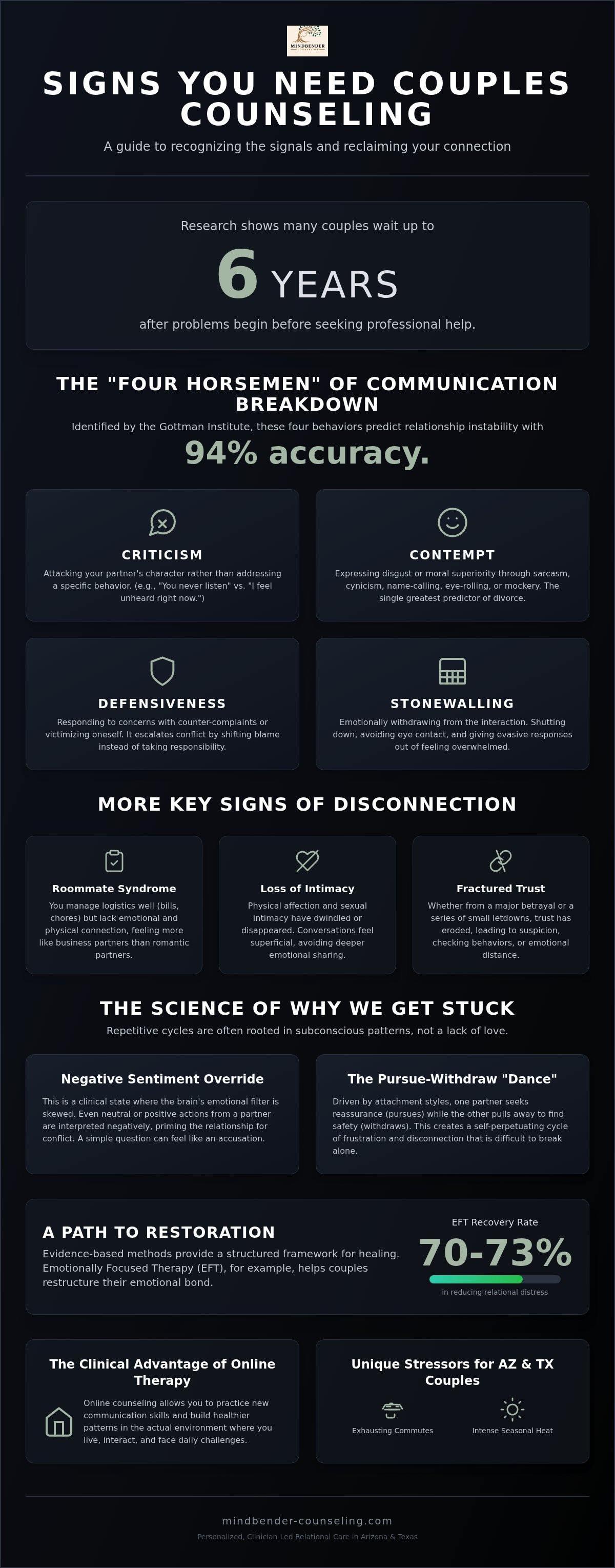
You find yourself replaying the same argument for the third time this week, feeling more like a weary roommate than a romantic partner. It’s a heavy realization when the person who used to be your greatest support now feels like a source of constant tension or quiet distance. You aren't alone in this feeling. Research shows that many couples wait up to six years after problems begin before seeking help, often letting negative patterns become deeply entrenched. Identifying the specific signs you need couples counseling is the first step toward reclaiming the intimacy you once shared.
We understand that the thought of opening up can feel overwhelming; however, relational distress is often a biological signal that your partnership needs a methodical, evidence-based recalibration. This guide will help you gain clarity on your relationship’s health by outlining ten critical red flags. You’ll learn how research-backed methods like the Gottman Method and Emotionally Focused Therapy can restore your bond. We’ll also explore how to access professional, evidence-based online counseling from the comfort of your Arizona or Texas home, providing you with actionable tools to replace circular arguments with meaningful connection and a renewed sense of hope.
Key Takeaways
- Identify the ten specific signs you need couples counseling and learn to view professional support as a proactive tool for growth rather than a last resort.
- Understand the science behind your conflict, including how attachment styles and "Negative Sentiment Override" can trap you in repetitive cycles of misunderstanding.
- Discover the clinical advantages of online therapy, which allows you to practice new communication skills in the natural environment where you actually live and interact.
- Reframe your approach to the first session by viewing it as a gentle invitation toward restoration rather than a confession of relational failure.
- Learn why choosing a personalized, clinician-led practice in Arizona or Texas offers a more stable foundation for healing than high-volume, generic therapy apps.
Recognizing the Shift: 10 Common Signs You Need Couples Counseling
Many people view therapy as an emergency room for a dying relationship. This perspective often causes couples to wait years before seeking support, which allows resentment to settle into the foundation of the home. In reality, it's helpful to understand What is Couples Counseling?: it's a professional resource designed to strengthen your bond before the cracks become structural. Recognizing the signs you need couples counseling early allows you to address issues while you still have the emotional energy to invest in each other.
We can generally categorize these red flags into three pillars: communication breakdowns, the cooling of physical and emotional intimacy, and the subtle fracturing of trust. One of the most pervasive modern indicators is "roommate syndrome." This occurs when you effectively manage a household, a budget, and a calendar together, yet you feel completely disconnected. You're efficient partners in logistics but strangers in spirit. This is a primary symptom of relational erosion, which is the gradual loss of friendship and shared meaning.
The "Four Horsemen" of Communication
Research from the Gottman Institute identifies four behaviors that predict relationship instability with 94% accuracy. Criticism involves attacking your partner’s character, while contempt uses sarcasm or eye-rolling to suggest moral superiority. Defensiveness turns every concern into a counter-complaint, and stonewalling is the act of shutting down. In our digital age, these patterns often migrate to screens. You might notice "text-fighting" where tone is lost or the intentional use of "read" receipts to stonewall a partner during the workday.
Local Stressors in Arizona and Texas
Relationships don't exist in a vacuum; they're shaped by our environment. For couples in the Southwest, unique stressors often accelerate tension. The exhausting Phoenix commute or the sprawling urban traffic in Dallas and Houston can drain your "emotional gas tank" before you even walk through the front door. Seasonal stressors also play a role. When intense Texas or Arizona heat keeps everyone indoors for months, household harmony often feels strained. These external pressures magnify existing signs you need couples counseling by reducing your patience.
The Science of Connection: Why Relational Patterns Persist
Understanding why we get stuck is often the first step toward moving forward. While the signs you need couples counseling often manifest as surface-level arguments, the root usually lies in our biological wiring and early attachment styles. These styles act as a subconscious blueprint for how we give and receive love. When this blueprint is challenged, we fall into a repetitive "dance" of pursuit and withdrawal. One partner may move closer to seek reassurance, while the other pulls away to find safety, creating a cycle that feels impossible to break alone.
A therapist acts as a methodical guide to help you identify these patterns. Without professional intervention, many couples fall into "Negative Sentiment Override." This is a clinical state where the emotional filter becomes so skewed that even a neutral or positive gesture from a partner is interpreted as a slight. It’s why a simple question about dinner can spiral into a fight; the brain is already primed for conflict. Breaking this filter requires more than just "trying harder"; it requires a restructuring of the relational foundation.
It’s also common to seek relief by venting to friends. While well-intentioned, this often reinforces your negative perspective instead of solving the core issue. Friends usually validate your frustration, which can unintentionally deepen the divide between you and your partner. A professional provides a neutral space to rebuild your bond without the bias of social circles. If you're ready to explore this path, you can schedule a session with an evidence-based therapist to begin your work.
Evidence-Based Modalities Explained
We rely on research-backed methods like the Gottman Method and Emotionally Focused Therapy (EFT). These aren't just theories; they're proven frameworks for change. EFT, for instance, shows a 70-73% recovery rate in reducing relationship distress according to clinical studies. For more on how these approaches build strength, read our guide on Understanding Therapy and Behavioral Therapy: A Guide to Modern Emotional Resilience. These methods provide the sturdy anchor needed during turbulent times.
The Biological Impact of Conflict
Chronic conflict isn't just an emotional burden; it’s a physical one. When you’re in a state of constant tension, your body stays flooded with cortisol, the stress hormone. This "fight or flight" loop makes it biologically impossible to listen or empathize effectively. Learning "physiological soothing" is essential. By lowering the heart rate and calming the nervous system, you can finally have the conversations that lead to resolution rather than further injury. Recognizing these physical symptoms of stress is one of the most significant signs you need couples counseling to ensure your long-term health.
Addressing the Signs Remotely: Why Online Therapy is a Clinical Advantage
Once you recognize the signs you need couples counseling, the logistical hurdle of attending sessions often stalls the healing process. Online therapy offers a unique clinical advantage known as "ecological validity." This concept means you practice your new communication skills in the exact environment where you'll actually use them. Instead of performing in a sterile office, you stay on your own sofa, navigating real-life triggers in real time. This context allows a therapist to observe your natural dynamics more accurately than in a traditional setting, making the interventions more relevant to your daily life.
There's a common myth that virtual sessions are less personal or effective. On the contrary, many couples experience the "online disinhibition effect." This phenomenon often leads to faster breakthroughs because the digital screen provides a subtle layer of safety that encourages vulnerability. You might find it easier to discuss sensitive topics like intimacy or financial strain when you're in a space where you already feel secure. This sense of safety helps lower the defenses that often lead to the circular arguments we discussed earlier.
Convenience as a Catalyst for Consistency
In states like Arizona and Texas, the "commute barrier" is a significant reason couples stop attending sessions. By removing the friction of a long drive through Phoenix traffic or Houston sprawl, you protect the emotional energy needed for the work itself. Consistency is the primary driver of relational healing. For high-conflict pairs, the "neutral digital ground" of a video call can also prevent arguments from escalating in the car before the session even begins. To learn more about how this process unfolds, see our article on How Does Online Couples Counseling Work? The Rise of On-Demand Therapy in 2026.
Maintaining Privacy and Calm Assurance
We utilize HIPAA-compliant platforms to ensure your sessions remain a private, clinical environment. This level of security provides the calm assurance you need to be fully present. When both partners are in their own "safe space" at home, the defensive walls often lower more quickly. In the digital frame, our therapists work diligently to ensure both individuals feel equally seen and supported. This balanced approach helps you address the signs you need couples counseling with clarity and mutual respect, fostering a sense of order in a time of emotional uncertainty.
From Recognition to Restoration: Preparing for Your First Session
Once you have identified the signs you need couples counseling, the transition from recognition to action requires a shift in perspective. It's helpful to view this first step as a gentle invitation to growth rather than a confession of failure. It takes significant courage to admit that your current patterns aren't working, but that admission is the foundation of restoration. Entering your first session with a sense of quiet confidence allows you to focus on the possibility of a healthier future rather than the weight of the past.
Choosing a therapist who aligns with your specific goals is vital for long term success. You aren't just looking for a neutral party; you're seeking a professional facilitator who uses research-backed methods to guide your progress. Individual readiness is also a key factor. While you work toward relational healing, you must also be personally prepared to look inward and take accountability for your own contributions to the relationship dynamic. This combination of personal growth and shared commitment creates the most resilient outcomes.
Setting the Physical and Mental Stage
Practical preparation is just as important as emotional readiness. We recommend the "10-minute buffer" rule: stop all work, chores, and household tasks ten minutes before your session begins. This brief window allows your nervous system to downshift from daily stress to a state of receptive focus. Creating a "sacred space" in your home is equally essential to ensure privacy. The ideal environment for a successful virtual session is a private, well-lit space where you both feel physically supported and mentally shielded from outside distractions.
Defining Shared Goals
It's common for one partner to feel more skeptical than the other. If your partner is hesitant, frame the decision as a collaborative project to improve the "we" rather than a critique of the "you." Your initial assessment sessions aren't about finding who's at fault; they're about creating a personalized intervention plan that respects both perspectives. Sometimes, personal struggles like chronic stress or burnout can bleed into the relationship. In these cases, we often recommend individual counseling for anxiety alongside couples work to build a more stable internal foundation for each partner.
Taking the initiative to address the signs you need couples counseling is a profound act of care for your partnership. When you're ready to move from recognition to restoration, you can reach out to our clinical team to begin your journey toward lasting connection.
Mindbender Counseling: Personalized Relational Care in Arizona & Texas
Choosing where to seek professional support is a significant decision that impacts the trajectory of your relationship. Mindbender Counseling stands apart as a boutique practice with deep roots in Arizona and Texas. Unlike massive therapy apps that often prioritize high-volume matching and automated systems, we are a clinician-led practice. This means your care is directed by experienced professionals who prioritize the quality of your transformation over the quantity of users. We act as a sturdy anchor for couples navigating the complexities of 2026, providing a stable foundation when your partnership feels most uncertain.
Our commitment to evidence-based therapy ensures that your time is spent on interventions that actually work. We don't rely on vague advice or surface-level suggestions. Instead, we utilize research-backed methods like the Gottman Method and Emotionally Focused Therapy (EFT) to address the root causes of your distress. By focusing on these proven frameworks, we help you replace destructive patterns with healthy, sustainable habits. When you've identified the signs you need couples counseling, you deserve a methodology that is as rigorous as it is compassionate.
Local Expertise for Southwest Lifestyles
Relationships don't exist in a vacuum; they are heavily influenced by the world around them. We understand the specific pressures of the Southwest region, from the professional demands of the Austin tech corridor to the logistical strain of a Phoenix summer. These environmental factors contribute to your stress levels in ways that national platforms often overlook. By integrating this local context into our work, we facilitate deeper internal progress and long-term stability. It is time to Break the Stigma and embrace private therapy as a vital asset for your personal well-being and your career.
Your Next Steps Toward Healing
We've designed our scheduling process to be as low-friction as possible because we know that the first step is often the hardest. Once you reach out through our website, you can expect a personal response within 48 hours to begin the assessment phase. This initial period is focused on understanding your unique dynamic and creating a roadmap for your restoration. We'll guide you through the logistics of online sessions, ensuring that you feel confident and prepared before your first log-in. If you recognize the signs you need couples counseling in your own home, don't wait for the distance to grow. Begin your journey toward a stronger bond today and rediscover the connection that brought you together.
Embracing a Path Toward Relational Restoration
Recognizing the signs you need couples counseling isn't an admission of defeat; it's a strategic decision to prioritize your emotional health and long-term happiness. We've explored how identifying subtle shifts like "roommate syndrome" early can prevent the deep-seated resentment that often follows years of unresolved conflict. By utilizing evidence-based frameworks like the Gottman Method and EFT, you can replace exhausting circular arguments with meaningful, lasting reconnection. Online therapy makes this healing process both accessible and effective, allowing you to build a stronger foundation directly from the safety of your home in Arizona or Texas.
Mindbender Counseling offers personalized, research-backed care plans led by licensed professionals who understand the unique stressors of Southwest life. We provide a steady, methodical approach to help you navigate the complexities of modern partnership with quiet confidence. Our practice acts as a sturdy anchor, ensuring you have the expert guidance needed to move from recognition to restoration.
Schedule your initial consultation with a Mindbender specialist today to begin your journey toward a deeper bond. Your relationship deserves the care and professional attention required to thrive, and we're here to facilitate your path back to each other with optimism and expertise.
Frequently Asked Questions
Is online couples counseling as effective as in-person therapy?
Online couples therapy is just as effective as traditional in-person sessions, with a 2024 study confirming that the Gottman Seven Principles program maintains its clinical impact when delivered virtually. This format allows you to practice new communication skills in your own home, which often leads to better "ecological validity" and more sustainable long-term habits.
How do we know if our relationship "signs" are serious enough for therapy?
If you're consistently researching signs you need couples counseling, your relationship is likely ready for professional support. Research indicates that couples who seek help early have better outcomes, yet many wait six years after problems begin, which allows negative patterns to become deeply entrenched and harder to resolve.
What if my partner refuses to attend counseling with me?
You can begin with individual counseling services if your partner isn't yet ready to participate. Improving your own emotional resilience and communication patterns can often shift the relational "dance," which sometimes encourages a hesitant partner to join the process once they see positive changes in the home dynamic.
How do we handle technology or internet issues during a session?
We recommend having a secondary connection, such as a mobile hotspot, available to ensure your session continues smoothly if your primary internet fails. Your therapist will also establish a clear protocol during your first meeting to handle any unexpected technical interruptions so that your time remains focused on healing.
Are our digital sessions private and HIPAA compliant?
Every digital session is conducted through a secure, HIPAA-compliant platform to ensure your absolute privacy. These systems use high-level encryption and meet rigorous clinical standards, ensuring that your vulnerable conversations remain strictly between you, your partner, and your licensed clinician.
How long does the couples counseling process typically take?
The length of the process depends on your specific goals, though evidence-based methods like EFT have shown a 70% to 73% recovery rate in reducing distress within 12 to 20 sessions. Identifying the signs you need couples counseling early often allows for a more streamlined process before conflict becomes structurally damaging to the bond.
Does insurance in Arizona or Texas cover online couples therapy?
Most health insurance plans in Arizona and Texas do not cover couples therapy unless one partner has a specific mental health diagnosis. It's helpful to check with your provider or your Employee Assistance Program (EAP), as some employers offer a limited number of sessions to support household stability.
What makes Mindbender different from a large therapy app?
Mindbender is a boutique, clinician-led practice that prioritizes personalized, research-backed care over the high-volume algorithms found in massive therapy apps. We offer deep roots in the Southwest region and a commitment to evidence-based methods, providing a stable and supportive environment that national corporations cannot replicate.


