

What if feeling challenged in therapy doesn’t automatically mean you need to leave, but feeling consistently unheard deserves attention? If you’re asking when is it time to switch therapists, you may be weighing real concerns against the hope that things will improve. It can be hard to tell a temporary rough patch from a mismatch, especially when starting over sounds like losing the trust and progress you’ve already built.
Therapy is a working partnership, not a test you pass or fail. A difficult session, slow progress, or discomfort can be part of meaningful work. Those experiences matter differently, though, if they persist or you don’t feel able to discuss them safely.
This checklist can help you spot recurring concerns without treating any single sign as proof that you should leave. You’ll learn how to raise concerns, what to notice in your therapist’s response, and how to weigh continuing, adjusting your goals or approach, or looking for someone new. A change doesn’t erase what you’ve learned. It may help you find support that better meets your needs.
Key Takeaways
- Use a checklist of recurring concerns to explore when is it time to switch therapists, without treating any single concern as an automatic reason to leave.
- Consider how trust, communication, shared goals, and collaboration shape your experience with a therapist.
- Compare continuing as-is, asking to adjust the approach, and looking for another therapist. Each option starts with a different question.
- Prepare for a conversation by naming your concern, describing its impact, and asking to review your goals together.
- If you decide to switch, clarify what you want from therapy and what questions could help you explore a better fit.
When is it time to switch therapists? Start with these signs
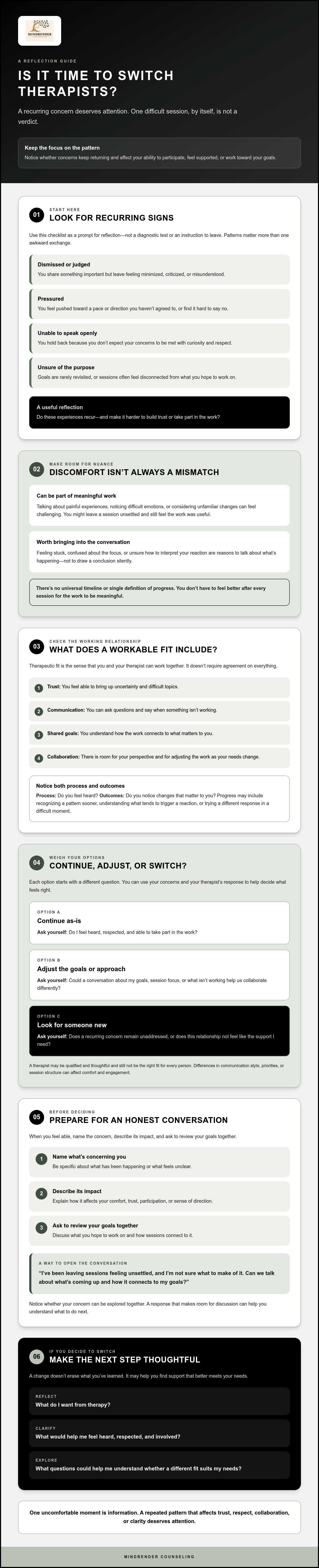
If you’re wondering when is it time to switch therapists, uncertainty doesn’t mean you or therapy have failed. It may be a sign that something needs attention. Rather than treating one uncomfortable session as a verdict, look for concerns that keep returning and affect your ability to participate or feel supported.
Use this checklist as a prompt for reflection, not a diagnostic test or an instruction to leave. Notice whether you can speak openly, feel respected, and understand how your sessions connect to your goals. Recurring concerns about safety, respect, collaboration, or clarity are worth taking seriously and discussing when you feel able.
What signs may point to a persistent mismatch?
Patterns matter more than one awkward exchange. Consider whether you repeatedly feel:
- Dismissed or judged: You share something important but leave feeling minimized, criticized, or misunderstood.
- Pressured: You feel pushed toward a pace or direction you haven’t agreed to, or find it hard to say no.
- Unable to speak openly: You hold back because you don’t expect your concerns to be met with curiosity and respect.
- Unsure of the purpose: Goals are rarely revisited, or sessions often feel disconnected from what you hope to work on.
Ask yourself whether these experiences recur and make it harder to build trust or take part in the work. A single misunderstanding may be repairable. A repeated pattern that remains unaddressed deserves attention.
What can feel difficult without meaning therapy is failing?
Therapy can involve talking about painful experiences, noticing difficult emotions, or considering unfamiliar changes. You might leave a session unsettled and still feel the work was useful. Discomfort alone doesn’t prove the fit is wrong. A difficult conversation also doesn’t mean you should continue without question.
There’s no universal timeline or single definition of progress. If you feel stuck, confused about the focus, or unsure how to interpret your reaction, bring it up rather than drawing a conclusion silently. You could say, “I’ve been leaving sessions feeling unsettled, and I’m not sure what to make of it. Can we talk about what’s coming up and how it connects to my goals?” Your therapist’s response can help you understand whether the concern can be explored together.
How therapist fit, trust, and progress shape the therapy experience
Therapeutic fit is the sense that you and your therapist can work together with trust, clear communication, shared goals, and room for your perspective. It doesn’t require agreement on everything. It does mean you can ask questions, say when something isn’t working, and understand how the work connects to what matters to you.
A therapist may be qualified and thoughtful yet still not be the right fit for every person. Differences in communication style, priorities, or session structure can affect how comfortable and engaged you feel. Consider both the process of therapy, such as whether you feel heard, and its outcomes, such as whether you notice changes that matter to you. No particular approach guarantees a specific result.
Shared goals and open communication help make therapy collaborative, so you and your therapist can adjust the work as your needs change.
How do you know whether therapy is making progress?
Return to the goals you set and compare them with your own observations over time. Progress may show up in small ways: recognizing a pattern sooner, understanding what tends to trigger a reaction, or trying a different response in a difficult moment. You don’t have to feel better after every session for the work to be meaningful. If progress feels unclear, ask to revisit your goals and discuss what you’ve noticed.
Why does the relationship with a therapist matter?
Feeling heard can make it easier to bring up painful thoughts, uncertainty, or topics you might otherwise avoid. The relationship is collaborative. You don’t have to agree with your therapist or follow every suggestion without question. You should be able to discuss a difference of opinion and explore what feels helpful. If you’d like more background, read about therapy and behavioral therapy in the relevant guide on the practice’s site.
If you’re considering a different therapeutic fit, you can explore Mindbender Counseling’s individual and couples counseling as one option. For people looking for counseling in Arizona or Texas, a conversation about goals and needs can help clarify what kind of support may suit them.
Stay, change the approach, or switch therapists? Compare your options
There isn’t one right answer for every concern. If you’re asking when is it time to switch therapists, compare your options rather than treating the decision as all-or-nothing. The table below can help you prepare for a conversation or clarify what you want from a different fit. It’s a guide, not a rulebook, and you don’t have to decide before you feel ready.
| Option | When it may be worth considering | Question to ask next |
|---|---|---|
| Continue as-is | Your concern feels recent or specific, and the work still feels respectful and connected to your goals. | “What feels useful about continuing with the current plan?” |
| Discuss adjustments | You want to keep working together but need clearer goals, a different session structure, or a communication change. | “Could we review what’s working and what we might adjust?” |
| Explore another therapist | Your needs remain unmet, or concerns about trust, communication, boundaries, or direction persist after you’ve tried to raise them. | “What would I want to be different in a new therapeutic relationship?” |
When might it make sense to continue or adjust the work?
If a concern is recent and you can imagine discussing it openly, a conversation may help you understand what happened and whether an adjustment could address it. You might ask to revisit your goals, talk about how sessions are structured, or explain what communication helps you feel understood. You can ask what changes are possible without agreeing to them. The aim is to gather information and decide what, if anything, feels helpful.
When might another therapist be worth exploring?
If important needs remain unmet despite attempts to talk about them, it may be reasonable to consider another fit. There’s no fixed number of conversations or universal threshold. Reflect on what matters to you: clear boundaries, a comfortable communication style, relevant experience for your concerns, and goals you can work on collaboratively. As you compare care options, a private therapy guide may help you identify questions to ask when exploring individual counseling.
One exception: If you have an immediate safety concern, seek prompt help from local emergency services or a crisis support service rather than waiting to resolve a routine question about therapy fit.
How to talk with your therapist before making a decision
Raising a concern can feel vulnerable, especially if you’re unsure how it will be received. You don’t need a final decision before speaking up. A focused conversation can help you understand whether your needs can be discussed and whether working together still feels possible. Try this simple sequence:
- Name the concern: Choose one specific moment or pattern you want to talk about.
- Describe its impact: Explain how it affects your comfort, trust, or ability to use the session.
- Ask to review the work: Invite your therapist to revisit your goals and consider what might help.
What can you say when therapy does not feel helpful?
A concrete example can make the conversation easier to follow than a broad statement like “This isn’t working.” Adapt any of these first-person prompts to your circumstances:
- “When we moved on from that topic, I felt I hadn’t been heard. Could we talk about what I was trying to say?”
- “I’m not sure what direction our sessions are taking. Can we review what we’re working toward?”
- “I’m uncertain how we’re measuring progress. What changes should we be looking for, based on my goals?”
Ask your question, then allow room for an honest response. You can also say that you’re nervous about bringing it up or need a moment to explain. You’re not responsible for finding perfect wording.
What should you notice in the therapist’s response?
Listen for curiosity, respect, and a willingness to explore your concern with you. Your therapist may ask follow-up questions, acknowledge the impact, or discuss possible adjustments. No particular response is guaranteed, and one conversation may not settle everything. Notice whether you feel able to keep speaking or instead feel dismissed, pressured, or shut down. Take time afterward to reflect on what the exchange means for you.
If you’re asking when is it time to switch therapists, this conversation can offer useful information, but it doesn’t obligate you to stay or leave. If you’re considering a different fit, explore individual counseling services as one way to learn about another source of support.
If you switch therapists, make the next step thoughtful and manageable
Changing therapists can bring relief, uncertainty, sadness, or several feelings at once. It doesn’t erase what you’ve learned or mean that you have to start from nothing. Your experience can help you get clearer about what you want from support now.
As you consider when is it time to switch therapists, give yourself room to identify what you hope will be different. Write down your goals, what helps you feel comfortable speaking openly, and practical needs that affect your choice. If continuity matters, ask whether your current therapist can coordinate with someone new or help you obtain a summary of past work. Any sharing of information should be handled with your consent and in line with applicable privacy rules.
What should you consider when looking for another therapist?
Use your experience to shape the questions you ask, rather than searching for a perfect match on paper. Consider:
- Communication preferences: What helps you feel respected, understood, and able to speak honestly?
- Your goals: What would you like to focus on, and how would you recognize useful change?
- Relevant experience: Does the therapist work with concerns like yours?
- Practical constraints: What factors, such as cost, location, or scheduling, will affect whether care is workable for you?
You can also ask how a prospective therapist collaborates on goals and checks in about progress. If anxiety support is relevant, the practice’s individual counseling for anxiety guide may offer another starting point for considering your needs.
How can you prepare for a first conversation with a new therapist?
A short note can help you begin without feeling you need to explain everything at once. Include what has helped, what hasn’t felt useful, and what you hope to work toward. You might ask, “How do you usually work with clients to set goals?” or “How can we talk about it if I’m unsure that therapy is helping?” You can ask about the therapist’s general approach, too, without needing to know a particular method in advance.
There’s no pressure to have every answer before you reach out. If you’re considering a new fit, explore individual or couples counseling with Mindbender Counseling as a possible next step.
Choose the next step that supports your well-being
There isn’t a single answer to when is it time to switch therapists. Look for recurring concerns rather than judging the relationship by one difficult session. Consider whether trust, communication, and shared goals can improve through an honest conversation. You can continue, ask to adjust the work, or explore another therapist based on what you need.
Changing therapists doesn’t erase the insight or effort you’ve already gained. Your experience can help you name what matters in a therapeutic relationship and ask more clearly for the support you’re seeking.
Mindbender Counseling offers personalized, evidence-based individual and couples counseling. If you’re considering a different fit in Arizona or Texas, explore individual or couples counseling with Mindbender Counseling as a possible next step.
Frequently Asked Questions
When is it time to switch therapists?
It may be time to consider a change when recurring concerns about trust, respect, communication, or shared direction continue to affect your ability to engage in therapy. Ask yourself whether you’ve been able to discuss what feels unhelpful and whether the response gives you room to work through it. One difficult session or a stretch of slow progress alone doesn’t settle the question. Immediate safety concerns need prompt help, not just a routine fit discussion.
Can I switch therapists if I do not feel a connection?
Yes, you can look for another therapist if the relationship doesn’t feel workable for you. A strong connection doesn’t mean you’ll agree on everything or feel comfortable in every session. Consider whether you can speak honestly, ask questions, and collaborate on goals. If you’re unsure, name what feels missing and see whether discussing it changes the experience. You don’t need to prove that your reasons are serious enough to explore a different fit.
How do I know if therapy is working?
Compare your current goals with changes you’ve noticed in your thinking, feelings, or responses over time. Progress might include recognizing a pattern sooner, understanding a reaction more clearly, or trying a coping strategy outside sessions. You may not feel better after every meeting, and progress doesn’t follow one universal timeline. If you’re uncertain, ask your therapist to review your goals with you and discuss what signs of change you might look for together.
Should I tell my therapist I want to switch?
You can tell your therapist if you feel comfortable, but you don’t have to discuss the decision before exploring another option. A conversation may help clarify whether a concern can be addressed or whether you’re ready to move on. You could say, “I’m considering a change because I haven’t felt clear about our direction. Can we talk about it?” If you decide to leave, ask about records or a summary of your work if that would support continuity.
Is it normal to feel uncomfortable with your therapist sometimes?
Some discomfort can happen when therapy brings up painful experiences or unfamiliar feelings. That alone doesn’t mean the relationship is a poor fit. Notice whether you can talk about the discomfort and whether your therapist responds with respect and curiosity. Feeling repeatedly judged, pressured, or unable to speak openly is different from temporary unease and deserves attention. You can ask what a difficult moment might mean without deciding in advance that therapy is failing.
What should I look for in a new therapist?
Look for someone whose communication style, relevant experience, and way of working toward goals fit your needs. Ask how you’ll set goals together, review progress, and raise concerns if something isn’t helping. Practical factors matter too. If you’re comparing options in Arizona or Texas, confirm current availability and whether the therapist can work with someone in your location. Take time to consider whether you feel respected and able to ask questions during an initial conversation.
Will switching therapists mean starting over?
Not necessarily. You may need to explain your concerns and goals to someone new, but you bring the insight and skills you’ve already developed with you. To make the transition more manageable, note what has helped, what hasn’t, and what you hope to focus on next. You can also ask your current therapist about a summary of your work or coordination with a new provider. Sharing information should involve your consent and respect applicable privacy rules.


