

What if infertility support could help you feel more like partners, even when you’re facing different emotions and difficult decisions? If you’re searching for couples counseling for infertility Houston, you may be wondering whether talking together can make a difference alongside medical care.
Fertility appointments, uncertainty, and grief can affect communication, closeness, and intimacy. You might be ready to talk while your partner needs time, or find that treatment decisions keep turning into tense conversations. Those differences don’t mean you care less about each other. They can be a reason to make room for both perspectives with patience and support.
Couples counseling doesn’t treat infertility or change medical outcomes. It offers a relationship-focused space to express what you’re experiencing, listen with greater care, and approach decisions as a team. Mindbender Counseling provides personalized, evidence-based couples counseling to support communication and emotional well-being during difficult seasons. This article explores what that support can look like, how counseling can complement fertility care, and how to consider a manageable next step in Houston, Texas.
Key Takeaways
- Notice how appointment demands and uncertainty may be shaping the way you talk, make decisions, and stay connected.
- Understand the difference between reproductive medical care and relationship-focused counseling, and how each can support you.
- With couples counseling for infertility Houston, you can work toward sharing concerns and treatment-related decisions with greater care.
- Prepare for a first conversation by naming what feels difficult, sharing what you hope to gain, and choosing one manageable goal together.
- Mindbender Counseling’s personalized, evidence-based couples counseling can help address communication and relationship challenges during this season.
When infertility affects your relationship: couples counseling in Houston
Infertility can bring uncertainty, grief, pressure, and a sense that life is being organized around appointments or unanswered questions. It may also change how you relate to each other. One partner might want to talk through every possibility, while the other needs quiet before finding the words. Neither response means someone cares less. Both can be ways of managing a demanding experience.
Infertility has many possible causes and may involve different forms of evaluation and care. This general overview of Infertility explains the medical context, while relationship support serves a different purpose. Couples counseling focuses on how you communicate, respond to strain, and face shared challenges together.
Couples counseling supports the relationship and emotional experience around infertility; fertility care evaluates and addresses reproductive health. Counseling does not diagnose or treat infertility, replace medical advice, or guarantee a particular relationship or fertility outcome. It can complement medical care by giving partners space to talk about what the process brings up and how they want to support one another.
Why infertility can feel different for each partner
Partners may experience grief, hope, and uncertainty in different ways, and those feelings can shift over time. One person may seek information and conversation; the other may prefer to focus on the next immediate task. Neither pattern belongs to a particular gender, and there’s no single timeline for processing loss or difficult news. Tension can arise when different coping styles are mistaken for indifference, avoidance, or pressure. Naming what each person needs can make room for understanding without requiring you to feel the same way.
When relationship support may feel useful
You might consider support if conversations about appointments or next steps repeatedly turn into conflict, if one or both of you withdraw, or if it’s hard to raise concerns without fearing another painful exchange. These experiences aren’t a diagnosis or proof that your relationship is failing. They may simply signal a need for a calmer, more structured place to listen and be heard.
In counseling, the focus can be on patterns between you rather than deciding who is right. For example, one partner’s repeated questions may be an attempt to feel prepared, while the other’s silence may be a way to avoid adding pressure. Exploring that cycle can help you explain what’s underneath each response and practice discussing hard topics with greater care.
If you’re considering couples counseling for infertility Houston, you don’t need to arrive with a shared explanation or a polished list of goals. You can begin with what feels difficult to say, what you wish your partner understood, or what would make conversations feel safer. Mindbender Counseling provides personalized, evidence-based couples counseling to address communication and relationship challenges while you continue making medical decisions with your fertility care team.
How infertility stress can shape communication, intimacy, and shared decisions
Fertility care can take up more of a couple’s shared attention than either partner expects. Appointment schedules, new information, treatment choices, and waiting for answers may leave less room for ordinary conversation or time together. Even practical questions, such as what to do next or when to revisit a decision, can carry emotional weight when the future feels uncertain.
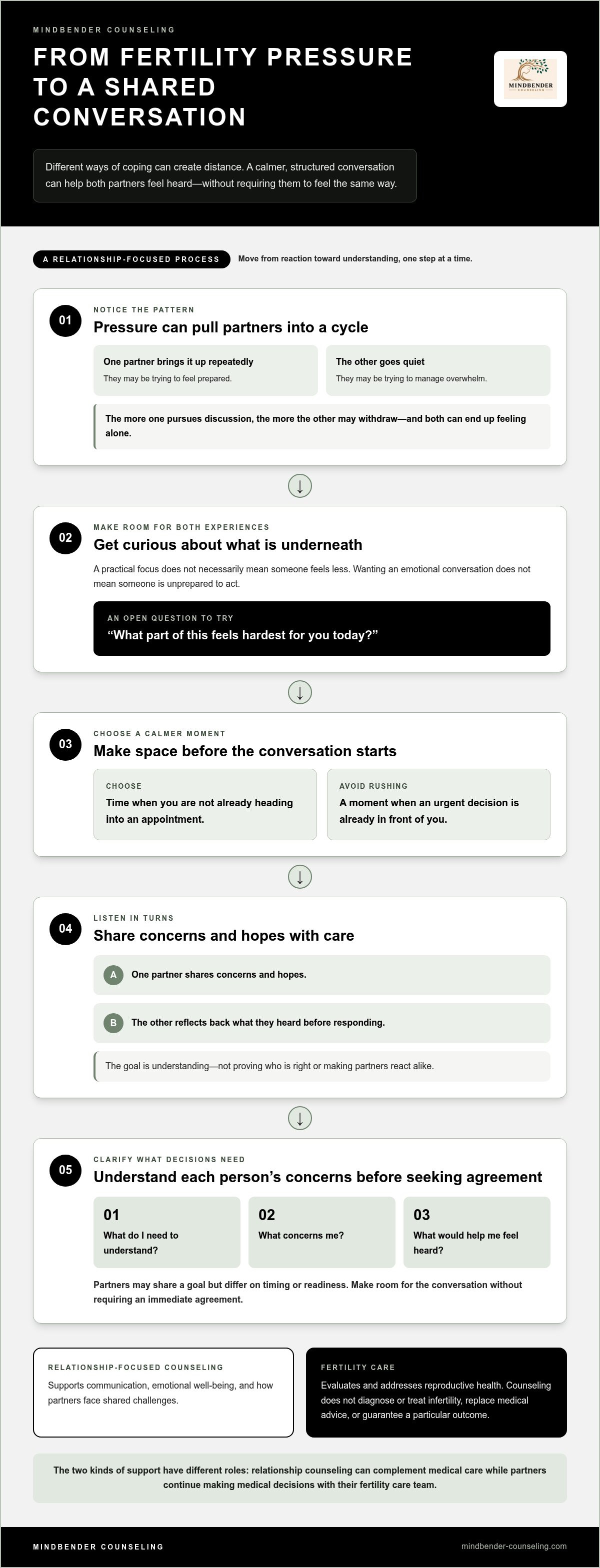
Pressure can create a familiar interaction cycle: one partner brings up the subject repeatedly to feel prepared, while the other goes quiet to manage overwhelm. The more one pursues discussion, the more the other may withdraw, and both can end up feeling alone. The mental health impacts of infertility can differ from person to person, which makes curiosity about each other’s experience especially valuable.
Relationship strain under fertility pressure is a sign that you’re carrying a lot, not proof that your relationship has failed.
Making room for different emotional responses
One partner may focus on logistics, gathering information, and keeping appointments organized. The other may need to pause and talk through what each possibility could mean. A practical focus doesn’t necessarily mean someone feels less, just as wanting an emotional conversation doesn’t mean they’re unprepared to act.
Instead of comparing who is more distressed, try asking, “What part of this feels hardest for you today?” A specific, open question can invite an answer without demanding that you react alike.
Talking through treatment choices as a team
Decisions about care can touch on personal values, readiness, boundaries, and tolerance for uncertainty. Partners might agree on a goal but differ on timing, or feel differently about what they’re prepared to consider. Before trying to reach a decision, each person can name what they need to understand, what concerns them, and what would help them feel heard. You can make space for that conversation without requiring an immediate agreement.
- Set aside time to talk when you aren’t already heading into an appointment or facing an urgent decision.
- Take turns sharing concerns and hopes. Reflect back what you heard before responding.
- Write down questions for your fertility-care professionals, who can guide medical recommendations and explain options.
Protecting connection matters, too. Infertility may affect intimacy, but there’s no single way it must look or feel. Desire, comfort, identity, and family-building hopes vary, and partners may want different kinds of closeness. A gentle check-in about what feels welcome can reduce pressure without assuming either person’s needs. If you’d like support having these conversations, couples counseling with Mindbender Counseling offers a personalized space to work on communication and shared challenges.
Infertility counseling versus fertility treatment: what couples support can and cannot do
Fertility treatment and couples counseling address different needs, and they can be part of the same broader support system. Medical care focuses on reproductive health. Counseling focuses on the emotional and relationship experience of facing infertility together. One doesn’t replace the other, and seeking emotional support doesn’t mean you’re giving up on medical care or expecting therapy to change its outcome.
Medical fertility care: Evaluation of reproductive health, diagnosis, treatment options, and medical guidance from qualified fertility-care professionals.
Couples counseling: Relationship-focused support for communication, emotional understanding, conflict patterns, and shared decisions.
Couples may consider counseling at different points: while deciding whether to seek an evaluation, during treatment, after a difficult result, or while considering what comes next. There’s no required stage or single reason to begin. Some want help discussing a decision; others want a steady space to understand how the experience is affecting their connection.
What couples counseling can support
In counseling, partners can slow down conversations that feel stuck, notice patterns that lead to conflict or distance, and practice expressing needs in ways that invite understanding. One person might want to revisit a decision while the other feels overwhelmed. Counseling can help both describe what’s underneath their reactions and listen without rushing to persuade.
Goals are personal. You might hope to communicate with less defensiveness, understand each other’s emotional responses, or feel more like a team while facing uncertainty. Progress can look different from couple to couple, and counseling can’t promise a particular outcome. It also can’t improve or guarantee conception or treatment success. Its role is to support how you cope and relate, whatever the medical path brings.
What remains within fertility care
Questions about diagnosis, reproductive health, treatment choices, benefits, risks, or medical advice belong with qualified fertility-care professionals. A counselor can help you prepare to discuss concerns or understand how a decision affects your relationship, but shouldn’t replace the medical guidance you need to make informed care decisions.
Think of these supports as addressing connected but distinct parts of the experience. You can pursue medical evaluation or treatment while also making room for emotional care. If you’re looking into couples counseling for infertility Houston, consider what you hope counseling will help with, such as feeling heard during decisions or finding a more constructive way to talk through uncertainty. Counseling is not a substitute for urgent or emergency support; if an immediate safety concern arises, seek appropriate emergency help.
How to prepare for couples counseling while navigating infertility in Houston
Starting couples counseling doesn’t require a complete account of everything you’ve been through or perfectly aligned goals. You can arrive with uncertainty, unfinished thoughts, or different ideas about what would help. A little preparation may make the first conversation feel more manageable, but it’s optional. The aim isn’t to rehearse a case or decide who’s right. It’s to identify what you’d like more space to discuss together.
A search for “couples counseling for infertility Houston” may bring up questions about how to begin. Consider this simple sequence, and adapt it to what feels comfortable:
- Name a concern. Each partner can identify one issue they hope to discuss, such as feeling disconnected, avoiding conversations about care, or having different needs after an appointment.
- Share your hopes. Talk about what you’d like more of, such as feeling heard, making space for both perspectives, or handling tense conversations with greater care.
- Choose a first goal. Agree on one relationship-focused area to explore, even if your broader hopes differ.
- Take one next step. Decide together whether you’re ready to seek counseling now or need time to think about it.
Questions to discuss before your first session
If it feels useful, each of you might consider: “What’s one thing I wish we could talk about more openly?” You could also name a topic that feels especially sensitive, such as a recent disappointment, uncertainty about next steps, or a change in closeness. You don’t have to share every detail in advance. These prompts can help you notice what matters and start a conversation.
It may also help to discuss what would make sessions feel respectful and useful. One person might want time to finish speaking; the other might need a pause when emotions rise. You can each describe what helps you feel safe enough to be honest. There’s no need to settle every preference beforehand. Sharing the question itself can be a useful beginning.
Setting realistic goals for support
Choose goals related to how you communicate and understand each other, rather than outcomes outside your control. For example, you might hope to discuss difficult topics without shutting down, better understand each other’s responses, or make room for both partners’ concerns before a decision. Medical recommendations and fertility outcomes remain separate from relationship goals. Counseling can support communication and coping, but it can’t promise a particular treatment result or family-building path.
There’s no single right way to begin. If you’re considering private therapy and supportive care, you can explore what might feel appropriate for you as a couple. Mindbender Counseling offers personalized couples counseling focused on communication and relationship challenges. Explore couples counseling support as one possible next step, at a pace that feels right for both of you.
Couples counseling for infertility in Houston with Mindbender Counseling
Infertility can bring conversations that are difficult to have anywhere, including at home. Mindbender Counseling provides personalized couples counseling for relationship challenges, using evidence-based therapy techniques and a focus on communication. For couples in Houston, Texas, this can offer a place to explore how you’re relating to each other through a demanding period, without needing to arrive with the same feelings or a complete plan. Mindbender Counseling serves clients in Arizona and Texas.
The focus is your relationship, not diagnosing or treating infertility. Counseling doesn’t replace reproductive evaluation, fertility treatment, or medical guidance, and it can’t promise a particular outcome. Instead, it can help you bring more openness and care to conversations, understand each other’s needs, and work through patterns that make connection harder.
What a personalized counseling focus means
Every couple brings its own history, communication habits, concerns, and hopes. You might want to work on how you talk about decisions; your partner may be more focused on feeling understood before discussing next steps. Personalized support makes room for both experiences instead of assuming that every couple needs the same thing.
Evidence-based therapy and individualized interventions can help address relationship challenges in ways that fit the concerns you bring. That might mean exploring how a conversation escalates, practicing a more constructive way to raise a sensitive topic, or making space for feelings that have been difficult to share. The work stays centered on your connection and communication, not on directing medical decisions or predicting fertility outcomes.
You don’t have to agree on every goal before beginning. One partner may hope to feel closer, while the other wants discussions to feel less tense. Both hopes can be part of the conversation. A counselor can help you identify a shared starting point while respecting what each person is experiencing.
A low-pressure next step for Houston couples
Before seeking support, you might ask each other: What feels hardest between us right now? What would make it easier to speak honestly? What would we like to be different about our conversations, even if we can’t control what happens medically? These questions can help clarify what kind of relationship support may feel meaningful now.
You don’t need a polished explanation. It’s enough to begin with a concern, a question, or the sense that you’d like more room to understand one another. If your hopes differ, that can be part of the conversation too. Counseling can meet you where you are and help you explore what you want to work on together.
If you’re looking for couples counseling for infertility Houston, consider whether personalized support could help you approach this season with greater understanding and care. Explore couples counseling with Mindbender Counseling as a gentle next step toward working on communication and relationship challenges together.
Take a gentle next step together
You don’t have to know exactly what you need before you begin. A first step can be as simple as noticing what you’d like to feel more able to share, or asking your partner whether they’re open to finding support together. Even if you’re not ready to decide, talking about the possibility can help you understand what feels manageable for both of you.
If you’re considering couples counseling for infertility Houston, Mindbender Counseling offers professional couples counseling grounded in evidence-based techniques and personalized interventions. The focus is on supporting your relationship, not directing fertility care or promising a particular outcome. You can consider whether this kind of support fits what you and your partner need now.
Explore couples counseling with Mindbender Counseling and take the next step at a pace that feels right. You deserve space to approach this experience with care, together.
Frequently Asked Questions
Can couples counseling help with infertility-related stress?
Yes, couples counseling can help partners talk about how infertility-related stress is affecting them and practice responding to each other more constructively. For example, after a difficult appointment, you might use a session to express what you need before moving into problem-solving. Counseling doesn’t remove uncertainty or control fertility outcomes, but it can give you a supported place to work through the emotional effects together.
Is couples counseling a substitute for fertility treatment?
No. Couples counseling is not a substitute for fertility evaluation, treatment, or medical advice. A counselor can help you talk about questions or concerns you want to bring to a medical appointment, but reproductive health guidance belongs with qualified fertility-care professionals. Keeping those roles clear lets you seek emotional support while continuing to make medical decisions with your care team.
How can infertility affect a relationship?
Infertility may influence how partners handle privacy, family conversations, and everyday plans. For instance, one person may want to tell relatives about treatment while the other prefers to keep details private. Differences like these can create tension even when both partners are trying to protect themselves or the relationship. Discussing what feels comfortable to share, and with whom, can help you approach those moments with more consideration.
Can we attend couples counseling if we disagree about fertility treatment?
Yes. You don’t need to agree about treatment before seeking couples counseling. You can use the space to clarify what each person is worried about, what information feels missing, and which boundaries matter. A counselor won’t make the medical decision for you or replace your fertility-care professionals. Counseling can help you hear each other’s perspectives and prepare to discuss medical questions with your care team.
What happens in couples counseling for infertility?
Sessions focus on the relationship concerns you bring, rather than following a fixed script for every couple. You might explore a recent conversation that left one of you feeling unheard, then consider what each person was trying to communicate. With couples counseling for infertility Houston, the work may include identifying patterns, clarifying goals, and practicing ways to discuss sensitive topics. The focus is personalized, and outcomes aren’t guaranteed.
When should a couple consider counseling during fertility treatment?
You can consider counseling whenever relationship support would feel useful, whether you’re preparing for an appointment, responding to a difficult update, or deciding how to talk about next steps. One practical sign is that an important conversation keeps getting postponed because you’re unsure how to begin. You don’t need to wait for a crisis or reach a particular treatment stage before seeking support.
Can couples counseling help when infertility is affecting intimacy?
It can offer a respectful place to talk about changes in closeness, comfort, or boundaries without assuming intimacy means the same thing to every couple. You might discuss how to show affection without pressure, or how to check in when one partner wants space. If you have physical symptoms or medical concerns affecting intimacy, bring those questions to a qualified healthcare professional as well.


