

What if seeking support for grief isn’t about moving on faster, but finding a steadier way to carry what you’re feeling? Loss can make everyday responsibilities harder, and it may not be clear whether counseling, a peer support group, or time with people close to you would help most. Considering grief counseling Fort Worth TX doesn’t mean you’re grieving incorrectly or taking too long.
The right kind of support depends on what you need, not on a timetable for feeling better. Individual counseling offers space to explore your response to loss at your own pace. Peer groups and personal support can offer connection in different ways. None can erase a loss or promise a particular timeline, but understanding what each can offer can help you choose a next step.
This guide explains what individual counseling can and cannot provide, compares it with peer and personal support, and offers practical questions to help you find a good fit. You’ll also find a manageable way to think about what to do next, without rushing yourself.
Key Takeaways
- Grief counseling Fort Worth TX can provide a private setting to explore how loss is affecting your emotions, routines, and relationships.
- Individual counseling, peer groups, and trusted personal support offer different kinds of connection. The best fit depends on what you need right now.
- Reflecting on your needs, preferred format, and goals can make it easier to choose support.
- You don’t have to be grieving “the right way” or wait until things feel worse to seek support.
- Mindbender Counseling offers personalized, evidence-based individual counseling to explore emotional needs and personal goals.
Grief Counseling in Fort Worth, TX: When Can Support Help?
Grief can vary from person to person, even after similar losses. There’s no universal schedule for adjusting, and feelings may shift from day to day. If grief is making responsibilities harder to manage, grief counseling Fort Worth TX can offer space to talk through what has changed and what kind of support might help.
Grief counseling is professional support for exploring your responses to a significant loss. It can make room for emotions and questions that are difficult to share elsewhere, without expecting you to reach a particular milestone. As this overview of grief counseling explains, support can take different forms. Individual counseling can focus on your particular concerns and needs.
Grief is a human response to loss, not, by itself, a mental-health diagnosis. People can experience grief without having a mental-health condition, though grief and other emotional difficulties can sometimes occur together. A counselor can help you explore what you’re experiencing without reducing it to a label.
What kinds of loss can bring someone to grief counseling?
The death of someone close is one reason people seek support, but it isn’t the only loss that can bring grief. A relationship ending, a change in health, losing a job, or leaving a meaningful role or life chapter can also have a deep impact. These experiences don’t need to be compared or ranked to deserve care.
Two people facing a similar event may respond differently because their relationships, circumstances, and sources of support differ. You don’t need to fit a particular pattern or wait until you feel worse to consider counseling. Not every loss requires therapy, either. Counseling is an option to explore, not a measure of how well you’re grieving.
How might grief affect everyday life?
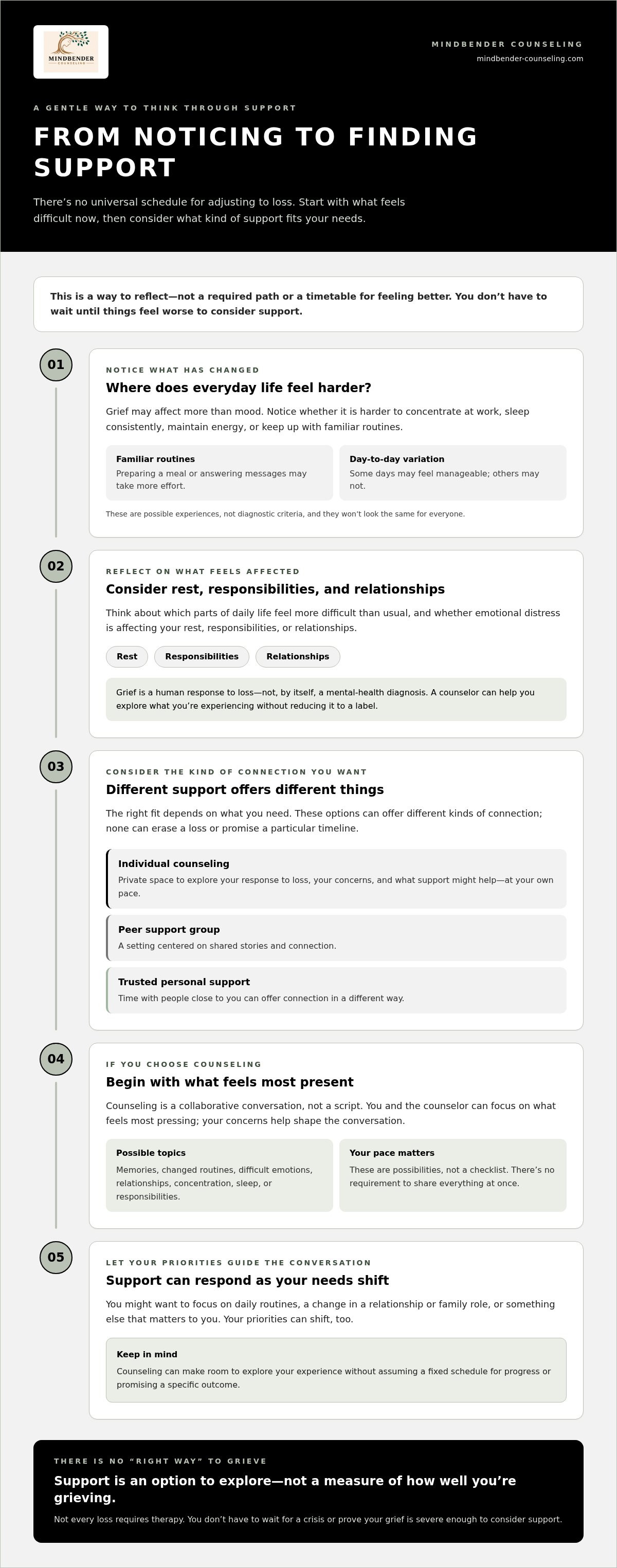
Loss may affect more than your mood. You might find it harder to concentrate at work, sleep consistently, maintain energy, or keep up with familiar routines. Some days may feel manageable; on others, preparing a meal or answering messages may take more effort. These are possible experiences, not diagnostic criteria, and they won’t look the same for everyone.
- Notice which parts of daily life feel more difficult than usual.
- Consider whether emotional distress is affecting rest, responsibilities, or relationships.
- Think about what kind of support would feel comfortable to start with.
You don’t have to wait for a crisis or prove that your grief is severe enough. If daily demands feel difficult to manage, or you want a private space to understand your response, individual counseling can help you explore what’s happening at your own pace.
What Happens in Grief Counseling, and How Can It Support You?
Grief counseling is a collaborative conversation, not a script you’re expected to follow. You and the counselor can focus on what feels most pressing, such as making sense of a loss, managing everyday responsibilities, or finding room for feelings that have been difficult to express. Your concerns help shape the conversation, and you can decide what feels useful to discuss.
Individual counseling is shaped around your experience, rather than general advice that assumes everyone needs the same thing. This personal focus can help you consider how loss is affecting you and what kind of support fits your circumstances, without pressure to reach a particular conclusion.
What might you talk about with a counselor?
You might bring up memories of the person or life chapter you’ve lost, changes to familiar routines, or emotions that feel difficult to hold. You could also talk about how grief is affecting your relationships, concentration, sleep, or responsibilities. These are possible topics, not a checklist. Start with what feels most present and leave other subjects for another time.
It may help to think about what you want from the conversation. Perhaps you’d like space to talk without needing to reassure others, or you want to understand why part of daily life feels harder. You can also discuss the support you already have and what still feels missing. There’s no requirement to share everything at once.
How does an evidence-based, personalized approach fit grief?
Evidence-based therapy draws on approaches informed by research and professional knowledge. In personalized counseling, that foundation is considered alongside your emotional needs, circumstances, and goals. The aim isn’t to apply one formula to every loss. It’s to make the support relevant to the concerns you bring and the priorities you identify.
For example, one person may want to focus on how grief is affecting daily routines, while another may want to talk through changes in a relationship or family role. Your priorities can shift, too. Counseling can respond to what matters to you without assuming a fixed schedule for progress or promising a specific outcome.
For readers exploring grief counseling Fort Worth TX, understanding how therapy can be personalized may make a first conversation feel less uncertain. Learn more about understanding therapy and behavioral therapy and how an evidence-based approach can support individual emotional needs. Mindbender Counseling provides individual counseling services where you can discuss what you’re experiencing and what you hope to work on.
Individual Grief Counseling or a Fort Worth Support Group: How Do You Compare?
Different kinds of support meet different needs. Individual counseling gives you dedicated space to focus on your experience. A peer group centers on shared stories and connection, while trusted friends or family may offer familiar, everyday companionship. None is automatically right for everyone, and you can combine options if that feels helpful.
| Support option | Format and personal focus | Shared experience | May fit when you want… |
|---|---|---|---|
| Individual counseling | One-to-one conversation focused on your circumstances and goals | Attention from a counselor, rather than a group of people with similar losses | Private space to explore personal concerns at your own pace |
| Peer support group | Group discussion or meetings organized around shared experiences | Connection with people who also understand aspects of loss | To hear others’ perspectives and feel less alone |
| Trusted personal support | Conversations and practical help from people you know | Ongoing connection within existing relationships | Familiar companionship or help with everyday needs |
This comparison can help clarify what you’re seeking in Fort Worth: focused attention, shared understanding, practical support, or a combination. A peer group and individual counseling serve different purposes. One doesn’t have to replace the other, and support from friends or family can remain meaningful alongside either option.
When might individual counseling feel like a better fit?
One-to-one counseling may suit you if you want to discuss circumstances that feel personal, complex, or difficult to share in a group. Privacy and having space to set goals around your own concerns may matter, too. Counseling isn’t necessary for everyone who is grieving. It’s one option when dedicated attention feels useful.
You might want to talk through a family relationship, how loss is affecting work, or emotions you aren’t ready to discuss with people close to you. The conversation can stay centered on what matters to you. For a closer look at what private therapy involves, consider how individual attention and privacy may fit your preferences.
What can peer support offer alongside counseling?
A peer group can offer a sense of recognition: other participants may understand parts of the experience that are hard to explain. Listening is one way to take part; you don’t have to compare losses or share more than you’re comfortable sharing. Groups can complement counseling by offering community, while counseling provides focused attention to your individual concerns.
GriefShare is one example of a directory readers can use to explore peer support options in the Fort Worth area. A group may offer connection with people who have faced loss, while individual counseling can focus on your particular emotional needs and goals. Mindbender Counseling provides personalized individual counseling. Choose the form of support that feels manageable now, and reconsider your needs as they change.
Choosing Grief Counseling in Fort Worth: Questions to Guide Your Decision
You don’t need certainty about exactly what you need before choosing support. Start with a few simple reflections, then adjust as you learn more. Asking for help doesn’t mean you’re grieving incorrectly or that you’ve waited too long or started too soon. It means you’re considering what might make this part of life easier to carry.
Use these questions as a starting point, not a test you need to pass:
- Name what feels hardest. Is grief affecting your routines, relationships, concentration, or sense of connection?
- Consider your preferred format. Would you rather have a private conversation focused on your experience, connect with peers, or begin by talking with someone you trust?
- Identify a small goal. You might want to put feelings into words, understand a change in your daily life, or feel more supported. Your goal can be modest and can change.
- Choose one first step. Write down a question, explore a support option, or start a conversation with someone you trust. Pick an action that feels manageable now.
How can you tell what kind of support you want?
Notice what you wish were different today. If you want focused attention on your circumstances, individual counseling may feel like a fit. If hearing from people with related experiences sounds helpful, a peer group may be worth exploring. You don’t need to be sure. “I’m not certain, but I’d like to talk it through” is a reasonable place to begin.
What can you bring into an initial counseling conversation?
You don’t need a polished explanation. Share what prompted your search, what has felt difficult lately, and what you hope might change. Describe only what you’re comfortable discussing. If the loss is affecting your sleep, relationships, responsibilities, or sense of stability, those details can give the conversation useful context.
It’s also reasonable to ask how the counselor approaches individual needs and how you might set or revisit goals together. Notice whether the communication feels clear and respectful, and whether you feel comfortable speaking at your own pace. A good fit involves more than the topic of grief; it also means feeling heard and able to help shape the work.
As you explore grief counseling Fort Worth TX, let your needs guide the decision rather than a fixed idea of how grief should look. If individualized support feels like a useful next step, explore individual counseling and consider what you’d like to bring to the conversation.
Mindbender Counseling for Grief Support: A Personalized Next Step
You don’t need to have everything figured out before exploring support. You might simply know that a loss is affecting your emotional well-being, relationships, or ability to manage daily life. Mindbender Counseling provides personalized individual counseling for emotional and psychological needs, with space to talk through what matters to you. The practice serves people in Texas and Arizona.
Mindbender Counseling uses evidence-based therapy techniques tailored to each person. The conversation can focus on your circumstances and personal goals, rather than a prescribed grief timeline. Counseling can offer space to reflect and explore your needs, but it can’t erase a loss or guarantee a particular outcome.
How does personalized individual counseling support a person navigating loss?
Loss affects people in different ways, so personal attention can help keep counseling relevant to your experience. You might want to explore how grief is affecting your relationships, what feels emotionally difficult, or which personal goals matter to you now. You and the counselor can shape the focus together and revisit what feels useful as your needs evolve, rather than measuring progress against a fixed timetable.
You don’t need to arrive with a complete explanation. A few words about what has been weighing on you can start a conversation. For example, you might say that concentrating has become harder or that you’re unsure how to talk about the loss with people close to you. Your concerns can help guide what you discuss next.
What is a manageable next step for Fort Worth readers?
A first step can be small. Before beginning individual counseling, jot down what prompted you to look for support, what you hope to discuss, and any questions you have about the approach. Your goals don’t need to be ambitious or permanent. They can simply help you describe the support you want right now.
It’s okay to feel uncertain or take time deciding. Seeking support isn’t a judgment about how you’re grieving; it’s a way to consider what might help you feel more supported. You can start by reflecting on whether individualized counseling fits your needs, whether you’re in Fort Worth or elsewhere in Texas or Arizona.
- Consider what feels most difficult to manage today.
- Identify one concern you’d like to discuss.
- Think about what would help you feel heard and comfortable in a counseling conversation.
If you’re ready to learn more about personalized support, explore Mindbender Counseling at your own pace.
Take One Thoughtful Step Toward Support
You don’t need the right words or a complete plan before exploring support. Begin with one honest question: what would you like more space to understand or express? The answer can be simple, and it can change as you reflect on what feels helpful.
If you’re considering grief counseling Fort Worth TX, Mindbender Counseling offers individual counseling focused on emotional and psychological goals. Its evidence-based approach is tailored to personal needs, so counseling can center on your circumstances rather than an assumed timeline or predetermined outcome.
Taking a first step doesn’t commit you to having everything figured out. It can open a conversation about what you’re carrying and what kind of support may feel right. When you’re ready, explore personalized counseling with Mindbender Counseling. You deserve support that respects your pace and experience.
Frequently Asked Questions
How do I know if I need grief counseling?
You don’t need to reach a crisis point or meet a particular threshold to consider counseling. If grief makes it harder to focus during a workday, respond patiently to family, or keep up with meals and errands, those effects are worth noticing. Searching for grief counseling Fort Worth TX can be a way to explore support, not proof that something is wrong with how you’re grieving.
Can grief counseling help after a loss other than death?
Yes. Counseling can help you explore the emotional impact of a meaningful change, even if no one has died. You might be adjusting to a separation, a move that disrupted your sense of home, or a change in health that altered familiar plans. You don’t have to label the experience as grief before discussing it. Start with what changed and how it’s affecting you now.
What happens during a first grief counseling session?
An initial session can give you a chance to explain what led you to seek support and what you’d like help thinking through. Bring a few notes if it’s hard to find words in the moment, or simply begin with one concern. You can also ask the counselor to explain anything that feels unclear. You’re not expected to share every detail right away.
How long does grief counseling take?
There’s no standard duration for grief counseling. The time you spend in counseling can depend on your circumstances, what you hope to work on, and whether your priorities change. You can discuss goals with the counselor and revisit them as you go. Be cautious of anyone promising a fixed schedule or guaranteed result. A useful plan leaves room for your needs and decisions to evolve.
Is grief counseling different from a grief support group?
Yes. Individual counseling centers on your own concerns, while a support group creates space to hear from and connect with other people experiencing loss. In a group, you may find it helpful just to listen before deciding whether to share. Counseling may suit someone who wants to focus on a personal concern in depth. The formats can complement each other, depending on what feels supportive.
Can I still seek grief counseling if the loss happened a long time ago?
Yes. There’s no deadline for seeking support. An older loss might feel newly present during a change such as becoming a parent, moving, or taking on a different role. You can focus on what’s coming up now without feeling that you need to recount the entire history first. What matters is whether exploring the loss’s current impact feels worthwhile to you.
What should I ask when considering grief counseling in Fort Worth?
Ask questions that help you understand what conversations may be like and whether the approach feels comfortable. For example: “How would we decide what to focus on?” or “Can I take time before discussing something difficult?” You might also ask how goals are reviewed if your needs shift. Clear, respectful answers can help you decide whether individual counseling feels like a suitable next step.


