

What if the most useful therapy practice isn’t a big breakthrough, but one small choice in an ordinary moment? You may understand an insight clearly in session, then struggle to remember it when stress rises. That doesn’t mean you’re doing therapy wrong. Learning how to apply therapy lessons in daily life takes practice, and progress rarely follows a straight line.
Between-session practice connects what you discuss in counseling with situations you actually face. Start with one manageable step instead of trying to change everything at once. This guide shows you how to turn an insight into a realistic practice, notice what helps without judging yourself, and bring useful observations back to therapy.
You’ll find practical ways to remember a skill in the moment, choose a practice rhythm, and adjust when an exercise doesn’t fit. Whether you’re in individual or couples counseling, your therapist can help tailor practice to your needs and goals. Small experiments can give you useful information to build on together.
Key Takeaways
- Learn how to apply therapy lessons in daily life by choosing one manageable practice for a real situation, rather than aiming for perfect follow-through.
- Use a simple cycle: connect an insight with an everyday cue, try a small action, and reflect on what you notice.
- Compare reflection notes, mindful pauses, communication practice, and goal-linked actions to find a starting point that suits your needs and routine.
- If practice feels difficult, make the action smaller, choose a different cue, or explore the obstacle in your next session.
- Bring everyday observations and questions to counseling so you and your counselor can adjust practice to your personal or relationship goals.
How to Apply Therapy Lessons in Daily Life Without Expecting Perfection
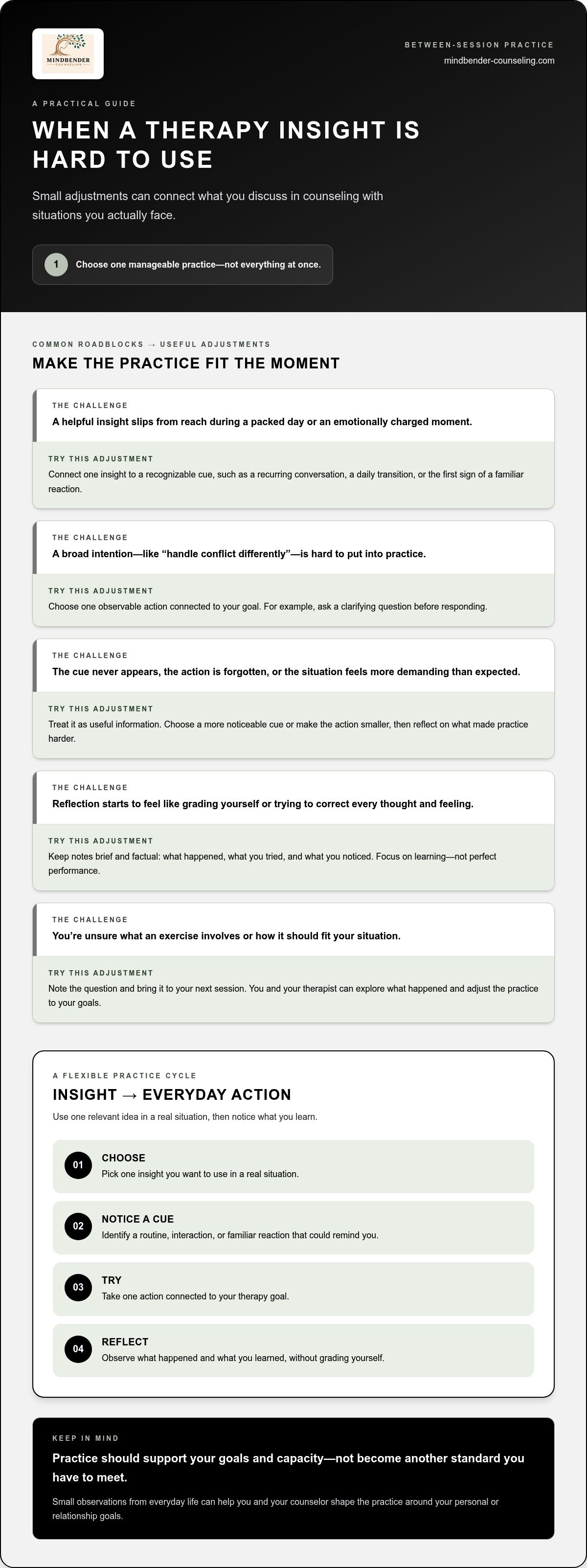
An insight can feel clear in a therapy session, then slip from reach during a packed day or an emotionally charged moment. That gap doesn’t mean the insight was useless or that you’ve failed. Learning how to apply therapy lessons in daily life is less about getting every response right and more about practising an idea when it’s relevant.
Progress may be subtle. You might recognize a familiar pattern sooner, pause briefly before responding, or reflect on a difficult interaction afterward. Those moments can matter even if the situation doesn’t change immediately. Practice should support your goals, not turn every thought or feeling into something to inspect, judge, or correct. Daily practice should fit your goals and capacity, not become another standard you have to meet.
What does it mean to apply something from therapy?
Applying a therapy insight means trying a relevant idea in an ordinary situation. For example, you notice a conversation is triggering frustration, pause, and consider a response that better fits your goal of communicating calmly. The specific skill depends on what you and your therapist are working on. Practice might involve reflection, communication, setting a boundary, or another action you’ve discussed together.
Some approaches emphasize learning and practising skills beyond the session. For a general overview, Cognitive Behavioral Therapy describes an approach that explores connections among thoughts, feelings, and behavior. The useful question isn’t whether you can use a particular method perfectly, but whether the practice relates to your goals.
Why can a helpful insight be hard to remember?
Familiar routines can lead to familiar responses before you have time to think. Stress or strong emotions may also make it harder to recall a new perspective, especially when you’re focused on getting through the moment. Repetition can make an idea easier to access, but needing time and reminders is part of learning, not proof that you’ve failed.
If you notice a gap between what made sense in session and what happened afterward, bring that example to your next appointment. You and your therapist can explore what made the moment difficult and whether the practice needs adjusting. In individual or couples counseling, everyday examples can connect therapeutic work with personal or relationship priorities. You don’t need a perfect account. Even a brief observation can give you something useful to discuss.
How Therapy Lessons Become Everyday Habits: A Flexible Practice Cycle
A therapy insight is easier to use when you connect it to a situation you recognize. Instead of trying to practise everything at once, use a flexible cycle: choose one insight, identify a cue, try one action, then reflect. The cue might be a recurring conversation, a transition in your day, or the first sign of a familiar reaction.
A small practice is one observable action linked to a therapy goal. For instance, if your goal is to communicate more clearly, you might name one need during a planned conversation. That’s an illustration, not a universal prescription. Your counselor can help you choose what fits your goals and circumstances. Some therapy approaches also focus on learning practical coping skills; the Mayo Clinic explains how CBT helps you cope.
How do you choose one therapy lesson to practise?
Start with an insight that feels relevant to something coming up or happening repeatedly. Turn a broad intention, such as “handle conflict differently,” into an action you could describe afterward, such as asking a clarifying question before responding. If you’re unsure what an exercise involves or how to adapt it, note your question and bring it to your next session rather than guessing.
- Choose: Pick one insight you want to use in a real situation.
- Notice a cue: Identify what might remind you, such as a routine or type of interaction.
- Try: Take one action connected to your goal.
- Reflect: Observe what happened and what you learned, without grading yourself.
How can you reflect without judging yourself?
Keep reflection brief and factual. Note the situation, what you tried, and what you noticed afterward. For example: “I wanted to avoid the conversation, so I wrote down the point I needed to raise. That made it easier to begin.” Focus on what supported the practice or made it harder, not on whether you performed it perfectly.
If the cue didn’t appear, or you forgot the action, that’s useful information. The reminder may not have been noticeable, the step may have felt too large, or the situation may have been more demanding than expected. Adjust the cue or simplify the action, then discuss what you learned in counseling. With personalized counseling, everyday observations can help shape practice around your individual or relationship goals.
Which Between-Session Practices Fit Your Therapy Goals and Daily Routine?
There isn’t one practice that suits every person or therapy goal. A good starting point depends on what you’re working toward, what feels manageable, your routine, and your therapist’s guidance. As you consider how to apply therapy lessons in daily life, treat the options below as possibilities to discuss or adapt, not a checklist you have to complete.
| Practice | Possible use | What to keep in mind |
|---|---|---|
| Reflection notes | Record a moment, reaction, or question to explore in a future session. | Writing can take effort, and detailed notes aren’t necessary. A few words may be enough. |
| Mindful pause | Take a moment to notice what you’re feeling before responding to a situation. | A pause may create space, but it won’t always change how you feel or resolve what’s happening. |
| Communication practice | Try a clear request or a listening response in a low-stakes conversation. | Another person’s response is outside your control, so focus on the part you can practise. |
| Small goal-linked action | Choose one practical step that supports a personal or relationship goal. | Adjust the action if it feels too demanding or doesn’t fit the situation. |
When might reflection or a pause be useful?
Reflection notes can help you remember a recurring pattern or save a question for your next session. Jot down what happened, what you noticed, and what you’d like to understand better. A mindful pause may help you notice a feeling before choosing how to respond. Neither practice guarantees relief or prevents a difficult moment. Their value depends on how well they fit your needs and the work you’re doing in therapy.
If you’re learning about behavioral therapy, the site’s Understanding Therapy and Behavioral Therapy article offers related context. Your therapist can help connect that information to your goals and preferences.
How can you practise communication or a new response?
Choose a low-pressure moment to practise one part of a conversation. For example, you might make a clear request about a shared plan or listen without immediately preparing a reply. In couples work, treat this as a shared opportunity to understand each other, not a way to assign blame or decide who is communicating “correctly.” The Communication Skills for Couples: A Beginner’s Guide offers a related topic to explore. If a suggested practice doesn’t feel right, bring that concern to counseling and work together on an approach that better suits your situation.
How to Keep Practising Difficult Therapy Lessons
A therapy exercise doesn’t have to work immediately, and you don’t have to practise it perfectly for it to be useful. Difficulty can point to something worth adjusting, such as the size of the action, its timing, or the reminder you chose. Learning how to apply therapy lessons in daily life includes making room for practice to change as you learn what fits.
Start by asking what got in the way without turning the answer into a judgment about yourself. Maybe the practice depended on privacy you didn’t have, or the planned moment was already stressful. You could make the action smaller, choose a more realistic time, or use a cue that occurs more reliably. If you’re exploring supportive routines, How to Practice Self-Care: A Therapeutic Approach is another related topic.
What if you forget, avoid, or cannot complete a practice?
Interruptions are part of everyday life. A missed opportunity might reflect competing demands, inconvenient timing, or uncertainty about what to do, rather than a lack of effort. Try getting curious: What was happening just before I meant to practise? Would a shorter step or a different moment make it easier to try?
You don’t need a rigid tracking system. A brief note about what got in the way can help you and your therapist decide whether to simplify the practice or change its cue. For example, if you planned to reflect at the end of the day but are often tired then, you might discuss choosing a more workable time. The aim is to learn from the experience, not build a case against yourself.
What if a therapy exercise increases discomfort?
Some practices may feel uncomfortable while still being manageable. But if an exercise feels confusing, overwhelming, or more distressing than you expected, don’t force yourself to continue it alone. Pause and bring the concern to your therapist. Share what you were asked to try, what felt difficult, and when the discomfort arose. Your therapist can help clarify the exercise or adapt the plan to your needs and pace.
It can help to distinguish between the ordinary effort of trying a new response and feeling unable to understand or manage the exercise. You don’t have to decide what the discomfort means by yourself. Talking it through in individual or couples counseling can help you find a practice that feels more appropriate. Mindbender Counseling provides support for adjusting therapy practice to your goals.
How Counseling Helps You Turn Therapy Insights Into Lasting Daily Change
Between-session experiences help you and your counselor understand how an idea fits your actual life. A moment when you tried a new response, avoided a conversation, or felt unsure what to do isn’t a pass-or-fail result. It’s context for refining your goals and deciding what to practise next. That collaborative review is one practical part of learning how to apply therapy lessons in daily life.
Mindbender Counseling provides personalized individual and couples counseling using evidence-based approaches. The focus is on connecting therapeutic work with your needs and priorities, rather than expecting one exercise to suit everyone.
What should you bring back to your next therapy session?
Bring whatever helps describe what happened. You might share what you noticed, what you tried, what you avoided, or which part of an exercise felt unclear. If useful, connect the moment to a goal: “I wanted to express what I needed, but I wasn’t sure how to start.” An imperfect attempt can still show where you felt stuck and what support might help.
In individual counseling, those details can help you and your counselor consider how a practice relates to a personal challenge or priority. In couples counseling, you might review a communication attempt together, notice what each person experienced, and identify a shared, realistic next step. The conversation is an opportunity to understand the interaction, not assign blame.
How can personalized counseling support everyday practice?
Practice can be adjusted as you learn. You and your counselor might consider what felt workable, what didn’t fit your routine, and whether the next step should be clarified or made more manageable. For example, if a planned conversation felt difficult to begin, you could explore what made it challenging and consider a smaller way to approach your shared goal. Adjustments should reflect your needs and counseling goals.
Everyday observations also help keep therapy collaborative. Instead of deciding on your own whether a practice is “working,” bring your questions and experiences into the conversation. Your counselor can help you make sense of them and shape a next step that relates to your individual or relationship priorities.
Mindbender Counseling offers personalized support through individual and couples counseling.
Take One Small Step Forward
Applying therapy lessons doesn’t require a perfect response or a major breakthrough. Choose one insight that fits a real situation, try a manageable action, and notice what you learn. If the practice feels difficult or unclear, that’s useful information to bring into your next session.
Learning how to apply therapy lessons in daily life is an ongoing, collaborative process. Everyday experiences can help you and your therapist adjust the approach to your goals, preferences, and capacity. A small observation or imperfect attempt can still guide the next step.
Mindbender Counseling offers personalized individual and couples counseling using evidence-based approaches tailored to client needs in Arizona and Texas.
Choose one manageable practice to discuss in counseling, and explore individual and couples counseling with Mindbender Counseling.
Frequently Asked Questions
How do I apply what I learn in therapy to everyday life?
Start with one therapy insight and turn it into a small action you can try in a real situation. For example, if you’re working on expressing your needs, practise stating one clear request during a calm conversation. Notice what helped or got in the way, then share that observation with your therapist. This is a practical way to learn how to apply therapy lessons in daily life without expecting yourself to change everything at once.
What if I forget my therapy lessons when I feel stressed?
Forgetting a lesson during stress can happen, especially when a situation feels familiar or emotionally intense. It doesn’t mean you’ve failed or that therapy isn’t helping. Consider what made the insight hard to access, then discuss it with your therapist. You might agree on a simpler reminder, practise the response in a more manageable situation, or adjust the approach to fit your needs.
How often should I practise skills from therapy?
There’s no single practice schedule that works for every person or therapy goal. The right rhythm depends on the exercise, your circumstances, and what you and your therapist are working toward. A small, realistic attempt may fit your life better than a demanding routine. Discuss how often to practise with your therapist, particularly if you’re unsure what an exercise involves or it feels uncomfortable.
Can I practise therapy techniques on my own between sessions?
Some practices may be appropriate between sessions when they’re part of the plan you’ve discussed with your therapist. Follow that guidance rather than assuming every technique is suitable to try independently. If an exercise feels confusing, overwhelming, or difficult to adapt to a real situation, pause and note your questions. You can review what happened with your therapist and decide together how to proceed.
What should I do if a therapy exercise makes me uncomfortable?
Pause if an exercise feels confusing or more distressing than you can manage, and tell your therapist what happened. Describe what you were trying, what felt uncomfortable, and when the feeling arose. You don’t have to force yourself through an exercise you don’t understand. Your therapist can help clarify the practice, adjust it to your needs, or discuss another step.
How can couples apply therapy lessons between counseling sessions?
Choose one manageable communication practice that supports a shared relationship goal. For example, during a calm conversation, partners might take turns listening before responding. Keep the practice collaborative, not a way to score points or assign blame. Afterward, each person can share what felt helpful or difficult. Bringing those observations to couples counseling gives you and your counselor useful context for choosing a realistic next step together.
How do I know whether therapy lessons are helping in daily life?
Notice small changes as well as larger ones, such as recognizing a familiar pattern sooner, expressing a need more clearly, or understanding what makes a situation difficult. Progress can vary, so one challenging day doesn’t define the whole process. Review your observations with your therapist and consider whether your goals or practice need adjustment. Mindbender Counseling offers personalized individual and couples counseling in Arizona and Texas, using evidence-based approaches tailored to client needs.


