
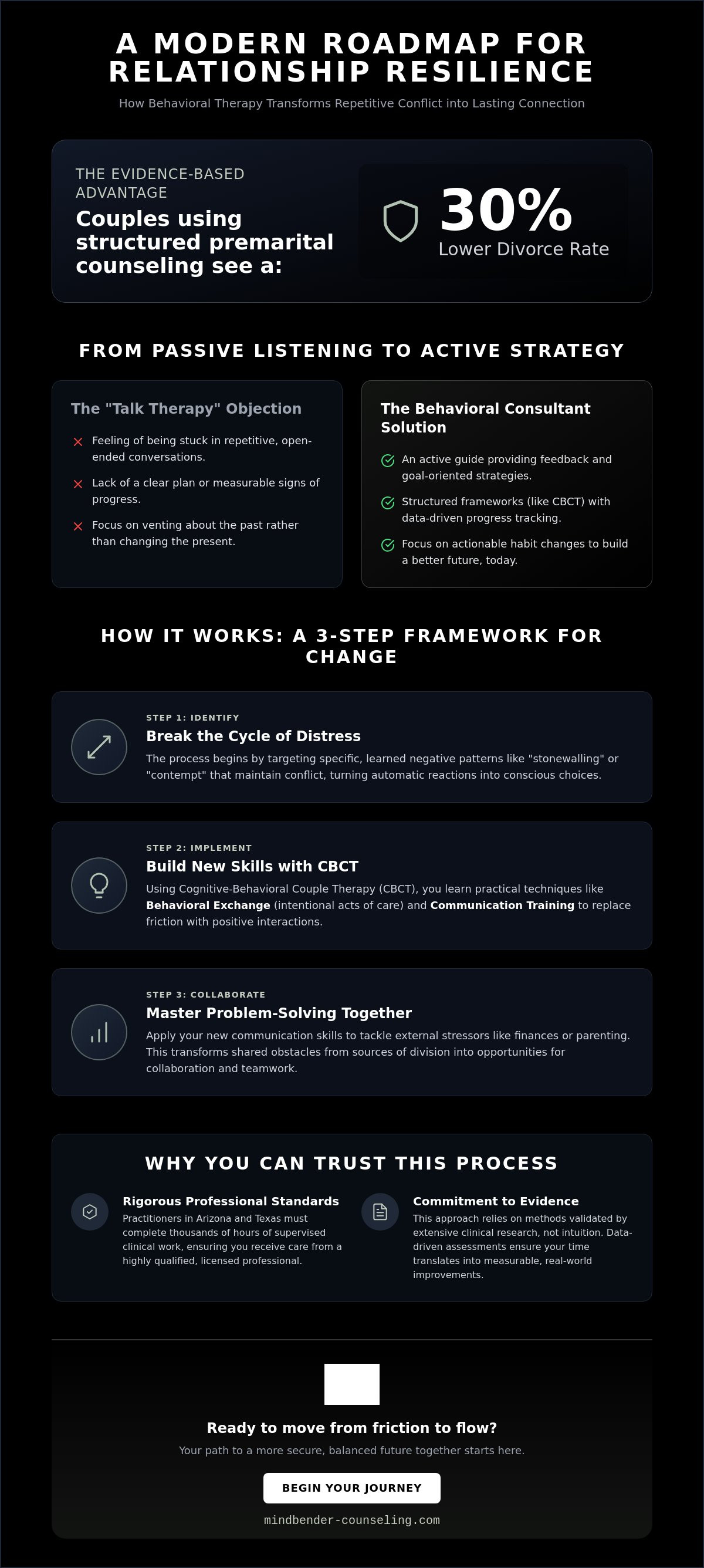
Research indicates that couples who complete premarital education or structured counseling have a 30% lower rate of divorce, yet many partners wait until they feel completely disconnected before seeking behavioral therapy for relationship issues. You might find yourself stuck in a repetitive cycle of negative communication where every discussion turns into a predictable argument. It's common to feel skeptical toward traditional therapy if you've experienced sessions that lack a clear plan or measurable progress. You deserve a path forward that feels both stable and restorative.
This guide illustrates how behavioral health consultants use evidence-based techniques to transform relational distress into lasting emotional resilience. We'll explore specific methods designed to stop arguments before they escalate and provide a roadmap for finding qualified providers in Arizona and Texas. By focusing on actionable change and personalized care, you can move beyond the frustration of being stuck and begin the work of building a more secure, balanced future together.
Key Takeaways
- Understand how behavioral health consultants bridge the gap between psychological theory and practical, everyday habit changes to foster a more stable partnership.
- Explore how behavioral therapy for relationship issues utilizes structured frameworks like Cognitive-Behavioral Couple Therapy to replace conflict with intentional, positive interactions.
- Discover why a methodical, goal-oriented approach provides the safety and predictability needed to lower defenses and rebuild trust.
- Identify the rigorous professional standards and licensing requirements for practitioners in Arizona and Texas to ensure you're receiving high-quality, evidence-based care.
- Learn how to transition from an initial inquiry into a personalized behavioral plan that addresses your unique needs and long-term goals.
What is a Behavioral Health Consultant?
A behavioral health consultant acts as a bridge between the clinical science of the mind and the practical realities of your daily life. While many people associate therapy with long, open-ended conversations about the distant past, these specialists focus on the immediate mechanics of how you interact with your world and your partner. They integrate psychological principles with tangible behavior change to help you move through current roadblocks. This specialized approach is particularly effective when implementing behavioral therapy for relationship issues, as it prioritizes the patterns you can change today over the history you cannot rewrite.
In states like Arizona and Texas, the path to becoming a qualified practitioner is demanding. Arizona requires thousands of hours of supervised work and direct client contact for licensing; Texas mandates similar rigor for its professional counselors. This high bar for entry ensures that when you work with a consultant, you're engaging with someone who has the clinical depth to handle complex relational dynamics with precision and care. They don't just offer an ear; they offer a strategy.
The Evidence-Based Difference
Choosing a consultant means prioritizing methods that have been validated through rigorous clinical research. Evidence-based practices, such as Integrative Behavioral Couples Therapy, are not based on intuition alone. Instead, they rely on techniques that have demonstrated success in controlled trials. Consultants often use data-driven assessments to track your progress, ensuring that your time in the office translates into measurable shifts at home. A behavioral health consultant is a professional who uses measurable interventions to improve mental and relational wellness.
Consultant vs. Traditional Therapist
The primary distinction lies in the dynamic of the sessions. Many people avoid seeking help because they fear a passive listener who merely nods while they vent. A consultant functions as an active guide. They provide feedback, suggest specific exercises, and maintain a goal-oriented focus to keep you moving forward. This level of structure is a hallmark of high-quality private therapy. By treating the therapeutic process as a collaborative project, you and your partner can find the clarity needed to resolve long-standing friction. This approach ensures that behavioral therapy for relationship issues remains a practical tool for growth rather than an abstract exercise in self-reflection.
How Behavioral Therapy for Relationship Issues Works
The effectiveness of this approach lies in its focus on observable change. Behavioral therapy for relationship issues operates on a clear, logical premise: your feelings about your partner are heavily influenced by your daily interactions. By changing these interactions, you can shift the emotional climate of your home. This process doesn't rely on hope alone; it uses structured frameworks to replace friction with predictable stability.
Cognitive-Behavioral Couple Therapy (CBCT) provides the primary roadmap for this transformation. According to the American Psychological Association's overview of how behavioral therapy for couples works, this method identifies specific behaviors that maintain distress while building a repertoire of healthier responses. A foundational technique is the "Behavioral Exchange." Instead of waiting to feel better before acting kindly, partners commit to intentional acts of care. This creates a positive feedback loop where small, meaningful actions rebuild a sense of safety and appreciation.
Communication and problem-solving training serve as the other core pillars. Communication training helps you navigate high-conflict cycles by teaching you how to express needs without triggering defensiveness. Problem-solving training then applies these skills to external stressors like finances or parenting. This turns obstacles into opportunities for collaboration rather than sources of division. If you're ready to move from friction to flow, exploring structured evidence-based therapy can provide the roadmap you've been looking for.
Breaking the Cycle of Relational Distress
Consultants target maladaptive behaviors like "stonewalling" or "contempt" early in the process. These patterns often feel automatic, but they are learned responses that can be unlearned. Behavioral therapy for relationship issues replaces sharp criticism with constructive requests. This ensures both partners feel heard and respected. Emotional regulation plays a vital role here. It gives you the tools to pause before an argument escalates, preserving the tranquility of your connection.
The Role of Homework in Behavioral Change
Change doesn't stop when you leave the office. Consultants assign between-session tasks to reinforce new skills in real-world settings. A classic example is the "Caring Days" exercise, where each partner performs small, requested actions that make the other feel valued. While the focus is on the pair, individual growth remains essential. Engaging in personal counseling services can support this internal progress. It ensures you bring your best, most resilient self to the partnership.
Addressing the "Talk Therapy" Objection: Why Structure Matters
You might worry that therapy is simply a place to vent without reaching a resolution. It's a common skepticism, especially if you've experienced sessions that felt like "paying someone to listen" without a clear path forward. We should reframe behavioral therapy for relationship issues as more than just a conversation. It's a deliberate, tactical process designed to build a solid internal foundation for your partnership. Structure isn't a constraint; it's a foundation that provides the safety you need to explore difficult emotions without getting lost in them.
When a relationship is in crisis, it often feels like you're adrift in a storm of reactive emotions. A structured behavioral plan acts as a sturdy anchor. By establishing clear expectations and measurable goals, we create a space where both partners feel safe enough to lower their defenses. This organized approach reduces the friction often associated with seeking help. You aren't just talking about your problems; you're actively constructing a new way of being together. While the framework is consistent, the application is always deeply personal. Personalized care means we adapt the structure to your specific dynamic, ensuring the process feels like a custom-fit solution rather than a one-size-fits-all script.
The Science of Emotional Resilience
Change takes time. It also takes a plan. Learning new behaviors actually helps to re-wire the brain’s stress response, replacing old, reactive triggers with calmer, more intentional interactions. Think of behavioral health as a proactive state of wellness rather than just the absence of conflict. By focusing on how you respond to one another in the present, you build a lasting capacity for recovery. This understanding of therapy and behavioral therapy serves as a guide to modern emotional resilience, moving you from survival mode into a state of steady growth.
When Individual Support Complements Couple Work
Relational success often requires individual stability. There are times when a consultant might recommend individual counseling for anxiety alongside your couple sessions. If one partner is struggling with a high internal stress load, it can be difficult for them to engage fully in the collaborative work of the relationship. By addressing individual hurdles, you create a synergy where personal healing fuels relational progress. This dual focus ensures that behavioral therapy for relationship issues remains a dynamic and responsive process, treating both the connection and the individuals within it with fresh attention and care.
Behavioral Health Standards in Arizona and Texas
Arizona and Texas maintain some of the most rigorous standards for mental health practitioners in the country. This commitment to quality ensures that when you seek behavioral therapy for relationship issues, you're working with a professional who has met demanding clinical benchmarks. In Arizona, a Licensed Professional Counselor (LPC) must complete at least 3,200 hours of supervised work experience, while Texas requires 3,000 hours for its LPC-Associates. These requirements aren't just bureaucratic hurdles. They represent a deep investment in clinical skill and ethical practice, providing you with a sense of security and reliability from your very first session.
The professional landscape in the Southwest is heavily influenced by major research institutions, particularly in hubs like Phoenix. This proximity to academic excellence means local consultants often stay at the forefront of evolving methodologies. They understand the specific stressors facing professionals in our growing tech corridors. High-pressure environments in cities like Austin or Scottsdale often create unique challenges for work-life balance, which can strain even the strongest partnerships. A local consultant recognizes these regional pressures and integrates them into your personalized care plan. If you're ready to partner with a professional who understands these dynamics, you can schedule a consultation for evidence-based therapy to begin your journey.
Verifying a consultant's credentials is a vital step in your search for care. You should look for the following markers of professional standing:
- A master's degree or higher in counseling, marriage and family therapy, or a related field.
- An active license in good standing with the Arizona Board of Behavioral Health Examiners or the Texas State Board of Examiners of Professional Counselors.
- Specific training or certifications in evidence-based models like CBCT or IBCT.
- A clear explanation of their structured approach to relationship health.
Finding Qualified Care in Phoenix and Beyond
You should prioritize practitioners who lead with evidence-based methods rather than general "talk therapy." Whether you prefer meeting in a professional office setting or require the flexibility of telehealth, residents in both Arizona and Texas have access to high-quality care. It's essential to verify that your consultant is licensed by the relevant state board, such as the Arizona Board of Behavioral Health Examiners, to ensure they meet current regulatory standards. This verification provides a sturdy anchor for your therapeutic process.
The Importance of Cultural Competence
The diverse populations of Arizona and Texas require a nuanced approach to behavioral therapy for relationship issues. Inclusive care means respecting different cultural backgrounds, family structures, and communication styles. A skilled consultant adapts behavioral techniques to align with your personal values and heritage. This ensures that the structure of therapy feels supportive and relevant rather than restrictive. By honoring your unique history while focusing on future growth, we create an atmosphere of safety where real transformation can occur.
Your Path Forward with Mindbender Counseling
At Mindbender Counseling, we act as a bridge between the rigorous world of evidence-based science and the deeply personal journey of relational growth. We understand that taking the first step toward professional support can feel daunting. Our approach is rooted in a sense of calm assurance, designed to lower your defenses and build immediate trust. We don't just offer sessions; we provide a professional facilitator for your journey toward well-being. By choosing behavioral therapy for relationship issues, you're making a proactive investment in the longevity of your partnership rather than simply reacting to a crisis.
We treat every couple with fresh attention and care. Our role is to be both a sturdy anchor and a catalyst for positive movement. We avoid the coldness of clinical jargon, focusing instead on the practical, everyday benefits of our methods. You'll find that our communication rhythm is methodical and steady, mirroring the patient nature of the therapeutic process itself. This organized approach creates a sense of predictability that helps reduce the friction often associated with starting something new. You deserve a space where you feel seen, heard, and supported as you construct a more resilient future together.
What to Expect in Your First Consultation
Our intake process moves from an initial inquiry to a personalized behavioral plan with minimal stress. During your first consultation, we conduct an assessment to identify the specific behavioral patterns that may be contributing to your current distress. This isn't about assigning blame. It's about gathering the data needed to create a roadmap for change. We set goals collaboratively, ensuring that the structure of your treatment aligns with your unique needs. This low-friction path ensures you can begin the work of healing without feeling overwhelmed by the process.
Building a Solid Internal Foundation
The long-term benefits of behavioral health consulting extend far beyond the resolution of a single argument. You'll gain a sophisticated set of tools for psychological growth and stability. By focusing on individualized attention and the restoration of balance, we help you build a solid internal foundation that can withstand future challenges. This steady, unwavering support allows you to evolve both as individuals and as a couple. If you're ready to transform your relational friction into predictable emotional stability, we invite you to take the next step. Schedule a consultation with our behavioral health experts today.
Building Your Foundation for Lasting Connection
Choosing a path toward healing requires both courage and a clear, actionable strategy. By prioritizing behavioral therapy for relationship issues, you move away from the frustration of repetitive cycles and toward a structured environment where real change can take root. You've seen how evidence-based frameworks like CBCT provide the measurable solutions needed to restore balance and build emotional resilience. This methodical approach ensures that every session serves as a stepping stone toward a more stable and fulfilling partnership.
Our licensed providers in Arizona and Texas maintain the highest professional standards, offering personalized, goal-oriented plans that respect your unique dynamic. We believe that therapy is a proactive investment in your future, providing a sturdy anchor when life feels unpredictable. You don't have to navigate these complexities alone. We invite you to Connect with a Behavioral Health Consultant at Mindbender Counseling to begin your journey with a compassionate expert. Positive change is within your reach when you have the right guide to facilitate your growth. Your path toward a healthier, more connected life starts with this single, intentional step.
Frequently Asked Questions
What is the difference between a behavioral health consultant and a marriage counselor?
A behavioral health consultant focuses on the integration of psychological principles with practical behavior change, while a marriage counselor may use broader, less structured approaches. This distinction is vital because consultants act as active guides, using data-driven assessments to track your progress. They prioritize the here and now mechanics of your interactions rather than exclusively exploring deep seated historical patterns or childhood history.
How many sessions of behavioral therapy are typically needed for relationship issues?
Most couples begin to see meaningful shifts within 8 to 20 sessions of behavioral therapy for relationship issues. The exact duration depends on the complexity of your situation and how consistently you apply the between session tasks. Because this approach is goal oriented, your consultant will regularly review your progress to ensure the treatment remains efficient and effective for your specific needs.
Is behavioral therapy effective for couples dealing with infidelity?
Behavioral therapy is highly effective for rebuilding trust after infidelity because it focuses on creating transparent, predictable patterns of interaction. By establishing a behavioral exchange of intentional acts of care, partners can slowly restore a sense of safety. This structured framework helps manage the intense emotional triggers that follow a breach of trust, allowing for a more stable path toward healing.
Do behavioral health consultants accept insurance in Arizona and Texas?
Coverage for couples services varies significantly by provider and plan. It's common for many health insurance plans in Arizona and Texas to exclude couples therapy from their coverage. We recommend contacting your insurance carrier directly to verify your benefits. If your plan doesn't cover these services, many families view this as a proactive, out of pocket investment in their long term stability and happiness.
Can we do behavioral therapy if only one partner is willing to attend?
You can absolutely engage in behavioral therapy for relationship issues even if your partner is not yet ready to join you. While the dynamic changes, focusing on your own behavioral responses can still shift the overall climate of the relationship. This individual work helps you build emotional resilience and provides you with healthier communication tools that can eventually encourage your partner to participate in the process.
What happens if we don’t see progress after a few sessions?
If you don't feel a sense of movement after several sessions, your consultant will facilitate a transparent review of your treatment plan. This methodical approach allows us to identify specific roadblocks, whether they are external stressors or internal triggers. We may adjust your goals or incorporate individual support to ensure the structure of the therapy continues to meet your evolving needs and fosters genuine progress.


