

What if the reason your self-care routine feels like another chore on your to-do list is because it isn't actually self-care at all? Many of us fall into the trap of believing that wellness requires an all-or-nothing commitment, leading to a cycle where we only pause when we're already reaching a breaking point. If you're currently waking up with tension headaches or feeling unusually irritable with the people you love, you aren't failing. You're likely just running on empty because the temporary fixes we often call "pampering" can't keep pace with the relentless demands of a high-stress life. Learning how to practice self-care effectively means moving beyond the surface to build a sturdy, internal foundation that supports you even on your hardest days.
You deserve to feel like yourself again, and that starts with a realistic approach to emotional regulation that fits into your actual schedule. In this guide, you'll discover a research-backed framework designed to help you manage stress through sustainable habits rather than fleeting escapes. We will explore the science of micro-recovery and provide a clear methodology for creating a personalized plan that honors your unique needs. This therapeutic roadmap will help you move away from temporary fixes and toward a lifestyle of lasting resilience and quiet confidence.
Key Takeaways
- Shift your perspective from using self-care as a temporary escape to embracing it as a proactive method for restoring your internal equilibrium.
- Explore a balanced framework of physical, emotional, cognitive, and social pillars that build resilience without requiring hours of your time.
- Learn how to practice self-care while overcoming common barriers like the "selfishness trap" and the pressure of an all-or-nothing mindset.
- Discover practical strategies tailored for those navigating the intense professional climates and environmental stressors of Arizona and Texas.
- Recognize the clear indicators that mark the transition from self-directed maintenance to the deeper healing of professional evidence-based therapy.
What Does It Really Mean to Practice Self-Care in 2026?
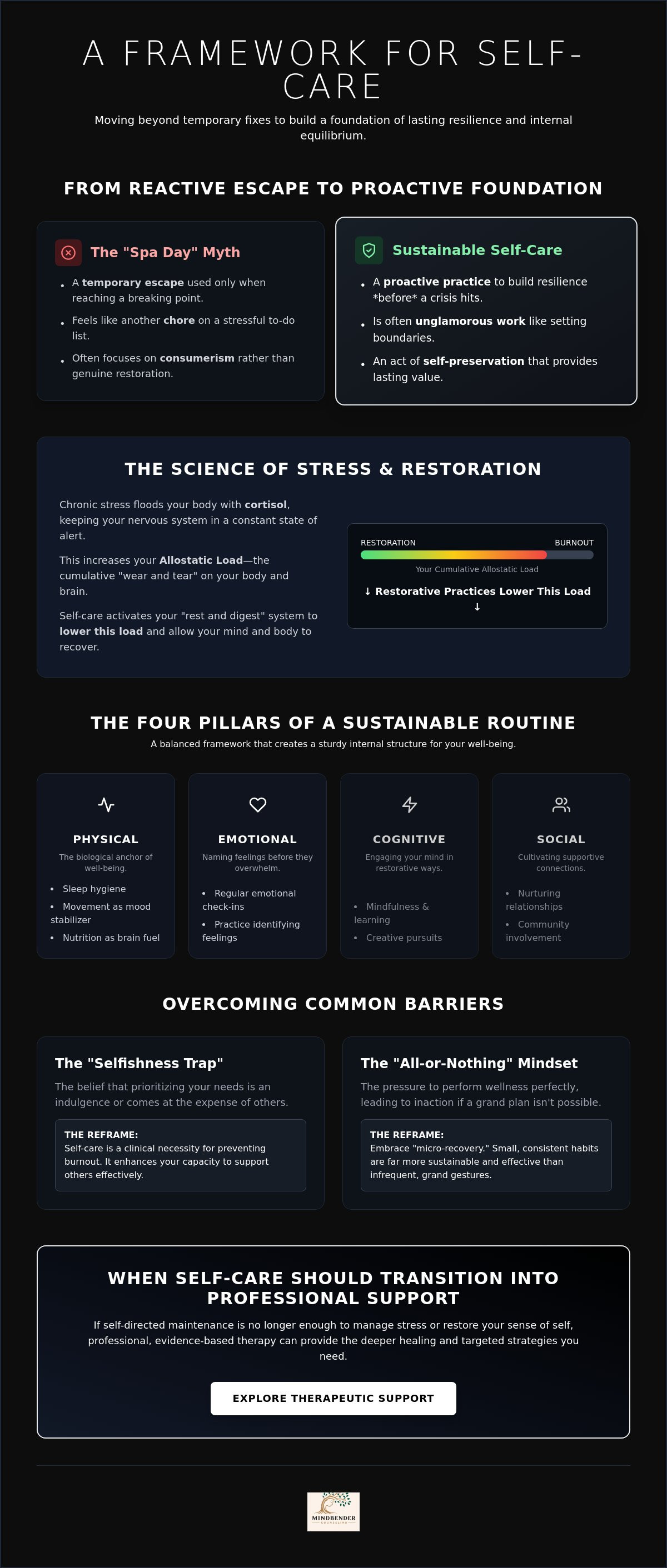
Self-care is often discussed as if it were a luxury or a reward for hard work. In reality, it is the intentional practice of restoring your internal equilibrium. When your life feels out of balance, your mind and body send signals that require more than just a temporary distraction. True wellness is found in the quiet, consistent choices you make to protect your energy and maintain your health. To understand how to practice self-care effectively, you must first view it as a therapeutic foundation rather than an occasional escape.
There is a significant difference between reactive and proactive self-care. Reactive self-care happens when you are already reaching a breaking point; it is an attempt to escape stress that has already become overwhelming. Proactive self-care, however, is the process of building resilience before the crisis hits. It involves creating a lifestyle that supports your mental health on a daily basis. By treating these practices as a clinical necessity, you can prevent the emotional burnout that often leads to deeper psychological distress. For a comprehensive overview of self-care and its evolution, it's helpful to see it as an individualized journey toward stability.
Moving Beyond the 'Spa Day' Myth
The commercialized version of wellness often suggests that you can buy your way to peace. This "spa day" narrative focuses on consumerism, but authentic self-care is frequently quite boring. It involves the unglamorous work of setting firm boundaries at the office, managing a realistic budget, or keeping a doctor's appointment. Often, the most powerful way to practice self-care is through what you choose not to do. Saying no to an extra project or choosing to log off social media are acts of self-preservation that provide more lasting value than any luxury product ever could.
The Science of Stress and Restoration
Your body is designed to handle stress in short bursts, but modern life often keeps us in a state of constant alert. When you experience chronic stress, your body is flooded with cortisol, which can lead to physical and mental fatigue. Engaging in intentional self-care activities helps to activate your parasympathetic nervous system, which is the "rest and digest" mode that allows your body to recover. This process is vital for managing your allostatic load. Allostatic load is the cumulative wear and tear on the body and brain that results from chronic overexposure to the physiological responses of stress. By lowering this load through restorative practices, you give your mind the space it needs to heal and grow stronger.
The Four Pillars of a Sustainable Self-Care Routine
Developing a sustainable routine requires a balanced approach to four core pillars: Physical, Emotional, Cognitive, and Social. When you understand how to practice self-care using this framework, you create a sturdy internal structure that supports you through life's inevitable fluctuations. These pillars are not separate silos; they work together to provide the emotional bandwidth needed for deeper personal growth. In fact, maintaining these areas often makes your work in individual therapy sessions more effective, as you're already providing your mind with the basic safety it needs to explore complex topics. By taking a low-friction approach to each pillar, you ensure that your wellness remains consistent even during busy seasons.
Physical and Biological Foundations
Your physical health is the biological anchor of your well-being. This starts with sleep hygiene and respecting your circadian rhythm, which are non-negotiable elements of a resilient life. Instead of viewing movement solely through the lens of fitness, try to see it as a natural mood stabilizer that helps regulate your nervous system. Nutrition is brain fuel. Providing the essential nutrients your brain requires for emotional stability is a profound act of self-respect. If you're feeling stuck, starting with these low-friction physical habits can create immediate momentum and quiet the noise of stress.
Emotional and Cognitive Maintenance
Emotional self-care involves regular check-ins to identify and name your feelings before they become overwhelming. This awareness allows you to respond to your needs with compassion rather than reacting out of exhaustion. Cognitive maintenance focuses on the quality of your thoughts and the information you consume. Learning how to practice self-care in this area might involve challenging negative self-talk or intentionally limiting information overload from news and social media. Many professionals highlight the importance of self-care practices like journaling or mindfulness to help declutter the mind and restore focus.
The Role of Social Connection
Social self-care is a delicate balance of connecting with others and setting necessary boundaries to protect your energy. It's about finding "vulnerability partners" who offer safe spaces for authentic sharing, rather than just maintaining casual acquaintances that might feel draining. In our hyper-connected world, this also includes protecting your peace in digital spaces by knowing when to disconnect. If you find that your social connections are consistently a source of stress, exploring these patterns through individual counseling services can help you establish healthier relational foundations and restore your sense of belonging.
Overcoming the Common Barriers to Consistent Self-Care
Even when you understand the core pillars of wellness, the largest hurdle is often the internal resistance that arises when you try to prioritize your own needs. Knowing how to practice self-care intellectually is different from integrating it into a life that already feels overstretched. Many of us treat our well-being as a "nice-to-have" luxury rather than a fundamental requirement for functioning. This hesitation often stems from deep-seated psychological blocks that make rest feel like a risk rather than a restoration.
The most common objection is a perceived lack of time. We often wait for a perfectly clear afternoon that never arrives. However, if we look at the World Health Organization's definition of self-care, we see it's about the broad ability of individuals to promote health and cope with stressors. This isn't a task to add to your calendar; it's a way of operating within your existing schedule. We also face the "Selfishness Trap," where we feel guilty for taking time away from others. Reframing this through the "oxygen mask" metaphor is essential. You cannot effectively care for your family, your career, or your community if your own internal resources are depleted.
From a therapeutic perspective, we often avoid self-care when we need it most because stillness can feel threatening. When you finally stop moving, the emotions you've been outrunning often have a chance to catch up with you. This can lead to a subconscious avoidance of the very rest that would allow you to heal. Learning how to practice self-care involves gently dismantling the "Perfectionist Barrier." You don't need to perform wellness perfectly for it to count. A messy, inconsistent routine is still infinitely more beneficial than no routine at all.
Navigating the Guilt of Prioritizing Yourself
Distinguishing between healthy self-interest and narcissism is a vital step in your growth. Taking care of yourself isn't about being self-centered; it's about being self-aware. You can create a simple "permission slip" for yourself, affirming that taking 15 minutes of quiet time is a service to your household. When you model these boundaries, you teach your children and partners that mental health is a priority. This creates a culture of wellness within your home that benefits everyone, not just you.
Micro-Self-Care: The Power of Five Minutes
If the idea of a long routine feels overwhelming, focus on micro-self-care. These are small, one-to-five minute interventions that you can sprinkle throughout your day to reset your nervous system. These small wins build your "resilience muscle" over time without requiring a massive schedule shift. Consider these simple examples:
- Box Breathing: Practice four counts of inhaling, holding, exhaling, and holding between your meetings.
- Physical Reset: Stand up for a quick 60-second stretch to release tension in your shoulders and neck.
- Hydration Break: Drink a full glass of water mindfully, focusing on the sensation rather than your phone.
Practical Self-Care Strategies for Arizona and Texas Lifestyles
Living in the Southwest presents unique environmental challenges that directly influence your mental well-being. In cities like Phoenix, Austin, and Houston, the intense heat isn't just a physical inconvenience; it's a psychological weight. When the mercury stays above 100 degrees for weeks at a time, your ability to engage with the world often shrinks. Understanding how to practice self-care in this context requires adapting your routine to an environment that frequently demands confinement. This regional reality, combined with the high-pressure "hustle culture" of growing tech sectors, can quickly lead to burnout if you don't have a localized plan for restoration.
Managing Environmental Stressors
Many residents in Arizona and Texas experience what is known as Summer Seasonal Affective Disorder (SAD). Unlike the winter version, this is triggered by heat-induced isolation and the lack of outdoor movement. To counter this, you can integrate light therapy into your morning or create indoor "nature" experiences with house plants and desert soundscapes. Hydration is also a critical, yet overlooked, mental health tool in our arid climate. Even mild dehydration can increase irritability and decrease cognitive focus. Treating water intake as a primary pillar of your emotional stability helps maintain your internal equilibrium when the external world is harsh.
Digital Detox in a High-Growth Professional Culture
The professional landscape in hubs like Austin and Phoenix often prizes constant availability. This "always on" expectation creates a persistent state of low-level anxiety that wears down your resilience. A powerful way to reclaim your peace is by implementing a "Sunset Rule" for your devices. By putting away screens an hour before bed, you allow your brain to transition naturally into a restorative sleep cycle. Setting firm "Out of Office" boundaries isn't just a professional courtesy; it's an act of radical self-care that protects your time for restoration. If you're finding it difficult to set these boundaries, exploring these patterns in evidence-based therapy can provide the tools you need to prioritize your growth without guilt.
Southwestern Community and Indoor Resources
When outdoor activities aren't an option, look for community-based indoor spaces that offer a sense of connection. Local libraries, indoor botanical conservatories, and community centers often provide low-friction opportunities for social self-care without the heat. Learning how to practice self-care means being flexible with your environment and finding beauty in the spaces available to you. By focusing on these localized strategies, you build a resilience that is as sturdy and enduring as the desert landscape itself. These small, intentional shifts in how you navigate your surroundings can make a profound difference in your daily quality of life.
Recognizing When Self-Care Should Transition into Professional Support
While learning how to practice self-care is a vital skill for daily well-being, it's essential to recognize the boundaries of what individual efforts can achieve. Self-care is primarily a maintenance tool. It's the consistent work of keeping your internal house in order and protecting your energy. Therapy, by contrast, is a reparative tool. It's designed to address the structural issues in the foundation of your mental health that self-care alone cannot reach. When the weight of your experience feels too heavy to carry through routine adjustments, transitioning to professional support is the most compassionate choice you can make for yourself.
There are specific "red flags" that indicate your current strategies might need the reinforcement of a clinical perspective. If you experience persistent hopelessness, an inability to perform basic daily tasks, or physical symptoms of stress that don't subside with rest, these are signs that your system is overwhelmed. In these moments, simply trying harder to relax isn't the solution. Instead, engaging in private therapy provides a structured framework that allows you to process deep-seated challenges in a safe, guided environment. This professional intervention becomes the foundation upon which better, more effective self-care is built.
The Limits of Individual Self-Care
Sometimes the stress we face is structural rather than personal. You might find that no matter how many boundaries you set or how much you sleep, the underlying tension remains. This is often because our internal responses are tied to long-standing patterns or unresolved experiences that require an outside perspective to untangle. Exploring therapy and behavioral therapy can help you uncover the specific roots of why self-care feels so difficult to maintain. Professional intervention is especially critical for individuals navigating clinical depression or chronic anxiety, where biological and psychological factors require specialized evidence-based therapy to manage effectively.
Construction of a Personalized Healing Plan
At Mindbender Counseling, we act as a supportive partner in constructing a wellness strategy that is as unique as your life in Arizona or Texas. A counselor helps you identify which self-care pillars need the most attention and provides the tools to strengthen them. This collaboration is known as the therapeutic alliance, and it serves as the ultimate form of social self-care. It's a relationship built on trust and expert guidance, designed to move you toward lasting resilience. As you refine how to practice self-care in your daily life, remember that true wellness isn't a solo journey. Real progress often starts with the courage to ask for support and the willingness to let a professional guide you toward the restoration of your balance.
Building Your Foundation for Lasting Resilience
Creating a resilient life is a continuous process of returning to your center. You've explored how a balanced framework of physical, emotional, cognitive, and social pillars provides the stability needed to navigate the unique environmental and professional pressures of the Southwest. By moving away from commercialized myths and embracing the power of micro-recovery, you gain a clear methodology for how to practice self-care that truly lasts. These intentional shifts in your daily routine act as a sturdy anchor, allowing you to maintain your equilibrium even when the external world feels demanding or overwhelming.
While self-directed habits are essential, they're often most effective when paired with professional guidance. Mindbender Counseling offers a supportive partnership through personalized therapeutic interventions for individuals and couples. Our compassionate, professional counselors in Arizona and Texas use evidence-based therapy techniques to help you move from simply surviving to genuinely thriving. Take the first step toward lasting resilience; schedule your individual counseling session with Mindbender Counseling today. You possess the capacity for profound growth, and with the right tools, you can restore the quiet confidence and balance you deserve.
Frequently Asked Questions
Is self-care a form of therapy?
Self-care is not a replacement for professional therapy, though it serves as a vital companion to the healing process. While therapy focuses on repairing deep-seated psychological wounds and processing trauma, self-care is a maintenance tool for daily stability. Think of it as the difference between a mechanic fixing an engine and a driver checking the oil. Both are necessary for the journey, but they serve distinct purposes in your overall mental health strategy.
What are the 7 types of self-care?
The seven types of self-care include physical, emotional, mental, social, spiritual, practical, and professional dimensions. Each type addresses a specific area of your life to ensure a holistic sense of well-being. For example, practical self-care might involve organizing your workspace, while spiritual self-care could focus on meditation or connecting with your values. Balancing these areas helps you build a more comprehensive and sustainable foundation for resilience.
How do I practice self-care when I have no money?
You can learn how to practice self-care without spending any money by focusing on fundamental biological and emotional needs. Effective practices like deep breathing, drinking adequate water, and establishing a consistent sleep schedule are completely free. Additionally, setting firm boundaries with your time or taking a quiet walk in a local park are powerful ways to restore your energy. True wellness is found in intentionality rather than consumer products or expensive experiences.
Can self-care help with clinical depression?
Self-care can help manage the symptoms of clinical depression, but it is not a substitute for professional evidence-based therapy. Consistent routines can provide a sense of agency and help regulate your nervous system during difficult periods. However, depression often involves biological factors that require clinical intervention. Using self-care as a secondary support system allows you to maintain progress while working with a professional to address the underlying causes of your condition.
How much time should I spend on self-care each day?
There is no set time requirement, but spending as little as 15 minutes of intentional time each day can yield significant benefits. Consistency is far more important than the total number of minutes you log. Micro-self-care interventions, such as a five-minute breathing exercise or a brief stretch between meetings, help prevent the accumulation of stress. Focus on creating small, manageable windows of restoration that fit naturally into your existing daily schedule.
Is it selfish to put my needs before my family's?
It is not selfish to prioritize your needs; it is a necessary act that allows you to show up more fully for your family. When you are emotionally regulated and physically rested, you have more patience and empathy to offer those you love. Neglecting your own well-being often leads to resentment and burnout, which ultimately strains your relationships. Taking time for yourself ensures that you are giving from a place of abundance rather than depletion.
What is the first step to starting a self-care routine?
The first step is developing an honest awareness of where your energy is currently being drained. Before you add new activities to your life, identify which of the four pillars needs the most immediate attention. You might start by simply noticing how your body feels during a stressful work day or tracking your sleep quality. This initial assessment allows you to choose how to practice self-care in a way that directly addresses your most pressing needs.
How do I know if my self-care routine is working?
You will know your routine is working when you notice a steady improvement in your emotional regulation and overall energy levels. You might find that you are less irritable with colleagues or that you recover more quickly from minor setbacks. Another key indicator is feeling more like yourself again, with a restored sense of interest in your hobbies and relationships. These subtle shifts in your internal landscape are clear signs of building lasting resilience.


