

What if the most productive hour of your week wasn't spent crossing items off a to-do list, but rather dismantling the emotional cycles that keep you feeling stuck? It's common to feel a sense of hesitation when considering individual therapy sessions; you might wonder if the time spent will truly translate into a more resilient life or if you'll just get lost in clinical jargon like "evidence-based care." You deserve to feel certain that your commitment to personal growth is building a solid internal foundation for your future.
You're likely looking for a way to manage modern stress without feeling overwhelmed by the process itself. This guide provides an expert-led checklist designed to help you prepare effectively, identify the right support, and measure your progress with clarity. We'll move past the confusion of technical terms to focus on what matters most: your healing and restoration of balance. By the end of this article, you'll have a practical plan to transform your therapeutic experience into a powerful catalyst for lasting change and emotional stability.
Key Takeaways
- Understand the essential elements of productive individual therapy sessions, including how to create a safe space for vulnerability and set clear, collaborative goals.
- Learn to identify effective evidence-based approaches like Cognitive Behavioral Therapy to transform negative thought cycles into paths for psychological growth.
- Evaluate your current stress levels and daily functioning to determine the ideal time to transition from self-help to professional counseling services.
- Use our practical preparation checklist to articulate your personal "why" and gather significant life events to ensure a focused and meaningful first session.
- Discover how to track your internal progress and build a foundation of emotional resilience that supports your long-term personal evolution.
Essential Elements of Productive Individual Therapy Sessions
Productive individual therapy sessions rely on more than just showing up; they require a deliberate architecture of trust and structure. When you enter a session, you should feel an immediate sense of safety that allows your defenses to lower naturally. This confidential environment is the bedrock of healing. It's where you can speak the unspoken without fear of judgment. A professional guide ensures this space remains sacred, balancing compassionate listening with the clinical expertise needed to facilitate change. To better understand the foundations of this practice, you might find a comprehensive overview of psychotherapy helpful in clarifying how these professional standards protect your growth.
The rhythm of your sessions matters as much as the content. Consistency creates a predictable container for emotional work, mirroring the steady pace of personal evolution. You can look for these specific elements to ensure your time is well-spent:
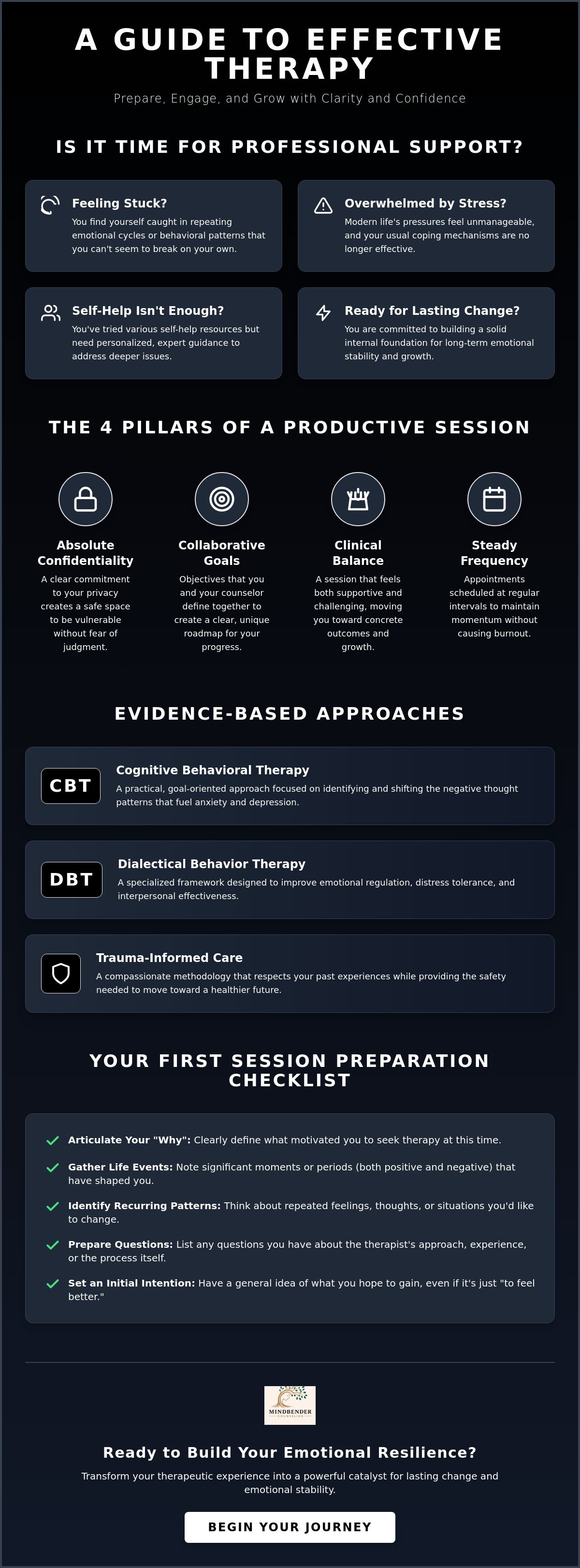
- Absolute Confidentiality: A clear commitment to your privacy that fosters immediate vulnerability.
- Collaborative Goals: Objectives that you and your counselor define together to track your unique progress.
- Clinical Balance: A session that feels both supportive and challenging, moving you toward concrete outcomes.
- Steady Frequency: Appointments scheduled at intervals that maintain your momentum without causing burnout.
The Quality of the Therapeutic Alliance
The "click" you feel with your counselor isn't just a bonus; it's often the strongest predictor of your success. This connection, known as the therapeutic alliance, thrives when there's a balance of professional distance and genuine care. A wise guide remains a sturdy anchor, providing a perspective you can't get from friends or family. You'll know the alliance is healthy when boundaries feel firm yet kind, ensuring the focus remains entirely on your internal progress. If the rapport feels forced or dismissive, it's difficult to build the foundation required for deep work.
Goal-Oriented Frameworks vs. Casual Conversation
It's easy to mistake a good vent session for a productive therapy hour. While sharing your feelings is necessary, individual therapy sessions should move beyond casual conversation. You're investing in a methodology designed to build resilience and shift long-standing patterns. This is where understanding therapy and behavioral therapy becomes essential. These structured frameworks help you identify measurable milestones, such as how you handle a specific stressor or how your internal dialogue changes over time. By tracking these behavioral shifts, you can see the tangible value of your commitment to healing.
The Evidence-Based Checklist: Finding the Right Therapeutic Approach
Choosing a path for personal growth can feel overwhelming when you're faced with a sea of clinical terms. However, understanding the "why" behind a specific method is just as vital as the session itself. Evidence-based therapy isn't a hollow label; it signifies treatments that have undergone rigorous scientific scrutiny to ensure they produce real, measurable results. When you engage in individual therapy sessions, you aren't just participating in a conversation. You're utilizing a toolkit that has been refined through clinical research to help you reclaim your balance and build a sturdy internal foundation.
The American Psychological Association’s Recognition of Psychotherapy Effectiveness confirms that these structured approaches are highly effective across diverse populations. To ensure you're receiving the highest quality of care, look for these proven modalities in your treatment plan:
- Cognitive Behavioral Therapy (CBT): A practical approach focused on identifying and shifting negative thought patterns that fuel anxiety or depression.
- Dialectical Behavior Therapy (DBT): A specialized framework designed to improve emotional regulation and build resilience against intense fluctuations in mood.
- Trauma-Informed Care: A compassionate methodology that respects your past experiences while providing the safety needed to move toward a healthier future.
Why Clinical Rigor Matters for Your Growth
By choosing a modality that aligns with your specific neurobiology and life experience, you reduce the time spent in the "trial and error" phase of healing. Research-backed methods provide a clearer roadmap for your journey. Behavioral health consultants often play a key role here, helping to design a treatment plan that is both personalized and scientifically sound. In 2026, it's essential that your therapist utilizes methods that meet current clinical standards, ensuring your progress is supported by the latest psychological insights. This level of rigor transforms therapy from a passive experience into a dynamic process of evolution.
Matching Modalities to Your Specific Needs
Not every challenge requires the same tool. For instance, CBT is often the gold standard for managing modern workplace stress or social anxiety because it provides immediate, actionable strategies. If you find yourself struggling with more intense emotional waves, DBT-informed skills can offer the stability you need to stay grounded. Many practitioners now integrate these proven clinical techniques with holistic approaches, treating the whole person rather than just a set of symptoms. If you're ready to start this structured journey, exploring Evidence-Based Therapy can help you find the specific methodology that resonates with your goals.
Evaluating Your Needs: Is Individual Counseling the Right Path?
Determining if it's time for professional help often begins with a quiet realization. You might notice that the stress from your career or relationships has started to bleed into your quiet moments. When your daily functioning feels like a performance rather than a lived experience, it's a sign that the internal pressure has reached a tipping point. It's time to act. Individual therapy sessions provide the necessary pause to evaluate these patterns before they become permanent fixtures in your life.
In a world filled with constant digital noise and social expectations, having a sturdy anchor is invaluable. Many people try to "self-help" their way out of emotional ruts using podcasts or journals. These are excellent tools for maintenance, but they often reach a natural limit when faced with deep-seated behavioral cycles. The true value of therapy lies in its ability to offer a structured environment where you aren't just managing symptoms, but actively building resilience. You deserve a space where your evolution is the primary focus.
Therapy vs. Support Systems
It's common to wonder why you can't just talk to a trusted friend. Friends offer vital emotional support, yet they lack the professional objectivity required for deep transformation. A therapist acts as a neutral facilitator, helping you resolve internal conflicts without the bias of personal history. Choosing private therapy creates a dedicated space for this work, allowing you to explore your thoughts in a way that social circles simply cannot accommodate. This professional distance is exactly what allows for genuine clarity.
Signs You Are Ready for Professional Intervention
Readiness often reveals itself through persistent signs. You might feel a sense of burnout that a long weekend or a vacation doesn't seem to fix. Life transitions also play a significant role. For those navigating a career shift or a relocation to a new environment like Arizona or the expanding professional markets in Texas, the loss of familiar structures can be taxing. If you find yourself wanting more than just temporary relief, you're likely ready for a deeper commitment to your personal evolution. Steady support makes these transitions manageable.
The question of resources is valid. Is the investment of time and energy worth it? When you consider the cost of remaining stuck in the same emotional cycles for another year, the perspective shifts. Therapy is an investment in your future self. It's the construction of a foundation that allows you to navigate modern stress with a sense of calm assurance rather than constant reactiveness. You aren't just paying for an hour of time; you're gaining the tools for a lifetime of stability.
A Practical Preparation Checklist for Your First Session
The transition from deciding to seek support to actually attending your first appointment is a significant milestone. Preparation isn't about having all the answers or presenting a perfect version of yourself. Instead, it's about reclaiming your agency and setting the stage for a meaningful partnership. By arriving with a clear sense of your needs, you ensure that your individual therapy sessions are focused and productive from the very first minute. This proactive approach helps lower the natural defenses that often arise when we face new emotional territory.
To help you move forward with quiet confidence, use this practical checklist as you prepare for your initial meeting:
- Define your "Why": Take a few moments to write down the primary challenge you want to address. Whether it's a specific workplace stressor or a recurring relationship pattern, having a focal point provides a sturdy anchor for the conversation.
- Gather your history: Briefly note significant life events or previous experiences with therapy. You don't need a full memoir; just a few markers of what has worked or hasn't worked for you in the past.
- Check your logistics: Confirm your insurance coverage or session fees specifically for your location in Arizona or Texas. Knowing these details ahead of time reduces administrative friction.
- Prepare your questions: Think about what you need to know to feel safe and supported. This is your time to interview the counselor as much as it's their time to get to know you.
What to Ask Your Potential Therapist
A wise guide will welcome your curiosity. Inquire about their specific experience with evidence-based interventions and how they tailor these methods to individual needs. You might ask, "How do you balance clinical structure with genuine empathy?" or "What is your philosophy on long-term personal growth?" Understanding their approach to the therapeutic alliance helps you determine if the "click" mentioned earlier is likely to develop. This clarity ensures that your investment of time leads to the restoration of balance you're seeking.
Managing the "First Session Anxiety"
It's entirely normal to feel a flutter of vulnerability before your first session. This feeling is simply an acknowledgment that you're doing something brave and new. To stay grounded, try a simple breathing exercise or arrive five minutes early to sit in quiet reflection. Remember that you have the right to set boundaries and move at a pace that feels secure. If you're ready to take this step with a compassionate professional, exploring our Individual Counseling Services can provide the structured support you need to begin your healing journey.
Navigating Your Growth with Mindbender Counseling in Arizona and Texas
Mindbender Counseling stands as a professional partner for those seeking to transform their emotional landscape. We recognize that professionals in Phoenix and throughout the vast regions of Texas face unique pressures, from the rapid pace of urban growth to the demands of high-stakes careers. Our tailored individual therapy sessions are designed to meet these specific challenges head-on. We don't just offer a listening ear; we provide a sophisticated blend of clinical expertise and healing language that speaks to your lived experience. By acting as a catalyst for movement, we help you transition from a state of mere survival to one of thriving emotional well-being. You deserve a guide who possesses deep experience but still treats your journey with fresh attention and care.
Our commitment is to be a wise and compassionate presence in your life. We strike a balance between being an authoritative resource and a supportive partner in your personal growth. This quiet confidence allows us to focus on the possibility of positive change without sounding unrealistic or overly sentimental. We use clear, balanced communication to ensure you feel seen and heard. This organized approach creates a sense of order and predictability, which helps to build a feeling of security and reduces the friction often associated with seeking professional services.
The Mindbender Approach to Individual Healing
Our methodology centers on the construction of a solid internal foundation. We believe that true healing isn't a temporary fix but a permanent restoration of balance. By integrating Evidence-Based Therapy with deeply personalized care, we ensure that every session aligns with your unique personal evolution. This balance allows you to explore complex emotional cycles while remaining rooted in proven, reliable methods. We treat every individual with fresh attention, ensuring that your path toward stability is as unique as your own history. Our focus remains on your internal progress and the steady construction of resilience that lasts long after the session ends.
Taking the Next Step Toward Resilience
The journey toward personal healing begins with a single invitation to yourself. We've designed our process to be low-friction, ensuring that scheduling your first appointment is a simple, stress-free step. When you join the Mindbender Counseling community, you can expect a steady, unwavering support system that acts as both a sturdy anchor and a facilitator for change. You'll find a space where your defenses can lower, allowing the real work of growth to begin. Your resilience is already within you; we're here to help you uncover and strengthen it. Reach out today to start your journey toward a more balanced and resilient life.
Building Your Foundation for Lasting Change
You've explored how to identify the right therapeutic approach and the practical steps needed to prepare for your first visit. By focusing on evidence-based methods and establishing a strong therapeutic alliance, you transform your individual therapy sessions from simple conversations into a structured architecture for personal evolution. This journey is about more than just managing modern stress; it's about the steady construction of a resilient, balanced life that supports your long-term goals. You now have the tools to measure your progress and engage with the process with quiet confidence and clarity.
Our team consists of licensed experts in Arizona and Texas who specialize in evidence-based therapeutic interventions. We provide compassionate, professional care that is specifically tailored to your unique history and aspirations. We're here to act as a sturdy anchor and a catalyst for your movement toward emotional well-being. Schedule your first individual therapy session with Mindbender Counseling today. Your path toward personal healing and internal progress is ready to begin. We look forward to supporting your journey toward a more stable and fulfilling future.
Frequently Asked Questions
How long does a typical individual therapy session last?
A typical individual therapy session lasts between 45 and 60 minutes. This timeframe is often referred to as a "therapeutic hour," which allows for a deep dive into specific challenges while leaving room for administrative updates. This structure ensures you have enough time to process complex emotions without feeling rushed or emotionally exhausted by the end of the meeting.
What is the difference between a therapist, a counselor, and a behavioral health consultant?
While these terms are often used interchangeably, there are subtle differences in their professional focus. Therapists and counselors generally provide long-term support for emotional and psychological growth. A behavioral health consultant often works within a medical team to address the intersection of physical health and mental well-being. All three roles serve as professional facilitators for your journey toward internal stability and resilience.
Can individual therapy help with modern workplace stress in cities like Phoenix?
Yes, individual therapy sessions are highly effective for managing modern workplace stress, especially in high-growth environments like Phoenix or Austin. These sessions provide a safe space to develop practical tools for boundary setting and emotional regulation. By building a solid internal foundation, you can navigate professional demands with a sense of calm assurance rather than constant reactiveness or burnout.
How many sessions will I need before I start seeing progress?
The timeline for measurable progress varies for every individual, but many people begin to notice internal shifts within four to eight sessions. Initial progress often looks like improved self-awareness or better management of daily stressors. Deeper, lasting transformation involving long-standing behavioral cycles typically requires a more sustained commitment to the therapeutic process over several months to build lasting stability.
Is individual therapy covered by insurance in Arizona and Texas?
Most health insurance plans in Arizona and Texas cover individual counseling services due to federal mental health parity laws. These regulations require that mental health coverage is comparable to physical health benefits. While coverage varies by provider, many clients find their out-of-pocket copay for a session typically ranges between $20 and $75. It's always wise to verify your specific benefits before your first appointment.
What happens if I don’t feel a "click" with my therapist after the first session?
If you don't feel a natural connection after your first meeting, it's perfectly acceptable to explore other options. The therapeutic alliance is the strongest predictor of successful outcomes, so finding a guide who feels like a sturdy anchor for you is essential. A professional counselor will understand this need and may even provide a referral to ensure you find the right fit for your personal evolution.
Is telehealth as effective as in-person individual therapy sessions?
Research consistently shows that telehealth is just as effective as in-person individual therapy sessions for most mental health concerns. In fact, many of the flexibilities initiated recently have been extended through 2026 and 2027 to ensure continued access to care. Telehealth offers the added benefit of receiving support from the security of your own home, which can lower the initial friction of seeking help.
What should I do if I feel overwhelmed during a session?
If you feel overwhelmed during a session, please communicate this to your therapist immediately. Your guide is trained to recognize these moments and will use grounding techniques to help you return to a state of balance. This experience is a natural part of the healing process and provides a valuable opportunity to practice managing intense emotions in a safe and supportive environment.


