

What if feeling lonely in a marriage is a signal to understand, not proof that your relationship has failed? You may share a home, plans, and responsibilities yet still feel unseen or unsure how to talk about the distance without another argument. If you’ve searched “feeling lonely in a marriage help Houston,” you’re looking for a way forward that takes your feelings seriously without blaming either partner.
This article explores what marital loneliness may be pointing to, practical first steps toward a more honest connection, and whether couples counseling could fit your needs. You don’t have to wait until both partners feel equally ready to ask questions about support.
We’ll look at ways to raise the subject, what a structured counseling setting may offer, and what to check when exploring options in Houston, including service location, format, and payment. If your spouse isn’t ready, individual counseling may be an appropriate place to clarify your own needs and next steps.
Key Takeaways
- Marital loneliness can reflect a felt lack of emotional closeness; it doesn’t automatically mean your marriage is over.
- Notice patterns of missed bids for attention or unresolved disagreements, then consider a calm, specific way to open a conversation.
- Compare a first conversation, couples counseling, and individual counseling based on your needs and readiness, rather than expecting a guaranteed outcome.
- When seeking feeling lonely in a marriage help Houston, verify that a provider serves Houston clients, is licensed for the applicable Texas service location, and offers a format that works for you.
- Personalized, evidence-based couples counseling may provide a structured space to explore disconnection and communication.
Feeling Lonely in a Marriage: What the Experience Can Mean
Feeling lonely while married can be confusing. You may share a home, responsibilities, and everyday routines, yet miss the sense of being emotionally close. That feeling deserves compassionate attention. It doesn’t mean either partner is failing, and it doesn’t automatically mean the marriage is over.
Marital loneliness is the felt absence of emotional closeness or meaningful connection within a marriage. It describes an experience, not a diagnosis or verdict about the relationship. The broader experience of loneliness can involve feeling emotionally disconnected even when other people are physically present, so being married doesn’t rule it out.
How loneliness can show up between spouses
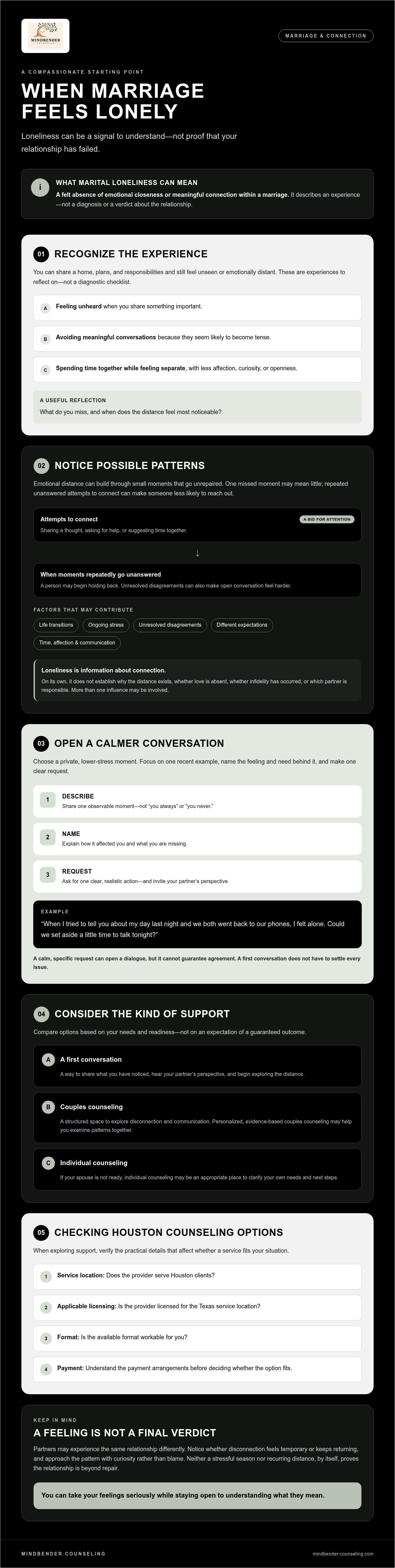
You might feel unheard when you share something important, avoid meaningful conversations because they seem likely to become tense, or spend time together while feeling separate. Daily life can continue smoothly on the surface even when affection, curiosity, or emotional openness feels harder to reach.
Partners may experience the same relationship differently, and their feelings can shift over time. One person might feel distant while the other feels connected, or both may notice disconnection for different reasons. These examples are invitations to reflect, not a diagnostic checklist. Ask yourself what you miss and when the distance feels most noticeable, without using a single moment to define the whole marriage.
What may contribute to emotional distance
Life transitions, ongoing stress, unresolved disagreements, or mismatched expectations about time, affection, and communication can affect emotional closeness. For example, a demanding season at work or a change in family responsibilities may leave less energy for conversation. If disagreements repeatedly go unaddressed, partners may also begin holding back to avoid another difficult exchange.
Feeling lonely is information about your experience of connection; on its own, it doesn’t establish why the distance exists, whether love is absent, whether infidelity has occurred, or which partner is responsible. More than one influence may be involved, and each partner may understand the pattern differently. Naming that uncertainty can make room for curiosity instead of blame.
Notice whether the disconnection feels temporary or keeps returning. A brief period of distance during a stressful transition may ease as circumstances change, while a recurring pattern may be worth discussing more directly. Neither situation proves that the relationship is beyond repair. If you’re seeking feeling lonely in a marriage help Houston, identify what you’d like your partner to understand, then consider what kind of conversation or support could help you explore it.
Why Marriage Can Feel Lonely, and What a First Conversation Can Change
Emotional distance can build through small moments that go unrepaired. One partner reaches out to share a thought, ask for help, or spend time together, but the other doesn’t notice or respond. A missed moment alone may mean little. When similar attempts repeatedly go unanswered, a person may stop reaching out. Unresolved disagreements can have a similar effect if they leave either partner reluctant to speak openly.
There isn’t one explanation for loneliness in marriage. Stress, communication habits, and unmet expectations can affect each partner differently, and no one role or gender is automatically responsible. Research from the University of Georgia connects ongoing marital conflict with loneliness and subsequent physical health concerns, underscoring why repeated conflict deserves attention rather than dismissal.
How to raise loneliness without turning it into blame
Choose a private, lower-stress moment when you have room to talk. Start with one recent example, then name the feeling and the need behind it. For instance: “When I tried to tell you about my day last night and we both went back to our phones, I felt alone. Could we set aside a little time to talk tonight?” This gives your spouse something specific to understand and respond to instead of asking them to defend against a broad accusation.
- Describe: Share one observable moment, not “you always” or “you never.”
- Name: Explain how it affected you and what you’re missing.
- Request: Ask for one clear, realistic action, then invite your partner’s perspective.
A calm, specific request can open a dialogue, though it can’t guarantee agreement. The aim of a first conversation isn’t to settle every issue. It’s to make your experience easier to hear and learn how your partner sees the moment.
What to do when your spouse responds defensively
A defensive reply can come from feeling criticized or misunderstood. If you can, listen for the concern underneath without taking back your own need. You might say, “I hear that you felt blamed. I’m trying to explain what I miss, not label you.” If the exchange becomes unproductive, suggest a time to return to it instead of forcing a resolution while emotions are high.
Respect and emotional safety matter more than having the conversation immediately. If speaking openly could put you at risk, don’t pressure yourself to disclose; consider seeking appropriate support first. If you’re searching for feeling lonely in a marriage help Houston, exploring couples counseling support may be one option to consider. Confirm that the practice serves your location.
Is Couples Counseling Right for Marriage Loneliness, or Should You Start Alone?
There isn’t one right starting point for every couple. A first conversation may help you share what you’re experiencing. Couples counseling can provide a facilitated setting to explore recurring disconnection and communication, while individual counseling may help you clarify your own needs. The best fit depends on your circumstances, each partner’s readiness, a provider’s assessment, and whether it feels safe to participate.
| Option | May fit when | Possible first step |
|---|---|---|
| Conversation together | You both feel able to talk respectfully. | Share one concern and ask to hear your partner’s perspective. |
| Couples counseling | You both want help understanding patterns or improving communication. | Ask a provider about their experience with couples and how they set goals. |
| Individual counseling | Your partner isn’t ready, or you want space to understand your own feelings. | Ask whether individual counseling is available and appropriate for your goals. |
When couples counseling may fit your goals
Couples counseling may be worth exploring when both partners can take part respectfully and want support understanding a recurring pattern, such as withdrawing after disagreements or struggling to discuss needs. A counselor can help structure conversations, make room for each person’s perspective, and support clearer communication. That doesn’t mean the counselor takes sides or promises reconciliation. Before deciding, ask about the clinician’s experience working with couples, how they approach goal-setting, and what participation involves.
If your partner is not ready to attend
It can feel discouraging when you’re prepared to seek support and your spouse isn’t. You can invite them, explain what you hope to work on, and ask what concerns they have, but you can’t make them participate willingly. Their hesitation doesn’t mean you must ignore your own needs.
Mindbender Counseling offers individual counseling as well as couples counseling. If you’re considering individual support, ask whether it’s available and appropriate for what you want to explore. Individual work can help you reflect on your feelings and choices; it isn’t automatically a substitute for joint counseling when the goal is to work on relationship patterns together.
If both partners are open but have questions about remote sessions, this overview of online couples counseling options and how they work may help you understand what to ask a provider. Before booking, confirm that the provider serves your location and that the format is appropriate for both of you. If you feel unsafe speaking openly with your partner, prioritize safety and seek appropriate individual support rather than pressuring yourself into a joint conversation or session.
How to Find Marriage Counseling for Loneliness in Houston
Finding a counselor involves more than choosing a name from a search result. Look for a provider whose experience, approach, and practical arrangements fit your relationship and circumstances. If your search is “feeling lonely in a marriage help Houston,” use this checklist to make a first inquiry more focused.
- Confirm service location and licensure. Ask whether the provider currently serves clients in Houston and whether the clinician is licensed for the Texas location where sessions will take place. Don’t assume that a website mentioning Texas confirms Houston availability.
- Ask about couples experience. Find out about the clinician’s experience working with couples facing emotional distance. Ask how they support partners with different goals or levels of readiness.
- Understand the approach to conflict and goals. Ask how sessions make room for each person’s perspective, what happens when conversations become tense, and how you’ll set and review goals together.
- Check session format and access. Confirm whether in-person appointments in Houston or telehealth are available for your location. Ask about scheduling and current availability rather than assuming a particular format or timeline.
- Clarify practical details. Ask about fees, payment options, and confidentiality, including how privacy works when both partners attend. Make sure you understand the answers before deciding whether to proceed.
Prepare for a first inquiry
A few notes can help you explain what you’re looking for without telling the whole story at once. Write down one recent example of feeling disconnected, what you hope might change, and any questions about logistics. If your partner is joining, invite them to name a goal too. An initial inquiry or conversation is a chance to assess fit and ask questions, not a promise of a particular outcome.
You may also want to read about what private therapy can involve and how to approach it as you consider what feels comfortable to share and which practical questions matter to you.
Mindbender Counseling offers personalized, evidence-based couples counseling focused on communication and relationship conflict. The practice’s stated service areas include Arizona and Texas, but Houston-specific availability and session format aren’t confirmed. Verify whether the practice serves your location, and ask about clinician licensure, scheduling, fees, and payment details before booking. Explore couples counseling with Mindbender Counseling and ask whether it may fit your needs.
Taking the Next Step with Mindbender Counseling
Once you’ve considered what kind of support might fit, you can explore whether Mindbender Counseling’s couples counseling aligns with your needs. The practice describes its counseling as personalized and evidence-based, with couples counseling focused on communication and relationship conflict. This may offer a structured place to discuss disconnection, but the right fit depends on your circumstances and the provider’s assessment.
What to clarify before scheduling
Before making a decision, contact the practice to confirm the practical details that matter to you. The stated service areas include Arizona and Texas, but current Houston availability, session formats, and clinician credentials aren’t confirmed. Ask directly:
- Does the practice currently serve clients in Houston, Texas, and are sessions in person, by telehealth, or both for my location?
- What experience does the counselor have working with couples facing emotional distance or communication concerns, and how are sessions structured?
- How does the counselor protect privacy and handle information shared by each partner?
- What are the fees, payment options, and current appointment availability?
- What credentials does the clinician hold, and are they licensed for the location where sessions would take place?
If both partners are willing and able to participate, invite each person to share what they hope counseling might help them understand or change. Their goals don’t need to be identical. Naming concerns early can help you ask whether the counselor’s approach is suitable for both of you. If one partner isn’t ready, ask whether individual counseling is available and appropriate for your needs.
A gentle first step toward support
Contacting a practice doesn’t commit you to scheduling. You can begin with a few questions, notice whether the responses feel clear and respectful, and decide at your own pace whether to continue. If you’re searching for feeling lonely in a marriage help Houston, a thoughtful inquiry can help you understand your options without forcing an immediate decision about your relationship.
Seeking support is a considered step toward understanding what you need and what may be possible. It isn’t a promise to stay together or to separate, and it can’t guarantee a particular outcome. If you’d like to explore whether the service fits, contact Mindbender Counseling about couples counseling and confirm Houston eligibility, format, clinician credentials, and availability before scheduling.
Choose a Thoughtful Next Step Toward Connection
Feeling lonely in a marriage can be a reason to pause and understand what you need, not a verdict on your relationship. A calm, specific conversation may help you share your experience, while couples counseling can offer a structured setting to explore communication and recurring conflict. If your partner isn’t ready, you can ask whether individual counseling may fit your goals.
Mindbender Counseling offers personalized, evidence-based counseling tailored to individual or couple needs, including couples counseling focused on communication and relationship conflict. Before scheduling, confirm whether the practice currently serves Houston clients, what session formats are available, and details about clinician credentials and availability. The practice lists Arizona and Texas among its service areas, so confirm Houston eligibility directly.
If you’re looking for feeling lonely in a marriage help Houston, you can take this at your own pace. Contact Mindbender Counseling to ask about couples counseling and Houston availability. Reaching out doesn’t commit you to staying together or separating; it’s one considered way to learn what support may be appropriate. You deserve space to explore the next step with care.
Frequently Asked Questions
Can you feel lonely in a marriage even if you still love your spouse?
Yes, love and loneliness can exist at the same time. You may care deeply for your spouse while feeling unheard, emotionally distant, or disconnected in daily life. That feeling alone doesn’t prove your marriage is failing. Notice when loneliness tends to arise and what kind of connection you miss, such as meaningful conversation or shared time. If the pattern persists or feels difficult to discuss, consider a calm conversation or professional support.
How do I tell my spouse I feel lonely in our marriage?
Choose a private moment when neither of you is rushing or already upset. Describe one specific situation, explain how it affected you, and make a clear request. For example, you might say, “I felt distant when we spent the evening on our phones. Could we set aside time to talk?” Focus on your experience rather than blame. If the conversation becomes heated, pause and agree on a time to return to it.
Can couples counseling help if only one spouse wants to go?
Couples counseling generally involves both partners, and one person can’t make the other participate willingly. You can still contact a provider to ask whether individual counseling may help you clarify your needs and next steps. Mindbender Counseling offers individual counseling services as well as couples counseling, though suitability depends on your goals and the provider’s services. Counseling can support reflection and communication, but it can’t guarantee a particular relationship outcome.
How do I find a couples counselor in Houston?
Start by confirming that the counselor currently serves clients in Houston, Texas, and is licensed for the location and session format you’d use. Ask about experience with couples, session structure, confidentiality, fees, availability, and how goals are reviewed. If possible, consider whether both partners feel heard during an initial conversation. Mindbender Counseling lists Arizona and Texas among its service areas, but confirm directly whether Houston service is available before scheduling.
What if my spouse refuses marriage counseling?
You can explain why support matters to you and invite your spouse without using attendance as a threat or condition. Ask what concerns them, listen, and still be clear about your own needs. If they remain unwilling, ask a qualified provider whether individual counseling could help you think through your options. Mindbender Counseling offers individual counseling services. If you feel unsafe, prioritize your safety and seek appropriate local support.
Is online couples counseling an option for people in Houston?
It may be, but availability depends on the provider and the clients’ locations. Ask whether the counselor serves Houston-area clients by telehealth, whether the clinician is licensed for your location, and how sessions are conducted. Clarify privacy expectations and whether both partners can join from suitable locations. Ask what the plan is if technology fails. Don’t assume every provider serving Texas offers online counseling or has current availability for Houston clients.


