

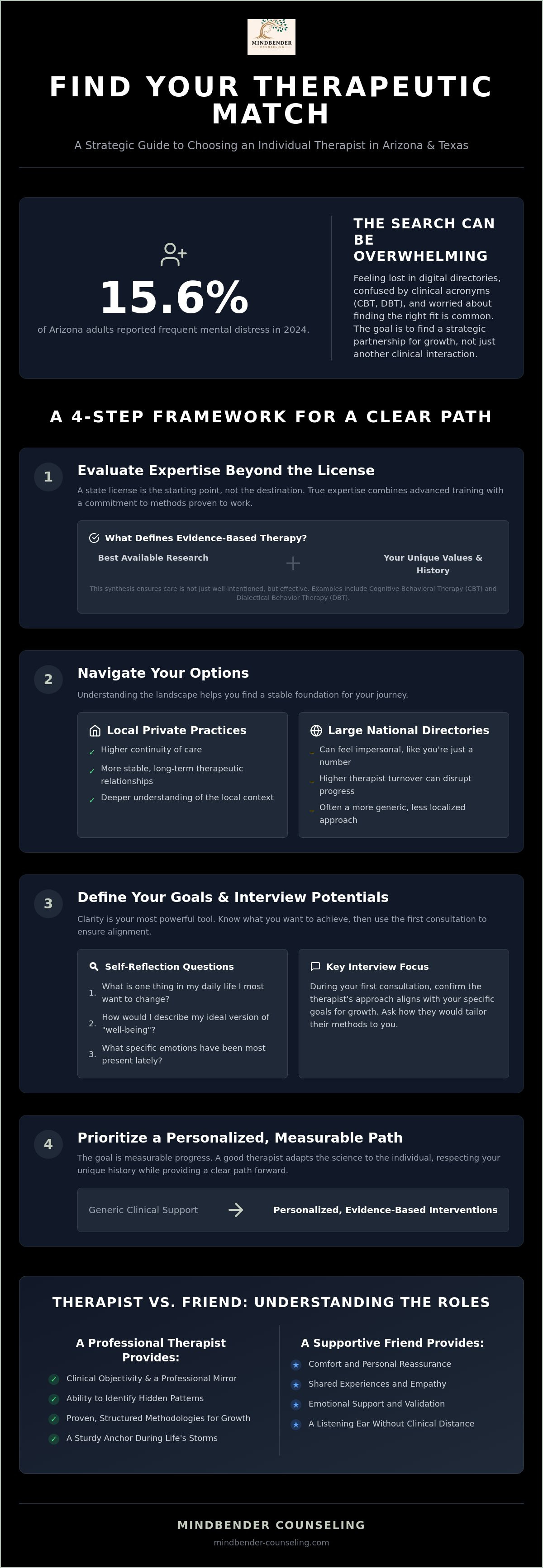
What if the most important factor in your mental health journey isn't the credentials on a wall, but the strategic alignment between proven science and a resonant personal connection? In 2024, 15.6 percent of Arizona adults reported experiencing frequent mental distress, yet many still struggle to find individual therapists who offer care that feels truly personalized. It's exhausting to scroll through digital directories where you feel like a number, or to feel paralyzed by the potential awkwardness of a first session and confusing acronyms like CBT or DBT.
You're looking for more than a clinical interaction; you want a partnership that feels grounded and real. You deserve clarity. We're here to help you identify providers who offer a clear, evidence-based roadmap tailored to your life in Arizona or Texas. This article will help you cut through the noise to find a professional who aligns with your personal goals and values.
We'll provide a practical framework for choosing a provider who understands your local context. You'll learn how to ensure your time and energy lead to the measurable growth and internal stability you deserve.
Key Takeaways
- Identify the distinction between basic licensing and specialized training to ensure your care is rooted in proven, evidence-based therapy.
- Understand why local private practices often provide a more stable foundation and higher continuity of care than large, impersonal national directories.
- Learn how to effectively interview potential individual therapists during your first consultation to confirm they align with your specific goals for growth.
- Gain a clear framework for navigating the Arizona and Texas mental health landscapes to find a professional who understands your local context.
- Establish a reliable path toward measurable progress by prioritizing personalized interventions that move beyond generic clinical support.
The Journey to Finding Individual Therapists Who Align With Your Goals
The decision to begin therapy often marks a pivotal shift in your life. It's the moment you choose to prioritize your internal foundation over the external noise. Finding individual therapists who truly resonate with your specific needs is more than just a logistical task; it's the first step toward a more balanced version of yourself. This process begins with understanding what is psychotherapy and how it serves as a structured environment for healing and progress.
We recognize the profound courage required for seeking professional counseling. It isn't just about managing a crisis; it's about shifting from a mindset of simply "needing help" to one of actively seeking a partnership for personal evolution. You aren't looking for someone to fix you. You're looking for a skilled professional to help you process the complexities of your own experience with clarity and care.
People often seek out individual therapists for a variety of reasons, including:
- Chronic stress or burnout from demanding professional roles.
- Major life transitions, such as a career change or relocating to a new city.
- The weight of grief or loss that feels too heavy to carry alone.
- A desire to break generational cycles or long-standing behavioral patterns.
Understanding the Role of a Modern Individual Therapist
A professional therapist offers something a supportive friend cannot: clinical objectivity. While friends provide comfort, a therapist provides a mirror held with professional precision. They act as a sturdy anchor during life's inevitable storms, helping you identify the "why" behind your reactions. This clinical distance allows them to spot patterns you might miss, facilitating the construction of a more resilient internal state through proven methodologies.
Identifying Your Personal "Why" Before You Search
Clarity is your best tool when beginning your search. Before you browse directories, take a moment to define one or two primary goals for your sessions. Are you looking to reduce daily anxiety, or do you want to improve how you communicate in your relationships? Knowing your "why" helps you find a specialist whose expertise aligns with your desired outcomes. Consider these starting points for self-reflection:
- What is the one thing in my daily life I most want to change?
- How would I describe my ideal version of "well-being"?
- What specific emotions have been most present in my life lately?
Evaluating Therapeutic Expertise: Beyond the License
While a state license ensures a provider has met the legal requirements to practice, it's merely the baseline. When you're searching for individual therapists, you're looking for a professional who has moved beyond the basics into mastery. True expertise is found at the intersection of clinical experience and a commitment to evidence-based therapy. This approach ensures that the care you receive isn't just well-intentioned but is grounded in methods proven to work. Understanding how to choose a psychologist involves looking closely at these advanced certifications and specialized training paths to ensure they align with your specific needs.
Personalized care means the therapist adapts the science to the individual, rather than forcing you into a rigid clinical box. It's about finding a guide who respects your unique history while utilizing a framework that provides a clear path forward. This balance of compassion and clinical precision is what allows for a truly transformative experience.
The Importance of Evidence-Based Modalities
Evidence-based practice is the gold standard for modern clinical care. It represents a synthesis of the best available research, the therapist's clinical judgment, and your unique personal values. Modalities like Cognitive Behavioral Therapy (CBT) or Dialectical Behavior Therapy (DBT) aren't just acronyms; they're structured frameworks designed to help you regain control over your thought patterns and emotional responses. Evidence-based therapy is a commitment to using methods that have a proven track record of success. These research-backed protocols, such as those used in individual counseling for anxiety, lead to more efficient and lasting emotional resilience. They provide you with a toolkit that remains effective long after your sessions conclude.
Specialization in Adult Mental Health and Modern Stress
Professionals in Arizona and Texas face a unique set of modern pressures. High-demand careers, shifting workplace dynamics, and the constant threat of burnout require a therapist who understands these specific contexts. Specialized individual therapists don't just listen; they help you navigate the nuances of personal identity and relational challenges in a fast-paced world. This includes a need for inclusive, affirming care, such as LGBTQIA+ therapy, where the provider understands the intersectional stressors you may face. If you're ready to find a partner in this process, exploring evidence-based therapy options can be a transformative step toward building a more sustainable sense of well-being.
Navigating Your Options: Private Practice vs. National Directories
When you begin the search for individual therapists, you'll likely encounter two distinct paths. One leads to massive national directories that use algorithms to sort through thousands of providers. The other leads to focused, local private practices rooted in your specific community. While directories offer a high volume of names, they often lack the human touch necessary for a successful therapeutic match. You shouldn't feel like a data point in a software program when you're looking for support. The process of finding a partner for your growth should feel personal from the very first click.
Choosing a practice over a platform ensures a higher level of continuity. In a large directory, you're often left to vet providers on your own, which can feel like a second job. A dedicated practice provides a more curated experience, matching you with a professional based on nuanced goals rather than just zip codes. This human-centered approach reduces the friction of starting care and ensures your therapist is invested in your long-term evolution. As you look into Finding a Mental Health Professional, consider how the environment of the practice itself contributes to your sense of safety and progress.
The Benefits of a Local Arizona or Texas Practice
A local practice understands the specific rhythm of life in Arizona and Texas. Whether it's navigating the professional pressures of the Phoenix tech corridor or the unique community dynamics in Austin, a local therapist shares your context. This shared understanding allows them to recommend relevant community resources and understand the external factors impacting your mental health. Local practices also build their reputation on long-term results within the community, offering a level of accountability that national platforms can't match. If your needs change, a local practice often makes it easier to transition between virtual and in-person care without disrupting your progress.
Telehealth vs. In-Office Sessions: Which is Right for You?
Virtual therapy offers unparalleled convenience for busy professionals. It eliminates commute times and allows you to attend sessions from the privacy of your own home or office. However, some individuals find that the physical "third space" of an office helps them disconnect from daily stressors and engage more deeply. Consider this checklist to help you decide:
- Do you have a private, quiet space where you feel safe speaking freely?
- Is your schedule so demanding that a commute would create more stress?
- Do you find it easier to build rapport through physical presence and body language?
- Are you looking for a clear physical boundary between your therapeutic work and your home life?
Both formats are effective when delivered by skilled individual therapists, so the choice should reflect what best supports your personal comfort and consistency. Your environment should be a catalyst for your growth, not a barrier to it.
The Vetting Process: How to Interview Your Potential Therapist
The first interaction with a therapist is a significant milestone. It's the moment where the search ends and the internal work begins. However, before you commit to a long-term therapeutic relationship, it's vital to ensure the fit is right. Professional individual therapists understand that the therapeutic alliance, which is the quality of the bond between you and your provider, is the strongest predictor of positive outcomes. This initial meeting is your opportunity to determine if this person can be the sturdy anchor you need for your journey. Treat this consultation as a mutual interview where your comfort and goals are the priority.
Trusting your intuition is a key part of this process. If the conversation feels forced or if you don't feel a sense of calm assurance from the provider, it's perfectly acceptable to continue your search. You aren't being difficult; you're being a diligent advocate for your own well-being. A great therapist will respect your need for a resonant connection and may even offer referrals to colleagues who might be a better match.
Essential Questions to Ask During a Consultation
Prepare a few specific questions to help you understand how the therapist operates. This clarity reduces the "first session" awkwardness and sets a professional tone for your future work together. Consider asking:
- What is your specific experience helping clients with the challenges I'm facing?
- How do you measure progress during our time together?
- Which research-backed protocols do you use, and how do they apply to my goals?
- What are the logistics regarding insurance, scheduling, and communication between our sessions?
A clear, direct answer on how you will work together is the hallmark of a professional therapist. If you're ready to find a partner who values this level of transparency, you can schedule an initial session to explore how our personalized approach fits your life.
Assessing the "Therapeutic Alliance"
During your conversation, pay attention to how it feels to be in the "room" with them, even if that room is virtual. You should feel seen and heard without the weight of judgment. A supportive therapist acts as an empathetic partner who balances a safe environment with the gentle challenge required for growth. This balance is delicate. You need to feel safe enough to be vulnerable, yet confident that your therapist will help you move toward the evolution you desire. If you leave the consultation feeling a sense of quiet optimism, you've likely found a solid foundation for your progress. If something feels off, remember that finding the right partner is worth the extra time.
Mindbender Counseling: Personalized Individual Therapy in Arizona and Texas
Choosing a therapist is a significant investment in your future. At Mindbender Counseling, we provide the expert, evidence-based care you need to navigate life's complexities with greater ease. Our team of individual therapists serves professionals and individuals across Arizona and Texas, offering a level of personalized attention that national directories simply cannot replicate. We believe that therapy is most effective when it's a collaborative partnership designed to foster long-term emotional growth and internal stability. You aren't just another name on a schedule; you're an individual with a unique story and a specific vision for your well-being.
We don't believe in one-size-fits-all solutions. Instead, we focus on personalized interventions that respect your history while providing a clear, structured path forward. Our goal is to help you move beyond temporary relief toward a more balanced and fulfilling life. This commitment to individualized care ensures that the work we do together translates into real, sustainable change in your daily experience.
Our Evidence-Based Approach to Individual Growth
At the core of our practice is a commitment to the highest clinical standards. We integrate research-backed techniques with deep compassion, acting as a wise and compassionate guide through your therapeutic journey. By utilizing proven methods, we help you build a solid internal foundation that allows you to face challenges with resilience. Our individual therapists focus on the construction of internal strength, helping you identify and dismantle the patterns that no longer serve your evolution. This methodical approach ensures that your progress is both measurable and rooted in reliable science.
Seamlessly Scheduling Your Therapeutic Appointment
We understand that the logistics of starting therapy can sometimes feel like a barrier. That's why we've focused on creating a low-friction process for scheduling your therapeutic appointment. It's natural to feel a bit of anxiety about that first session. You might wonder if you'll know what to say or if the therapist will truly understand your local context in Arizona or Texas. We're here to lower those defenses and create an atmosphere of immediate trust from the very first interaction.
Your first session is a gentle invitation to explore what's possible for your life. It's a space designed for safety, reliability, and calm assurance. We invite you to take the next step toward the clarity and growth you deserve. Reach out today to begin a partnership that prioritizes your individual growth and restores balance to your internal world.
Embracing Your Path Toward Internal Stability
Finding the right individual therapists is a transformative act of self-advocacy. By prioritizing specialized expertise and a resonant therapeutic alliance, you've already taken the most difficult step toward your personal evolution. You now have the framework to distinguish between simple licensing and the deep, evidence-based mastery required for lasting change. Whether you're processing workplace burnout or seeking a stronger sense of identity, the right partnership provides the steady anchor you need to move forward with confidence.
At Mindbender Counseling, we're dedicated to providing compassionate care tailored to your unique personal goals. Our practice serves professionals and individuals across Arizona and Texas, utilizing evidence-based therapy techniques to ensure your investment leads to measurable progress and a more balanced life. You deserve a space where you feel seen, heard, and empowered to grow.
Begin your journey to personal healing with a Mindbender therapist today. Your commitment to well-being is the catalyst for a more fulfilling future, and we're honored to be your guide through every step of that journey.
Frequently Asked Questions
How do I know if I need an individual therapist or couples counseling?
Individual therapy is the right choice if you want to focus on your personal internal foundation and individual behavioral patterns. While couples counseling addresses the space between two people, working with individual therapists allows you to explore your own history and personal evolution without the presence of a partner. It's a space dedicated entirely to your own growth and stability.
What is the difference between a therapist, a psychologist, and a counselor?
The primary difference lies in their educational background and specific licensing board. In Arizona, the Board of Behavioral Health Examiners regulates counselors and social workers, while psychologists are licensed by a separate board and typically hold a doctoral degree. All are qualified to provide evidence-based therapy, but their specific clinical focus may vary based on their advanced training and specialization.
How long does individual therapy typically last before I see results?
Most clients begin to notice a shift in their perspective within eight to twelve sessions, though the timeline for deep, sustainable growth is unique to every person. Evidence-based methods are designed to create measurable progress, so you aren't left wondering if your investment is working. We focus on building a solid internal foundation early in the process to ensure your resilience lasts.
Do individual therapists in Arizona and Texas accept my insurance?
Insurance acceptance varies significantly between private practices and individual providers. Arizona's telehealth parity laws require private insurance and Medicaid (AHCCCS) to cover virtual services just like in-person care, which expands your options. You should always verify your specific out-of-network benefits or copayments with your carrier before your first session to ensure the path forward is clear.
What should I do if I don’t feel a connection with my therapist after the first session?
You should trust your intuition and prioritize finding a professional who feels like a resonant match. Since the therapeutic alliance is the strongest predictor of success, it's perfectly acceptable to keep looking if the first connection doesn't feel right. A supportive therapist will respect your decision to find the guide who best aligns with your goals and may even offer referrals.
Can individual therapy help with work-related stress and burnout?
Individual therapy is highly effective for managing burnout and the unique pressures faced by high-achieving professionals in Arizona and Texas. By using research-backed protocols, individual therapists help you identify triggers for your stress and develop a toolkit for restoring balance. We focus on helping you navigate complex workplace dynamics while maintaining your personal well-being and professional focus.
Is telehealth as effective as in-person individual therapy?
Research consistently shows that telehealth is just as effective as in-person sessions for the majority of mental health goals. Virtual care offers the added benefit of convenience, which helps busy individuals maintain the consistency required for long-term growth. In both Arizona and Texas, the legal framework for telehealth is well-established, ensuring you receive the same high standard of professional care regardless of the format.
What happens during the very first therapy session?
The first session is a low-pressure intake process designed to build rapport and establish your primary goals for care. Your therapist will ask about your history and the specific challenges that led you to seek support today. It's an opportunity for you to ask questions about their methodology and begin to experience the calm assurance of a supportive therapeutic partnership.


