

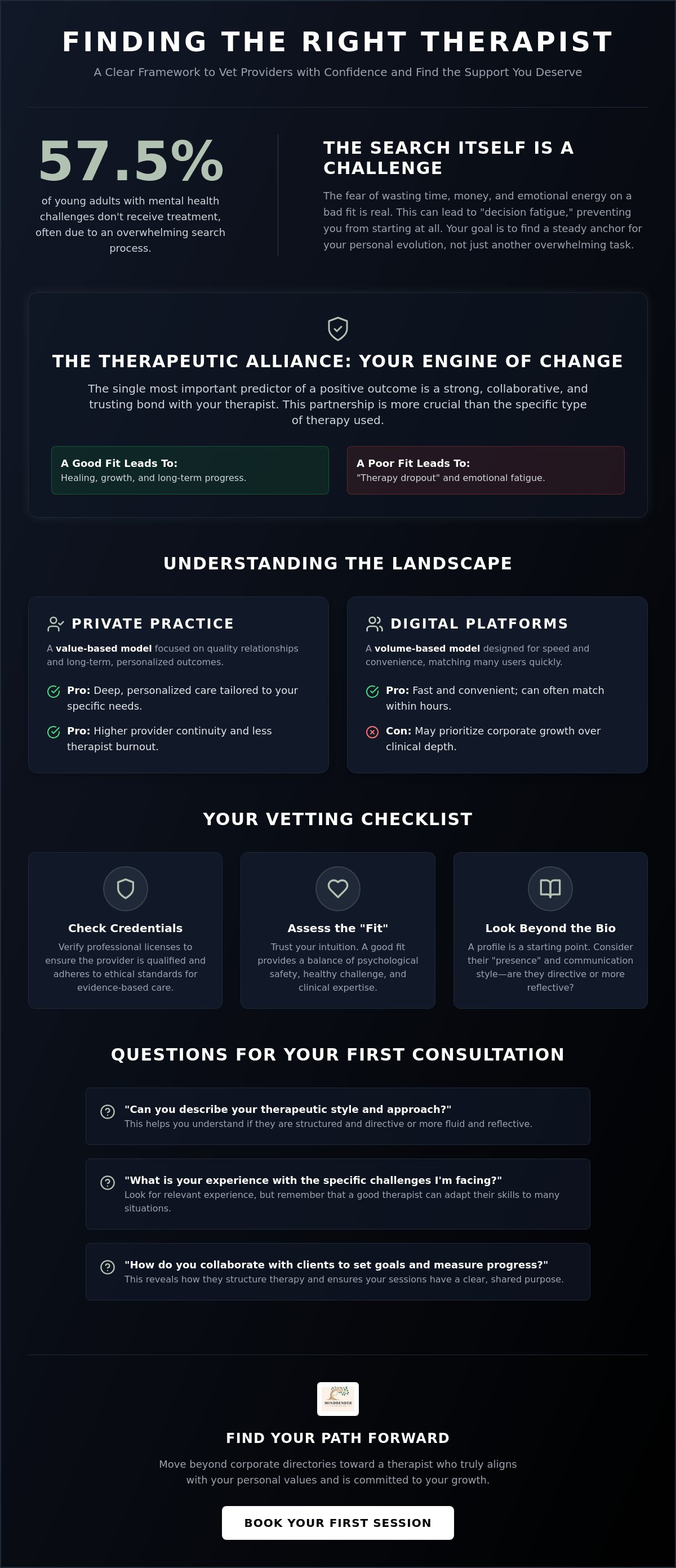
Did you know that 57.5% of young adults living with mental health challenges don't receive treatment, often because the search for help feels entirely overwhelming? It's a common struggle to feel stuck before you even begin. You might find yourself staring at a screen full of clinical acronyms and worrying about the cost of a bad fit. When you're deciding what to look for in a therapist, the fear of wasting time and money is real. You're looking for a professional who offers more than just a listening ear; you want someone who provides a steady anchor for your personal evolution.
Finding the right support shouldn't feel like an impossible task. This guide will provide you with a clear, methodical framework to vet providers with confidence. You'll learn how to interpret modern licensing standards, understand the practical differences between private practice and large digital platforms, and identify the qualities that lead to a successful therapeutic bond. We'll help you move from a place of uncertainty to a position of strength, ensuring you have the tools to book your first session with total peace of mind.
Key Takeaways
- Understand the vital role of the therapeutic alliance and how a strong collaborative bond prevents emotional fatigue and therapy dropout.
- Learn the practical differences between volume-based digital platforms and value-based private practices to choose the environment that best supports your growth.
- Discover what to look for in a therapist by decoding professional licenses and prioritizing evidence-based care for reliable, long-term results.
- Prepare for your first consultation with specific questions that reveal a provider's therapeutic style and their experience with your unique challenges.
- Explore how a personalized matching process can move you beyond corporate directories toward a therapist who truly aligns with your personal values.
The Search for Support: Why Your Choice of Therapist Matters
The decision to seek support is a profound act of self-advocacy. At its heart, the success of your journey rests on the therapeutic alliance; a collaborative, trusting bond between you and your provider. This partnership isn't just a professional courtesy. It's the primary engine of change. When you understand what to look for in a therapist, you aren't just browsing a directory. You're selecting a partner for your most personal work. Research consistently shows that a strong relationship with your therapist often predicts a positive outcome more accurately than the specific type of treatment used.
A poor fit does more than just stall your progress. It can lead to "therapy dropout," where individuals leave treatment prematurely and feel more discouraged than when they started. This creates a cycle of increased emotional fatigue, making the prospect of starting over feel exhausting. Investing time in vetting a provider upfront offers a significant long-term return. By choosing carefully, you ensure that your energy goes toward healing rather than managing a disconnect with your counselor. Understanding Psychotherapy and its various approaches helps you set a solid foundation for this search.
A good fit is the precise balance of psychological safety, healthy challenge, and clinical expertise.
The Emotional Weight of the Search
Starting the search requires immense vulnerability. It's natural to feel overwhelmed by the sheer volume of options available. This often leads to decision fatigue, where the pressure to make the "perfect" choice prevents you from making any choice at all. Don't ignore your intuition. In the clinical community, "feeling a click" is a valid metric. It signals that your nervous system feels safe enough to begin the deep work of growth. Be patient with yourself as you sift through your options.
Beyond the Bio: What a Profile Does Not Tell You
A therapist's profile is a helpful starting point, but a list of specialties only tells part of the story. While certifications matter, they don't capture a provider's "presence" or their active listening style. You need to know how they show up in the room. Are they directive and structured, or do they offer a more fluid, reflective space? Many people find that a private therapy approach offers the individualized attention necessary for true stability. This model prioritizes the person over the process, ensuring you don't feel like just another name on a high-volume schedule. When considering what to look for in a therapist, look for someone whose presence makes you feel seen, not just processed.
Understanding the Landscape: Private Practice vs. Large Mental Health Companies
The way we access mental health care has shifted dramatically. Today, you'll likely encounter a choice between large-scale digital platforms, often called therapy aggregators, and traditional private practices. These large companies often operate on a volume-based model. Their goal is to match as many users as possible with providers as quickly as possible. While this offers speed, it can sometimes prioritize corporate growth over clinical depth. When you're deciding what to look for in a therapist, it's vital to consider the environment where they practice. A therapist's surroundings directly influence their ability to show up for you with clarity and focus.
Private practices generally follow a value-based model. In this setting, the focus remains on the quality of the therapeutic relationship and long-term outcomes. Therapists in private settings often have more control over their schedules, which helps prevent the burnout common in high-volume corporate environments. A provider who isn't overwhelmed is better equipped to facilitate effective therapy behavioral therapy. This personalized attention ensures that your treatment plan is built around your specific life, rather than a standardized algorithm.
The Pros and Cons of Therapy Aggregators
Large platforms offer undeniable convenience. You can often sign up and get a match within hours. However, this convenience often comes at the cost of provider continuity. Many therapists leave these platforms due to low compensation and high administrative pressure, which might leave you searching for a new provider just as you've started to build trust. Data privacy has also become a significant concern for many in 2026, as users question how large-scale companies manage sensitive information. This American Psychological Association guide suggests that the clinical setting and the provider's autonomy are key factors in receiving high-quality care.
The Private Practice Advantage
Working with a therapist in private practice means working with someone who manages their own caseload. They have the mental space to truly reflect on your progress. This autonomy allows for individual counseling for anxiety that is flexible and responsive to your needs. Local practices in Arizona and Texas also offer the benefit of community-specific knowledge. They can connect you with local resources and understand the unique stressors of your area. If you're looking for a more stable and focused environment, you can explore our approach to see how a dedicated team prioritizes your personal evolution. Knowing what to look for in a therapist involves choosing a practice that treats you as an individual, not a data point.
The Essential Checklist: Technical Credentials and Evidence-Based Care
While personal chemistry is the spark that starts the process, technical credentials are the foundation that keeps it safe. Understanding what to look for in a therapist begins with a clear look at their professional background. A license isn't just a piece of paper; it's a guarantee that the provider has met rigorous state standards for education, supervised clinical hours, and ethical practice. Licensure is the floor, while specialized expertise is the ceiling. By verifying these basics, you ensure your vulnerability is met with professional competence and a commitment to your safety.
A therapist's profile should reflect a dedication to ongoing growth. The mental health field evolves rapidly, and the best providers stay current with the latest clinical research. Look for evidence of continuing education or advanced certifications in specific areas like trauma, grief, or anxiety. This specialized training allows a therapist to move beyond general support and offer targeted interventions that address your unique circumstances. When you prioritize both a valid license and deep expertise, you build a solid internal foundation for your own progress.
Decoding the Alphabet Soup
The variety of acronyms in mental health can be confusing. A Licensed Professional Counselor (LPC) typically focuses on clinical mental health and emotional well-being. Licensed Clinical Social Workers (LCSW) often look at individuals within their broader social systems. If you're seeking help with relationship dynamics, a Licensed Marriage and Family Therapist (LMFT) is trained to focus on the "we" rather than just the "me." Psychologists (PhD or PsyD) often have extensive training in psychological testing and research. You can easily verify these licenses through the Arizona Board of Behavioral Health Examiners or the Texas State Board of Examiners. It's also vital to remember that a "Life Coach" is not a substitute for a licensed professional, as they lack the clinical regulation and ethical oversight required to treat mental health conditions.
What is Evidence-Based Therapy?
Evidence-based therapy refers to treatments that have been rigorously tested in clinical trials and proven effective. Modalities like Cognitive Behavioral Therapy (CBT) help you reframe unhelpful thought patterns, while Dialectical Behavior Therapy (DBT) provides tools for emotional regulation. For those seeking couples support, the Gottman Method offers a research-backed roadmap for improving communication and intimacy. These structured methods provide a clear path for measurable progress, ensuring your time in session is used efficiently. Mindbender Counseling prioritizes these proven techniques because they offer predictable, high-quality results. As you prepare your questions to ask a potential therapist, ask which evidence-based models they use. This ensures that what to look for in a therapist includes a commitment to science-backed healing.
Navigating Your First Consultation: Questions to Ask
The first consultation is your opportunity to move beyond a written bio. It's where you verify if the clinical expertise you've researched translates into a supportive, real world presence. One of the most important things to ask is about their therapeutic style. Some providers are directive; they offer structured feedback, specific exercises, and active guidance. Others are non-directive, acting as a quiet mirror to help you lead the conversation. Understanding this dynamic helps you decide if their approach matches your personal learning style and goals.
When considering what to look for in a therapist, specificity is your best ally. Ask about their experience with your exact challenges, such as professional burnout, unresolved grief, or recurring relationship conflict. A seasoned professional will describe their methodology and past success with similar cases without breaking confidentiality. You should also ask how they measure progress. Effective therapy includes clear milestones. This ensures you aren't just talking in circles but are actually building a more stable internal foundation for the future.
Logistics are the practical pillars that sustain your care. Confirm session frequency and clarify their cancellation policies early to avoid future stress. In Arizona and Texas, insurance landscapes and billing practices can vary significantly. Ask how they handle out-of-network claims or if they provide documentation for reimbursement. Getting these details settled allows you to focus entirely on your growth during your sessions. If you're ready to find a provider who respects these practicalities while offering deep clinical insight, schedule a consultation with our team today.
The "Vibe Check": Assessing Personal Chemistry
Pay close attention to how you feel within the first fifteen minutes of the conversation. Do you feel genuinely heard? Does the therapist’s tone of voice and body language create a sense of safety? A vital component of what to look for in a therapist is cultural humility. This means the provider respects your unique background, identity, and life experiences without making assumptions. If you don't feel a sense of ease and mutual respect, it's a sign that the therapeutic alliance might not be strong enough to support deep work.
Setting Boundaries and Expectations
Professional boundaries protect the integrity of your healing process. Ask about their availability for communication between scheduled sessions or how they handle crises. It's helpful to remember that a therapist is a professional guide, not a friend who simply listens. This professional distance is what allows them to challenge you effectively and remain objective. In couples sessions, clarify how they handle potential conflicts of interest. Knowing their policy on individual secrets ensures that both partners feel equally supported and safe throughout the process.
Finding Your Path Forward with Mindbender Counseling
Mindbender Counseling stands as a bridge between clinical excellence and heartfelt human connection. We understand that knowing what to look for in a therapist is only half the battle; the other half is finding a practice that honors your time and your story. Our commitment to evidence-based care across Arizona and Texas ensures that you receive interventions grounded in research, delivered with a quiet confidence that respects your autonomy. We've built our practice to be a sturdy anchor for those in the middle of a storm and a catalyst for those ready for movement.
Unlike the high-volume corporate platforms that rely on impersonal algorithms, our personalized matching process is handled with fresh attention and care. We prioritize the quality of the bond between you and your provider because we know it's the most reliable predictor of success. Scheduling your first session for individual or couples support is a low-friction process designed to lower your defenses and build immediate trust. You deserve a space where your progress is the primary focus, not a secondary metric.
Our Approach to Individual and Couples Healing
We specialize in helping Southwest professionals navigate complex relational challenges and personal stressors with clarity. Our use of research-backed methods is never rigid; instead, it's tailored to the specific rhythm of your life. We invite you to view therapy not as a clinical chore or a sign of failure, but as a deliberate path toward personal evolution. By focusing on the construction of a solid internal foundation, we help you restore balance and achieve the long-term stability you've been seeking. Our goal is to act as a professional facilitator for your unique journey.
Taking the First Step Toward Balance
Reaching out is often the hardest part of the process, especially if you've experienced the frustration of a bad fit in the past. We address the common anxiety of "starting over" by providing a transparent, supportive methodology from the very first contact. Our team is here to facilitate your movement toward well-being with unwavering support and professional expertise. If you're a resident of Arizona or Texas ready to prioritize your mental health, contact Mindbender Counseling to begin your consultation. When you decide what to look for in a therapist, choose a partner who is as invested in your growth as you are.
Building Your Foundation for Change
Finding the right support is a journey that requires both patience and clarity. By understanding the importance of the therapeutic alliance and decoding the technical credentials of providers, you've already taken the most difficult steps. You now have a framework for what to look for in a therapist that prioritizes clinical evidence over corporate algorithms. This knowledge empowers you to choose a setting where your personal evolution is the central focus, rather than a side effect of a high-volume business model.
Your path toward stability doesn't have to be a solo effort. We specialize in evidence-based therapy techniques that provide a clear roadmap for both individuals and couples. By serving Arizona and Texas with personalized support, we ensure that every session is a meaningful step toward the balance you seek. Begin your journey toward emotional resilience with a compassionate expert at Mindbender Counseling. You possess the strength to start this process, and we're here to offer the steady anchor you deserve.
Frequently Asked Questions
What is the difference between a therapist and a counselor?
While people often use these terms interchangeably, "therapist" is an umbrella term for licensed professionals who provide psychotherapy, such as Psychologists, LCSWs, and LMFTs. A counselor often focuses on specific, shorter term goals like career guidance or school issues. In a clinical mental health setting, both roles usually require state licensure to provide evidence-based support for emotional and behavioral challenges.
How do I know if I need individual therapy or couples counseling?
Choose individual therapy if your primary goal is to explore personal growth, manage internal anxiety, or process private history. Couples counseling is the right choice when the distress lives within your partnership and both people are willing to work on shared dynamics. It's common for individuals to start with their own sessions to build a solid internal foundation before beginning work with a partner.
Are large mental health companies as good as private practices?
Large digital platforms offer high speed and convenience, but they often operate on a volume based model that can lead to high therapist turnover. Private practices prioritize a value based approach, offering deeper continuity of care and more personalized attention. When you're deciding what to look for in a therapist, consider whether you prefer a stable, long term relationship or a more transactional experience.
What should I do if I don’t feel a connection with my therapist after the first session?
It's perfectly okay to look for a different provider if the first session doesn't feel like a good fit. The therapeutic alliance is the primary engine of change, so forcing a connection that isn't there can actually stall your progress. You can politely inform the therapist that you're seeking a different style; most professionals will understand and can even offer referrals to help you find a better match.
How much does therapy typically cost in Arizona and Texas?
Costs for professional support in Arizona and Texas vary depending on the provider's specialty, years of experience, and the specific region. Private practice rates reflect the high level of individualized attention and the clinical expertise offered by the staff. You should always discuss fees and payment structures directly with a practice during your initial consultation to ensure their services align with your personal financial goals.
Can I use my insurance for evidence-based therapy sessions?
Many insurance plans provide coverage for evidence-based therapy, although the specific reimbursement rates depend on your policy details. Some specialized practices operate as out of network providers and will offer you a "superbill" to submit for potential reimbursement. It's a good idea to contact your insurance carrier before your first session to clarify your mental health benefits and any potential out of pocket costs.
What is the most important quality to look for in a therapist?
The most vital quality is the therapist’s ability to build a strong, trusting alliance while maintaining high clinical standards. When you evaluate what to look for in a therapist, prioritize a balance of genuine empathy and specialized expertise. You need someone who creates a safe environment for vulnerability but also has the professional tools to challenge you and facilitate meaningful, long term growth.
How long does it typically take to see progress in therapy?
The timeline for healing is unique to your specific challenges and the goals you set with your provider. Some individuals experience a sense of relief and clarity within the first few sessions, while deeper behavioral changes may take several months of consistent work. Using structured, evidence-based methods often helps you track your progress more clearly, providing a sense of momentum as you build your new foundation.


