

What if the secret to a resilient partnership isn't found in simply "talking things out," but in the precise, biological science of human connection? It's exhausting to feel like you're repeating the same argument for the hundredth time, only to end up more distant than when you started. Many couples hesitate to seek help because they fear therapy will become a session of aimless venting where the therapist might inadvertently take sides. You want progress, not just a place to air grievances without a resolution in sight.
There's a more reliable way to navigate these challenges. Through evidence-based couples therapy, you can follow a structured, proven roadmap that moves beyond surface-level conversation to address the root of your conflict. This approach provides you with specific, research-backed tools to de-escalate tension and deepen your emotional intimacy. It's about building a solid internal foundation that allows your relationship to thrive even during difficult seasons.
In this guide, we'll examine how clinical frameworks provide a clear plan for relationship improvement. You'll discover how these methodologies help you restore trust and move forward with a sense of calm assurance and renewed hope for your future together.
Key Takeaways
- Learn how understanding the neurobiology of connection can help you transition from defensive reactions to meaningful dialogue.
- Discover how evidence-based couples therapy uses research-backed techniques to move beyond aimless venting toward structured, measurable progress.
- Explore proven methodologies like Emotionally Focused Therapy and the Gottman Method to build a resilient foundation for your partnership.
- Gain clarity on the step-by-step therapeutic process, from the initial joint assessment to a personalized plan for restoring trust.
- Find out how to select a specialized therapist in Arizona or Texas who focuses on clinical excellence and personalized relational care.
What is Evidence-Based Couples Therapy?
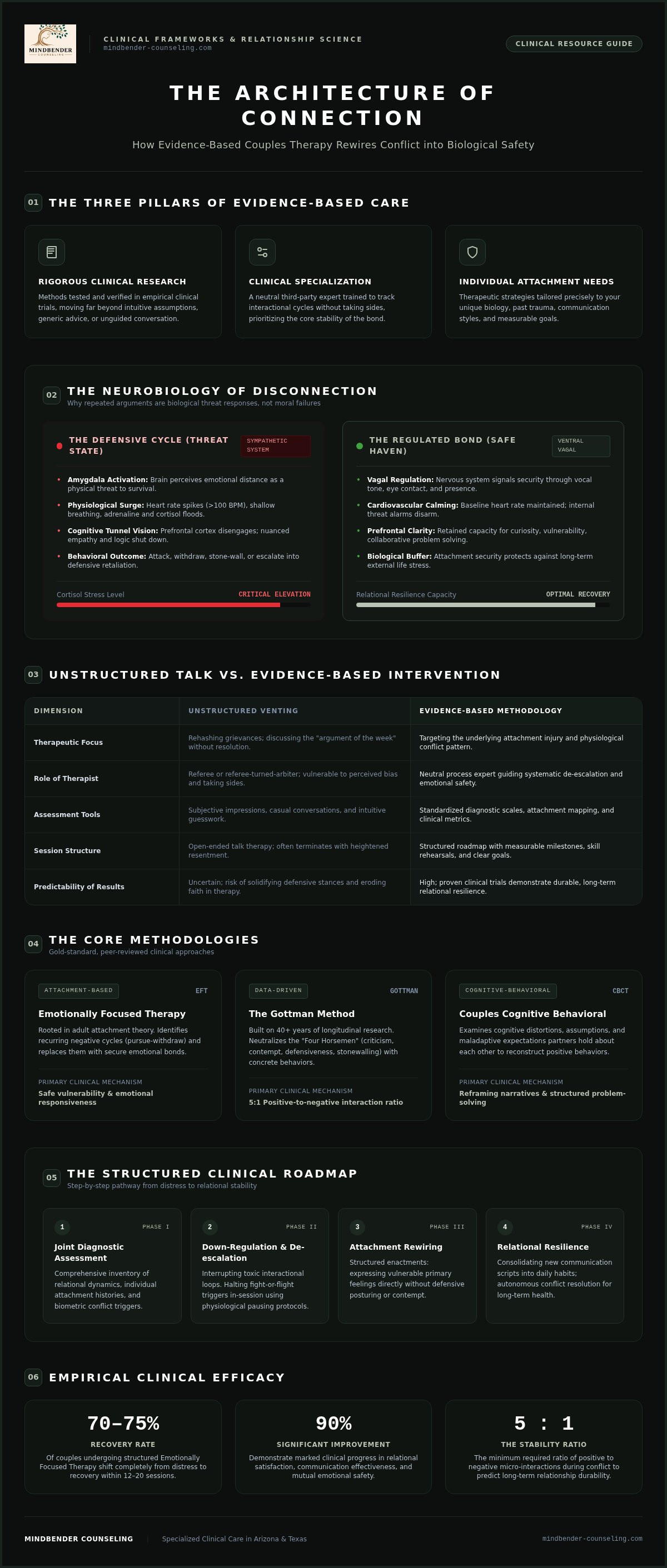
Evidence-based couples therapy isn't a single technique or a rigid script. It's a sophisticated integration of three vital components: the highest quality research, the therapist’s clinical expertise, and your unique goals and values. While traditional counseling might feel like a series of unstructured conversations, this model relies on methods that have been rigorously tested in clinical trials. It moves beyond a therapist’s intuition or personal opinion, offering a structured path toward healing that respects the complexity of your bond.
When emotions feel chaotic, science provides a sturdy anchor. It's common to feel lost when arguments spiral or silence settles between you. In those moments, you need more than a sympathetic ear; you need a framework that has been shown to work for thousands of other couples. By examining a clinical overview of couples therapy, we see that modern approaches prioritize measurable change over simple venting. This structured approach helps you feel safe enough to explore difficult topics without the fear of the session collapsing into further conflict.
The Difference Between Advice and Intervention
Well-meaning friends often offer advice based on their own limited experiences. Professional intervention is different. An evidence-based framework ensures your therapist remains a neutral third party, focusing on the health of the relationship rather than taking sides. This process starts with data-driven assessments. Instead of guessing why you’re stuck, your therapist uses validated tools to identify specific pain points in your communication and attachment styles. This objective approach lowers defenses and builds immediate trust, ensuring you both feel seen and heard.
Why 'Proven' Matters for Your Relationship
Your relationship is your most significant investment. You shouldn't have to gamble on whether a therapeutic approach will help or inadvertently make things worse. Structured models are designed to be efficient. Because they follow a clear roadmap, they often lead to faster results than open-ended talk therapy. This accountability ensures that every session serves a purpose. It provides the quiet confidence you need to believe that positive change isn't just possible; it’s predictable when you use the right tools. By choosing a methodology backed by data, you're making a sound investment in your future stability.
The Science of Connection: Why Research-Backed Methods Matter
Human connection isn't just a social desire; it's a biological imperative. Our brains are hardwired to seek safety and security in others. When a relationship feels unstable, the brain often treats emotional distance as a physical threat. This is why conflict frequently triggers a "fight or flight" response. Your heart rate increases, your breathing becomes shallow, and your ability to think logically diminishes. You aren't just "being difficult"; your nervous system is trying to protect you.
Research-backed methods in evidence-based couples therapy focus on regulating these intense physiological reactions. By calming the nervous system, partners can move from a state of defense to one of curiosity and care. According to Harvard Health's overview of couples therapy, structured approaches are essential for de-escalating these high-stress moments. This regulation doesn't just save the relationship; it improves your long-term physical health. Lowering chronic relationship stress reduces cortisol levels and supports cardiovascular well-being. This leads to relational resilience, which is the measurable ability of a couple to bounce back from adversity with even greater strength.
Attachment Theory: The Biological Blueprint
Our adult relationship patterns are often echoes of our earliest experiences. If you grew up feeling secure, you likely find it easier to trust and communicate. If your early needs weren't consistently met, you might struggle with anxiety or avoidance when things get difficult. Secure attachment acts as a biological buffer against life's stressors. Attachment theory is the biological need for a safe haven in a partner. By understanding this blueprint, evidence-based couples therapy helps you rewire these patterns to create a more stable, supportive bond.
Measuring Progress in Therapy
Personal growth shouldn't be a mystery or a guessing game. To ensure you're moving forward, we use standardized scales to track emotional growth and communication patterns. At Mindbender Counseling, we believe that tracking these metrics ensures your path to personal healing is actually working. We move beyond subjective feelings of "doing better" to objective markers of relational improvement. This data-driven approach provides a clear view of your progress, allowing you to see the tangible results of your investment in each other. It provides the quiet confidence that your relationship is building a solid, lasting foundation.
Core Methodologies: EFT, Gottman, and CBT for Couples
Not all therapy is created equal. To provide effective evidence-based couples therapy, we rely on three primary methodologies that have stood the test of rigorous clinical scrutiny. These aren't just theories; they are practical toolkits that allow us to tailor interventions for families and professionals across Arizona and Texas. Whether you're navigating the fast-paced environment of Phoenix or the community-focused life of a Texas suburb, these models provide the structure needed for lasting change. We treat your relationship as a living system that requires specific, proven interventions to thrive.
Emotionally Focused Therapy (EFT)
EFT is often considered the gold standard for restoring emotional bonds. It focuses on de-escalating the negative cycles of interaction, the "dance" where one partner pursues and the other withdraws. Research indicates that EFT has a success rate of approximately 75%, with nearly 90% of couples showing significant improvement. By creating new, positive "bonding moments" in a controlled environment, couples learn to see each other as a source of comfort rather than a threat. If you're curious about how these sessions translate to a digital format, you can learn more about How Does Online Couples Counseling Work? to see if it fits your schedule.
The Gottman Method
The Gottman Method is built on over 40 years of research with thousands of couples. It introduces the concept of the "Sound Relationship House," a framework for building friendship, managing conflict, and creating shared meaning. A critical part of this method is identifying the "Four Horsemen," which are communication styles that predict the end of a relationship if left unchecked:
- Criticism: Attacking a partner's character rather than a specific behavior.
- Contempt: Assuming a position of moral superiority, often through sarcasm or eye-rolling.
- Defensiveness: Shifting blame to avoid taking responsibility.
- Stonewalling: Withdrawing from interaction to avoid conflict.
Many high-functioning professionals find this method particularly useful. It functions as a workplace asset, teaching conflict management skills that are as effective in the boardroom as they are in the living room. It provides a clear, logical map for navigating emotional terrain that otherwise feels unpredictable.
Finally, we utilize Cognitive Behavioral Conjoint Therapy (CBCT). This approach addresses the shared thought patterns and behaviors that keep a couple stuck in a loop. By examining the "stories" you tell yourselves about your relationship, you can replace unhelpful narratives with realistic, supportive ones. At Mindbender, we don't believe in a one-size-fits-all approach. We blend these proven methods to meet you exactly where you are, ensuring your investment in therapy leads to a more stable, joyful future.
What to Expect: The Evidence-Based Process Step-by-Step
Embarking on a journey toward relational healing requires a clear, reliable map. Evidence-based couples therapy provides this by following a structured four-stage process. This methodical approach ensures that every session contributes to your long-term stability and emotional growth. We don't guess at what might work; we follow a sequence that has been clinically proven to foster deep, lasting change.
- Step 1: The Comprehensive Assessment. This phase includes both joint and individual sessions. It allows your therapist to observe your interaction patterns while giving each partner a private space to share their personal history and concerns.
- Step 2: Data-Driven Goal Setting. We use the information gathered during your assessment to build a personalized treatment plan. This plan outlines specific, measurable objectives that align with your values as a couple.
- Step 3: Active Intervention. Here, we apply specific research-backed protocols. You'll learn to apply the methodologies discussed earlier, such as de-escalating negative cycles in real-time, guided by a compassionate professional.
- Step 4: Consolidation and Relapse Prevention. The final stage focuses on ensuring these changes last. We help you internalize the tools you've learned so you can navigate future challenges without needing constant professional support.
The Intake: Beyond the First Impression
When you attend a therapeutic appointment at Mindbender, the intake process goes much deeper than a simple introduction. Your therapist will ask about your family history and previous traumas. We do this because these elements often act as silent architects of your current relationship dynamics. By understanding the biological and psychological roots of your reactions, we can build a more effective path forward. If you're feeling nervous about the process, you can read our guide on Couples Therapy: What to Expect in Your First Session to gain a sense of calm and clarity before you walk through the door.
Active Change: The Middle Phase of Therapy
The middle phase is where the most significant transformation happens. We move from talking about the problem to practicing the solution. This is a dynamic process where behavioral health consultants guide the flow of each session to ensure you stay focused on your goals. You'll be invited to engage in homework and out-of-session exercises. These tasks aren't just extra work; they are essential for reinforcing the science of connection in your daily life. By practicing new communication skills at home, you turn temporary insights into permanent habits. This phase builds the relational resilience we discussed earlier, giving you the quiet confidence to handle conflict with grace. Ready to begin your structured path to a stronger bond? Schedule your evidence-based therapy session today to start your journey toward lasting stability.
Finding the Right Fit: Evidence-Based Care in Arizona and Texas
Choosing a therapist is a deeply personal decision that requires both clinical excellence and a strong personal connection. When you seek out evidence-based couples therapy, you're looking for more than just a listener. You're looking for a licensed professional who has undergone specialized training in rigorous models like EFT or the Gottman Method. This level of expertise ensures that your sessions are focused on measurable progress rather than just maintaining the status quo. It's about finding a guide who can navigate the complexities of your relationship with the steady hand of experience and the warmth of genuine compassion.
We believe that your relationship is your most significant investment. It is the foundation upon which the rest of your life is built. Protecting that foundation with proven, research-backed methods isn't just a choice; it's a commitment to your long-term well-being. We treat every couple with fresh attention and care, acting as a sturdy anchor as you move toward personal and relational evolution. This approach provides the quiet confidence you need to believe that positive change is not only possible but predictable when you use the right tools.
Local Expertise in Arizona & Texas
Life in the Southwest brings its own unique set of stressors. Phoenix professionals often balance high-pressure careers with the challenges of a rapidly growing urban environment. Texas families may navigate different cultural expectations and the logistical hurdles of expansive suburban life. At Mindbender, we understand these nuances. We recognize how external pressures like long commutes or demanding work schedules can seep into the home, creating friction where there should be support. Our approach is tailored to these regional realities, offering both in-person and on-demand therapy options to fit your lifestyle. By understanding therapy and behavioral therapy as a tool for resilience, you can learn to buffer your relationship against these outside forces.
Taking the Next Step with Mindbender
We believe that seeking help should be a process defined by calm assurance rather than anxiety. Our goal is to lower the barrier to care by providing a clear, low-friction path forward. Scheduling a consultation is the first step toward restoring the balance you've been seeking. We prioritize your stability by creating a safe, predictable environment where growth can happen naturally. You don't have to navigate this journey alone. With the right tools and a compassionate guide, you can transform your partnership into the source of strength it was meant to be. Strengthen your bond with Mindbender Counseling today.
Building Your Future on a Foundation of Science
Your relationship is the most significant investment you'll ever make. Throughout this guide, we've explored how evidence-based couples therapy moves beyond simple conversation to provide a structured, biological, and psychological roadmap for healing. By understanding the neurobiology of connection and utilizing proven methods like EFT and the Gottman Method, you can transition from repetitive conflict to a state of lasting emotional stability. It's about replacing the fear of stagnation with the quiet confidence that comes from using tools that actually work.
At Mindbender Counseling, we provide personalized interventions specifically designed for the unique needs of couples in Arizona and Texas. Our licensed experts offer professional, compassionate care that treats your relationship with the fresh attention it deserves. You don't have to navigate these challenges alone; you can rely on techniques that have been clinically shown to restore trust and intimacy. It's time to move forward with a clear plan for your future together.
Schedule your evidence-based couples consultation with Mindbender Counseling today. You possess the strength to evolve, and we are here to act as your steady anchor throughout that journey toward well-being.
Frequently Asked Questions
What is the success rate of evidence-based couples therapy?
Research indicates that these methods offer high success rates because they rely on clinically tested protocols. For example, Emotionally Focused Therapy (EFT) shows that approximately 75% of couples move from distress to recovery, while 90% report significant improvement. These results are more predictable than traditional talk therapy because the techniques target the biological roots of human connection. By following a structured roadmap, most couples find they can build a more stable partnership.
How many sessions does evidence-based couples therapy usually take?
The duration of your care depends on your unique goals and the complexity of your situation. Most research-backed models, such as the Gottman Method or EFT, typically involve 8 to 20 sessions to achieve lasting change. We start with a comprehensive assessment to build a personalized plan, ensuring every session is productive. This structured approach helps you reach your objectives more efficiently than open-ended counseling, providing a clear path toward relational healing.
Is evidence-based therapy more expensive than traditional counseling?
Pricing for specialized sessions is generally comparable to traditional counseling. However, many couples find it to be a sounder investment because the methods are more efficient and goal-oriented. Since these techniques are backed by clinical trials, you're likely to see measurable progress in a shorter timeframe. We view this as a vital investment in your future stability, focusing on delivering high-quality care that produces tangible, long-term results for your partnership and family.
Can evidence-based methods help if my partner is unwilling to attend?
If your partner isn't ready to join yet, you can still make significant progress through individual counseling services. By working on your own emotional regulation and communication patterns, you can often shift the dynamic of the relationship from your side. We focus on providing you with research-backed tools to handle conflict and build internal strength. This personal growth frequently acts as a catalyst for positive change, even before your partner chooses to participate in the process.
Does insurance cover evidence-based couples therapy in Arizona or Texas?
Insurance coverage for therapy varies significantly by provider and specific plan details in Arizona and Texas. We recommend contacting your insurance company directly to verify your out-of-network benefits for professional counseling. While we focus on delivering specialized, research-backed interventions, every policy has different requirements for reimbursement. Our team provides the necessary documentation to help you navigate this process with ease, ensuring you can focus on your personal and relational growth without unnecessary friction.
What is the difference between Gottman and EFT?
The Gottman Method focuses on practical skills and identifying negative communication patterns like the "Four Horsemen." It's highly effective for couples who need a logical, skill-based framework. Emotionally Focused Therapy (EFT) prioritizes the emotional bond and attachment needs, helping you move from defensive reactions to deep connection. Both are proven evidence-based couples therapy models. We tailor these methodologies to fit your specific needs, acting as a wise guide to help you choose the right path.
How do I know if a therapist is truly using evidence-based methods?
You can identify an evidence-based couples therapy practitioner by asking about their specific training in recognized models like EFT or the Gottman Method. Truly evidence-based therapists don't just "chat"; they use standardized assessments and follow structured protocols shown to work in clinical trials. At Mindbender, our licensed experts are dedicated to using these research-backed sessions. We ensure your care is rooted in science, providing the calm assurance that you're receiving the highest standard of professional intervention.
What happens if we don't see results after a few sessions?
It's normal for progress to feel slow at first, especially during the initial assessment phase. If you don't see results after several sessions, your therapist will review your treatment plan and adjust the interventions. We use progress tracking to move from subjective feelings to objective relational improvement. This accountability ensures that we stay focused on your goals. Open communication with your therapist allows us to refine our approach, ensuring your investment leads to genuine, observable growth.


