

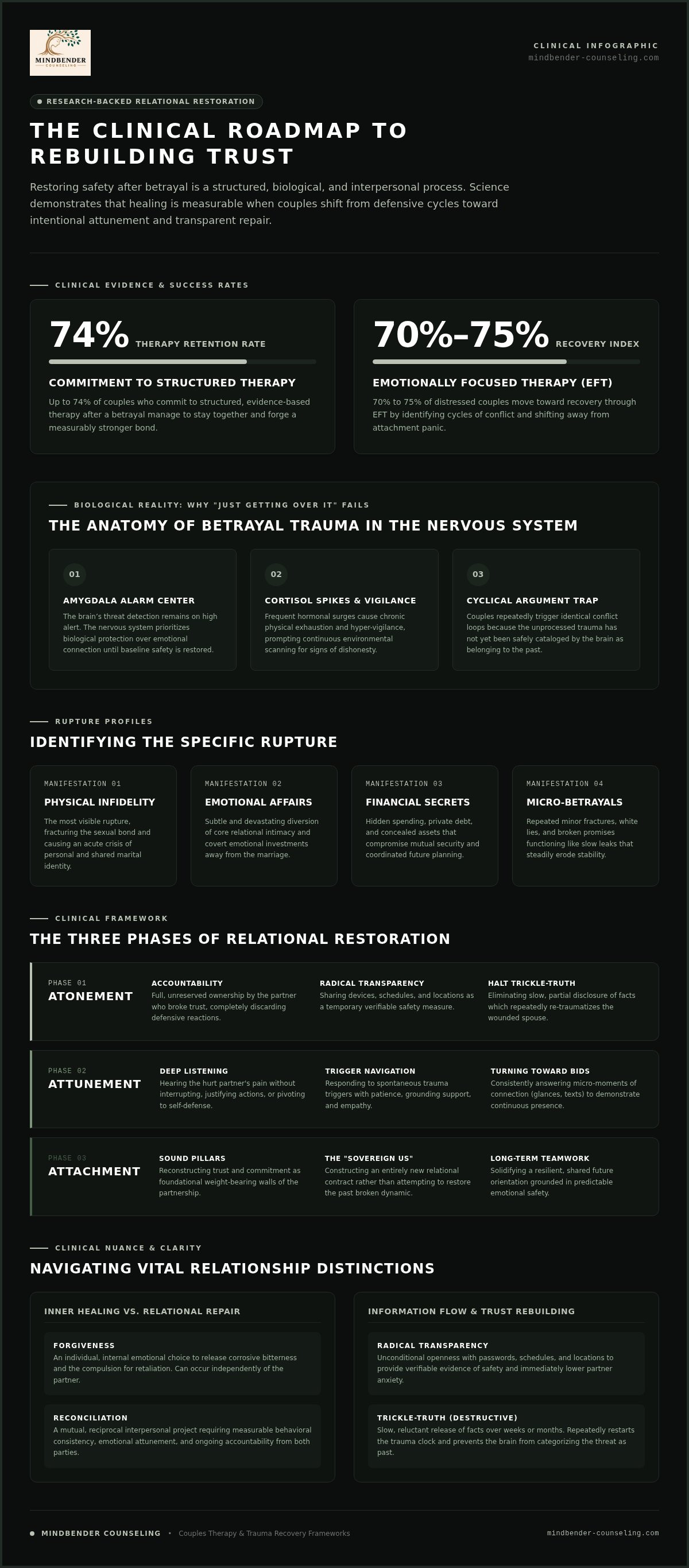
Did you know that up to 74% of couples who commit to structured, evidence-based therapy after a betrayal manage to stay together and create a stronger bond? While you might feel like your relationship is currently unsalvageable, this data suggests that healing is a measurable reality. Learning how to rebuild trust in a marriage isn't about forgetting what happened or simply moving on. It's about constructing a new, "Sovereign Us" that's rooted in transparency and emotional safety rather than the cyclical arguments of the past.
It's exhausting to live in a state of constant hyper-vigilance, wondering if the foundation you've built will ever feel solid again. You deserve a path forward that's grounded in science rather than just well-meaning advice. This guide offers a compassionate, research-backed roadmap to help you navigate the delicate process of restoration. We'll explore the specific clinical phases of atonement and attunement, provide practical tools for communication, and help you find a clear answer on whether your marriage can thrive in its next chapter.
Key Takeaways
- Understand that trust is a predictable reliance on your partner for emotional safety. Recognize how micro-betrayals can erode that foundation over time.
- Discover how to rebuild trust in a marriage by applying research-backed frameworks like the Gottman Method to restore attunement and security.
- Distinguish between the internal act of forgiveness and the interpersonal work of reconciliation to ensure your healing process remains balanced.
- Follow a structured roadmap for recovery. This process begins with immediate transparency and moves toward establishing safe, time-limited spaces for dialogue.
- Learn to identify the stagnation points where professional couples counseling provides the necessary tools to break through cyclical arguments.
Understanding the Anatomy of Broken Trust
Trust is often described as a feeling, but in a long-term partnership, it's actually a predictable reliance on your partner for emotional safety. When you know what to expect from your spouse, your nervous system can relax. Relational trust is the intersection of transparency and reliability. Learning how to rebuild trust in a marriage begins by acknowledging that betrayal is rarely a single, isolated event. It often includes "micro-betrayals," such as small secrets, white lies, or broken promises, which act like slow leaks in a ship. Over time, these minor fractures can be just as devastating as a major crisis.
The impact of broken trust is deeply physical. When betrayal occurs, your body often enters a state of betrayal trauma. You might experience chronic hyper-vigilance, where you're constantly scanning for signs of dishonesty. This leads to frequent cortisol spikes that leave you feeling exhausted and anxious. Your brain's primary goal becomes protection rather than connection. This is why many couples find success through clinical couples therapy, which provides a structured environment to lower these biological defenses and begin the work of repair.
The Different Faces of Betrayal
Betrayal shows up in many forms, and identifying the specific rupture is the first step toward recovery. Physical infidelity is perhaps the most visible, causing a direct rupture of the sexual bond and a crisis of personal identity. Emotional affairs are often more subtle but can be equally damaging, as they involve a redirection of intimacy and secret emotional investments outside the marriage. Additionally, financial secrets, such as hidden spending or undisclosed debt, destroy the sense of shared security and future planning. Each of these "faces" requires a unique approach to restore the foundation of the relationship.
Why "Just Getting Over It" Doesn’t Work
The common advice to "forgive and forget" often fails because it ignores how the brain functions. Your brain needs a baseline of safety before it can even begin to process complex emotions like forgiveness. When trust is broken, the amygdala, your brain's alarm center, stays in a state of high alert. This creates relationship triggers that lead to the "cyclical argument" trap. You might find yourselves revisiting the same painful memories because the brain hasn't yet categorized the threat as "past." True recovery requires addressing this neurobiology. You cannot simply bypass the need for safety; you must process the trauma to truly learn how to rebuild trust in a marriage.
The Psychological Framework for Relational Repair
Repairing a relationship after a breach isn't a matter of luck or simply waiting for time to pass. It's a structural process. The Gottman Method uses a concept called the "Sound Relationship House," where trust and commitment serve as the weight-bearing pillars. When these pillars crumble, the entire structure feels unstable. Understanding how to rebuild trust in a marriage requires a shift from defensive reactions to intentional attunement. This involves deeply listening to your partner's pain without interrupting or justifying your actions, allowing them to feel truly heard.
Emotionally Focused Therapy (EFT) provides another vital tool for this journey. Research shows that 70% to 75% of distressed couples move toward recovery through EFT by identifying their "cycle" of conflict. Instead of seeing your partner as the enemy, you learn to see the cycle of "attachment panic" as the shared problem. You can start small by "turning toward" bids for connection. These are simple moments, like a shared glance or a brief text, that signal you're still present and engaged. If you're struggling to find these moments, seeking professional couples counseling can help you identify these opportunities for repair.
The Three Phases of Trust Recovery
Clinical evidence maps the journey of mending a marriage after broken trust into three distinct stages. First is Atonement. The partner who broke trust must take full, unreserved accountability. Defensiveness acts as a barrier to healing and must be set aside. Second is Attunement. This is where you reconnect emotionally and learn to navigate the hurt partner’s triggers with patience and empathy. Finally, there is Attachment. This stage focuses on re-establishing a secure, long-term bond and looking toward the future as a unified team.
The Role of Radical Transparency
In the wake of betrayal, the standard rules of privacy often change. Radical transparency becomes a temporary but necessary safety measure to lower the hurt spouse's anxiety. This means sharing passwords, schedules, and locations to provide verifiable evidence of safety. It's vital to avoid "trickle-truth," which is the slow, partial release of information over weeks or months. This lingering dishonesty is often more damaging than the initial betrayal because it restarts the trauma cycle every time a new detail emerges. True transparency involves setting boundaries that protect the relationship's integrity. This is a core part of how to rebuild trust in a marriage effectively.
Forgiveness vs. Reconciliation: Navigating the Middle Ground
Forgiveness is often misunderstood as an immediate ticket back to the way things were. In reality, forgiveness and reconciliation are two distinct processes. Forgiveness is an internal, autonomous release of resentment that you do for your own peace. Reconciliation, however, is a joint effort that requires two active participants and verifiable change. It's helpful to view reconciliation as a privilege earned by the partner who broke trust, rather than a right they're entitled to. Utilizing established psychological frameworks for healing from infidelity can help you distinguish between letting go of the past and deciding to build a future together.
Many people fear that choosing to stay makes them a "doormat," but healthy repair is actually built on firm, non-negotiable boundaries. During the early stages of learning how to rebuild trust in a marriage, it's normal to operate within a framework of conditional trust. This isn't about being punitive; it's about creating a structure where safety is proven through daily actions rather than promised through words. You don't have to jump into total vulnerability immediately. Instead, you can offer the opportunity for your partner to demonstrate their commitment to the new rules of the relationship.
When Forgiveness Is Not Enough
There are times when forgiveness is possible, but reconciliation is not. If a partner is unwilling to take full accountability or continues to hide information, the path to repair is blocked. It's vital to recognize the difference between a one-time mistake and a persistent pattern of behavior. When a spouse remains defensive or refuses to engage in the work of atonement, you must prioritize your own mental health. Choosing to forgive someone for your own emotional clarity doesn't mean you're obligated to remain in a relationship that lacks the basic foundation of reliability.
Building a "New" Marriage, Not Fixing the Old One
Successful couples often realize that the marriage they had before the betrayal is gone. Rather than trying to fix a broken vessel, they focus on constructing "Marriage 2.0." This is a conscious, evidence-based construction of a new partnership with higher levels of transparency and emotional depth. This process is demanding and often brings up intense emotional triggers. Utilizing individual counseling for anxiety can be a powerful way for the hurt partner to manage these triggers while the couple works on their collective bond. This individualized support ensures that your own psychological growth keeps pace with the evolution of the relationship, which is a core part of how to rebuild trust in a marriage.
A Step-by-Step Roadmap for Rebuilding Consistency
Rebuilding consistency requires a shift from vague promises to verifiable actions. The first step is to cease all deceptive behavior and outside contact immediately. This creates the necessary vacuum where honesty can finally begin to grow. Once the external threats are removed, you must establish a safe space for difficult conversations. By setting a strict time limit, such as 20 minutes, you prevent the discussion from devolving into emotional exhaustion. This structure allows both partners to engage without the fear of a "Waltz of Pain" that lasts all night.
Consistency is also built through a formal Transparency Agreement. This document outlines shared access to phones, financial records, and daily schedules. While it may feel intrusive at first, it's a vital tool for reducing hyper-vigilance in the hurt partner. Over time, these daily acts of openness prove that you're prioritizing the relationship's integrity over individual privacy. If you find it difficult to navigate these boundaries on your own, you can book a couples counseling session to work with a licensed facilitator who can help you draft a roadmap tailored to your needs.
The Daily Check-In Ritual
One of the most effective ways to learn how to rebuild trust in a marriage is through a 15-minute daily check-in. This time is strictly for emotional needs, not for discussing logistics like bills or childcare. During this ritual, focus on the following:
- Use "I" statements: Express your fears or needs without attacking your partner. For example, say "I feel anxious when I don't hear from you" instead of "You never call me."
- Practice active listening: The goal is to understand, not to defend.
- Validate feelings: Even if you don't agree with the perspective, acknowledge that your partner's pain is real.
Managing the "Relapse" of Trust
Triggers are an inevitable part of the healing process. When a memory or event causes a relapse of doubt, how you respond matters more than the trigger itself. Both partners should have a plan for these moments. The partner who broke trust can use a four-part apology framework: express regret, accept full responsibility without "buts," offer restitution, and state a clear plan for change. Remember that consistency over months and years is the only true cure for chronic doubt. By celebrating small wins, like a week of successful check-ins, you reinforce the new positive cycle and prove that a different future is possible. This steady progress is the core of how to rebuild trust in a marriage.
When to Seek Professional Couples Counseling
Even with the best intentions, many couples reach a "Stagnation Point" where self-help books and independent exercises no longer move the needle. Statistics from the Gottman Institute show that the average couple waits six years after the onset of distress before seeking professional help. By the time they reach out, patterns of resentment are often deeply calcified. If you find yourselves trapped in a repetitive "Waltz of Pain" where every attempt at conversation leads to a new rupture, a neutral third party becomes essential. A professional counselor provides the steady, unwavering support needed to de-escalate these high-conflict moments and create a safe harbor for real dialogue.
For busy professionals in Arizona and Texas, finding the time for traditional in-person sessions can be a barrier to healing. Understanding how online couples counseling works can help you integrate support into your existing schedule without the added stress of a commute. Virtual therapy offers the same clinical effectiveness as in-person visits while providing a low-friction path toward recovery. Viewing therapy as a sturdy anchor rather than a sign of failure allows you to focus on the long-term goal of personal and relational evolution. This structured support is often the missing piece in the puzzle of how to rebuild trust in a marriage.
The Benefits of Evidence-Based Intervention
Unlike unguided talk therapy, which can sometimes lead to "venting sessions" that increase frustration, therapy behavioral therapy and research-backed methods like EFT provide faster, more measurable results. These clinical interventions help you navigate "unsolvable" problems by identifying the underlying attachment needs that drive your conflict. In a clinical environment, you have the safety to explore high-conflict topics without the fear of the conversation spiraling out of control. Your therapist acts as a professional facilitator, ensuring that both partners feel heard and respected throughout the process.
Finding Support in Arizona and Texas
Relational repair is a delicate process that requires a guide with specific, licensed expertise in your region. Choosing a professional who understands the unique landscape of your community ensures that your care is both personalized and legally compliant. Mindbender Counseling specializes in tailoring evidence-based interventions to local couples in Phoenix and throughout Arizona and Texas. We focus on the "Sovereign Us" concept, helping you move beyond the limits of self-help to build a foundation that lasts. If you're ready to take the next step in learning how to rebuild trust in a marriage, schedule a consultation with Mindbender Counseling to begin your repair journey.
Restoring Your Foundation for a New Future
Reclaiming the emotional safety of your relationship is a courageous journey that requires both patience and a structured approach. You've discovered that trust isn't a vague feeling; it's a structural foundation built through consistent, reliable micro-actions. By distinguishing between internal forgiveness and the joint work of reconciliation, you can protect your own well-being while offering your partnership a chance to evolve. Learning how to rebuild trust in a marriage is the first step toward creating a bond that is more resilient and transparent than before.
If you've reached the limits of self-help, professional intervention provides the clinical safety and de-escalation tools necessary for complex healing. At Mindbender Counseling, our licensed therapists in Arizona and Texas utilize evidence-based methods like EFT and Gottman-informed care to provide personalized support for relational trauma. We're here to act as a sturdy anchor as you move toward a more secure future together. Begin your journey toward relational healing with Mindbender Counseling and discover the possibility of lasting change.
Frequently Asked Questions
How long does it typically take to rebuild trust in a marriage?
Rebuilding trust is a gradual process that typically takes eighteen months to three years of consistent effort. It isn't a linear journey, and setbacks are common. The timeline depends on the depth of the betrayal and the willingness of both partners to engage in honest repair. Focusing on small, daily acts of reliability helps shorten the feeling of distance. Patience is vital as your nervous system learns to feel safe again.
Can a marriage really survive infidelity in the long term?
Yes, many marriages not only survive infidelity but eventually become stronger and more transparent. Research indicates that up to 74% of couples who utilize structured, evidence-based therapy manage to stay together long-term. Success depends on the betraying partner’s willingness to take full accountability and the hurt partner’s ability to move toward reconciliation. It's about building a "Marriage 2.0" rather than returning to the old, broken dynamic.
Is it necessary to tell the kids about the breach of trust?
In most cases, it's best to keep the specific details of a parental betrayal private from children. Kids need to feel secure, and adult relationship issues can cause them unnecessary anxiety. However, if the tension is visible, you can acknowledge that "Mom and Dad are working through some hard things with a helper." This validates their observations without burdening them with graphic information that they aren't developmentally ready to process.
What if my partner refuses to go to couples counseling?
If your spouse refuses counseling, you can't force their participation, but you can still seek individual counseling services for yourself. In Arizona and Texas, many individuals start with our professional therapy when a partner is hesitant. Focusing on your own emotional resilience often shifts the relationship dynamic. Sometimes, when one partner begins making healthy changes, the other becomes more open. You can't control their choices, but you can control your own healing.
How do I stop obsessing over the details of the betrayal?
Obsessing over details is a common symptom of betrayal trauma and your brain's attempt to find safety. To manage this, establish containment by setting a specific 20-minute window each day to discuss the betrayal. Outside of that time, practice grounding techniques to stay in the present. Learning how to rebuild trust in a marriage involves moving away from the detective role and toward a focus on current, verifiable transparency and emotional safety.
Can individual therapy help if my spouse won’t participate?
Individual counseling services are incredibly effective even if your spouse doesn't participate. You'll learn to manage the hyper-vigilance and anxiety that often follow a betrayal. This personal growth helps you clarify your own needs and decide whether the relationship is healthy for you. By strengthening your own internal foundation, you become better equipped to handle whatever the future of your marriage holds, whether that includes reconciliation or a healthy, necessary separation.
What are the signs that a marriage is actually unsalvageable?
A marriage may be unsalvageable if there is ongoing physical abuse, active narcissistic manipulation, or a refusal to end the betrayal. If a partner shows no genuine remorse or continues to lie after being caught, the foundation for repair is missing. Trust requires two people who are willing to be honest and vulnerable. When one person remains checked out or continues the harmful behavior, the relationship lacks the safety required for healing.
How do I know if my partner is being truly transparent?
True transparency is proven through a consistent alignment of words and actions over a long period. You'll know your partner is being honest when they proactively share information rather than waiting for you to ask. This includes following through on transparency agreements without defensiveness. At our practices in Arizona and Texas, we teach couples to watch for these micro-consistencies. These steady habits eventually replace old patterns of secrecy and doubt as you learn how to rebuild trust in a marriage.


