

Could a therapist be skilled and still not be the right fit for you? Yes. Understanding what makes a good therapist means looking beyond credentials to the relationship you build together. It’s reasonable to want support without feeling judged or misunderstood, and to hope your time and effort will lead somewhere meaningful.
Effective therapy brings professional skill and a collaborative connection together. You should be able to share concerns at a pace that feels manageable, ask questions, and work with a therapist who takes your goals seriously. A good fit doesn’t mean every session feels easy, but you should feel respected and involved in the process.
This practical checklist will help you recognize qualities that support effective therapy, notice signs of safety and collaboration, and consider whether an approach fits your needs. It also explains how goals can differ in individual and couples counseling, and why personalized, evidence-based care matters. Use these points as a guide, not a test you need to pass, as you consider what kind of support could help you move forward in Arizona or Texas.
Key Takeaways
- What makes a good therapist includes skill, ethical practice, collaboration, and responsiveness to your needs.
- Evidence-based methods work best when guided by your goals and circumstances, rather than applied as a one-size-fits-all script.
- A helpful challenge can support growth; repeated dismissal, pressure, or misunderstanding may signal a poor fit.
- Reflect on listening, respect, shared goals, and clear communication to make sense of your therapy experience.
- Mindbender Counseling provides personalized, evidence-based individual and couples counseling in Arizona and Texas.
What Makes a Good Therapist? Start With These Core Qualities
It can be hard to judge a therapist’s quality before you’ve spent time working together. A profile or first conversation may tell you something about their experience, but it can’t show exactly how they’ll respond to your concerns. Asking what makes a good therapist is a useful starting point: look for professional skill, ethical practice, collaboration, and attention to your needs.
A good therapist brings relevant skill and sound professional judgment to a respectful, collaborative relationship, adapting the work to your concerns and goals. This doesn’t promise an instant connection or a particular result. It gives you practical qualities to notice as you learn whether the working relationship feels dependable and useful.
Professional competence and personal compatibility matter in different ways. Competence is about having the knowledge and judgment to guide therapy responsibly. Compatibility is about whether you can communicate with this person and feel that your perspective is taken seriously. A therapist might be capable and still not feel like the right fit for you. Warmth alone or an impressive-sounding approach can’t replace both sound practice and a workable connection.
How empathy and attentive listening show up in practice
Attentive listening means your therapist tries to understand what an experience means to you, rather than quickly deciding what it means or moving straight to advice. They may reflect back a concern, then ask a question to clarify what feels hardest or what you hope will change. Empathy isn’t automatic agreement or reassurance. It’s a respectful effort to understand your point of view, even when the conversation includes uncertainty or different perspectives.
For example, if you describe feeling tense around a family member, a therapist might ask what tends to happen before that tension rises. The question can help you explore the pattern without implying that your reaction is wrong. Notice whether you have room to correct a misunderstanding or add context.
Why boundaries and respect belong on the checklist
Clear, professional boundaries help make the relationship predictable: you can understand the purpose of therapy and what role each person plays. Respect shows in how a therapist responds to your pace, values, and identity, and whether they welcome reasonable questions about the work. You don’t have to share everything at once or agree with every suggestion. A respectful conversation leaves room for you to speak up when something feels unclear.
These qualities can be observed in small moments. Does the therapist explain an idea in language you understand? If you say a question feels too personal, do they pause and explore your concern rather than pressure you? Such moments won’t answer every question about fit, but they can help you assess whether the relationship has room for trust, honest discussion, and adjustment over time.
How Good Therapists Combine Evidence-Based Methods With Personalization
Therapy should have a thoughtful foundation, but it shouldn’t feel like a script you’re expected to follow. Evidence-based practice brings together relevant research, a therapist’s clinical judgment, and your circumstances, including your concerns, preferences, and goals. The approach should inform the work, not replace careful attention to the person doing it.
Evidence-based therapy uses relevant research and professional judgment while taking your needs and circumstances into account. It can guide care, but it doesn’t guarantee a particular result. A therapist should be able to explain the general purpose of an approach in language you understand and discuss how it may relate to what you want to address. For more context, explore this guide to evidence-based therapy.
What evidence-based therapy means for clients
Research-informed care differs from unsupported promises: it offers a reasoned approach, not certainty about how quickly change will happen or exactly what the outcome will be. A therapist may adjust how they work as they learn more about your situation. You can share what feels useful, raise concerns about an exercise, or ask why a particular direction might support your goals. Your perspective is part of the process.
Why a therapy plan should reflect your goals
A useful plan starts with understanding what you hope to work toward. That goal might be easier to describe in everyday terms, such as wanting to handle conflict differently, understand a recurring pattern, or feel more able to manage anxiety. Your therapist can help clarify the concern, discuss possible priorities, and revisit them as your needs shift. Progress may not follow a straight line, so checking whether the work still feels relevant matters.
Goals also depend on the kind of support you’re seeking. In individual counseling, conversations may center on your experiences, coping patterns, or personal growth. Couples counseling may focus on shared concerns, communication, or how each partner understands a recurring conflict. These are different starting points, so the plan should reflect who is in the room and what they want to work on together.
If anxiety is one of your concerns, you can explore individual counseling for anxiety as an example of care shaped around a person’s needs. As therapy continues, return to questions like: Are we working on what matters most to me? Do I understand the purpose of our conversations? Is there something I’d like to approach differently? These questions invite collaboration without turning progress into a pass-or-fail judgment.
At Mindbender Counseling, evidence-based techniques and personalized care come together in individual and couples counseling in Arizona and Texas. Learn about Mindbender Counseling and its counseling services for individuals and couples.
Therapeutic Fit: How to Distinguish a Helpful Challenge From a Poor Match
Therapy can bring up difficult feelings, so discomfort alone doesn’t tell you whether the relationship is working. A useful challenge may invite you to consider a familiar pattern from a new angle. A poor fit is more likely when you repeatedly feel dismissed, pressured, or unable to explain what matters to you. The difference often becomes clearer by noticing how the therapist responds when the conversation gets difficult.
First-session chemistry isn’t a definitive test. You may feel nervous or uncertain while you learn how therapy works, and trust can build gradually. Instead of asking whether every moment feels comfortable, notice whether you can talk about discomfort, understand the purpose of the work, and have your concerns taken seriously. These observations make the question of what makes a good therapist more practical and less dependent on an immediate feeling.
Signs the relationship may be supporting your work
A supportive relationship can hold difficult conversations without leaving you feeling small or unheard. You and your therapist can discuss what you’re working toward, what might come next, and whether the pace feels manageable. You can offer feedback, such as saying that a topic feels too difficult to explore today or that you’re unsure how an exercise connects to your concern. The response matters: curiosity and discussion create room to adjust.
When ongoing discomfort may deserve attention
Feeling vulnerable after discussing something personal can be part of therapy; it doesn’t automatically mean something is wrong. But persistent dismissal, pressure to move faster than feels manageable, or a recurring sense that your concern isn’t being understood may deserve a conversation. If you feel able, describe what you’re noticing and what would help. A disagreement by itself doesn’t prove the relationship is a poor match. Consider whether both of you can discuss it respectfully.
Helpful challenge
A therapist asks questions that help you reflect, explains the purpose of a difficult conversation, and makes room for your response.
Reason to raise a concern
You leave feeling pressured to agree, your stated concern is repeatedly bypassed, or questions about the work aren’t addressed.
Helpful adjustment
You share that the pace feels too fast, and the therapist discusses how to approach the topic differently.
Pattern to pay attention to
You try to explain a concern, but the conversation repeatedly returns to the therapist’s view without exploring yours.
Use these contrasts as observation prompts, not a rating system. One difficult session or misunderstanding doesn’t tell the whole story. Look at what happens over time, especially after you express a concern. Does the therapist try to understand your perspective and work with you on a next step? Or does the same interaction keep happening without room for discussion? Your honest feedback can help clarify whether the approach needs adjustment and whether the relationship remains workable for you.
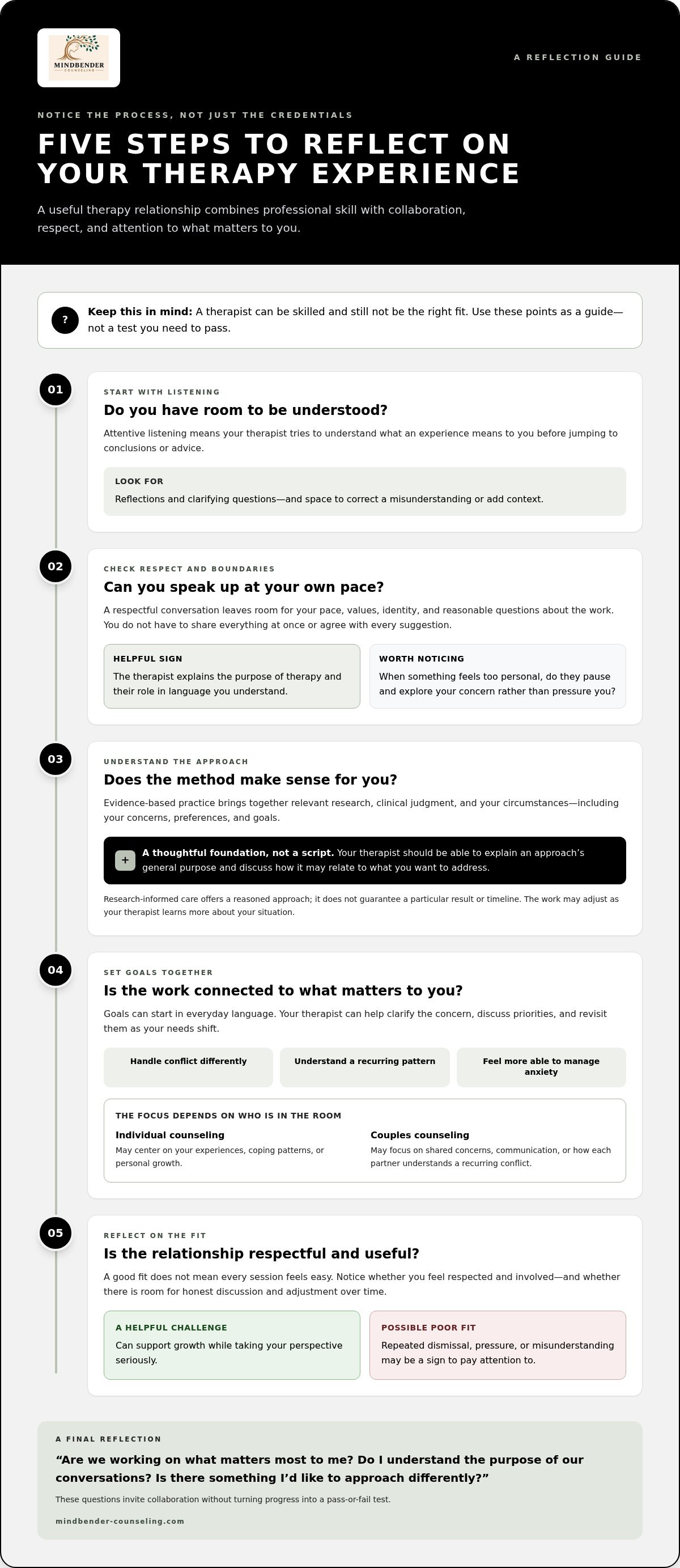
A Practical Checklist for Reflecting on Your Therapy Experience
It can be difficult to judge the whole of therapy from a single session. Use this checklist as a set of reflection prompts, not a scorecard or pass-or-fail test for your therapist. Notice patterns over time, including what happens when you ask questions, share feedback, or need to revisit a goal.
Collaboration and responsiveness are useful points to notice as you reflect on your therapy experience. Consider whether these qualities show up consistently, while allowing room for a session to feel challenging or imperfect.
- Listening: Do you feel your therapist understands the concern you’re trying to express, even if you need to clarify it?
- Respect: Can you share your perspective, values, and limits without feeling shamed or rushed?
- Shared goals: Do you understand what you’re working toward, and do your priorities return to the conversation?
- Clear communication: Can you ask why an approach is being used or what a suggested next step is meant to support?
- Responsiveness: When you offer feedback or say something isn’t helping, does the therapist make room to discuss it?
Questions to reflect on between sessions
You might take a moment after a session to consider what felt useful, difficult, or unclear. Did the conversation connect with something you want to address? Were your priorities understood, and did you have a chance to revisit them? Could you ask a question or offer feedback without feeling put down? A few brief notes can help you recognize recurring patterns without expecting every session to feel equally productive.
Notice context as well as emotion. A session may feel hard because you discussed something painful, not because the therapist handled it poorly. On the other hand, a repeated sense that you can’t speak openly may be worth exploring. Reflection can help you separate a moment of vulnerability from a pattern that deserves attention.
How to raise a concern with your therapist
If you feel able, use plain, specific language to open the conversation. For example: “I wasn’t sure how that suggestion connects with my goal. Could you explain it?” Or, “I noticed I felt rushed when we discussed that. Can we slow down or talk about what made it difficult?” You don’t need to make a case against your therapist. Sharing what you experienced gives both of you something concrete to discuss.
The response can offer useful information. Your therapist may ask what you meant, clarify their thinking, or discuss an adjustment with you. You might not resolve everything in one conversation, and a difference of opinion doesn’t automatically settle whether the relationship is right for you. Notice whether your concern is met with curiosity and whether you can continue the discussion without feeling dismissed.
As you consider what makes a good therapist for your needs, let the checklist guide your observations rather than make the decision for you. Mindbender Counseling provides individual and couples counseling in Arizona and Texas. Learn more about individual and couples counseling.
How Mindbender Counseling Builds Individualized, Evidence-Based Care
Knowing what to look for in therapy can help you think about what kind of support may suit your needs. Mindbender Counseling provides individual and couples counseling in Arizona and Texas, using evidence-based techniques and personalized interventions. Research-informed care and attention to each person or couple work together, rather than assuming one approach will serve everyone in the same way.
The question of what makes a good therapist also depends on the concerns and goals you bring to care. A useful starting point is identifying what you hope to understand, address, or change. You don’t need a perfectly formed goal before you begin. Naming what feels difficult or important can help shape a conversation about priorities.
Personalized individual and couples counseling
Individual counseling centers on one person’s mental health goals and circumstances. You might want to explore a recurring concern, understand your reactions, or work toward a change that feels important in your life. The focus can be shaped around your needs, with evidence-based techniques informing the work rather than dictating a fixed script.
Couples counseling offers a different focus: the relationship and the concerns partners want to address together. Conversations may involve communication challenges or recurring tensions, with attention to each partner’s perspective. Individual and couples counseling start from different needs. Neither promises a particular outcome; each provides a setting for working with the concerns that matter to the person or couple.
As therapy unfolds, it can be useful to revisit whether the work still reflects your priorities. Ask yourself what you want to focus on, what feels unclear, and what you’d like to understand better. Sharing those reflections can help keep the conversation connected to your needs. Mindbender Counseling pairs evidence-based techniques with care tailored to the individual or couple, taking your circumstances into account.
A considered next step in Arizona or Texas
If you’re considering counseling in Arizona or Texas, take time to identify the questions you’d like to bring into the process. You might write down what prompted you to seek support, what you hope therapy can help you explore, and what would make communication feel comfortable. Thinking through these points can help you describe what you’re looking for and what matters most to you.
There’s no need to have every answer before taking a next step. Mindbender Counseling provides individual and couples counseling in Arizona and Texas, with care shaped around each person’s or couple’s needs. Explore the practice to learn more about the counseling services available.
Take Your Next Step at Your Own Pace
You don’t need to know exactly how therapy will unfold before you begin. It’s enough to bring a question, a concern, or a sense that something in your life deserves attention. As you consider what makes a good therapist for you, remember that choosing support is a process: notice what helps you feel understood, involved, and able to speak honestly.
If you’re weighing individual or couples counseling, consider what you’d like support with and what questions would help you feel more prepared. There’s no need to have everything figured out first. A thoughtful next step can simply be learning about care and deciding whether it feels relevant to your situation.
Explore Mindbender Counseling to learn about individual and couples counseling in Arizona and Texas. When you’re ready, take the next step toward support tailored to your needs.
Frequently Asked Questions
Is it normal to feel nervous about meeting a therapist for the first time?
Yes, feeling nervous before a first session is common, especially if you’re unsure what you’ll be asked to share. You can start with a simple sentence such as, “I’m not sure where to begin.” You might also write down one concern or question beforehand and bring it with you. You don’t have to tell your whole story at once; you can take time to settle into the conversation.
Can a good therapist disagree with me or challenge my perspective?
Yes, a therapist can offer a different perspective, as long as the conversation remains respectful and connected to your concerns. For example, they might ask what supports an assumption or how a situation could look from another angle. You can ask what prompted the question or explain why it doesn’t feel right to you. A thoughtful exchange leaves room for you to consider the idea without being pressured to accept it.
What should I do if I do not feel comfortable opening up to my therapist?
You can tell your therapist that sharing feels difficult, or begin with a less personal topic while you get used to the process. For instance, you might say, “I want to talk about this, but I’m not ready to share the details yet.” You can also ask what information would be helpful to start with. You’re allowed to set a pace that feels manageable and revisit the topic later.
How can I tell whether a therapist respects my identity and personal values?
Notice whether the therapist uses the language you prefer, listens when you describe what matters to you, and avoids treating your identity as a problem to explain away. You might share a value or experience that affects a decision you’re facing and observe whether the therapist asks respectful questions rather than making assumptions. If something feels misrepresented, you can correct it and see whether your clarification is taken seriously.
Does a therapist need to have the same life experience as me to understand me?
No. Shared experience can sometimes help a therapist recognize certain context, but it isn’t the only path to understanding. Attentive questions, openness to correction, and respect for what you say can matter greatly. You might explain why a particular family, cultural, or personal experience shapes your choices. A therapist doesn’t need to have lived the same story, but should be willing to learn how it affects yours.
Should a good therapist give advice or help me find my own answers?
Therapy can include suggestions, information, and practical strategies, but advice shouldn’t replace understanding your situation. If you’re facing a decision, a therapist might help you clarify what matters, consider possible trade-offs, and identify a small next step. You can ask, “Could you help me think through my options rather than choose for me?” The right balance depends on your goals and what kind of support is useful to you.
Can online therapy be effective for individual or couples counseling?
Online sessions can be a useful format for some people and couples, depending on their needs, privacy, and ability to have a focused conversation through video. A private space and a reliable connection can help reduce interruptions. If you’re in Arizona or Texas, consider where you’ll be physically located during sessions and review current official state professional resources. Online care may not feel equally comfortable or practical for everyone.


