

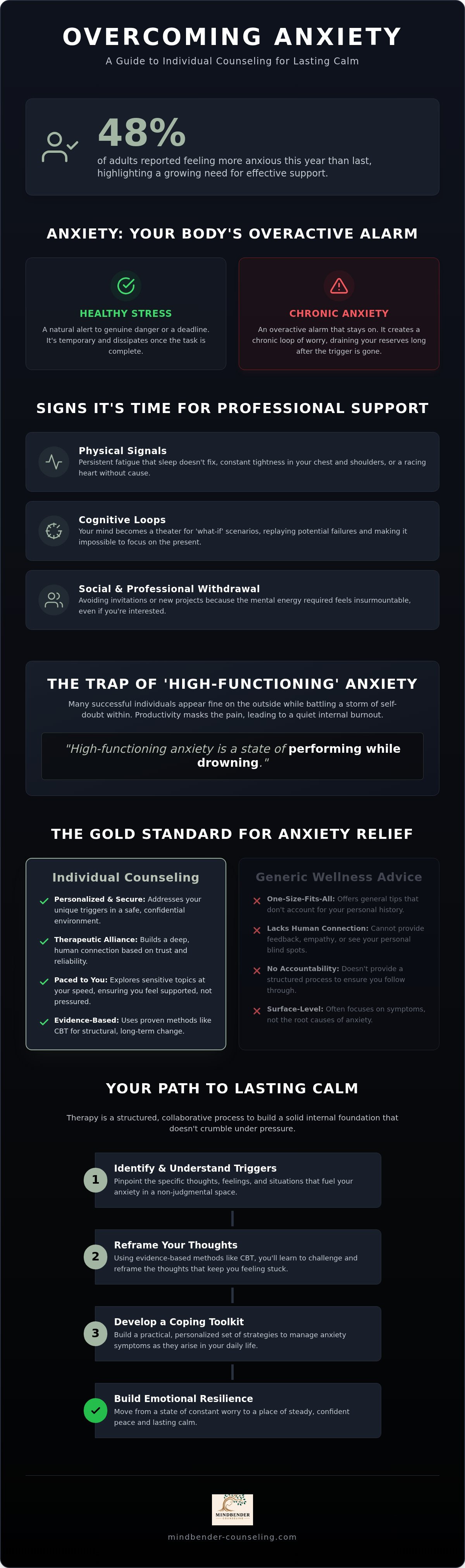
Did you know that nearly 48% of adults reported feeling more anxious this year than last? If you are part of that group, you likely know the heavy weight of a racing heart or the frustration of another night lost to insomnia. It is exhausting to feel like a prisoner to your own thoughts, especially when you are skeptical that simply talking will actually change anything. This is where individual counseling for anxiety makes a profound difference by moving beyond surface-level conversation into meaningful, structural change.
We understand that your experience is unique, and you deserve more than a one-size-fits-all approach. By choosing personalized, evidence-based therapy, you can finally move from a state of constant worry to a place of steady, confident peace. It is about building a solid internal foundation that does not crumble when life feels overwhelming. This guide explores how to identify your specific triggers, develop a practical toolkit of coping strategies, and restore the emotional balance you have been missing. We will walk through the process of how professional support acts as a sturdy anchor, helping you navigate toward a calmer, more resilient version of yourself.
Key Takeaways
- Learn how to reframe anxiety as an overactive alarm system, helping you approach physical symptoms with clarity rather than fear.
- Discover why individual counseling for anxiety is the most effective way to address your unique triggers in a secure and personalized environment.
- Explore how evidence-based methods like CBT provide a practical toolkit for reframing the thoughts that keep you feeling stuck.
- Understand what to expect when beginning therapy and how to find a licensed professional who fits your goals.
- See how a structured process acts as a sturdy anchor, guiding you from constant worry toward a state of lasting calm.
The Weight of Unseen Worry: Understanding Anxiety in 2026
Anxiety often feels like a relentless intruder, yet it's actually your body's natural alarm system functioning at an inappropriate volume. In its healthy form, this system alerts you to genuine danger. When it becomes overactive, it transforms into a chronic loop that distorts your perception of reality. For many professionals across Arizona and Texas, this internal noise is amplified by high-pressure environments and the fast-paced demands of modern life. Choosing individual counseling for anxiety provides a structured space to recalibrate this alarm, allowing you to distinguish between a momentary challenge and a false threat.
While 'healthy' stress usually dissipates once a task is finished, anxiety lingers. It creates a cycle where your mind and body remain in a state of high alert long after the workday ends. This persistent state of readiness is exhausting. It drains your emotional reserves and makes it difficult to find genuine rest. Seeking Cognitive Behavioral Therapy (CBT) or other evidence-based interventions helps you break this cycle by identifying the specific thoughts that fuel the fire. Through professional support, you can move from reactive survival to proactive living.
Common Signs Your Anxiety is Asking for Professional Attention
Anxiety manifests in ways that are often easy to dismiss as just being busy or tired. However, when these symptoms become your baseline, it is time to listen to what your body is saying. Professional attention can help you address these three primary areas:
- Physical signals: You might notice persistent fatigue that sleep doesn't fix, or a constant tightness in your chest and shoulders.
- Cognitive loops: Your mind becomes a theater for 'what-if' scenarios, replaying potential failures until you're unable to focus on the present moment.
- Social and professional withdrawal: You may start declining invitations or avoiding new projects, not because you're uninterested, but because the mental energy required to participate feels insurmountable.
The Emotional Toll of 'High-Functioning' Anxiety
Many individuals appear exceptionally successful on the outside while battling a storm of self-doubt within. This 'high-functioning' state is particularly deceptive because your productivity often masks your pain. You meet every deadline and maintain every social obligation, yet the cost is a slow, quiet internal burnout. Maintaining this facade of control in high-pressure environments eventually leads to a breaking point where the effort of appearing fine becomes too heavy to carry.
High-functioning anxiety is a state of performing while drowning.
Through individual counseling for anxiety, you can learn to lower the mask and find a way to thrive that doesn't require constant exhaustion. It is possible to maintain your drive and ambition without sacrificing your internal peace. By addressing the root causes of your worry, you build a foundation of emotional resilience that supports your long-term growth.
Why Individual Counseling is the Gold Standard for Anxiety Relief
While many seek relief through digital tools or general advice, individual counseling for anxiety stands apart because it prioritizes a deep, human connection. This relationship, often called the therapeutic alliance, creates a sanctuary of safety and reliability. Unlike a generic video or a group setting, a counselor listens to the specific nuances of your voice and the unique patterns in your story. This allows for personalized pacing. You never have to rush through painful topics. We move at the speed of your comfort, ensuring you feel supported rather than pressured as you explore your internal world.
Generic symptoms like worry or restlessness are often just the surface of a much more complex internal landscape. According to the National Institute of Mental Health, anxiety disorders involve more than temporary stress. They require targeted interventions that address your specific triggers. In a private session, we deconstruct these triggers in a judgment-free zone. This confidentiality is vital. It allows you to be completely honest about your fears without worrying about social or professional repercussions. This level of privacy creates the freedom necessary for genuine, transformative work.
One-on-one vs. Generic Wellness Advice
Self-help books offer valuable insights, but they cannot see your blind spots or hear the tremor in your voice when you discuss a specific memory. They provide a general map, but a professional counselor acts as a mirror, reflecting your internal progress and identifying the deep-seated roots of your anxiety. This is where individual therapy excels. It provides a structured foundation for growth that adapts to your needs in real-time. Instead of trying to fit your life into a pre-written chapter, we build the therapeutic process around your specific life experiences.
Building a Solid Internal Foundation
Real change happens when you shift from reactive coping to proactive emotional resilience. Instead of just putting out fires, you learn how to fireproof your internal world. These focused sessions foster long-term stability and self-assurance, helping you reclaim the parts of your life that anxiety has tried to shrink. Having a wise guide during life's most turbulent transitions ensures you don't have to navigate the fog alone. If you're ready to start building this foundation, exploring our Individual Counseling Services can be your first step toward a state of lasting, confident peace.
Evidence-Based Techniques: Beyond Just 'Venting' in Therapy
Many people hesitate to start therapy because they believe it's just an hour of venting without a clear path forward. While sharing your story is vital for building trust, modern individual counseling for anxiety focuses on evidence-based therapy. This shift means we prioritize goal-oriented strategies that produce measurable results in your daily life. Instead of only looking backward at the origins of your stress, we equip you with a functional framework to handle the challenges you face today. It's a collaborative process where we move beyond passive listening into active, skill-building sessions designed to restore your sense of agency and control.
CBT: The Mechanics of Reframing Thought Patterns
We often live within a narrative constructed by our fears. Cognitive Behavioral Therapy (CBT) helps you identify the "cognitive distortions" that fuel this narrative. These are mental shortcuts, such as catastrophizing or all-or-nothing thinking, that convince you a disaster is imminent. In our sessions, we use practical exercises to challenge these irrational fears. You might learn to use a thought record to track your triggers or practice behavioral experiments to test the validity of your worries in real-world scenarios. CBT is the practice of auditing your thoughts for accuracy. By doing this work, you stop being a passive observer of your anxiety and start becoming an active editor of your internal dialogue, ensuring your mind works for you rather than against you.
DBT and Mindfulness: Tools for the 'Stormy' Moments
When anxiety peaks into a panic attack or a sudden spike of dread, you need immediate tools to stay grounded. Elements of Dialectical Behavior Therapy (DBT) focus on masterfully navigating distress tolerance and emotional regulation. These techniques act as a toolkit for those stormy moments, helping you stay safe and present until the wave passes. Mindfulness-based interventions complement this by teaching you how to anchor yourself in the now, rather than the "what-ifs" of the future.
The science of neuroplasticity shows that consistent mindfulness practice actually changes the brain's response to stress. It strengthens the prefrontal cortex, which is the logical part of your brain, allowing it to better regulate the amygdala, your emotional alarm system. This bridges the gap between clinical techniques and the everyday peace you deserve, making calm a skill you can practice rather than just a feeling you hope for. By mastering these regulatory tools, you build a sturdy internal foundation that remains stable even when external circumstances are turbulent.
Navigating the Journey: What to Expect from Anxiety Therapy in Arizona & Texas
Taking the first step toward professional support is often the most difficult part of the healing process. While the previous sections explored the "why" and "how" of therapy, understanding the logistical journey helps to lower the remaining barriers to entry. Individual counseling for anxiety is a methodical process that begins with finding a professional who understands both your internal struggle and the external environment you inhabit. This journey is not a sprint; it is a steady evolution toward a state of lasting calm, supported by a therapist who acts as a sturdy anchor through every transition.
Consistency is the heartbeat of progress. At Mindbender, we emphasize a structured path that moves at your specific pace. We begin by assessing your current state and then develop a personalized treatment plan that targets your unique triggers. This approach ensures that every session builds upon the last, creating a predictable rhythm that helps reduce the friction often associated with seeking mental health care. By establishing clear, achievable goals early on, you can track your growth and see the tangible results of your commitment to emotional resilience.
Local Considerations for Arizona and Texas Residents
The professional landscape in the Southwest presents unique stressors that require a nuanced therapeutic approach. Whether you are navigating the rapid expansion of the Phoenix tech corridor or managing the high-stakes corporate expectations in Dallas, Austin, or Houston, your counselor should be attuned to these regional pressures. It is also vital to ensure your therapist meets the rigorous standards set by state authorities. In Arizona, Licensed Professional Counselors (LPCs) are regulated by the Arizona Board of Behavioral Health Examiners. In Texas, the licensing process is overseen by the Texas Behavioral Health Executive Council.
These boards require extensive master's level education and thousands of hours of supervised experience, ensuring that you receive care from a qualified expert. Today, accessing this high level of care is more flexible than ever. You can choose between traditional in-person sessions or secure telehealth options, allowing you to maintain your therapeutic momentum regardless of your location or professional schedule. If you are ready to begin this process with a licensed professional, you can schedule an initial consultation to discuss your specific needs.
Your First Session: Lowering the Barriers
The initial intake session is primarily about assessing "fit" and establishing a sense of safety. You don't need to arrive with all the answers or a perfectly polished history of your anxiety. It's helpful to bring any completed intake forms and a brief list of the milestones you hope to reach. Overcoming the "first-time jitters" is a natural part of the experience. Your counselor is there to facilitate the conversation, not to judge your progress or pressure you into sharing more than you are ready to disclose.
During this first meeting, we will begin to set realistic milestones for your recovery. This might involve identifying immediate coping strategies for panic or discussing the long-term goal of restoring professional confidence. By breaking the journey down into digestible segments, the path to calm becomes less overwhelming and more achievable. This collaborative foundation is what allows individual counseling for anxiety to be so effective, as it transforms a daunting internal struggle into a manageable, guided process of personal evolution.
Finding Your Anchor: How Mindbender Counseling Supports Your Growth
At Mindbender Counseling, we believe that professional expertise and deep, quiet compassion are not mutually exclusive. Our philosophy is rooted in the understanding that while clinical methods provide the necessary framework, it's the human connection that facilitates true healing. When you seek individual counseling for anxiety with us, you aren't just another case file. You are an individual with a unique history, specific strengths, and a personal vision for your future. Our process moves methodically from the initial acknowledgement of your struggles to a sustainable resolution, ensuring that every step we take together is purposeful and grounded in your specific needs.
We don't believe in applying a rigid template to your life. Instead, we tailor evidence-based methods to fit your unique life story. This means we take the time to understand how your anxiety interacts with your professional goals, your relationships, and your sense of self. By blending proven techniques with personalized care, we help you move toward a more resilient, calm version of yourself. This structured approach creates a sense of order and predictability, which helps to build a feeling of security and reduces the friction often associated with seeking professional support.
A Personalized Approach to Emotional Resilience
Treating the individual rather than just the diagnosis is central to our mission. A diagnosis might describe your symptoms, but it doesn't capture the nuance of your lived experience. We act as a sturdy anchor in your mental health journey, providing the stability you need to explore difficult emotions without feeling swept away. Our Individual Counseling Services empower you to build a solid internal foundation, allowing you to face life's uncertainties with a sense of quiet confidence. This internal progress is the key to long-term stability and the restoration of balance in every area of your life.
Ready to Begin? Your Path Forward Starts Here
Starting therapy should be a low-friction experience that respects your energy and your time. We have designed our intake process to be as responsive and supportive as the therapy itself. When you reach out, you can expect a clear, organized path forward that honors your readiness to change. There is no high-pressure demand, only a gentle invitation to begin the work of reclaiming your peace. Taking that first step is a profound act of self-care, and we're here to facilitate your journey toward well-being with professional care and unwavering support.
Schedule your individual counseling session for anxiety today.
Reclaiming Your Peace and Resilience
You have explored how anxiety functions as an overactive alarm and why specialized, one-on-one support is the most effective path to recalibration. By integrating evidence-based techniques like CBT and mindfulness, you can transform your internal narrative from one of constant worry to one of steady, confident peace. Individual counseling for anxiety offers more than just a place to talk; it provides a structured foundation where your unique goals take center stage. For residents in Arizona and Texas, this expert care is accessible through both in-person and secure telehealth options, ensuring your journey toward emotional balance is never interrupted.
Our professional, compassionate, and judgment-free sessions are designed to act as a sturdy anchor as you navigate life's transitions. You don't have to carry the weight of unseen worry alone any longer. It's time to invest in the internal progress you deserve. Begin your journey to calm with Mindbender Counseling today. You possess the capacity for profound change, and we are ready to guide you toward the lasting calm you've been seeking.
Frequently Asked Questions
How do I know if my anxiety is 'bad enough' for individual counseling?
Anxiety is bad enough whenever it begins to shrink your world or disrupt your daily peace. You don't need to reach a point of total exhaustion or a crisis before seeking professional support. If persistent worry, chest tightness, or insomnia are affecting your work in Phoenix or your relationships in Dallas, individual counseling for anxiety can help. Proactive intervention allows you to build resilience before your internal alarm system becomes completely overwhelming.
What is the difference between CBT and DBT for treating anxiety?
CBT focuses on auditing and reframing the specific thought patterns that trigger your anxiety. It helps you identify cognitive distortions like catastrophizing. DBT, while related, emphasizes distress tolerance and emotional regulation. It provides immediate tools to handle intense, stormy moments without being swept away by them. Both are evidence-based methods we use to help you build a solid internal foundation, but they address different aspects of the anxious experience.
How long does it typically take to see results from anxiety therapy?
The timeline for results varies for every individual, but many people notice a shift in their perspective within the first few sessions. Structural, long-term change typically requires a more methodical commitment over several months. This steady pace mirrors the patient nature of the therapeutic process. Our goal is to move you from reactive coping to a state of lasting calm, ensuring that the progress you make is sustainable and deeply rooted.
Can individual counseling help with physical symptoms like panic attacks?
Yes, individual counseling for anxiety is highly effective at addressing physical symptoms like panic attacks or heart palpitations. By understanding the science of your body's alarm system, you learn how to de-escalate the physiological response in real-time. We provide a toolkit of grounding exercises and mindfulness techniques that help you anchor yourself during a spike in worry. This process restores your sense of control over your body and your environment.
Is therapy for anxiety covered by insurance in Arizona or Texas?
Most insurance plans in Arizona and Texas provide coverage for mental health services due to the Mental Health Parity and Addiction Equity Act. However, you should always verify your specific plan's deductibles and copays. Under the No Surprises Act, if you aren't using insurance, you have the right to a Good Faith Estimate of expected costs. We encourage you to contact your provider directly to confirm how your benefits apply to professional counseling.
What should I look for when choosing an individual therapist for anxiety?
Look for a therapist who is licensed by the appropriate state board, such as the Arizona Board of Behavioral Health Examiners or the Texas Behavioral Health Executive Council. Beyond credentials, ensure they specialize in evidence-based therapy and have experience with your specific type of anxiety. The most important factor is the therapeutic alliance. You should feel a sense of safety and reliability, knowing your counselor acts as a wise guide in your growth.
Is online counseling as effective as in-person therapy for anxiety?
Research and current trends in 2026 indicate that secure telehealth is just as effective as in-person sessions for treating anxiety. Online platforms offer a more accessible and flexible alternative for busy professionals in high-pressure environments. It allows you to receive expert care from the comfort of your own space, which can actually lower the initial barriers to starting therapy. We provide secure, HIPAA-compliant options for residents across both Arizona and Texas.
What happens if I don't feel a 'click' with my therapist after the first session?
It is perfectly normal and acceptable if you don't feel an immediate click with your counselor. The relationship between you and your therapist is the most vital component of successful treatment. If the fit doesn't feel right after your initial consultation, we encourage you to speak up. A professional therapist will support your decision to find a different guide who better aligns with your personality and your specific goals for personal evolution.


