

What if the recurring arguments that keep you up at night aren't a sign that your relationship is failing, but simply a signal that your current toolkit has reached its limit? It's incredibly draining to feel unheard or dismissed by the person you love most. You likely want to move past the anxiety of what comes next and find a way to break the cycle of circular disagreements. By integrating structured communication exercises for couples into your daily life, you can begin to rewire how you interact and respond to one another.
This article provides ten research-backed strategies designed to de-escalate tension and deepen your emotional intimacy. We'll explore how these tools help you rebuild your relational foundation and regain the confidence to handle future conflicts with grace. You'll discover practical ways to transition from being adversaries in a disagreement to being a united team. From micro-intimacy habits to structured dialogue techniques, we'll guide you through the process of restoring balance and stability in your partnership. These tools offer a clear path toward a more secure and connected future together.
Key Takeaways
- Learn how to regulate your nervous system during heated moments so you can step out of "fight or flight" mode and return to a place of mutual understanding.
- Deepen your connection by creating detailed "Love Maps" that help you navigate your partner’s internal world with fresh curiosity and care.
- Master practical communication exercises for couples, such as the Speaker-Listener technique, to ensure every conversation leads toward resolution rather than resentment.
- Identify the specific signs that indicate when self-guided efforts should be supported by professional couples counseling to address deeper relational patterns.
- Adopt the concept of "relational fitness" to maintain your progress and view consistent communication as a vital habit for long-term stability.
Understanding the Science of Connection: Why Communication Fails
Communication is often misunderstood as a simple exchange of information. In reality, it's a complex regulation of the nervous system. When you feel safe, your brain allows for empathy and logic. When you feel threatened, those systems shut down. To understand why your efforts sometimes fall flat, we must look at the science of interpersonal communication. It's about how two people manage their internal states while trying to connect. When these states aren't managed, even the simplest conversation can feel like a battle for survival.
The Biological Basis of Relational Stress
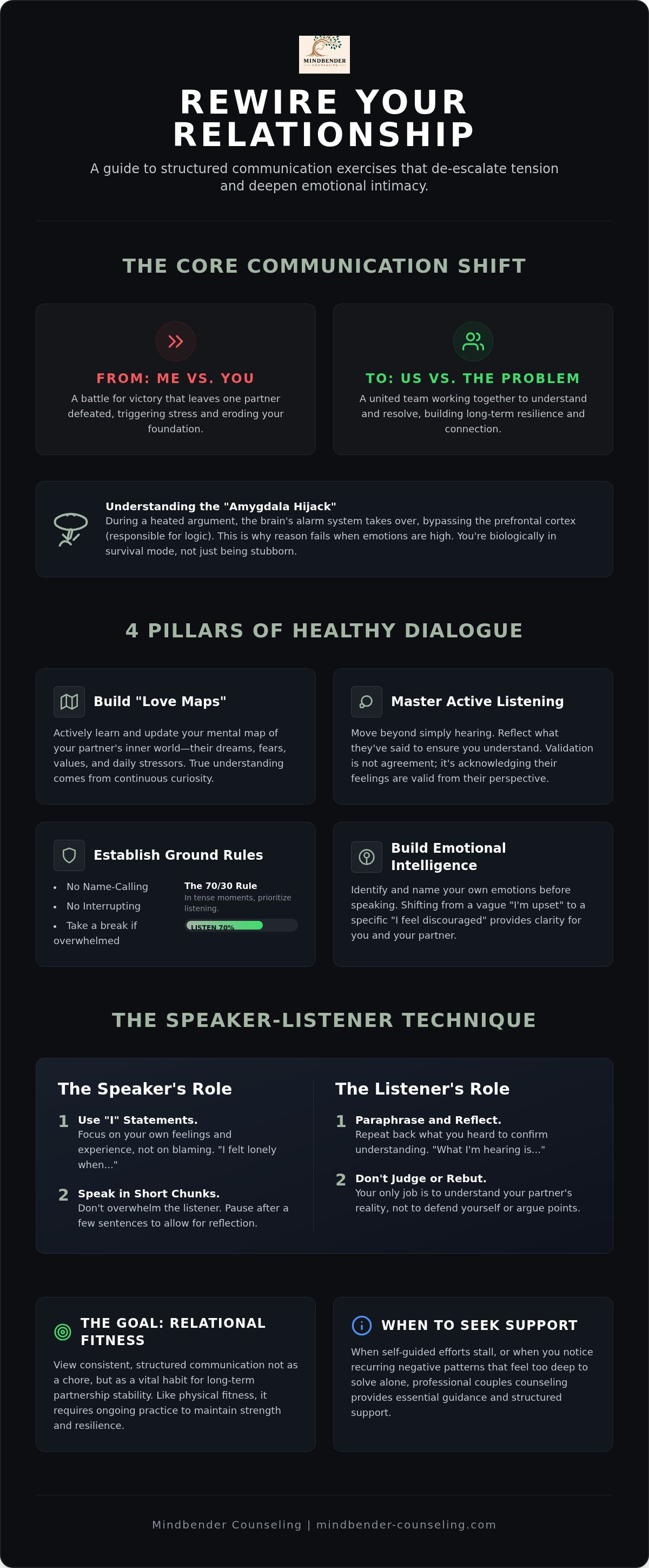
During a heated argument, your amygdala, the brain's alarm system, takes control. This "amygdala hijack" effectively bypasses the prefrontal cortex, which is the part of your brain responsible for reasoning and problem-solving. This is why logic fails when emotions are high. You aren't being stubborn; your brain is literally in survival mode. In this state, you might resort to defensiveness or stonewalling to protect yourself from perceived harm.
True connection requires emotional safety. Without it, even the best communication exercises for couples won't work. Many couples fall into the trap of trying to win an argument. Biologically, winning is a loss for the relationship because it leaves one partner defeated and disconnected. This triggers further stress for both people and erodes the foundation you've built together. By integrating communication exercises for couples into your routine, you can create a safe space for dialogue that avoids these biological pitfalls.
From Conflict to Connection: The Goal of Exercises
The objective of structured exercises is to shift your perspective from "me versus you" to "us versus the problem." This transition is essential for building long-term resilience. There's a vital difference between venting, which often keeps you stuck in a loop of frustration, and productive communication, which seeks to understand and resolve. At Mindbender Counseling, we help you navigate these shifts through professional guidance and evidence-based techniques.
Many people find that understanding these patterns is the first step toward change. This is where therapy behavioral therapy becomes a powerful framework. It helps you recognize the triggers that lead to conflict and provides the tools to replace them with healthier responses. By practicing these exercises, you aren't just talking; you're engaging in a form of neural rewiring that strengthens your bond and restores balance to your partnership.
The Foundation of Healthy Dialogue: Research-Backed Principles
Effective communication begins with a detailed map of your partner's inner landscape. Dr. John Gottman refers to these as "Love Maps," which represent the mental space where you store information about your partner’s dreams, fears, and daily stressors. When you use research-backed communication exercises, you're essentially updating this map with fresh data. This process requires the active cultivation of empathy, treating it as a vital skill that strengthens with practice rather than a fixed personality trait. Before starting any home-based work, establish firm ground rules: no name-calling, no interrupting, and a commitment to the "70/30 Rule." In high-stakes moments, aim to listen 70% of the time and speak only 30% of the time to ensure your partner feels fully witnessed.
The Power of Active Listening
Active listening involves moving beyond simply hearing words to reflecting and validating your partner’s experience. You might use specific phrasing such as, "What I hear you saying is that you felt lonely when I stayed late at the office; is that right?" This signals that you're attuned to their emotional reality. Validation doesn't require you to agree with their perspective; it simply means you acknowledge their feelings make sense from their point of view. Active listening is the bridge between two different subjective realities.
Building Emotional Intelligence Together
Emotional intelligence starts with the ability to identify and name your own emotions before you speak. Instead of a vague sense of being "upset," try to pinpoint specific feelings like "discouraged" or "unimportant." This clarity prevents your partner from falling into defensiveness and keeps the focus on your internal experience. You should also stay alert for "bids for connection," which are small attempts your partner makes for attention or affection. Recognizing a shared glance or a brief touch as a bid allows you to "turn toward" them, building a culture of fondness. For those who want to explore these patterns in a more structured environment, private therapy offers a confidential space to deconstruct long-standing habits. If you find that these practices reveal deeper wounds that feel difficult to navigate alone, seeking support from Mindbender Counseling can provide the professional guidance needed to restore your bond.
Choosing the Right Path: When to Use DIY Exercises vs. Therapy
"Can we just fix this ourselves with a book or a blog?" It's a question many couples ask when they first notice a drift in their connection. Self-guided communication exercises for couples are excellent tools for maintenance and for building a culture of appreciation. They act as a first-aid kit for minor relational scrapes. However, even the most dedicated partners can find that some wounds require the precision of a professional guide. On average, couples wait about three years after problems begin before seeking help. By that time, negative patterns are often deeply ingrained, making DIY efforts feel like a temporary bandage on a deeper issue.
A neutral third party offers a perspective that's impossible to achieve from within the relationship. When you're stuck in a circular argument, you're often too close to the fire to see the sparks. A professional helps you identify the underlying dynamics you might be missing. Transitioning from home-based tools to couples counseling Phoenix isn't a sign of failure. Instead, it's a proactive step toward ensuring your relational foundation is truly secure.
Signs Your Relationship Needs Professional Mediation
If your attempts at "communication" consistently lead to a total breakdown or emotional withdrawal, it’s time to seek support. You should look for the presence of the "Four Horsemen": criticism, contempt, defensiveness, and stonewalling. These behaviors are clinical indicators that your conflict has reached a level where self-regulation is no longer sufficient. In some cases, personal struggles like chronic stress can bleed into the partnership. When this happens, individual counseling for anxiety can be a necessary parallel to your work as a couple, providing each person with the internal stability needed to show up fully for the other.
The Benefits of Evidence-Based Professional Support
A therapist provides a "safe container," a structured environment where difficult disclosures can happen without the fear of the conversation spiraling out of control. There's a significant difference between well-meaning advice from friends and clinical intervention. Evidence-based therapy utilizes proven methodologies to rewire how you interact. For busy Arizona and Texas professionals, you don't have to worry about traditional scheduling hurdles. Understanding how does online couples counseling work can help you access high-quality care from the comfort of your own home, ensuring that your journey toward reconnection fits into your modern lifestyle.
5 Effective Communication Exercises to Try at Home Tonight
Engaging in communication exercises for couples at home allows you to build relational skills in a familiar, low-pressure environment. These tools aren't meant to be perfect on the first try. Instead, they act as a practice field where you can learn to navigate emotional terrain with more agility. If you find that an exercise starts to cause more tension rather than resolving it, it's a signal to pause and breathe. This awareness prevents the "failure state" where a tool intended for connection becomes a new source of conflict.
The Speaker-Listener Technique: A Step-by-Step Guide
This exercise provides a structured way to discuss sensitive topics without spiraling into an argument. It's built on three non-negotiable steps:
- Step 1: Assign the Floor. One person holds a physical object, like a remote or a coaster, to signify they are the speaker. The other person is the dedicated listener.
- Step 2: Paraphrase. After the speaker shares a brief thought, the listener must summarize what they heard in their own words.
- Step 3: Switch. Once the speaker feels fully understood, the roles reverse and the object is handed over.
A vital component of this technique is the "Stop Rule." If either partner feels flooded or begins to feel a surge of anger, you must call a 20-minute timeout to regulate your nervous systems. Remember, the goal of this exercise is understanding, not agreement.
The Stress-Reducing Conversation
Many professionals struggle with bringing the weight of the office home. This exercise is vital for those managing counseling for work stress Arizona, as it creates a clear boundary between professional pressure and personal peace. The rules are simple: the listener must not try to fix the problem. Instead, you should take your partner’s side against the world. Focus on offering emotional support, which validates their feelings, rather than instrumental support, which focuses on logistics and solutions.
Building a Culture of Fondness
To maintain your progress, incorporate these three additional habits into your routine:
- Daily Appreciation: Share one specific thing you appreciated about your partner today. This builds a "bank account" of positive sentiment.
- Weekly State of the Union: Schedule 30 minutes to discuss what's going well and what needs attention. This proactive approach prevents small issues from festering.
- The Miracle Question: Ask each other, "If a miracle happened tonight and our relationship was perfect tomorrow, what would be the first small sign you'd notice?" This shifts your focus toward a shared positive future.
If these home-based tools feel difficult to implement or if you find yourselves stuck in old patterns, our team at Mindbender Counseling can provide the professional structure and evidence-based guidance you need to move forward together.
Sustaining Progress: Building a Lasting Relational Foundation
Think of your relationship as a living organism that requires consistent nourishment. Relational fitness isn't a destination but a continuous practice. Just as you wouldn't expect to stay physically fit after a single visit to the gym, you shouldn't expect communication exercises for couples to yield permanent results without regular engagement. Communication is a muscle that requires consistent exercise to stay strong and flexible. By viewing your growth as an ongoing journey, you allow space for the natural evolution that occurs within every healthy partnership.
When you inevitably slip back into old communication patterns, try not to view it as a total setback. These "relapses" are often just data points that indicate where you might need a bit more support or focus. Instead of losing hope, use these moments to recalibrate and practice your new skills. Celebrating small wins, such as catching a defensive thought before it's spoken or successfully navigating a minor disagreement, helps build the momentum needed for long-term stability. It's the small, consistent efforts that ultimately define the strength of your foundation.
Creating a Culture of Repair
The "Repair Attempt" is perhaps the most critical skill for long-term stability. A repair is any statement or action, whether silly or serious, that prevents negativity from escalating out of control. Successful repairs can take many forms: a well-timed joke that breaks the tension, a gentle touch on the arm, or a simple, sincere verbal apology. The key is to move from a mindset of blame to one of curiosity. Instead of asking why your partner is being difficult, ask yourself what they might be needing in that moment. This shift creates an environment where both partners feel safe enough to be vulnerable after a conflict.
Integrating Professional Support into Your Growth
While home-based communication exercises for couples are foundational, periodic check-ins with a counselor can act as a powerful preventative measure against future crises. Personalized therapy offers Arizona and Texas couples a dedicated space to fine-tune their dynamics and address deeper patterns before they become entrenched. Think of professional support as a relational tune-up that keeps your connection running smoothly and helps you navigate life's inevitable stressors with greater ease. If you're ready to move beyond the basics and build a truly resilient bond, you can schedule a consultation with Mindbender Counseling to begin your journey toward lasting growth and emotional resilience.
Strengthening Your Relational Future
Reclaiming the connection in your relationship is a journey that begins with a single, intentional step. You now understand that healthy dialogue is more than just an exchange of words; it's a practice of nervous system regulation and emotional safety. By consistently integrating communication exercises for couples into your daily life, you're doing more than just resolving conflicts. You're building a culture of repair and mutual appreciation that serves as a sturdy anchor during life's inevitable storms.
While home-based tools are a powerful starting point, remember that seeking professional guidance is a sign of commitment to your shared future. Our licensed counselors in Arizona and Texas offer evidence-based therapeutic interventions and compassionate, expert guidance tailored to the needs of modern partners. Whether you're navigating a specific crisis or simply want to enhance your relational fitness, we're here to help you move forward with confidence. Begin your journey toward a stronger bond with Mindbender Counseling today. You have the capacity to transform your relationship, and you don't have to navigate that evolution alone.
Frequently Asked Questions
What if my partner refuses to participate in communication exercises?
Start by modeling the behavior yourself and focus on your own emotional regulation. Sometimes, seeing a partner's positive shift can encourage the other person to join in. If refusal persists, you might consider individual counseling to work on your own relational skills. This approach often lowers a partner's defenses and creates a more inviting atmosphere for change. You can still grow personally even if your partner isn't ready to participate yet.
How often should we practice these communication tools?
Consistency is more important than duration when practicing communication exercises for couples. Aim for short, daily check-ins of about five to ten minutes; combine these with a more structured weekly session. Treating these tools as a regular habit, much like physical exercise, helps build the relational fitness required for long-term stability. Regular practice ensures that these skills are accessible when high-stakes conflicts inevitably arise. It's about building a sustainable rhythm together.
Can communication exercises actually save a marriage on the brink of divorce?
Exercises can be a powerful catalyst for change, but they are often most effective when paired with professional support. While they provide immediate tools to de-escalate tension, a marriage on the brink usually requires deeper exploration of entrenched patterns. Research suggests that proactive work can significantly improve relationship satisfaction. However, couples in crisis benefit most from the safe container provided by evidence-based therapy, which addresses the root causes of distress.
What is the most effective communication exercise for high-conflict couples?
The Speaker-Listener Technique is highly effective because it forces a pause in the reactive cycle. By requiring one partner to paraphrase before responding, it ensures that both individuals feel heard and understood. This structure prevents the rapid escalation common in high-conflict dynamics. It allows couples to discuss sensitive topics without the conversation turning into a battle; this shifts the focus back to mutual understanding rather than winning or losing.
Are these exercises a substitute for professional couples therapy?
No, home-based communication exercises for couples are designed to supplement, not replace, professional clinical intervention. While these tools build essential skills, they cannot provide the neutral mediation and expert guidance found in a therapeutic setting. For Arizona and Texas residents, working with a licensed professional ensures that deeper issues, such as trauma or long-standing resentment, are addressed with the appropriate care. Therapy provides the clinical depth that self-guided exercises often cannot reach.
How do we stop an exercise if it starts turning into a real argument?
Implement a "Stop Rule" or a pre-agreed timeout signal as soon as someone feels flooded. When your heart rate exceeds 100 beats per minute, logic fails and the fight or flight response takes over. Take a minimum 20-minute break to engage in self-soothing activities before attempting to return to the conversation. This pause protects the relationship from the damage of words spoken in a state of high emotional arousal or distress.
How long does it take to see results from these communication skills?
Many couples report a decrease in immediate tension after just one or two successful sessions. However, lasting neural rewiring and habit formation typically take several months of consistent practice. You might notice small wins early on, such as a shorter recovery time after an argument. Long-term progress is usually a gradual process of building trust and emotional safety through repeated, positive interactions. Patience is vital during this transformative process.
Can individual therapy help if my partner won’t go to couples counseling?
Individual counseling for relationship issues allows you to explore your own triggers and communication style. When one person in a system changes their behavior, it often forces a shift in the entire dynamic. Our therapists in Arizona and Texas frequently work with individuals to help them build emotional resilience and more effective relational habits. This individual growth can ultimately improve the health of the partnership and lead to more constructive interactions.


