
What if your therapy session was the one place where you didn't have to explain the basic facts of your existence? For many individuals and partners in Arizona and Texas, searching for lgbtq couples counseling often feels like a defensive maneuver. You might find yourself scanning for clinical bias or bracing for the same heteronormative assumptions you face in everyday life. This hypervigilance is an exhausting byproduct of a regional climate where legislative shifts can make the world feel less certain. You shouldn't have to spend your time and energy educating your provider before the actual work of healing can begin.
We recognize that a therapist should be a sturdy anchor, especially when external stressors feel overwhelming. You deserve a professional environment where your identity is validated as a baseline, allowing you to move directly into deeper growth. This article explains how specialized LGBTQIA+ affirming therapy uses evidence-based methods to address minority stress and cultivate emotional resilience. We will look at how tailored support helps you manage anxiety and strengthen your relationship bonds through a lens of genuine understanding. By choosing a path rooted in both compassion and clinical rigor, you can find the stability and balance you need to thrive.
Key Takeaways
- Learn the critical difference between passive "friendly" labels and active clinical affirmation to find a professional who truly understands your lived experience.
- Understand how minority stress impacts your nervous system and gain practical tools to manage the chronic hypervigilance often felt in the Southwest.
- Strengthen your relationship through specialized lgbtq couples counseling that addresses unique dynamics like outness discrepancies and chosen family bonds.
- Identify the specific clinical tools a therapist needs to move beyond simple validation toward active, expert-led emotional growth.
- Explore how evidence-based therapy provides a structured path toward emotional resilience and stability for residents in Arizona and Texas.
Defining LGBTQIA+ Affirming Therapy: Moving Beyond 'Friendly'
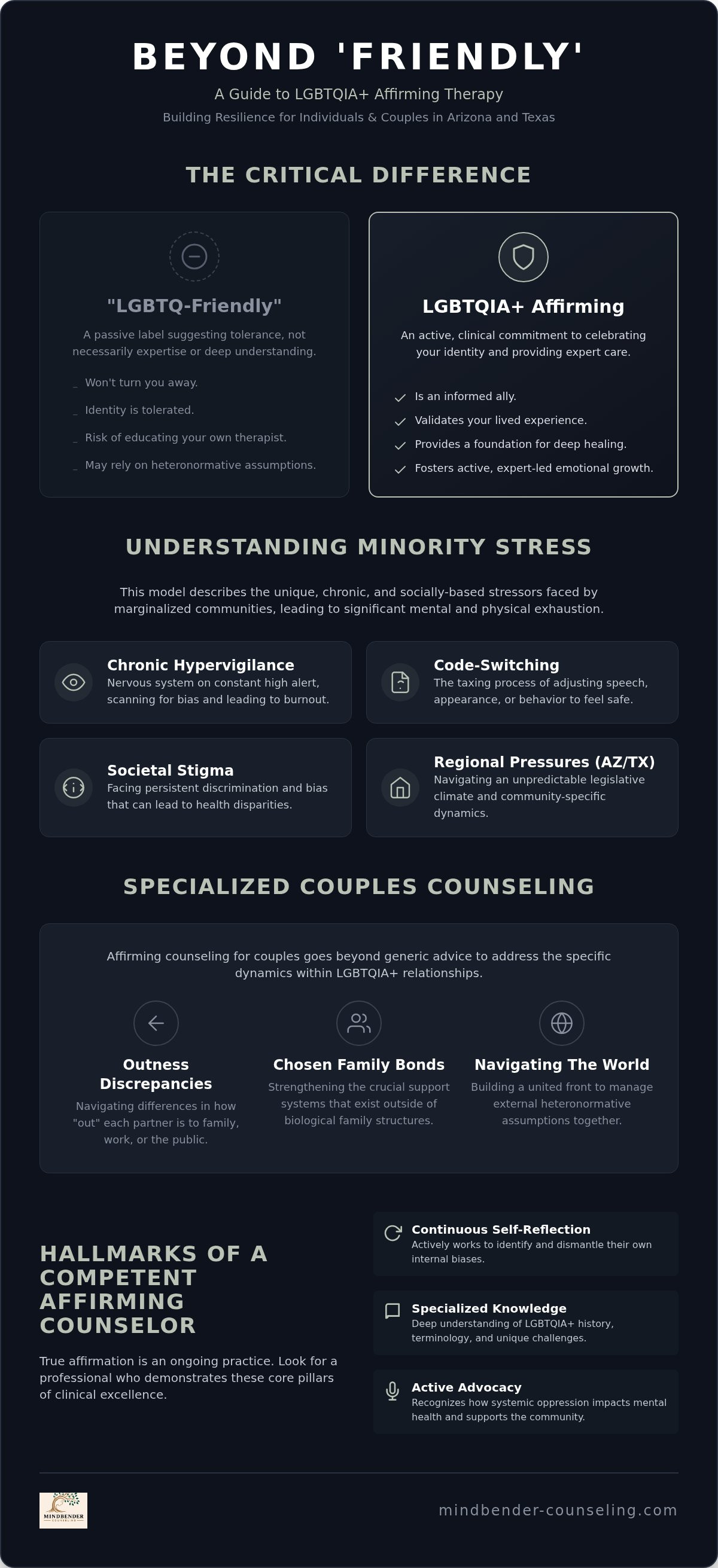
The term "LGBTQ-friendly" often appears as a passive marketing label, suggesting a provider simply won't turn you away. However, for those seeking lgbtq couples counseling, being tolerated isn't enough to foster deep healing. True progress requires an active clinical stance. By Defining LGBTQIA+ Affirming Therapy as a celebration of diverse identities, we move from mere acceptance to a rigorous clinical competency. This approach shifts the therapeutic power dynamic; the therapist doesn't act as a neutral observer but as an informed ally who validates your lived experience as a fundamental truth.
Identity validation serves as the essential foundation for any successful therapeutic outcome. When a therapist understands that your identity is a source of strength rather than a problem to be solved, it lowers your defenses. This safety allows you to focus on the actual work of relationship growth or personal resilience without the exhausting need to explain your basic reality. It's about building a solid internal foundation where you feel seen, heard, and respected from the very first session.
The Core Pillars of Affirming Practice
Affirming care isn't a static achievement. It's an ongoing commitment to excellence that rests on several key pillars:
- Continuous Self-Reflection: Therapists must engage in regular work to identify and dismantle their own internal biases, ensuring they don't bring heteronormative assumptions into the room.
- Specialized Knowledge: A deep understanding of LGBTQIA+ history, terminology, and community-specific challenges is required to provide accurate, evidence-based care.
- Active Advocacy: Affirming providers recognize how systemic oppression impacts mental health and actively support the well-being of the community beyond the office walls.
Why Affirmation is Vital for Arizona and Texas Residents
In Arizona and Texas, the legislative environment can feel unpredictable. For many, the therapist's office must function as a reliable sanctuary space when external environments lack support. Residents here face unique regional stressors, from shifts in healthcare access to community-specific social dynamics. Finding a therapist who understands these specific pressures is crucial for your mental health.
Choosing a local, state-licensed professional ensures your therapist understands these regional pressures. Unlike faceless national networks, a therapist rooted in your community understands the specific climate you're navigating. This proximity allows for a more nuanced approach to lgbtq couples counseling, providing the stability needed to build resilience despite external uncertainty. It creates a sense of order and predictability that is often missing in the broader social landscape.
Navigating Minority Stress: The Psychological Landscape of Queer Identity
Living with a marginalized identity often means managing a specific type of exhaustion that isn't just about a busy schedule. The Minority Stress Model describes these unique, additive stressors that the LGBTQIA+ community faces daily. Unlike general life stress, these pressures are chronic and socially based, often requiring a therapist who understands the nuances of lgbtq couples counseling to navigate effectively. Data suggests that LGBT individuals face health disparities because of persistent societal stigma and discrimination. In states like Arizona and Texas, this might manifest as "code-switching," which is the taxing process of adjusting your speech, appearance, or behavior to feel safe in professional or family settings.
Chronic hypervigilance keeps your nervous system in a state of high alert. You're constantly scanning for signs of rejection or bias, which eventually leads to burnout and deep-seated anxiety. This physical response isn't your fault; it's a logical reaction to an unsupportive environment. For those navigating the world at the intersection of queer identity and a marginalized race or disability, these pressures multiply. Recognizing these layers is the first step toward reclaiming your peace of mind. When you and your partner face these external pressures together, lgbtq couples counseling can serve as a protective buffer, helping you both process the specific fatigue of living in the Southwest.
The Impact of Chronic Stress on Mental Well-being
Minority stress is a chronic, socially-based stressor that requires specialized clinical attention because it originates from external systemic factors rather than internal pathology. Evidence-based therapy provides the tools to regulate a chronically "on-guard" nervous system, helping you return to a state of calm. By building emotional resilience, you can learn to navigate a heteronormative world without losing your sense of self or your connection to others.
Breaking the Cycle of Internalized Phobia
Reclaiming self-worth starts with identifying the "inner critic" that has been shaped by societal bias and rejection. You can use cognitive techniques to reframe these negative self-beliefs into narratives that are self-affirming and grounded in your actual value. The role of therapy behavioral therapy is vital here, as it offers structured methods to dismantle internalized phobia and restore your emotional stability. If you're ready to explore these tools in a safe environment, you might consider reaching out for individual counseling services tailored to your journey. This structured approach creates a sense of order and predictability, which helps to build a feeling of security in your daily life.
LGBTQIA+ Couples Counseling: Strengthening Bonds in a Heteronormative World
Your partnership doesn't exist in a vacuum. It lives and breathes within a society that often assumes a specific, heteronormative mold for what a "healthy" relationship looks like. When you navigate a world that wasn't built with your specific dynamics in mind, it's natural for external pressures to manifest as internal conflict. Specialized lgbtq couples counseling addresses these pressures directly. It moves beyond standard communication exercises to look at how external stigma enters the home, helping you and your partner build a sanctuary that is truly your own.
One of the most common challenges involves "outness" discrepancies. This occurs when one partner is more public about their identity than the other, which can lead to feelings of being "hidden" or, conversely, feeling "exposed." These aren't just simple disagreements; they are complex negotiations of safety and identity. We also provide a judgment-free space for non-traditional relationship structures, including polyamory and ethical non-monogamy. The American Psychological Association notes that significant barriers to equitable health care often prevent couples from finding this level of nuanced support. By working with a therapist who understands these specific needs, you can focus on strengthening your bond rather than defending your lifestyle.
The health of your partnership is also tied to your individual well-being. If one partner is struggling with the chronic weight of minority stress, it inevitably impacts the relationship's shared energy. Sometimes, seeking individual counseling for anxiety is a necessary step to support the health of the relationship as a whole. It allows each person to bring their most stable, resilient self to the partnership.
Identity Milestones and Relational Transitions
Relationships often face unique turning points, such as the "inviting in" process at different life stages or a partner's gender transition. These milestones require deep empathy and clear communication. We help you navigate these transitions while managing family-of-origin complexities, especially during holidays or major life events where traditional expectations might clash with your lived reality. This structured support provides the steady anchor you need during times of personal and relational evolution.
Building a Supportive Social Architecture
In the absence of biological family support, "chosen family" becomes a vital part of your social architecture. We explore the therapeutic importance of these bonds and help you develop shared values that defy heteronormative expectations. By fostering secure emotional attachment and creating your own "rules" for the relationship, you can build long-term intimacy that feels authentic and safe. This process transforms your partnership from a shared life into a resilient, fortified foundation for the future.
How to Evaluate an LGBTQIA+ Competent Counselor
A rainbow flag on a homepage is a welcoming signal, but it isn't a substitute for clinical competence. When you're searching for lgbtq couples counseling, you need more than just a "friendly" face. You need a provider who understands the intersection of identity and mental health as a core part of their practice. This distinction is vital because a well-meaning but untrained therapist can inadvertently reinforce the very biases you're trying to escape. True competence means the therapist has done the work to understand queer-specific stressors before you ever walk through the door.
There's a meaningful difference between a therapist who is a "learner" of your experience and one who is an "expert" in the clinical tools required to support it. You shouldn't have to spend your paid sessions acting as a cultural educator. An expert already understands the nuances of queer relational dynamics and uses that knowledge to facilitate your growth. They act as a sturdy anchor, providing a safe space where your identity is the foundation, not the focus of the problem. This allows you to move directly into the work of personal and relational evolution.
A trauma-informed lens is also essential. Many in the LGBTQIA+ community carry the weight of systemic or relational trauma that shapes how they interact with partners. A competent counselor recognizes these patterns without judgment. They also prioritize your safety and discretion. Evaluating a therapist's commitment to private therapy and confidentiality is paramount, especially in regional climates where privacy feels like a necessary layer of protection. Knowing your sessions are a secure vault allows for the deep vulnerability required for true change.
Essential Questions for Your Consultation
Don't hesitate to interview your potential therapist. A professional who is truly competent will welcome these questions. You might ask:
- "How do you integrate your understanding of minority stress into your clinical work?"
- "What is your experience supporting clients with my specific identity or relationship structure?"
- "How do you handle mistakes or misgendering within the therapeutic relationship?"
Red Flags to Watch For
Trust your instincts during the initial meeting. If a therapist attempts to "neutralize" or pathologize your identity as the root cause of your relationship issues, it's a sign they lack affirming competence. Another red flag is a provider who expects you to provide the majority of the education on LGBTQIA+ basics. Finally, a lack of awareness regarding WPATH standards or gender-affirming care protocols indicates they may not be equipped to support the full spectrum of your needs. If you want to ensure your care is grounded in both expertise and empathy, you can schedule a consultation for couples counseling to see if our approach fits your journey.
Cultivating Resilience: Mindbender Counseling’s Inclusive Approach
At Mindbender Counseling, we believe your identity is a source of strength, not a clinical hurdle. We blend deep, professional compassion with rigorous, research-backed therapeutic methods to ensure your care is as effective as it is affirming. While large, national telehealth networks often prioritize scale over depth, we focus on being a sturdy anchor for your personal and relational evolution. Our licensed therapists in Arizona and Texas understand the specific regional pressures you face, providing a level of stability that transactional platforms often lack. This personalized attention ensures that your specific needs aren't lost in a faceless directory.
We're committed to providing steady, unwavering support through every life transition. Whether you're navigating the complexities of a new relationship or seeking to strengthen a long-term partnership, our approach to lgbtq couples counseling is designed to meet your unique needs. We don't just offer a safe space; we provide a structured methodology that fosters real, measurable progress. This combination of warmth and clinical expertise allows you to lower your defenses and focus on the possibility of positive change. Our goal is to help you build a solid foundation that remains firm even when external environments feel uncertain.
Evidence-Based Care for the LGBTQIA+ Community
We utilize proven techniques like Cognitive Behavioral Therapy (CBT) and Dialectical Behavior Therapy (DBT) to address the roots of queer-specific trauma and minority stress. These modalities provide practical tools that help you build a solid internal foundation for long-term healing. By focusing on lgbtq couples counseling that integrates these evidence-based methods, we facilitate a journey toward lasting emotional well-being and self-actualization. This structured approach creates a sense of order and predictability, helping you reclaim a feeling of security in your daily life. We focus on the practical, everyday benefits of these methods, ensuring they resonate on an emotional level.
Taking the Next Step Toward Healing
Starting therapy shouldn't feel like another source of stress. We've designed a safe, low-friction entry into professional care so you can focus on your growth from day one. In your first session, you can expect a calm, welcoming environment where your lived experience is respected as a baseline. Whether you're seeking affirming care in Phoenix or via telehealth across Texas, we invite you to begin this journey with a wise and compassionate guide. You don't have to navigate these transitions alone; we're here to provide the steady support you need to build a resilient, authentic life. We treat every individual with fresh attention and care, acting as a professional facilitator for your unique journey toward well-being.
Building a Resilient Foundation for Your Future
You deserve a therapeutic space where your identity is celebrated rather than just tolerated. We've explored how moving beyond "friendly" labels toward true clinical affirmation creates the safety needed for deep, transformative work. By addressing the specific roots of minority stress with evidence-based tools, you can move from a state of hypervigilance to one of lasting stability. Whether you are seeking lgbtq couples counseling to strengthen your partnership or individual support to manage regional stressors, the right guidance makes all the difference. This journey is about reclaiming your sense of self and building a life that feels authentic and secure.
Our team brings deep expertise in trauma-informed care and research-backed interventions to every session. We are licensed to serve residents across Arizona and Texas, providing a local, compassionate alternative to transactional national networks. You don't have to navigate these complexities alone. We invite you to schedule a consultation for affirming LGBTQIA+ therapy today. Taking this step is a powerful act of self-advocacy. We're here to be your steady anchor as you cultivate the resilience and connection you deserve. There is a path forward to a more balanced, joyful future, and it starts with the right support.
Frequently Asked Questions
Is LGBTQIA+ therapy different from regular therapy?
LGBTQIA+ affirming therapy differs from traditional models because it actively celebrates diverse identities rather than merely tolerating them. It moves beyond a "neutral" stance that can inadvertently cause harm by ignoring the realities of systemic bias. Our approach integrates an understanding of queer history and community-specific challenges into the clinical process. This ensures that your identity is validated as a baseline for all therapeutic work.
How do I know if a therapist is truly gender-affirming?
You can identify a truly gender-affirming therapist by looking for specific clinical competencies rather than just inclusive marketing. Ask potential providers about their familiarity with WPATH standards and how they handle mistakes like misgendering within the therapeutic relationship. A competent therapist will be an expert in clinical tools who doesn't expect you to provide the majority of their LGBTQIA+ education.
What is minority stress and how does it affect my mental health?
Minority stress is a chronic, socially-based stressor that results from living in a society where your identity is marginalized. This additive pressure keeps your nervous system in a state of constant hypervigilance, which often leads to persistent anxiety and emotional burnout. Understanding this model helps you realize that your distress is a logical reaction to your environment rather than an internal flaw.
Do you offer couples counseling for same-sex partners in Arizona?
We offer specialized lgbtq couples counseling for same-sex partners and all queer-identified couples throughout Arizona. Our sessions focus on the unique dynamics of your relationship, such as navigating outness discrepancies or building a chosen family. We provide a professional sanctuary where you can strengthen your partnership without facing heteronormative assumptions.
What should I do if I’ve had a bad experience with a therapist before?
If you've had a negative experience with a provider, it's important to recognize that your caution is a valid form of self-protection. We recommend using a consultation to ask direct questions about a therapist's experience with your specific identity or relationship structure. Finding a "wise guide" who prioritizes a trauma-informed lens can help you rebuild trust and feel safe in a clinical setting again.
Is online therapy safe and confidential for LGBTQIA+ individuals in Texas?
Online therapy is both safe and highly confidential for Texas residents when conducted through HIPAA-compliant platforms. We prioritize your privacy to ensure that our virtual office remains a secure vault for your personal and relational evolution. This format allows you to access specialized care from the comfort of your home, providing a sturdy anchor regardless of your local legislative climate.
Can therapy help me with the 'coming out' process to my family?
Therapy is an excellent resource for navigating the "coming out" or "inviting in" process with your family. We help you manage the complexities of family-of-origin dynamics and prepare for various outcomes with emotional resilience. Our goal is to support you through these transitions while ensuring your sense of self remains stable and fortified.
How does evidence-based therapy work for LGBTQIA+ issues?
Evidence-based therapy works by applying research-backed methods like CBT or DBT to the specific challenges addressed in lgbtq couples counseling. These techniques help you dismantle internalized phobia and reframe negative self-beliefs into self-affirming narratives. By using structured interventions, we help you build a solid internal foundation for long-term healing and emotional well-being.


