

What if the best place to begin therapy isn’t with a particular method, but with the concern you want help addressing? Looking for phoenix therapy often raises a practical question: should you start with individual counseling or couples counseling? It’s understandable to feel unsure, especially if you want support that feels personal rather than impersonal or overly clinical.
The right starting point depends on what you hope to work on. Individual counseling gives you space to focus on personal mental health goals, while couples counseling centers on communication and relationship conflict. You don’t have to choose perfectly at the outset. Your needs can help shape the conversation and the goals you set.
This guide explains how the two formats differ, what evidence-based, personalized support can involve, and how Mindbender Counseling approaches care for individuals and couples. It also offers practical ways to prepare for a first conversation, even if you’re still figuring out what you need. Mindbender Counseling provides counseling in Arizona and Texas, including support for people searching for Phoenix therapy.
Key Takeaways
- Therapy offers structured professional support for emotional or relationship concerns, even when you’re still finding the words for what feels difficult.
- Evidence-based care draws on research-informed approaches and adapts the process to your goals, rather than following a fixed script.
- Who will attend and what you want to address are practical ways to identify a counseling format to start with.
- With phoenix therapy, you can begin by naming one concern and one manageable goal. You don’t need a formal diagnosis or a perfectly phrased explanation to take that step.
- Mindbender Counseling offers individual counseling, couples counseling, and evidence-based therapy, with personalized interventions shaped around your needs.
Phoenix Therapy: When Counseling Can Help You Find More Balance
Starting therapy can feel unfamiliar, even when you know support might help. You don’t need to wait until you’re in crisis or have a clear explanation for everything you’re feeling. In this guide, phoenix therapy means mental health counseling for emotional and relationship concerns, not physical rehabilitation. Mental health therapy helps you explore thoughts, feelings, and patterns; physical therapy focuses on movement and physical function.
Therapy is structured professional support: a place to talk through what’s happening, consider what you want to change, and work toward personal goals. People seek counseling during difficult periods, but also for self-understanding, personal growth, or everyday challenges that have become hard to manage. There’s no single reason you need to have before starting.
What concerns can Phoenix therapy help you explore?
You might want space to make sense of persistent stress, difficult emotions, a major life change, or a feeling that everyday demands are becoming difficult to manage. Counseling can help you notice what’s weighing on you and put your experience into words, without assuming a diagnosis or applying a one-size-fits-all explanation.
Relationship concerns can also be a reason to seek support. You and your partner may keep returning to the same disagreement, struggle to communicate clearly, or feel unsure how to raise a sensitive issue. Couples counseling focuses on communication and recurring conflict, while individual counseling centers on your personal mental health goals.
In Phoenix and across Arizona, “therapy” can refer to different kinds of care. Here, the focus is mental health counseling. Mindbender Counseling also provides individual and couples counseling in Texas. For broader context on psychotherapy and the range of approaches it can include, see this overview of psychotherapy.
What does a supportive therapy experience aim to provide?
A supportive counseling process gives you structured conversations in which you can slow down, describe what feels difficult, and clarify what you’d like to be different. You don’t need perfect words. “We keep having the same argument” or “I feel stretched thin” can be enough to identify what deserves attention.
Goals can make the work more personal and purposeful. You might want to understand an emotional pattern, strengthen communication, or feel more grounded as you face a challenge. Evidence-based therapy draws on research-informed approaches and adapts support to your needs. It isn’t a fixed script or a promise of a particular result.
It’s understandable to feel uncertain about what private counseling involves. This guide to private therapy explores the subject further. To start reflecting, ask yourself: what would you most like support in understanding or changing? You don’t need to solve it alone before asking for help.
How Evidence-Based Phoenix Therapy Connects Methods to Personal Goals
Evidence-based care draws on research-informed approaches and connects them to your personal goals. In phoenix therapy, this means considering the person or couple in front of the therapist, rather than applying one formula to every concern. Evidence can inform the work, but it doesn’t determine what matters most to you or guarantee a particular outcome.
A method guides the work; it doesn’t dictate every conversation. Your circumstances, priorities, and responses matter. Someone hoping to feel more grounded during a demanding life change may have different goals from a couple working to communicate more constructively during disagreements. Counseling can be shaped around those distinct concerns.
How does personalized counseling shape the work?
Personalized therapeutic interventions connect counseling to what you want to address. You might start with a broad concern, then identify a more practical focus, such as noticing what tends to happen before a difficult conversation or finding a clearer way to express a need. A couple might focus on understanding a recurring conflict and communicating through it with greater care.
Goals can help sessions stay relevant, but they don’t have to remain fixed. As you reflect on your experiences and gain clarity, an initial goal may shift or become more specific. That’s a useful part of the process, not a sign that you’ve chosen the wrong direction. For more on how behavioral approaches relate to emotional well-being, see this guide to evidence-based behavioral therapy.
What does evidence-based therapy mean in everyday language?
In everyday terms, evidence-based therapy uses methods informed by research rather than relying only on guesswork. Applying that knowledge still calls for professional judgment: the approach should make sense for your circumstances, goals, and responses. Research can inform the work, but it can’t tell your whole story.
For couples, evidence-informed support can provide a focused space to examine communication and relationship conflict. This general overview of the benefits of couples therapy explains how relationship counseling differs from working on personal goals individually. The right focus depends on what you want counseling to address.
At Mindbender Counseling, evidence-based therapy is paired with personalized interventions for individual and couple needs. You can begin with one concern and refine your goal as the work develops. Learn more about Mindbender Counseling’s approach to counseling shaped around your goals.
Individual or Couples Therapy in Phoenix: Which Starting Point Fits?
Choosing between individual and couples counseling doesn’t require a label or diagnosis. Start with the concern you want to address: is it centered on your personal emotional well-being, or on a pattern between you and your partner? That distinction can make phoenix therapy feel more practical, even if you’re still unsure which format is the best fit.
| Counseling format | Who attends | Primary focus |
|---|---|---|
| Individual counseling | One person | Personal mental health goals and emotional needs |
| Couples counseling | Partners together | Communication and relationship conflict |
The formats differ in focus, not in how valid your concern is. If personal feelings and relationship patterns both seem relevant, consider which feels most pressing right now. You can start with the issue that’s easiest to describe and use counseling to clarify your goals.
When might individual counseling be a useful fit?
Individual counseling may be a useful starting point when you want to focus on your own experience, choices, or emotional goals. Perhaps you’re feeling overwhelmed by a change, finding it hard to switch off from worry, or hoping to understand how you respond to stress. You don’t need to know the cause or arrive with a diagnosis. Start with what you notice and what you’d like to feel or handle differently.
If anxiety is one of the concerns you want to explore, this resource on individual counseling for anxiety offers related context. The focus of individual counseling remains your personal needs and the goals you want support with.
When might couples counseling be a useful fit?
Couples counseling may fit when the concern involves how you and your partner communicate or handle recurring conflict. You may keep returning to the same disagreement, feel unheard during difficult conversations, or struggle to raise a concern without tension taking over. Counseling can focus on understanding these interaction patterns and addressing communication together.
Couples counseling isn’t individual counseling with both partners present. Its focus is the relationship and the communication or conflict you want to examine. It can’t promise that every relationship will be repaired or preserved. Instead, it offers a structured way to explore concerns and work toward goals that matter to the people involved.
A useful first question is: “Would I like support with my own goals, or do we want to work on something happening between us?” Your answer doesn’t need to settle every detail. It can point toward a starting conversation, with the focus becoming clearer as you consider what you hope to understand or change.
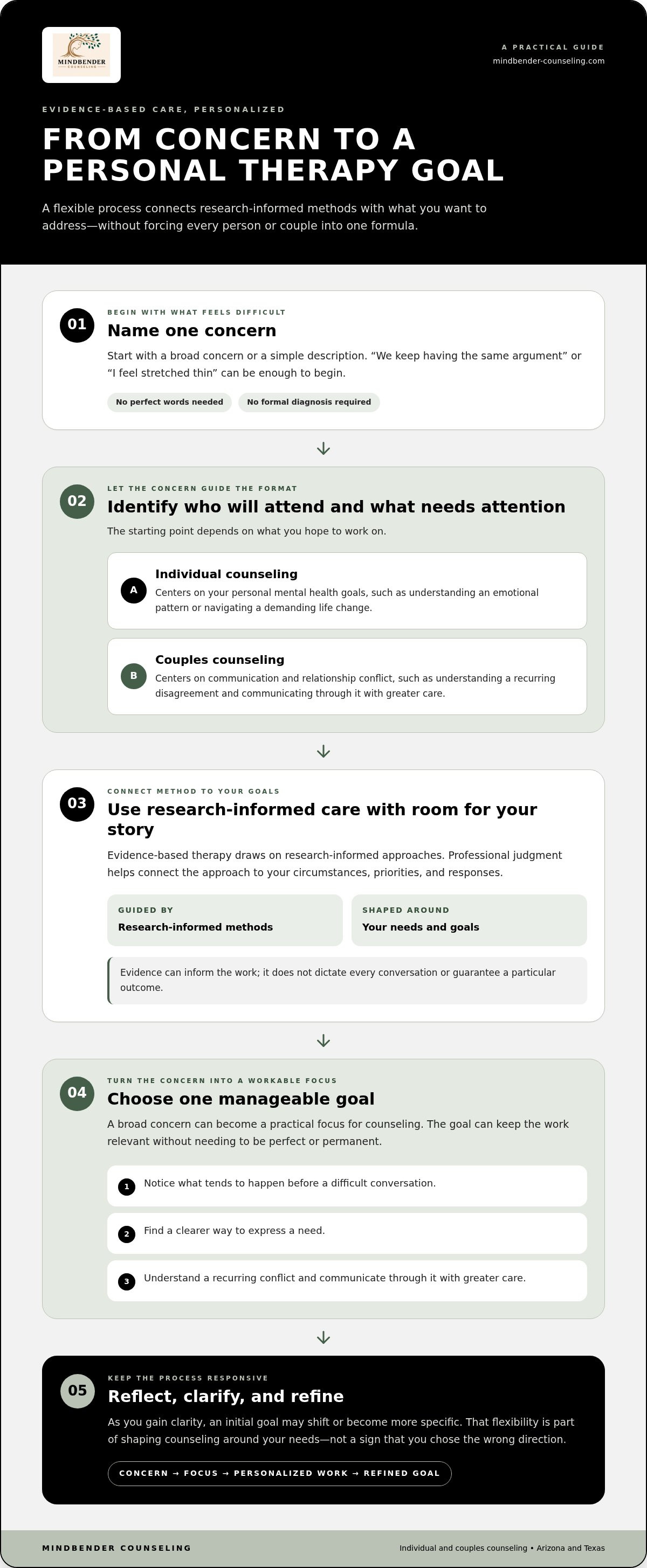
Taking a Practical First Step Toward Therapy in Phoenix
You don’t need a complete plan before seeking support. A little reflection can help you explain what’s been difficult and what you hope might change. If you’re looking for phoenix therapy, a first step can be as simple as naming a concern and deciding whether you want to explore it with a counselor.
Try this simple sequence:
- Name the concern. Describe what has been on your mind or what keeps happening. “I feel tense after work” or “we keep getting stuck in the same argument” is enough to begin.
- Identify a goal. Think about what you’d like to understand, express, or handle differently. Your goal can be broad at first, such as feeling more settled or communicating with less frustration.
- Choose a starting format. Consider whether the focus feels personal, relational, or a mix of both. Individual counseling centers on personal goals; couples counseling addresses communication and relationship conflict.
How can you clarify what you want support with?
Take a few minutes to jot down what tends to recur, what you wish could change, and any questions you have about counseling. You might note that you feel overwhelmed at a particular time of day, or that conversations with your partner often end before either of you feels heard. These observations make a first conversation more concrete without turning reflection into a diagnostic checklist.
Not knowing exactly what you need is also a reasonable starting point. You can say, “I’m not sure where to begin, but something feels difficult.” You don’t need a formal diagnosis or a polished explanation to explore your concerns.
What can help make reaching out feel manageable?
Keep the next step small. Write down one concern, decide whether you’d prefer to focus on personal goals or a relationship concern, or learn more about the counseling process. You don’t have to resolve every question before seeking support. You can move at a pace that feels manageable.
Mindbender Counseling offers individual and couples counseling with personalized therapeutic interventions shaped around each person’s or couple’s needs. The concerns you bring and the goals you identify can guide the work, rather than forcing your experience into a preset script. Even a few honest words about what’s been hard can provide a meaningful place to start.
To learn more about counseling with Mindbender Counseling, visit the practice website.
Mindbender Counseling: Personalized Therapy for Phoenix-Area Needs
Finding support that fits begins with the concerns you want to bring into the conversation. For Phoenix-area readers exploring mental health counseling, Mindbender Counseling offers individual counseling, couples counseling, and evidence-based therapy. The focus is not on assigning you a label or fitting your experience into a preset plan. It’s on understanding what feels difficult and shaping therapeutic interventions around the needs and goals you identify. Mindbender Counseling also serves clients in Texas.
That may mean working toward personal mental health goals, exploring communication concerns, or looking at relationship conflict. You don’t need to arrive with every detail worked out. Your questions and the changes you hope to make can help give the counseling process direction.
How Mindbender Counseling approaches individual and couples care
Individual counseling centers on your personal mental health goals. You might want to better understand what’s affecting your well-being, reflect on a challenge, or identify a meaningful change to work toward. One-on-one counseling makes room to focus on your experiences and priorities, with interventions tailored to your needs.
Couples counseling has a different focus: communication and relationship conflict. Partners can bring concerns about how they talk through disagreements or patterns that keep recurring. The work is shaped around the needs of the couple and the concerns they want to address. Evidence-based approaches inform both individual and couples care, while personalization keeps the work connected to each person’s or couple’s goals.
Choose a gentle next step toward Phoenix therapy
You don’t have to know exactly which concern matters most or how to describe it perfectly before you begin. A simple starting point might be, “I want to understand why this has been difficult,” or “We’d like help with how we communicate.” Even uncertainty can help identify what you want to explore. You can begin with one question and let your goals become clearer over time.
As you consider phoenix therapy, think about whether your main focus is a personal goal or something happening in your relationship. That reflection can help you decide which counseling format feels like a sensible place to start, without treating the choice as permanent or requiring a diagnosis. Mindbender Counseling connects evidence-based interventions with the concerns you bring and the growth you hope to pursue.
If you’re ready to explore support, visit Mindbender Counseling to learn about individual or couples counseling.
Take the Next Step at Your Own Pace
You don’t need to feel completely certain before you begin. A useful next step can be a simple conversation about what you’re hoping to change, understand, or approach differently. Let that intention guide your search for phoenix therapy, rather than waiting until you have a perfect explanation or a fully formed plan.
Mindbender Counseling provides individual and couples counseling grounded in evidence-based approaches, with personalized therapeutic interventions shaped around each person’s or couple’s needs. Whether you’re considering support for your own growth or hoping to work through concerns together, the process can begin with what matters to you now.
Give yourself room to ask questions and decide what feels manageable. Reaching out doesn’t require having everything figured out; it can simply open the door to exploring support. Connect with Mindbender Counseling to begin a conversation about individual or couples counseling. Your path forward can start small and still be meaningful.
Frequently Asked Questions
How do I know if therapy is right for me?
Therapy may be worth exploring if emotional strain, a life change, or relationship tension is affecting your daily choices or sense of well-being. You might notice you’re withdrawing from people, having trouble concentrating, or repeating a response you’d like to understand better. You don’t have to be certain counseling is the answer. A first conversation can help you decide whether support feels useful for what you’re facing.
Can therapy help if I do not have a mental health diagnosis?
Yes. You can seek counseling without a formal diagnosis. People may want help thinking through a transition, strengthening self-understanding, or working toward a personal goal, even when they don’t identify with a clinical label. You can describe what’s happening in everyday language, such as “I’ve been feeling stuck” or “I want to handle conflict differently.” The focus can be on the concern and the kind of change you hope to pursue.
How long does therapy usually take?
There isn’t one standard timeline. The length of counseling can depend on what you want to work on, how your goals develop, and what feels useful as you make progress. Some concerns may call for a focused period of support; other goals may take longer to explore. You can talk with your counselor about what you hope to address and revisit whether the work still fits your needs as it continues.
Is individual therapy different from couples counseling?
Yes. Individual counseling involves one person working on personal concerns and goals, while couples counseling brings partners together to focus on relationship patterns. You might choose individual support to explore how stress affects your decisions, or couples counseling to address how disagreements unfold between you. If both personal and relationship concerns matter, identifying which feels most urgent can help you decide where to begin.
Can couples counseling help when partners disagree about the relationship?
It can offer partners a structured setting to express different perspectives, listen to one another, and clarify what each person wants to address. You don’t need to agree on every outcome before starting a conversation about the relationship. Counseling can support clearer communication and exploration of the conflict, but it can’t guarantee that partners will reach the same decision or that a relationship will continue.
What should I do if I need immediate crisis support?
If you or someone else may be in immediate danger, call 911 or go to the nearest emergency department. In the United States, including Arizona and Texas, call or text 988 to reach the Suicide & Crisis Lifeline for urgent emotional support. If you can, stay with a trusted person while seeking help. Routine counseling is not a substitute for emergency support when safety is at immediate risk.


