

What if the first sign that relationship therapy could help isn’t a major crisis, but the feeling that the same conversation keeps ending the same way? If you’re searching for relationship therapy Chandler AZ, you may already know that recurring conflict or growing distance can be hard to shift alone. You may also wonder whether both partners need to feel ready before counseling can be useful.
That uncertainty is understandable. A good therapy fit makes room for both perspectives, clarifies what you want to work toward, and responds to your relationship rather than following a one-size-fits-all plan. The next step isn’t about securing a particular outcome. It’s about finding a process you can understand and take part in together.
This guide explains what relationship therapy can help you explore, how to assess whether an approach fits your needs, and how personalized, evidence-based couples counseling at Mindbender Counseling can support your goals. You’ll also find practical ways to start the conversation, whether you’re both ready to begin or still considering the idea. These steps can help couples in Chandler and elsewhere in Arizona or Texas clarify what support could look like.
Key Takeaways
- Recognize when recurring conflict, strained communication, or disconnection may be worth addressing with professional support.
- Use a simple decision framework to clarify concerns, shared goals, and what a comfortable therapy process would look like.
- Consider how relationship therapy Chandler AZ can help you explore distinct goals, from communicating more clearly to rebuilding connection.
- Prepare for a thoughtful conversation by noting your concerns, hopes, and questions before discussing them together.
- Learn how Mindbender Counseling uses evidence-based techniques and personalized interventions to support each couple’s relationship goals.
When to Consider Relationship Therapy in Chandler, AZ
Seeking help can feel like a significant step, especially if you and your partner aren’t sure what to expect or whether you’re both ready. You don’t need a perfect explanation of what’s wrong before exploring support. It may be enough to notice that familiar conversations keep going off track or that you miss feeling close to one another.
Couples consider relationship therapy Chandler AZ for many reasons, including repeated arguments, difficulty listening without becoming defensive, and uncertainty about how to reconnect. Therapy doesn’t have to be a last resort. It can provide a structured space to understand what’s happening between you and decide what you would like to change. Couples in Arizona and Texas can begin by identifying the patterns that matter most in their own relationship.
What relationship concerns can couples bring to therapy?
You might revisit the same disagreement about household responsibilities, feel unheard when raising a concern, or avoid certain topics because they tend to escalate. Tension can also build through smaller moments: a missed bid for attention, a sharp response after a stressful day, or an apology that doesn’t resolve the hurt. Over time, these moments can become a pattern both partners want to understand.
Relationship difficulties don’t automatically mean a couple needs therapy. But if a concern keeps returning, affects your sense of connection, or feels hard to discuss productively, a professional conversation may help you look at it more clearly. Couples therapy offers a general introduction to the field. In practice, the focus can be shaped around the concerns and goals each couple brings.
Do we need to agree on everything before starting?
No. Partners may have different levels of hope, uncertainty, or readiness. One person might want to work on communication, while the other worries that therapy will become a search for someone to blame. Naming those concerns can be part of beginning, rather than a barrier you must resolve first.
Start by describing what you each hope could feel different in everyday life. Perhaps you want disagreements to feel less overwhelming, to listen with more patience, or to make room for affection and shared time. You don’t have to choose identical words or settle every question before exploring counseling. A useful first step can be simple curiosity: What would the process involve, and could it help us understand one another better?
Couples counseling is collaborative, not a verdict about which partner is at fault. It can make room for both perspectives and help you examine shared interaction patterns while deciding which goals feel meaningful. You can explore support without promising a particular outcome or assuming every relationship challenge requires therapy.
How to Evaluate Relationship Therapy in Chandler: A Couple’s Decision Guide
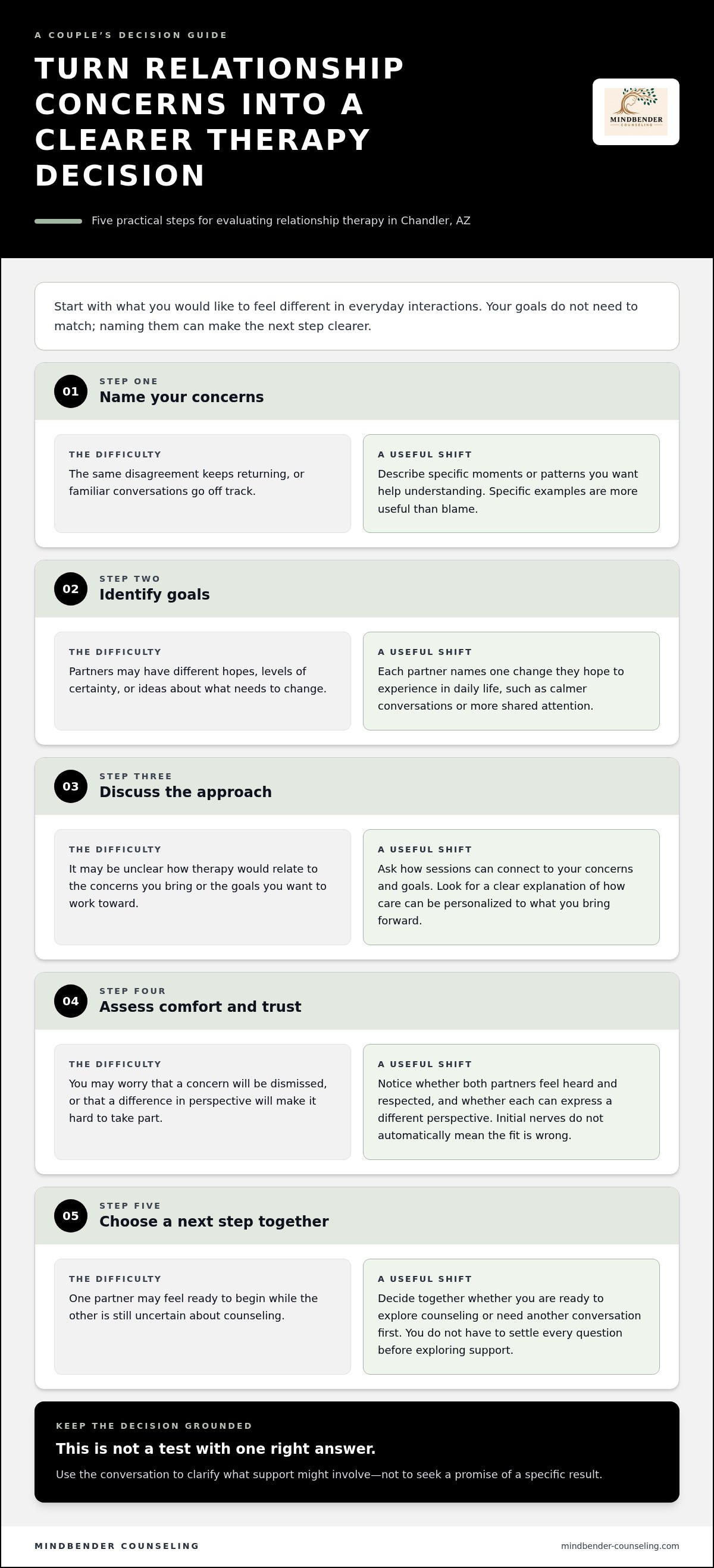
Searching for relationship therapy Chandler AZ can bring up many options, but a useful decision starts with your needs as a couple. Before comparing details, talk about what you would like to feel different in everyday interactions. Maybe you want to pause before an argument escalates, feel more understood, or reconnect during ordinary moments. Your goals don’t need to match, but naming them can make the next step clearer.
Use this framework to organize the conversation:
- Name your concerns. Describe the moments or patterns you want help understanding. Specific examples are more useful than blame.
- Identify goals. Each partner can name one change they hope to experience in daily life, such as calmer conversations or more shared attention.
- Discuss the approach. Ask how sessions can connect to those concerns and goals. Evidence-based, personalized care should have a clear relationship to what you bring forward.
- Assess comfort. Consider whether each of you feels heard, respected, and able to express a different perspective.
- Choose a next step. Decide together whether you’re ready to explore counseling or need another conversation first.
This isn’t a test with one right answer. It helps turn a general sense that something should change into a clearer picture of what support might involve.
Which questions help clarify whether a therapy approach fits?
Bring questions that connect the process to your needs: “How could sessions help us work on our communication?” or “How can we both take part if we see the conflict differently?” A useful explanation should make room for both partners and show how the work can be tailored to your concerns. Look for clarity about the process, not a promise that therapy will produce a specific result.
For couples considering care in Chandler, Arizona, these questions keep the decision grounded in fit and goals rather than assumptions about what therapy should look like. The same framework can help couples elsewhere in Arizona or Texas consider what they want from counseling.
How can partners assess comfort and trust?
Notice whether you can share a concern without feeling dismissed and whether both perspectives receive respectful attention. It’s normal to feel unsure at first; initial nerves don’t automatically mean the fit is wrong. Pay attention to whether the conversation becomes clearer and whether the approach makes sense to you both.
If you’d like a preview of the process, read what couples therapy can involve. To explore personalized, evidence-based support, learn more about Mindbender Counseling couples counseling.
Relationship Therapy Approaches: Connecting Shared Goals With Personalized Care
There isn’t one relationship goal every couple needs to pursue. One pair may want to communicate more calmly during disagreements; another may want to understand why the same conflict keeps returning or find ways to feel close again. In relationship therapy Chandler AZ, the starting point can be the concerns and hopes each couple brings, rather than a preset path that assumes every relationship is alike.
A shared goal can make the work more practical. Instead of aiming vaguely to “get along better,” describe what you hope will change in an ordinary week: having a difficult conversation without shutting down, listening before responding, or making time to connect. The examples below can help you put that hope into words.
| Concern | A question to bring to therapy | Possible goal |
|---|---|---|
| Communication strain | How can we hear each other without getting stuck in defensiveness? | Express concerns and listen with more understanding. |
| Recurring conflict | What keeps bringing us back to this disagreement? | Recognize the pattern and explore ways to respond differently. |
| Feeling disconnected | What helps each of us feel cared for and included? | Build more meaningful moments of connection in daily life. |
How can therapy goals differ from couple to couple?
Goals reflect the relationship, not a standard checklist. A couple focused on communication may practice slowing down a tense exchange, while partners facing recurring conflict may explore what happens before, during, and after a disagreement. Another couple may begin by identifying small ways to make more room for connection. Goals can shift as partners learn what matters most. There’s no need to force a fixed timeline or assume a particular outcome.
What does evidence-based relationship therapy mean in practice?
Evidence-based care draws on methods informed by research, then adapts the work to the couple’s stated needs. In practice, sessions should connect to your goals, whether you’re working on communication, conflict, or connection. Personalized interventions help keep the focus relevant instead of applying the same plan to every couple.
It can also help to pause and reflect together: Are we discussing the concerns we came in with? Do the ideas feel understandable and useful in everyday life? Those questions support an open conversation about whether the work fits, without treating progress as guaranteed or perfectly linear. For a broader explanation, explore evidence-based therapy approaches.
Preparing for Relationship Therapy in Chandler: Practical Steps Before You Begin
A little preparation can make the idea of relationship therapy Chandler AZ feel more manageable. You don’t need to rehearse every detail or agree on a complete plan. Instead, notice what you’re experiencing, what you hope could change, and which questions would help you approach the process with greater clarity.
What should each partner reflect on beforehand?
Before discussing therapy together, each partner can make a few notes independently. Keep them focused on your own experience, not on building a case against the other person.
- Name one recurring challenge. For example, consider a conversation that tends to end in frustration or a concern that’s difficult to raise.
- Describe one hoped-for change. You might want to feel heard, respond more calmly, or make more room for connection in daily life.
- Note difficult conversations. Which topics feel hard to approach without becoming overwhelmed, shutting down, or talking past each other?
- Write down questions. Think about what would help you understand the counseling process and feel more prepared to take part.
When you compare notes, look for what matters to each of you, even if your concerns differ. A shared goal might emerge, or you may simply learn more about how each partner experiences the relationship.
How can couples make the next step feel manageable?
Agree on a few questions to bring forward and discuss what would help both of you feel respected during the process. You might want to know how sessions can address your concerns or how each partner can participate. Therapy involves active participation, and change may take time; it isn’t a promise of instant results.
Practical details matter, too. In Chandler and across Arizona, work routines, transportation, and other commitments may shape what feels manageable for both partners. Couples in Texas may also need to consider their own routines and commitments. Talk through these factors together. The aim is to choose a realistic next step, not to solve every logistical detail before exploring support.
If one partner feels uncertain, invite a conversation rather than pressing for an immediate yes. Ask what feels concerning and what information might make the process easier to consider. Curiosity can create room for an honest discussion, even when you aren’t equally ready.
For a related service resource, explore couples counseling in Phoenix. When you’re ready to take a step toward personalized support, explore couples counseling with Mindbender Counseling.
How Mindbender Counseling Supports Relationship Therapy Goals
For couples seeking relationship therapy Chandler AZ, Mindbender Counseling provides professional couples counseling focused on the concerns and goals each pair brings. You may want to communicate more clearly, understand recurring conflict, or make space for greater connection. The work starts with your relationship as it is, not with an assumption that every couple needs the same plan. Mindbender Counseling serves clients in Arizona and Texas.
Mindbender Counseling uses evidence-based techniques and personalized therapeutic interventions to support couples as they explore relationship challenges. Sessions can be structured around what you’ve identified as important, drawing on research-informed approaches instead of a one-size-fits-all formula. The focus is on working toward relevant goals, not promising a particular outcome.
What makes personalized couples counseling meaningful?
Partners can experience the same moment differently. One may feel shut out during a difficult conversation; the other may feel overwhelmed and unsure how to respond. Personalized counseling makes room for both perspectives while keeping the work connected to the couple’s priorities. Together, you can clarify what you’d like to address and consider how communication or conflict patterns affect your day-to-day relationship.
As those priorities become clearer, structured therapeutic work can help keep conversations focused and relevant. Goals may evolve as you learn more about what each partner needs. You don’t have to agree on every detail before beginning, and counseling doesn’t guarantee a particular result. It provides professional support as you explore possible ways forward.
How can couples take a first step with Mindbender Counseling?
Visit Mindbender Counseling’s website to explore couples counseling and consider what you’d like support with. You can bring questions, uncertainty, or different levels of readiness into the conversation. You don’t need to have everything figured out first; identifying what you hope to discuss is a useful beginning.
Taking a step toward counseling doesn’t mean you’ve failed or that you must already know where the relationship is headed. It can simply mean you’re open to understanding each other more clearly and working toward goals that matter to both of you. If you’re ready to explore that possibility, Explore relationship therapy with Mindbender Counseling.
Take a Thoughtful Next Step Toward Connection
Choosing relationship therapy isn’t about proving who’s right or having every answer before you begin. It’s about recognizing what feels difficult, identifying what you hope could change, and finding a process that gives both partners room to be heard. Shared goals can help you focus on practical shifts in communication, conflict, or connection.
As you consider relationship therapy Chandler AZ, remember that you don’t need to wait for a crisis or agree on every detail before exploring support. Start with a conversation about what each of you wants to understand better and what would help you feel comfortable taking a next step. Couples in Chandler, across Arizona, and in Texas can use the same questions to clarify what they want from counseling.
Mindbender Counseling provides couples counseling and individual counseling using evidence-based approaches and personalized therapeutic interventions. The work can be shaped around your needs and priorities, without assuming every couple follows the same path or promising a particular outcome.
If you’re ready to explore support, Explore relationship therapy with Mindbender Counseling. Bringing questions or uncertainty is a valid place to start. Identify one concern you’d like to discuss, then take the next step toward a counseling conversation.
Frequently Asked Questions
Is relationship therapy in Chandler, AZ only for couples in crisis?
No. Couples may explore therapy before reaching a crisis, including when they want to address communication strain, recurring disagreements, or a growing sense of distance. In Arizona, relationship therapy can provide a structured space to talk through concerns and clarify shared goals. You don’t need to be certain that your relationship is in serious trouble; noticing a pattern you’d like to understand can be a reason to consider support.
Can relationship therapy help if only one partner wants to attend?
It can be useful to talk openly about what’s making one partner hesitant and what the other hopes counseling might address. You can discuss questions about the process without demanding an immediate decision. Mindbender Counseling also provides individual counseling, which offers space to explore personal concerns. Individual counseling is distinct from couples work, so consider which kind of support matches your current needs as you decide how to proceed.
How do we know whether a relationship therapist is the right fit?
Consider whether the process feels respectful, understandable, and connected to the concerns you want to address. Both partners should have room to share their perspectives, even when they disagree. Notice whether the therapist explains how the work may support your goals without guaranteeing results. For relationship therapy Chandler AZ, fit is less about finding a perfect script and more about feeling able to participate in a thoughtful, collaborative process.
What happens during relationship therapy sessions?
Sessions generally give partners a structured setting to discuss relationship concerns, identify patterns, and work toward goals such as clearer communication or addressing conflict. The focus depends on what each couple brings. One conversation may involve understanding a recurring disagreement, while another explores what helps partners feel heard. Mindbender Counseling uses evidence-based approaches and personalized interventions to keep the work relevant to each couple’s needs.
Do both partners need to attend every relationship therapy session?
Attendance can depend on the couple’s goals and how the counseling work is structured. Couples counseling supports partners in addressing relationship concerns together, while individual counseling may focus on one person’s needs. If you’re unsure whether a particular session should include both partners, discuss the question in relation to your goals and the structure of care. Avoid assuming every couple follows the same format.
Can couples counseling help with communication problems?
Couples counseling can help partners examine how conversations unfold, including moments when one person feels unheard or a discussion becomes tense. The work may support clearer ways to express concerns, listen to different perspectives, and understand patterns that make communication difficult. Mindbender Counseling tailors therapeutic interventions to each couple, so the focus can connect to the specific communication challenges and goals you bring to counseling.
How long does relationship therapy take to work?
There isn’t one timeline that applies to every couple. The pace can depend on the concerns you’re addressing, the goals you set, and how the work develops over time. Therapy involves participation and reflection, and it doesn’t promise instant change or a particular result. You can revisit whether sessions feel relevant and discuss how your priorities may be evolving as you work toward greater understanding and healthier interactions.


