

What if a thought that keeps returning doesn’t define who you are? Repetitive, distressing thoughts can be hard to set aside, and it’s understandable to wonder what they mean or whether to seek help. An unwanted thought, by itself, doesn’t establish a diagnosis or reveal your character. If you’re considering counseling for obsessive thoughts Scottsdale, support can offer a space to explore what’s happening without judgment.
This guide explains how persistent thoughts can differ from a mental health diagnosis, when counseling may be worth considering, and what the process can involve. At Mindbender Counseling, individual counseling is personalized to your needs and goals, using evidence-based approaches in a collaborative setting. Counseling can help you examine recurring thoughts, your responses to them, and what you’d like to change. There’s no promise of a quick fix, and no assumption that the same approach fits everyone. The practical steps below can help you consider support in Scottsdale and across Arizona, at a pace that feels right for you.
Key Takeaways
- Unwanted, recurring thoughts don’t automatically indicate a diagnosis or define your character. Noticing their pattern can help clarify what support might be useful.
- Consider whether repeated mental checking, reassurance-seeking, or avoidance affects your daily life, particularly during stress or change.
- Early counseling conversations can explore your concerns, personal context, and goals rather than follow a fixed script.
- To prepare for counseling for obsessive thoughts Scottsdale, notice the pattern, name its impact, and consider what you hope could change. Writing down questions is optional.
- Mindbender Counseling offers personalized individual counseling using evidence-based approaches, with support tailored to your mental health goals.
Counseling for Obsessive Thoughts in Scottsdale: When Is Support Worth Considering?
Repetitive, unwanted thoughts can feel tiring and confusing, especially when they keep returning despite your efforts to move on. You might wonder why a thought appeared or whether it says something troubling about you. A thought, however, isn’t an intention or a measure of your character. If you’re considering counseling for obsessive thoughts Scottsdale, start by noticing how often the thoughts arise and how much they affect your life.
What can people mean by obsessive or intrusive thoughts?
People may use “obsessive thoughts” to describe recurring thoughts, mental images, or doubts that feel hard to disengage from. You might replay a conversation, question whether you made a mistake, or find your attention pulled back to a worry. The phrase is descriptive, not a diagnosis. You can read more about intrusive thoughts and how they may differ from ordinary thoughts.
Unwanted thoughts can happen occasionally, and their presence alone doesn’t mean something is wrong. The experience may be different when a thought repeatedly takes up your attention, causes substantial distress, or makes it harder to focus on what matters. Even then, the thought itself doesn’t reveal what you intend or value. Having a disturbing thought doesn’t mean you want it to happen.
When might counseling for obsessive thoughts be helpful?
Counseling may be worth considering if recurring thoughts affect your concentration, sleep, relationships, work, or daily routines. There’s no single threshold you have to reach before asking for support. You might want to understand a pattern, feel less caught up in it, or clarify what could help you move toward your personal goals.
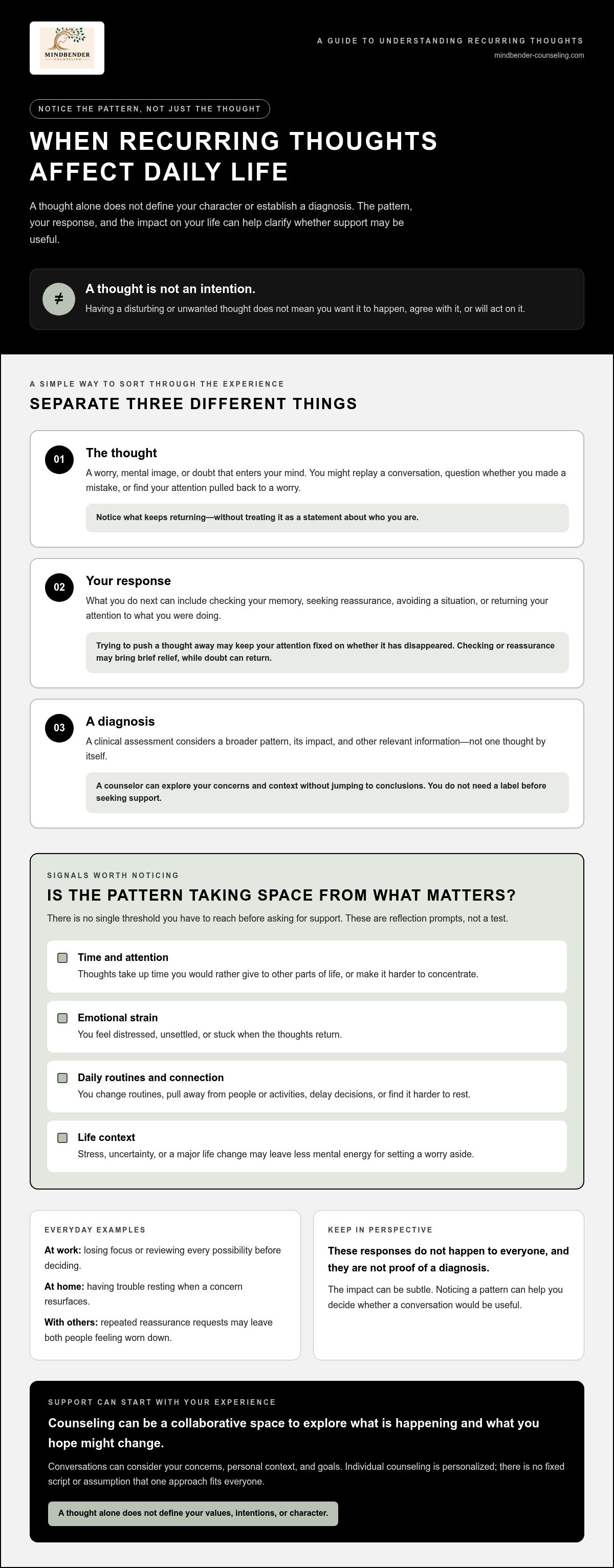
A thought alone does not establish a mental health diagnosis. Diagnosis involves more than noticing a particular thought. A counselor can help you explore your concerns and context without jumping to conclusions.
As you reflect, consider whether the thoughts:
- Take up time or attention you’d rather give to other parts of life.
- Leave you feeling distressed, unsettled, or stuck.
- Lead you to change routines or pull away from people or activities.
These questions aren’t a test. They can help you decide whether a conversation might be useful. In individualized counseling, you can discuss what you’re experiencing and what you hope might change. You don’t need a label before seeking support.
How Persistent Thoughts Can Affect Daily Life and Emotional Well-Being
A recurring thought can take up more space when you’re already managing stress, uncertainty, or a major life change. A work deadline, relationship tension, or disrupted routine may leave less mental energy for setting a worry aside. That doesn’t mean ordinary worry is a disorder. It may help explain why a familiar doubt feels more consuming at one time than another.
Why can a thought feel more powerful when you resist it?
For some people, trying hard to force a thought away can keep attention fixed on whether it has disappeared. Repeatedly checking your memory or seeking reassurance may bring brief relief, but the doubt can return and prompt another round of checking. These responses don’t happen to everyone, and they aren’t proof of a diagnosis. Noticing a thought is also different from agreeing with it or acting on it.
It can help to separate the experience into three parts:
- The thought: A worry, image, or doubt that enters your mind.
- Your response: What you do next, such as checking, asking for reassurance, avoiding a situation, or returning your attention to what you were doing.
- A diagnosis: A clinical assessment that considers a broader pattern, its impact, and other relevant information, not one thought by itself.
The National Institute of Mental Health on OCD explains that OCD can involve obsessions and compulsions that cause distress or interfere with daily life. Learning about a condition can offer context, but only a qualified clinical assessment can determine whether someone meets diagnostic criteria.
How do repetitive thoughts affect routines and relationships?
The impact can be subtle at first. You may lose focus at work, delay a decision while reviewing every possibility, or have trouble resting when a concern keeps resurfacing. Avoiding a place or activity can make it harder to maintain a routine. In conversations, repeated requests for reassurance may leave both you and the person responding feeling worn down. That isn’t a reason for blame; it may be a sign the pattern deserves attention.
A thought’s presence doesn’t define your values or intentions. Your responses and choices are separate. If these patterns are taking time or connection away from what matters to you, counseling for obsessive thoughts Scottsdale can provide a collaborative space to explore what’s happening and identify a meaningful goal. Learn more about personalized individual counseling as one option for support.
What Counseling for Obsessive Thoughts May Involve
Counseling isn’t a fixed script or a guaranteed solution. It’s a collaborative process that can help you understand what you’re experiencing, consider your goals, and explore possible next steps at a manageable pace. With counseling for obsessive thoughts Scottsdale, the focus can be your individual concerns and the changes you hope to make, rather than an assumption that one approach fits everyone.
What might a first counseling conversation cover?
An early conversation can give you space to describe what’s been happening and how it affects daily life. You might discuss when the thoughts tend to show up, what you do in response, and what you’d like to feel or do differently. You can also raise questions or concerns about counseling. The first session doesn’t guarantee a diagnosis, a particular technique, or immediate relief. It’s a beginning, not a test you need to pass.
It may help to distinguish the roles different types of support can play:
| Area | Main focus | What to keep in mind |
|---|---|---|
| Supportive counseling | Exploring concerns, context, and personal goals collaboratively. | It can support understanding and goal-setting, but doesn’t promise a specific outcome. |
| Diagnosis | Assessing a broader pattern of symptoms and their impact. | A single thought alone doesn’t establish a diagnosis. Assessment is separate from simply seeking support. |
| Medication management | Considering and managing medication as part of care. | This is distinct from counseling and involves medication-related decisions with an appropriate prescriber. |
How can individualized, evidence-based counseling support personal goals?
Evidence-based care draws on approaches informed by research while taking your circumstances and needs into account. Mindbender Counseling uses evidence-based approaches and tailors individual counseling to each person’s mental health goals. You and your counselor can clarify what feels most important to address, then revisit those goals as your needs become clearer. This means starting with your situation rather than assuming a particular method or diagnosis.
Persistent thoughts can overlap with other concerns, including anxiety, but the terms aren’t interchangeable. If anxiety is also on your mind, learn more about individual counseling for anxiety. For general information about OCD and related support, the International OCD Foundation offers educational resources. These resources can provide context, while counseling gives you space to explore your own experience and goals.
Taking a First Step Toward Counseling for Obsessive Thoughts in Scottsdale
Starting a counseling conversation doesn’t require a perfect explanation of what’s happening. If persistent thoughts have been weighing on you, a few simple steps can help you approach support with more clarity, whether you’re in Scottsdale or elsewhere in Arizona.
- Notice the pattern. Consider when the thoughts tend to show up or what seems to bring them on. If useful, jot down a few observations, but tracking isn’t required.
- Identify the impact. Think about whether the thoughts affect your focus, rest, relationships, or routines. You can describe what feels difficult without having to explain why it’s happening.
- Name a goal. Consider what you hope to understand or change. That could mean feeling less distracted, making decisions with more ease, or staying connected to daily life.
- Begin a conversation. Share what you can, ask questions, and let the discussion develop at a manageable pace. You don’t have to cover everything at once.
How can you prepare for an initial conversation?
A short note can help if you tend to forget questions or feel overwhelmed in new conversations. You might write down a situation you want to discuss, how it affected your day, or what you’d like counseling to help you explore. Keep it simple. You don’t need to organize your thoughts perfectly or prepare a full history before seeking support.
Privacy and comfort are also reasonable topics to raise. You can ask how confidentiality works, what information is kept private, and what circumstances may affect privacy. It’s okay to share concerns about discussing sensitive thoughts, too. These questions can help you understand the counseling process and decide what you’re comfortable sharing.
What questions can help clarify your counseling goals?
As you consider counseling for obsessive thoughts Scottsdale, you might ask how sessions work collaboratively around your concerns and goals. You could also ask how you and the counselor will review progress, what happens if your priorities change, and how the plan can adapt to your needs. For broader guidance on starting therapy, read what to expect in private therapy.
You don’t need every answer before beginning. Mindbender Counseling offers individualized counseling shaped around personal mental health goals. Explore individual counseling with Mindbender Counseling as a next step toward a thoughtful conversation.
Personalized Individual Counseling with Mindbender Counseling
Persistent thoughts can feel personal and unsettling, but an unwanted thought doesn’t define your character or intentions. Individual counseling offers a place to talk through what’s happening and consider what you’d like to change. You don’t need to arrive with a diagnosis or a perfectly formed explanation. For Scottsdale readers, Mindbender Counseling serves clients in Arizona and Texas, with support shaped around each person’s mental health goals.
How does individualized counseling keep your goals at the center?
There isn’t one universal template for discussing recurring thoughts. You can begin with what feels most important, whether that’s understanding a pattern, considering its effect on daily life, or identifying what you want to focus on in counseling. As your needs or priorities shift, you can revisit your goals together. This collaborative process makes room for your perspective rather than assuming a particular outcome or timeline.
Mindbender Counseling uses evidence-based approaches and tailors support to each person. Evidence-based care can inform thoughtful conversations about your needs and goals, while collaboration helps keep the work relevant to your experience. Counseling doesn’t require assuming a specific OCD diagnosis or applying a particular protocol. It can begin with listening, understanding your context, and identifying meaningful areas to explore.
What is a low-pressure next step for Scottsdale readers?
You don’t have to decide in advance exactly what your thoughts mean. It may be enough to recognize that they’re taking up attention or affecting something you care about. A conversation can help you describe your concerns, ask questions, and consider whether individualized support feels useful. You can share what matters most at your own pace.
As you consider counseling for obsessive thoughts Scottsdale, remember that a thought is an experience, not a definition of who you are. Mindbender Counseling’s individual counseling is personalized to your mental health goals and informed by evidence-based approaches. Explore the service details and decide whether beginning a conversation feels right for you.
Explore individual counseling with Mindbender Counseling
Take a Thoughtful Next Step Toward Support
Persistent thoughts can feel distressing, but an unwanted thought doesn’t define your character or intentions, and a thought alone doesn’t establish a diagnosis. When considering support, focus on how the pattern affects your life and what you hope might change. Counseling can offer a collaborative space to explore those concerns and shape personal goals without assuming the same path is right for everyone.
For readers in Scottsdale, Mindbender Counseling serves clients across Arizona and Texas. Its individual counseling is personalized to each person’s mental health goals and informed by evidence-based approaches. You can begin with what feels most important to discuss, then consider whether counseling is a useful next step.
If you’re ready to learn more, explore individual counseling with Mindbender Counseling. Begin with a concern or question that matters to you, then take the next step toward a thoughtful conversation.
Frequently Asked Questions
Can counseling help with obsessive thoughts?
Yes, counseling can help you explore recurring thoughts, how you respond to them, and what you’d like to change. The process is collaborative, and support can be tailored to your concerns and personal mental health goals. Counseling doesn’t guarantee that thoughts will disappear, but it can give you space to understand your experience and consider practical ways forward with a counselor.
Do obsessive thoughts mean I have OCD?
No. Having repetitive or unwanted thoughts by itself doesn’t mean you have obsessive-compulsive disorder (OCD). A diagnosis involves a broader clinical assessment of symptoms, their impact, and other relevant context. If you’re concerned, a counselor can help you talk through what you’ve noticed and consider what support may be useful. You don’t need to decide on a diagnosis before starting that conversation.
What happens in counseling for obsessive thoughts?
Early conversations may focus on what you’ve been experiencing, how it affects daily life, and what you hope to understand or change. You can ask questions and share concerns as you go. Counseling isn’t a fixed script, and the first conversation doesn’t necessarily lead to a diagnosis or a particular technique. At Mindbender Counseling, individual support is personalized to your mental health goals and informed by evidence-based approaches.
Can unwanted thoughts reflect what I really want to do?
An unwanted thought alone doesn’t establish your intentions, values, or character. People can experience thoughts that feel upsetting precisely because they conflict with what matters to them. Noticing a thought is different from agreeing with it or acting on it. If a thought is causing distress or making it hard to feel safe, share that concern with a mental health professional so you can discuss it in context.
How do I find counseling for obsessive thoughts in Scottsdale?
Look for individual counseling that makes space to discuss your concerns, goals, and how thoughts affect your daily life. Mindbender Counseling serves clients in Arizona and Texas, including people seeking counseling for obsessive thoughts Scottsdale. Its individual counseling is personalized and uses evidence-based approaches. Start by considering what you’d like help understanding, then explore whether a counseling conversation feels like a useful next step.
Can stress make obsessive thoughts feel more intense?
For some people, thoughts may feel more consuming during stress, uncertainty, or major life changes. These circumstances can make it harder to shift attention or feel settled, but stress-related worry alone doesn’t establish OCD or another diagnosis. Notice whether the thoughts are affecting your routines, rest, concentration, or relationships. Sharing those observations in counseling can help you explore the pattern and what support may fit your needs.
When should I seek professional support for persistent thoughts?
Consider seeking support if recurring thoughts cause distress, take up time you’d rather spend elsewhere, or interfere with work, sleep, relationships, or daily routines. You don’t have to wait until the impact feels severe, and you don’t need to arrive with a diagnosis or a complete explanation. A counselor can help you explore your concerns and goals. If you’re worried about immediate safety, seek urgent help in your area.


