

The most profound breakthroughs in your mental health journey don't require a physical office; in fact, the familiar comfort of your own living room might be the very thing that helps you open up more deeply. It's natural to feel skeptical about whether a screen can capture the nuance of a face to face conversation. You might worry about digital privacy or feel overwhelmed by the endless sea of high volume therapy apps that often feel more like tech platforms than actual clinical practices. If you've been searching for phoenix evidence-based counseling but hesitate to trade a handshake for a video call, your caution shows how much you value your well-being.
This guide will help you bridge that gap by showing you how to find high quality telehealth mental health providers who offer the same clinical rigor as an in-person visit. You'll learn how to leverage virtual therapy to achieve lasting emotional growth and build a solid internal foundation from the comfort of your home. We will walk through the benefits of structured sessions, how to verify licensing in the Phoenix or Texas context, and the simple steps to ensure your digital privacy remains a top priority.
Key Takeaways
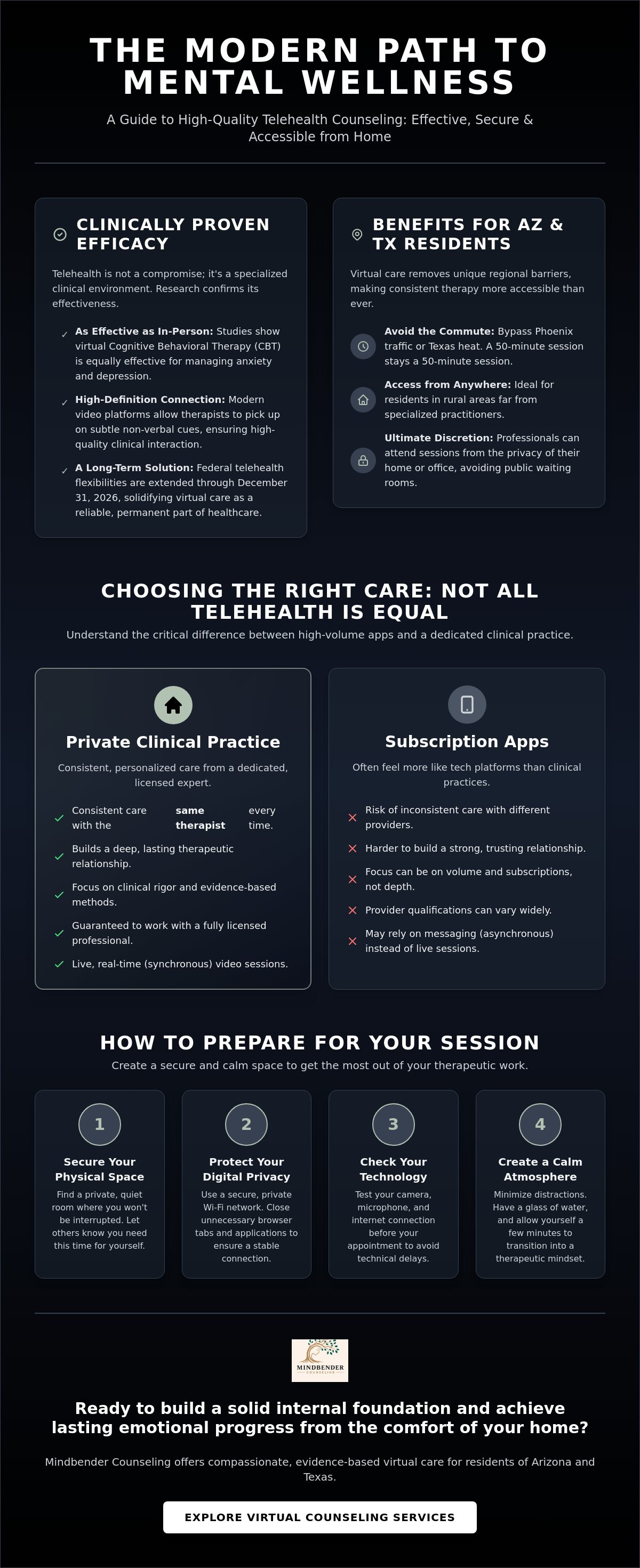
- Understand that telehealth is a secure, professional environment where virtual evidence-based therapy is proven to be as effective as traditional in-person sessions.
- Distinguish between high-volume subscription apps and private clinical practices to ensure you receive consistent care from the same licensed expert.
- Learn how to prepare your physical and digital space to protect your privacy and create a calm atmosphere for your therapeutic work.
- Discover how specialized phoenix evidence-based counseling provides tailored support for residents of Arizona and Texas without the stress of a commute.
- Gain the tools to build a solid internal foundation and achieve lasting emotional progress entirely from the comfort and safety of your home.
What Are Telehealth Mental Health Providers?
Telehealth mental health providers are licensed professionals who deliver clinical care through secure, high-definition video technology. Unlike the early days of telephone sessions, today's virtual environment is a sophisticated clinical space designed to protect your privacy and facilitate deep work. Most modern care follows a synchronous model, which means you and your therapist meet in real-time for live video sessions. This differs from asynchronous models that rely on text messaging or delayed recordings. For those seeking phoenix evidence-based counseling, the synchronous model is vital because it allows for the real-time observation and interaction necessary for clinical progress.
State regulations in both Arizona and Texas require your provider to hold a valid license in the state where you are physically located during the session. This ensures that you're receiving care from an expert who meets the rigorous standards set by local boards. As of June 2026, federal policy has shifted toward making these virtual connections a permanent fixture of our healthcare system. The U.S. Department of Health and Human Services has extended key telehealth flexibilities through December 31, 2026; this confirms that virtual care is a reliable, long-term option for your mental health needs.
The Evolution of Virtual Mental Health
The journey of virtual care has moved far beyond simple phone calls. We've seen a transition to encrypted, HIPAA-compliant platforms that allow for the seamless integration of therapeutic tools. Telepsychology is now recognized as a specialized field with distinct ethical standards that prioritize patient safety and data security. While early iterations of online therapy often focused on one-off crisis support, the current focus is on high-continuity care. This means you build a lasting relationship with a single expert who understands your history and goals. This approach is rooted in What is Evidence-Based Practice?, ensuring that every session is backed by clinical research rather than just conversation.
Why Phoenix and Texas Residents Choose Virtual Care
Residents in the Southwest face unique logistical hurdles that make virtual care an attractive choice. In Phoenix, the combination of urban sprawl and heavy traffic can turn a 50-minute session into a three-hour ordeal. For our Texas neighbors, the intense summer heat often makes a commute feel draining before the session even begins. When you seek phoenix evidence-based counseling, you're looking for a provider who understands these specific stressors, from the heat to the rapid growth of the city. Virtual care removes these barriers, allowing you to transition from your daily responsibilities to a therapeutic space in minutes.
This accessibility is particularly vital for those dealing with the complexities of a birth injury or traumatic brain injury. While you focus on emotional recovery through telehealth, The Dedric Brown Law Firm can provide the specialized legal support necessary to navigate these life-altering situations.
- Accessibility for Rural Areas: Many Texas residents live far from major metropolitan hubs where specialized practitioners are located.
- Discretion for Professionals: Arizona professionals often prefer the privacy of their own office or home over a public waiting room.
- Clinical Consistency: You don't have to pause your progress because of travel or weather; your care remains steady and predictable.
The Efficacy of Evidence-Based Therapy via Telehealth
Many people worry that a digital screen acts as a barrier to real healing. Clinical research suggests otherwise. Studies consistently show that virtual Cognitive Behavioral Therapy (CBT) is as effective as in-person sessions for managing anxiety and depression. When you engage in phoenix evidence-based counseling through a digital platform, you aren't settling for a secondary option; you're entering a specialized clinical environment. Telehealth Mental Health Providers utilize high-definition video to pick up on subtle cues, ensuring the clinical quality remains high while removing the logistical hurdles of traditional travel.
The virtual format actually offers unique advantages for structured work. Instead of leaning over a shared desk to look at a paper worksheet, therapists use screen sharing to collaborate on digital tools in real-time. This keeps the session focused and organized. It also allows you to save digital journals and progress trackers instantly. This level of organization helps build a solid internal foundation, making your progress visible and measurable. If you're ready to experience this connection, you can explore our Individual Counseling Services to see how virtual care fits your life.
CBT and DBT in a Virtual Setting
Adapting tools like CBT or Dialectical Behavior Therapy (DBT) for the screen is seamless. One of the greatest benefits is "in-the-moment" practice. If you're working on social anxiety or home-based stressors, you're already in the environment where those challenges occur. This allows you to apply new coping skills immediately in your natural surroundings. By 2026, data tracking and digital journals have become standard, allowing for better outcome monitoring between sessions and ensuring that your growth is rooted in consistent, reliable data.
Maintaining the Therapeutic Alliance Online
The "therapeutic alliance" is the trust and bond between you and your counselor. It's the most important predictor of success in any clinical setting. Skilled virtual therapists use specific techniques to maintain this bond, such as looking directly into the camera to simulate eye contact and using verbal cues to signal active listening. The human element remains the core of every session; the technology is simply the bridge that brings the expert to you. Therapists today are trained to bridge the distance, ensuring that the warmth and empathy of the relationship are felt clearly through the screen.
There's an undeniable comfort in being at home. When you're in a familiar space, your nervous system is often more regulated. This sense of safety allows many people to be more vulnerable and open than they might be in a clinical office. You don't have to navigate a lobby or a commute; you simply transition from your day into a space of healing, which can significantly accelerate the progress of phoenix evidence-based counseling.
Telehealth Apps vs. Private Clinical Practices
Choosing a therapist in the digital age often feels like selecting a streaming service. You see frequent advertisements for massive platforms promising instant, text-based access at any hour. However, there's a fundamental difference between a subscription-based app and a private clinical practice. While apps often prioritize high volume and a "user" experience, private practices focus on a relational model where you're treated as a person with a unique history. This distinction is vital when seeking phoenix evidence-based counseling, as the depth of clinical work requires a steady, unwavering partnership that a revolving door of app-based providers simply cannot offer.
High-volume apps often struggle with significant therapist burnout. When a provider is tasked with managing an unsustainable number of clients, the quality of care can suffer. In contrast, a specialized private practice allows the therapist to dedicate fresh attention and deep care to each individual. For those seeking targeted support, a provider like Women’s Mental Health Specialist can offer hormone-informed clinical care that addresses specific biological and emotional intersections. This stability ensures that you aren't just another notification on a screen, but a participant in a methodical, supportive process designed for your specific evolution. You deserve a professional who is an anchor in your journey, not someone juggling hundreds of chat windows.
Clinical Continuity and Personalized Care
When you work with a dedicated expert, they hold the narrative of your life. They remember the nuances of your history and the specific milestones of your growth from week to week. This continuity is the engine of progress. On-demand therapy might offer temporary relief for a bad day, but it rarely facilitates the structural change required for lasting emotional health. Choosing private therapy ensures that your sessions remain a high-discretion space where your long-term goals are the priority. This personalized attention allows for a more focused application of clinical methods, ensuring that every session builds upon the last.
Privacy, Security, and HIPAA Standards in 2026
Data security is a valid concern for anyone entering the virtual space. In 2026, HIPAA compliance has evolved to include advanced end-to-end encryption and secure client portals that far exceed the security of standard video apps. You should feel empowered to ask how your sensitive information is handled. The Efficacy of Evidence-Based Therapy via Telehealth depends on a foundation of absolute safety and confidentiality. If a platform is free or used for general social calls, it's likely not secure enough for your therapeutic work.
Before your first session, consider asking your provider these specific questions about your data:
- Does the practice use a dedicated, healthcare-grade portal for all video sessions?
- How are clinical notes stored, and is the data encrypted at rest?
- Does the practice have a policy against selling anonymized data to third parties?
A professional phoenix evidence-based counseling practice will always prioritize your privacy over convenience. By choosing a private clinical practice over a high-volume app, you're investing in a secure, professional environment where your progress is the primary measure of success.
How to Prepare for Your First Virtual Therapeutic Appointment
Preparing for your first session of phoenix evidence-based counseling is about more than just clicking a link. It's about intentionally creating a sanctuary where you can focus entirely on your internal growth. Unlike an in-person office where the environment is managed for you, virtual care invites you to become a co-creator of your healing space. Taking a few deliberate steps before your session starts helps lower your defenses and ensures that your time is spent on progress rather than technical troubleshooting.
Establishing a "transition ritual" is one of the most effective ways to prepare. Spend five to ten minutes before your call sitting in silence or practicing a brief grounding exercise. This simple act helps you shed the stress of your workday and move into a focused therapeutic mindset. When you enter the virtual room with a calm nervous system, you're better prepared to engage with the structured work ahead. Consider these practical steps to optimize your experience:
- Select a private sanctuary: Choose a room where you won't be overheard or interrupted. A door that locks or a simple "do not disturb" sign can provide essential peace of mind.
- Test your technology: Check your camera, microphone, and internet speed at least 10 minutes before the start to avoid last-minute frustration.
- Gather your essentials: Keep a journal, a glass of water, and tissues within arm's reach so you don't have to break your focus during a breakthrough.
Setting Up Your Physical and Digital Space
Lighting plays a subtle but vital role in building a connection. Position yourself so that light falls on your face rather than behind you. This helps your therapist see your expressions clearly, which is a key component of the therapeutic alliance we discussed earlier. Aim your camera at eye level to facilitate natural eye contact. Using headphones is a simple way to enhance both privacy and audio clarity, making the conversation feel more intimate and secure. Practicing good "digital hygiene" means closing out Slack, email, and social media notifications on all devices to ensure you're fully present for the work.
What to Ask During Your Initial Consultation
The first meeting is your opportunity to ensure the clinical fit is right for your needs. You should feel empowered to ask direct questions about the provider's expertise and methods. A professional therapist will welcome these questions with transparency and care. If you're ready to take this step and build a solid foundation for your well-being, you can schedule your individual counseling services today to begin your journey.
- "What is your specific experience helping clients with concerns similar to mine?"
- "How do you adapt your evidence-based approach to ensure it's effective in a virtual environment?"
- "Can you verify your licensure in Arizona or Texas and explain your emergency protocols for telehealth clients?"
Mindbender Counseling: Compassionate Virtual Care in AZ and TX
Mindbender Counseling stands as a dedicated partner for those seeking phoenix evidence-based counseling. We recognize that residents of Arizona and Texas face distinct challenges, from the logistical hurdles of metropolitan traffic to the isolation sometimes felt in more rural areas. Our practice isn't a high-volume platform; it's a clinical home where your progress is the primary focus. We provide a therapeutic environment that acts as a sturdy anchor for your personal evolution, offering the steady support you need to navigate life's transitions with confidence.
Our approach is defined by a balance of professional rigor and deep compassion. We understand that seeking help is a significant step, and we treat that decision with the respect it deserves. By combining authoritative clinical expertise with a warm, supportive presence, we lower the barriers to vulnerability. You won't find cold, academic jargon here. Instead, you'll find a clear, methodical path toward well-being that feels both safe and reliable. We're here to facilitate your journey, acting as a catalyst for the positive change you're ready to embrace.
Personalized Evidence-Based Care
At Mindbender, we utilize proven methods like Cognitive Behavioral Therapy (CBT) to help you build a solid internal foundation. We don't believe in "one-size-fits-all" templates. Every individual comes with a unique history and specific goals, which is why our interventions are deeply personalized. This structured approach ensures that your virtual sessions are productive and goal-oriented. We focus on fostering mental health through evidence-based techniques that have been rigorously tested, ensuring that your emotional growth is rooted in reliable clinical practice. Our goal is to help you restore balance and achieve a sense of internal stability that lasts long after the session ends.
Seamless Virtual Couples and Individual Counseling
We've designed our virtual services to be as accessible and low-friction as possible. Whether you're seeking individual counseling services or couples therapy, the process of starting is straightforward. For partners, virtual couples counseling offers a unique advantage. It allows you to practice new communication skills and conflict-resolution techniques in your actual home environment. You're doing the work in the space where your relationship lives, which often leads to more natural and sustainable progress. There's no need to worry about a stressful commute or navigating a public waiting room; you can simply focus on each other and your shared growth.
Achieving emotional balance shouldn't be a source of additional stress. We provide a clear, organized path forward so you can begin your journey toward a healthier perspective today. If you're ready to experience a higher standard of virtual care, we invite you to take the first step toward a more resilient future. Schedule your first virtual session with Mindbender Counseling today and discover how a professional, compassionate guide can help you build the life you desire.
Your Foundation for Emotional Growth Starts Here
You've discovered that virtual therapy isn't just a convenient alternative; it's a specialized clinical environment where real, measurable progress happens. By choosing a private practice over a high-volume app, you ensure that your journey is guided by a consistent expert who truly knows your story. Whether you're navigating the urban sprawl of Phoenix or the rural stretches of Texas, high-quality phoenix evidence-based counseling is now more accessible than ever.
Mindbender Counseling provides a high-security, HIPAA-compliant platform where your privacy is always the priority. As specialists licensed in both Arizona and Texas for individual and couples therapy, we offer individualized care that helps you build a sturdy internal foundation. It's time to trade the stress of a commute for the comfort of a dedicated healing space. You have the strength to pursue a more balanced life, and we're here to provide the steady support you deserve.
Begin your path to personal healing with a virtual therapeutic appointment at Mindbender Counseling
Frequently Asked Questions
Is telehealth as effective as in-person therapy for anxiety?
Yes, clinical research confirms that virtual sessions are just as effective as in-person visits for treating anxiety. When you engage in phoenix evidence-based counseling, you're receiving the same quality of care through a high-definition video link. This format allows you to practice coping skills in your natural environment, which often leads to more sustainable progress and a stronger internal foundation for long-term health.
Does insurance cover telehealth mental health providers in Arizona?
Arizona state law requires private health insurance plans and AHCCCS to cover healthcare services provided via telehealth in the same way they cover in-person visits. This insurance parity ensures that you can access professional support without geographic barriers or financial penalties. It's always a good idea to verify your specific plan details, but the legal framework in Arizona strongly supports virtual mental health access.
What happens if my internet connection fails during a session?
If your connection drops, your therapist will follow a pre-arranged backup protocol, which usually involves switching to a secure phone call to finish the session. Most professional portals allow for quick reconnection if a temporary glitch occurs. Having this predictable plan in place helps maintain the flow of your therapeutic work and reduces the friction often associated with using new technology.
Can I do couples counseling via telehealth if my partner is in a different location?
Yes, virtual couples counseling is designed to accommodate partners in different physical locations through secure, multi-way video technology. This is an excellent option for partners who travel for work or have conflicting schedules. It allows both individuals to participate fully in the session from their own space, ensuring that communication and growth remain the central focus regardless of distance.
How do I know if my telehealth provider is actually licensed in Texas?
You can verify a provider's credentials through the Texas Behavioral Health Executive Council’s online search tool. Every professional must hold a valid Texas license to legally provide services to patients located in the state. Checking this official database ensures you're working with a qualified expert who meets the state's rigorous clinical standards and ethical requirements for virtual care.
What is the difference between a "therapist" and a "telehealth provider" on an app?
A private clinical practice offers a relational model focused on long-term continuity, while app-based providers often work within high-volume subscription models. In a private practice, you see the same expert every week, which is vital for phoenix evidence-based counseling. This consistency allows you to build a deep therapeutic alliance, whereas apps may prioritize quick, on-demand sessions with a rotating staff.
Is my video session recorded or stored anywhere?
No, professional telehealth sessions are not recorded or stored. HIPAA-compliant platforms use advanced encryption to ensure that your conversation remains private and confidential in real-time. While your clinical notes are stored in a secure, encrypted electronic medical record system, the actual video and audio data from your session are never saved, protecting your sensitive information and digital privacy.
How do I prepare my home environment for a private therapy session?
Preparing your space involves choosing a private, well-lit room where you won't be interrupted or overheard by others. Close unnecessary digital tabs and turn off notifications on your phone and computer to ensure you're fully present. Gathering a journal, water, and headphones before you begin helps create a calm, focused atmosphere that mirrors the tranquility of a traditional clinical office.


