

Did you know it takes an average of 14 to 17 years from the onset of symptoms for an individual to receive an accurate diagnosis and effective care for obsessive patterns? This staggering gap often leaves people feeling exhausted and convinced that their minds are permanently broken. You might feel trapped in a loop where every attempt to "think your way out" only pulls you deeper into the spiral. When you're exploring the path of therapy obsession recovery, it's natural to feel anxious about whether the process will actually help or simply provide more fuel for your rumination.
You deserve to know that your mind isn't unfixable; it's simply following a pattern that hasn't been interrupted yet. In this article, you'll learn how to identify the signs of obsessive thinking and discover evidence-based steps to regain your mental clarity through professional guidance. We will explore the vital difference between healthy reflection and obsession, providing you with practical tools to stop a mental spiral. You'll also learn what to look for in a provider who understands the specific, proven methods needed to restore your internal balance and help you move forward with confidence.
Key Takeaways
- Understand the subtle cycle of "meta-obsession," where the pursuit of mental wellness itself becomes a source of persistent rumination and distress.
- Explore why the brain struggles to dismiss intrusive images and how the concept of "thought-action fusion" creates a false sense of urgency.
- Learn to distinguish between productive, solution-oriented reflection and the repetitive, open-ended fixation that leads to emotional isolation.
- Discover a practical five-step guide to disengage from mental hooks and utilize therapy obsession frameworks to regain your internal foundation.
- Learn how individual counseling services and evidence-based therapy provide the structured support needed to build a resilient, balanced mind.
What is Therapy Obsession? Defining the Cycle of Intrusive Thoughts
Obsession is more than just a preoccupied mind. It manifests as a persistent, unwelcome, involuntary thought that creates significant distress or anxiety. For many, these thoughts feel like a mental "hook" that won't let go. Your brain uses this as a misguided survival mechanism; it perceives a mental image or a "what if" scenario as a physical threat and refuses to look away until it feels certain you are safe. This hyper-focus creates a state of deep mental exhaustion that can make you feel disconnected from your daily life and your loved ones.
A specific challenge many face is what experts call "meta-obsession." This happens when the pursuit of mental health wellness itself becomes the source of your rumination. You might find yourself caught in a cycle of therapy obsession, where you constantly analyze your progress or worry that you aren't "doing the work" correctly. While clinical OCD involves specific diagnostic criteria, general obsessive thinking patterns can be just as draining. Understanding that your brain is trying to protect you, even if its methods are unhelpful, is the first step toward finding a sense of tranquility and a solid internal foundation.
Common Signs You Are Stuck in a Thought Loop
Recognizing the markers of a thought loop helps you step back from the spiral with more clarity. You might notice physical symptoms like a racing heart, persistent tension in your shoulders, or a thick "brain fog" that sets in during periods of heavy rumination. Behaviorally, you may find yourself checking mental health forums for hours or over-explaining your feelings to friends to seek temporary reassurance. Many people also experience a "just right" feeling, which is an internal drive that insists you must solve or perfectly understand a thought before you're allowed to move on to the next task.
The Role of Anxiety in Obsessive Thinking
Anxiety acts as the high-octane fuel for the obsessive engine. While productive worry helps you prepare for a specific, tangible event, unproductive rumination keeps you running in circles without ever reaching a resolution. It's the difference between checking your calendar once for an appointment and checking it fifty times to ensure you didn't imagine the entry. The anxiety-obsession loop is a self-reinforcing cycle of fear and checking that prioritizes immediate relief over long-term peace. By identifying this fuel source, you can begin to apply the brakes and restore your internal balance.
The Psychology of Why We Fixate
Your brain's cognitive architecture is designed to prioritize safety, but sometimes the "manager" of your mind, the prefrontal cortex, struggles to dismiss intrusive images. When a thought feels sticky, it's often due to a phenomenon called Thought-Action Fusion. This is the cognitive distortion where you believe that having a thought is just as significant as performing an action. You might feel that thinking about a catastrophe makes it more likely to happen, or that an unwanted image reflects a hidden truth about your character. It's a heavy burden to carry. The DSM-5-TR, updated in 2022, recognizes these patterns as distinct from general anxiety, highlighting how the brain can get trapped in specific loops of risk assessment and moral hyper-vigilance.
In an attempt to find peace, you might engage in "mental checking." This involves reviewing past events or future possibilities to ensure everything is okay. While this provides a brief moment of relief, it actually strengthens the obsession over time. It teaches your brain that the thought is a real threat that requires constant monitoring. In our current digital culture, this is often exacerbated by "therapy speak" on social media. While awareness is helpful, it can lead to a therapy obsession where you hyper-fixate on your own symptoms or progress. If you find yourself in this cycle, seeking evidence-based individual counseling can help you break the loop and restore your sense of agency.
Intrusive Thoughts vs. Core Values
It's a common misconception that our thoughts reflect our deepest desires. In reality, obsessions often target what we value most. If you value your health, you might obsess over illness. If you value your integrity, you might worry about making a moral mistake. These thoughts don't make you a bad person; they are simply "brain noise" that has become amplified. Through professional support, you can learn to externalize these thoughts, seeing them as separate from your identity. If you're ready to start this journey, exploring Individual Counseling Services can provide the steady, compassionate anchor you need to find your footing again.
The "White Bear" Effect
Psychology identifies a principle known as the "White Bear" effect. If you try your hardest not to think about a white bear, it's the only thing you'll see. Traditional "positive thinking" often backfires because it involves pushing thoughts away. This suppression only makes the fixations more frequent and intense. Instead, many modern approaches favor radical acceptance. This doesn't mean you like the thought or agree with it. It simply means you acknowledge its presence without fighting it. By giving the thought permission to exist without your active engagement, you eventually drain it of its power. This shift from resistance to observation is a foundational step in overcoming therapy obsession and finding long-term mental clarity.
Healthy Reflection vs. Unhealthy Fixation: Where is the Line?
It's often difficult to tell the difference between productive self-improvement and the beginning of a mental loop. Healthy reflection is time-limited and solution-oriented; it's a process that ultimately leads to emotional relief and a clearer path forward. In contrast, an unhealthy fixation is open-ended and repetitive. Instead of providing answers, it only generates more questions, leaving you feeling increasingly distressed and isolated. If you find that your internal self-work has become a distraction from actually living your life, it may be time to seek a more structured approach through individual counseling. This transition from circular thinking to linear progress is essential for building a resilient internal foundation.
A specific challenge in modern wellness is when the very process meant to heal us becomes another subject of rumination. This is a form of therapy obsession that can stall your personal evolution. You might find yourself spending your entire week preparing for a single session or constantly worrying about your therapist's opinion of you. This hyper-focus on the therapeutic process itself can ironically prevent you from applying the tools you are learning in the real world. Recognizing these markers allows you to pivot back toward genuine growth and restoration.
When Therapy Becomes Part of the Problem
Signs of therapy interference often include a compulsive need to "report" every thought or a fear that you aren't describing your feelings perfectly. To ensure your sessions remain a catalyst for movement, it's vital to know what to look for in a therapist before you commit to a provider. A professional who uses evidence-based, goal-oriented methods will help you maintain structure. This approach prevents sessions from becoming venting marathons and keeps the focus on measurable progress and practical outcomes. By working with a guide who understands these nuances, you can ensure your therapy obsession doesn't replace the life you're trying to build.
Setting Boundaries with Your Own Mind
Learning to set boundaries with your own mind is a vital skill for long-term stability. One effective method is creating Worry Windows, where you designate a specific twenty minute block each day for reflection. Outside of this time, you gently invite yourself to return to the present moment. You can also use the So What? technique to neutralize the power of an intrusive thought by following its logic to its least threatening conclusion. When you learn to manage an obsessive spiral with these tools, you move from being a victim of your thoughts to being a compassionate observer. This shift allows you to engage with your life fully while maintaining a sense of calm assurance.
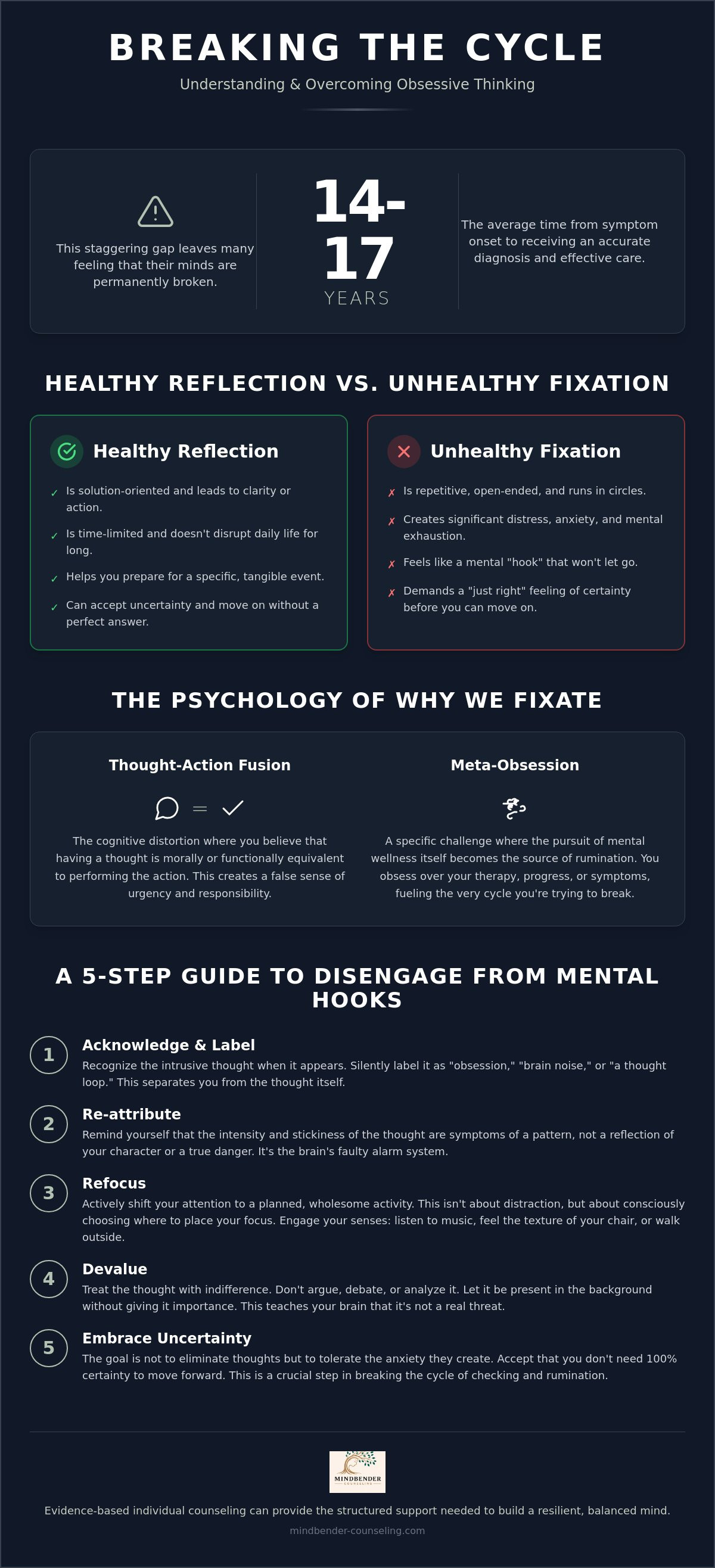
How to Manage an Obsessive Spiral: A 5-Step Guide
When you feel a mental loop beginning to tighten, it's easy to feel as though you've lost control. However, you can learn to navigate these moments with a structured response that grounds you in reality. When you find yourself spiraling into a therapy obsession, having a clear roadmap can be the difference between a lost day and a momentary distraction. Follow these five steps to regain your mental footing:
- Acknowledge and Name: Identify the thought immediately. Say to yourself, "This is an obsession, not a fact." By naming the process, you create a small but vital space between yourself and the distress.
- Disengage from the Hook: Stop the mental argument. Refuse to provide "evidence" to your brain to prove the thought wrong, as this only keeps the loop active.
- Grounding Exercises: Use the 5-4-3-2-1 method. Identify five things you see, four you can touch, three you hear, two you can smell, and one you can taste. This pulls your awareness back to the physical present.
- Value-Based Action: Commit to a small, meaningful task. Whether it's finishing a report or making a cup of tea, do it despite the presence of the intrusive thought.
- Scheduled Processing: Defer the thought. Tell yourself you will address this specific concern during your designated journaling or "worry" time later in the day.
Immediate Grounding for Arizona & Texas Professionals
For high-achieving professionals in fast-paced environments, a mental spiral can feel particularly disruptive to your productivity. If you are in the middle of a high-stress workday, try the "Physical Pivot." Stand up, walk to a different room, or step outside for two minutes of fresh air. This change in environment sends a signal to your nervous system that the current "threat" is not immediate. Many find that incorporating regular wellness therapy helps maintain the resilience needed to stay focused when these loops occur.
Cognitive Reframing Techniques
Once you have achieved a baseline of calm, you can begin to weigh the facts against the obsessive fear using an "Evidence File." This involves looking at documented reality rather than "what-if" scenarios. You can neutralize the weight of a fixation by simply labeling the thought as an intrusive image rather than a personal truth. This shift allows you to move from the paralyzing question of "Why is this happening?" to the empowering question of "What can I do right now?" If you are ready to build a personalized strategy for long-term clarity, our team is here to help through Individual Counseling Services.
Finding Balance with Evidence-Based Individual Counseling
When you are navigating the heavy weight of persistent rumination, specialized support acts as a sturdy anchor. It provides the stability you need to stop drifting into the same mental loops and start building a life defined by presence. While many people find temporary relief in sharing their story, there is a distinct difference between standard "talk therapy" and structured therapy behavioral therapy. At Mindbender Counseling, our approach is deeply personalized and research-backed. We focus on providing you with the tools to manage your current distress while constructing a foundation of long-term resilience that prevents future spirals from taking hold.
The transition from "thinking about help" to actually scheduling a session is often the most difficult step. It's common to feel a sense of therapy obsession during this phase, where you worry about whether you'll find the right fit or if your thoughts are too complex to be resolved. We view this initial hesitation with deep compassion. Our goal is to lower your defenses through a methodical, steady process that prioritizes your safety and individual progress. By choosing evidence-based methods, you ensure that your sessions are productive, goal-oriented, and focused on the restoration of your internal balance.
The Power of Personalized Care
A one-size-fits-all approach often fails for obsessive thinkers because it doesn't account for the specific "hooks" that keep your mind trapped. You don't just need a listener; you need a compassionate guide who can help you strategize and reframe your cognitive patterns. Within the safe environment of private therapy, you can explore deep-seated fixations without judgment. This individualized attention allows us to identify the unique architecture of your thoughts and provide the precise interventions needed to help you move forward with quiet confidence.
Starting Your Journey in Arizona or Texas
For professionals in Arizona and Texas, your first session at Mindbender Counseling is designed to be a low-friction, reassuring experience. We begin by acknowledging your specific needs and outlining a supportive methodology tailored to your lifestyle. We use proven, reliable methods to help you move from a state of mental exhaustion to one of calm assurance. You aren't broken, and you don't have to manage these intrusive thoughts alone. If you're ready to regain your mental clarity, you can begin your path to mental clarity with Mindbender Counseling today. Together, we can work toward a future where your mind is a source of strength rather than a source of stress.
Reclaiming Your Mental Freedom
You've explored how to distinguish between healthy reflection and the exhausting loops of fixation. By using structured grounding techniques and acknowledging intrusive thoughts as brain noise rather than personal truths, you've already begun the work of restoring your internal foundation. Breaking the cycle of therapy obsession requires more than just self-analysis; it requires a partnership with a guide who understands the intricate mechanics of your mind. It's time to move beyond the mental spiral and toward a life defined by presence and tranquility.
At Mindbender Counseling, our licensed professionals in Arizona and Texas specialize in evidence-based therapy techniques designed to provide a sturdy anchor for your personal growth. We offer personalized treatment plans that focus on long-term resilience for both individual and couples growth. You don't have to wait another day to start your journey toward a quieter, more balanced mind. Schedule your individual counseling session at Mindbender Counseling today. You have the capacity for positive change, and mental clarity is well within your reach. We are here to support you every step of the way.
Frequently Asked Questions
Is it normal to be obsessed with your own therapy or mental health?
Yes, it is a common experience often referred to as "meta-obsession," where the tools meant for healing become the new subject of your rumination. This often happens because you are highly motivated to feel better, but that drive can accidentally turn into a cycle of therapy obsession. When you find yourself constantly analyzing your progress or over-preparing for sessions, it is simply a sign that your brain is trying too hard to find certainty. A compassionate guide can help you shift this focus back toward living your life.
Can therapy actually make my obsessive thoughts worse?
Standard talk therapy can inadvertently fuel a spiral if it lacks a clear, evidence-based structure. If a session becomes a repetitive loop of "venting" without specific interventions, it might reinforce the habit of over-analyzing your thoughts. To avoid this, it is essential to work with a professional who uses goal-oriented methods. These structured approaches ensure that you are building practical skills rather than just providing more material for your mind to chew on.
How do I know if I have OCD or just a "therapy obsession"?
Clinical OCD is a specific diagnosis in the DSM-5-TR that involves obsessions and compulsions that consume more than one hour per day and cause significant distress. A therapy obsession is often a specific theme of rumination that can occur within OCD or as part of a general anxiety pattern. Because these experiences overlap, a professional evaluation is the most reliable way to understand your unique cognitive architecture. We treat every individual with fresh attention to ensure your care plan matches your specific needs.
What is the most effective type of therapy for obsessive thoughts?
Evidence-based methods like Exposure and Response Prevention (ERP) and Cognitive Behavioral Therapy (CBT) are considered the gold standards for managing fixations. These techniques focus on changing your relationship with your thoughts rather than trying to stop them entirely. By learning to sit with uncertainty without performing a mental "check," you gradually drain the thought of its power. This methodical approach builds a solid internal foundation that supports long-term stability.
How long does it take to see results when treating obsession with therapy?
While every person’s journey is unique, many individuals begin to feel a shift in their mental clarity within 12 to 20 weeks of consistent, structured care. Progress is rarely a straight line; it often moves at a pace that allows your nervous system to feel safe while you learn new ways of responding to triggers. The goal is steady, unwavering support that leads to a permanent restoration of balance. You aren't looking for a quick fix, but a meaningful evolution of your mental habits.
What should I do if my therapist isn’t helping with my intrusive thoughts?
If you feel your current sessions are providing more fuel for rumination than relief, it is important to speak up or consider a specialist. Not every provider is trained in the specific nuances of managing a therapy obsession or clinical intrusive thoughts. Seeking a therapist who utilizes research-backed, structured methodologies can provide the sturdy anchor you need. You deserve a facilitator who treats your journey with the expertise and care required for deep-seated patterns.
Are there local therapy options in Arizona and Texas for obsessive-compulsive patterns?
Yes, Mindbender Counseling offers specialized individual counseling services for residents across both Arizona and Texas. We provide flexible options, including telehealth, to ensure you can receive high-quality care from the comfort of your home. Our professionals are licensed in these states and understand the specific pressures faced by high-achieving individuals in these regions. We are committed to providing a safe, reliable path forward for anyone feeling overwhelmed by their thoughts.
Can couples counseling help if one partner has an obsession issue?
Couples counseling is an excellent resource for building a supportive environment when one partner struggles with obsessive thinking. It helps both individuals understand the "anxiety-obsession loop" and prevents the relationship from becoming a source of constant reassurance-seeking. By working together, you can learn how to support one another without accidentally fueling the obsessive cycle. This collaborative approach strengthens your bond while providing a catalyst for individual movement and healing.


