
Last Tuesday, you found yourself staring at your phone, hesitating to text your partner because you didn't want to start another argument. It's exhausting to be stuck in a cycle of conflict where every conversation feels like a minefield and every silence feels like a wall. You might find yourself weighing the merits of individual vs couples counseling, wondering if you should focus on your own healing or if the only way forward is to sit on the couch together. It's natural to feel anxious about being blamed in a joint session or to worry that personal growth might not be enough to save your marriage.
We recognize these fears and are here to help you find a path toward lasting stability. This guide will help you discover whether individual or couples therapy best meets your needs by providing an expert comparison of goals, benefits, and local resources. You'll gain clarity on the most effective starting point to reduce personal anxiety and improve communication with your partner. By exploring evidence-based therapy options, you can begin to restore balance and move toward the future with a sense of calm assurance.
Key Takeaways
- Understand the core differences between individual vs couples counseling to determine whether your current challenges require personal healing or relational repair.
- Learn how individual counseling services build a sturdy internal foundation, helping you navigate personal anxiety while fostering self-discovery.
- Discover how couples counseling serves as a proactive investment in your future, moving beyond conflict to strengthen your relational bond.
- Explore why a combination of both therapy formats is often the most effective way to address complex emotional and relational needs simultaneously.
- Find out how to access evidence-based therapy tailored to your unique journey within Arizona and Texas.
The Crossroads: Deciding Between Individual and Couples Counseling
Choosing to seek professional support is a profound act of courage, yet it often brings a new layer of uncertainty. You might find yourself standing at a crossroads, unsure which path will lead to the relief you deserve. This hesitation is completely normal. The decision between individual vs couples counseling isn't about picking the "better" option; it's about identifying which lens will most effectively bring your life back into focus. When you're feeling stuck, the weight of making the "right" choice can feel heavy, but remember that the goal of both paths is to restore your sense of peace and stability.
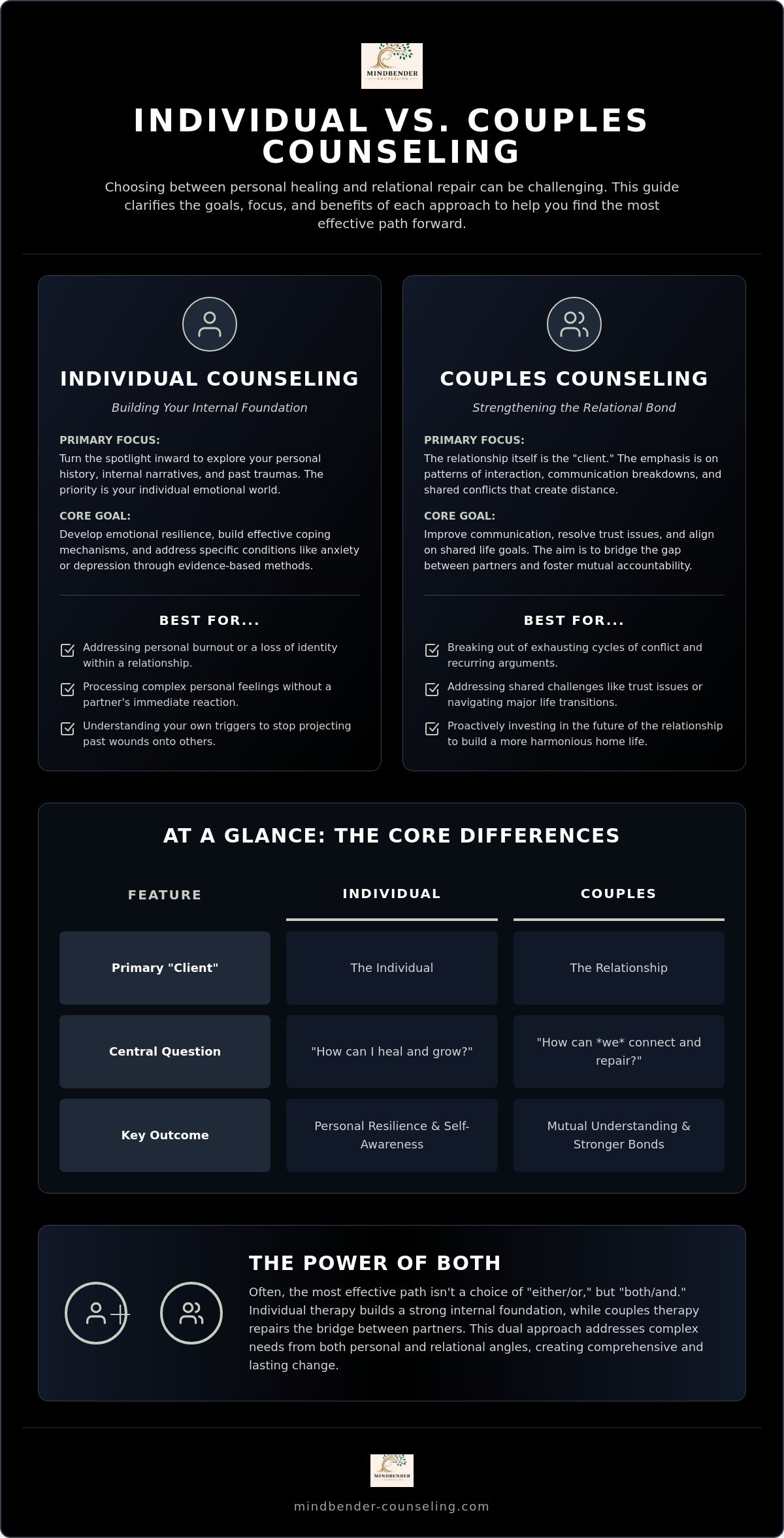
Individual counseling serves as a dedicated, focused space for you to cultivate personal emotional resilience. It's a journey of self-discovery where your internal world is the sole priority. In contrast, Couples therapy is a collaborative effort designed to bridge the gap between two people. It focuses on improving communication and resolving the shared conflicts that have created distance. While one path strengthens the person, the other strengthens the partnership. Both are valid, and both are transformative.
The most effective starting point usually depends on the primary source of your current distress. If your anxiety stems from personal history, career stress, or a sense of being lost within yourself, the individual path provides the necessary clarity. If the pain is rooted in the "space between" you and your partner, the relational path is often the most direct route to healing. Regardless of the direction you choose, engaging in private therapy offers a safe, confidential environment where you can speak freely. This secure setting allows you to lower your defenses and begin the honest work of growth without the fear of judgment or outside interference.
The Lens of Individual Therapy
This approach turns the spotlight inward to explore your internal narratives and past traumas. It's particularly helpful if you feel a sense of personal burnout or a loss of identity within your relationship. Individual sessions provide a private harbor where you can process complex feelings without worrying about a partner’s immediate reaction. By focusing on your own coping mechanisms, you build a sturdy foundation that supports every other aspect of your life.
The Lens of Couples Counseling
In these sessions, the therapist views the relationship itself as the "third entity" in the room. The focus shifts from individual flaws to the patterns of interaction and trust issues that affect both people. This format encourages mutual accountability rather than individual blame. It helps you and your partner align on shared life goals, ensuring that the work you do in the office translates into a more harmonious and supportive home life.
Individual Counseling: Building Your Internal Foundation
Individual therapy is more than just a place to vent; it's a structured environment where you can build a sturdy internal foundation. When your internal world feels chaotic, every other area of your life, from your career to your closest friendships, feels the impact. By focusing on your own mental health, you develop the emotional resilience needed to navigate modern stress with a sense of calm assurance. This personal work allows you to address specific conditions like anxiety or depression through Evidence-Based Therapy, ensuring your progress is rooted in proven, goal-oriented methods rather than just conversation.
One of the most profound benefits of personal healing is how it inadvertently improves your relationship. When you understand your own triggers, you stop projecting past wounds onto your partner. This shift reduces conflict and creates space for more authentic connection. Finding the right fit for this journey is essential, so understanding what to look for in a therapist ensures your journey begins on solid ground. If you're ready to begin this internal work, exploring Individual Counseling Services can provide the supportive guidance you need to thrive.
While many people initially search for resources like Online Couples Therapy to fix a partnership, starting with individual work is often the most strategic move in the individual vs couples counseling debate. It allows you to enter any future joint sessions with a clearer sense of self and a healthier set of coping mechanisms. This proactive approach ensures that you aren't just reacting to your environment, but actively shaping a life that feels balanced and stable. For those looking to apply this stability to their romantic life, you can check out Dating Explained for expert coaching and matchmaking.
When Individual Growth is the Priority
- Working through childhood trauma: Resolving long-standing emotional patterns that predate your current relationship.
- Developing personal boundaries: Reclaiming a sense of self that may have been lost or overshadowed in a long-term partnership.
- Navigating life transitions: Managing the unique pressures of career changes, grief, or individual identity shifts.
Signs You Need a Personal Counselor
- Emotional dependency: Feeling like your happiness or sense of security is entirely dependent on your partner’s mood or approval.
- Intrusive thoughts: Struggling with obsessive thinking, emotional regulation, or a persistent sense of personal burnout.
- Seeking resilience: Wanting to build a path to personal stability that remains sturdy regardless of your relationship status.
Couples Counseling: Strengthening the Relational Bond
Couples counseling is a proactive investment in your shared future. It's a collaborative effort that moves beyond simple troubleshooting. Many people mistakenly believe that this format is reserved for "relationships on the brink." In reality, the most successful outcomes often occur when partners engage before the foundation is compromised. By stepping into this space together, you're not admitting defeat; you're choosing to build a more resilient bond. This format allows you to address the "space between" two people, creating a safe harbor for honest dialogue.
When you're deciding between individual vs couples counseling, consider the nature of your distress. If the primary source of stress is the way you interact, relational therapy provides the tools to bridge that gap. A professional therapist acts as a neutral facilitator. They don't take sides. Instead, they help you identify and break the repetitive cycles of argument that leave you both feeling drained. This process fosters long-term emotional intimacy by teaching you how to speak so your partner can hear you and how to listen so your partner feels understood.
For residents who have already explored individual counseling in Phoenix, couples work often serves as a powerful complement. It allows you to take the personal resilience you've built and apply it to your most important connection. The data supports this choice. Research indicates that 90% of individuals who engage in couples therapy report an improvement in their emotional health; additionally, 75% see a measurable improvement in their relationship. These statistics highlight that the effort you put in today yields significant results for your collective well-being.
Core Goals of Relational Therapy
Relational therapy is highly goal-oriented. One primary objective is identifying and shifting negative communication loops, such as the common "pursue-withdraw" pattern where one partner seeks connection while the other retreats. Counselors also help you rebuild trust after infidelity or major life betrayals. In instances where establishing factual transparency is a necessary first step toward reconciliation, you can learn more about Morgan Polygraph to understand the accuracy and role of professional verification in the healing process. Beyond conflict, these sessions help you align on core values like parenting styles, financial management, or career moves, ensuring you're moving in the same direction with a shared sense of purpose.
Navigating the "Blame Game"
A common fear is that one partner will be blamed for all the relationship's problems during a session. Professional counselors are trained to ensure both partners feel heard and validated. The focus shifts from "you did this" to "we are experiencing this pattern together." This transition is vital. It moves the conversation from individual defense to collective problem-solving. By looking at the relationship as the client, you can both lower your guards and focus on healing the connection rather than winning the argument.
The Comparison: When to Choose One Over the Other
Deciding between individual vs couples counseling requires an honest assessment of where the most friction exists in your daily life. It's a common dilemma. You might wonder if you should fix yourself first or if the relationship needs immediate intervention to survive. The most effective starting point is often the one that addresses the most urgent source of distress. By identifying the primary "pain point," you can choose a path that offers the quickest path to emotional relief and long-term stability.
In many cases, concurrent therapy is the gold standard for growth. This means one partner attends individual sessions while both partners attend joint sessions. However, ethical boundaries are vital here. Usually, one therapist should not provide both individual and couples work for the same client. This ensures the therapist remains a neutral facilitator during joint sessions and maintains a private, unbiased harbor for you during personal sessions. If you're struggling with internal hurdles, seeking individual counseling for anxiety can be a necessary prerequisite for successful couples work, as it helps you manage your own triggers before engaging in complex relational dialogue.
Individual vs Couples: A Decision Matrix
- Choose individual counseling if: You feel personally lost, are working through unaddressed childhood trauma, or your partner currently refuses to attend therapy.
- Choose couples counseling if: The conflict is specific to your interaction patterns, communication has completely broken down, or you both share a desire to save the marriage.
- Choose both if: Personal issues like depression, addiction, or chronic anxiety are actively sabotaging the relational bond and preventing healthy connection.
Initiating the conversation with a partner about seeking help can feel daunting. Approach the topic during a calm moment rather than in the heat of an argument. Use "I" statements to express your needs, such as "I feel overwhelmed by our recent conflicts and I want us to find a way back to each other." Framing the request as a desire for a stronger connection, rather than a list of their faults, helps lower their defenses. If you're ready to explore these options together, you can schedule a session for evidence-based therapy to begin your journey toward restoration.
The Role of Evidence-Based Methods
Structured, research-backed interventions are essential because "just talking" often isn't enough to create lasting change. Methods like Dialectical Behavior Therapy (DBT) or Cognitive Behavioral Therapy (CBT) apply differently in individual versus joint settings. In individual sessions, these tools help you regulate your own emotions; in a couple's setting, they help you navigate shared triggers. Evidence-based therapy is the integration of clinical expertise and the best available research. This organized approach ensures that every session moves you closer to your specific goals for well-being and relational health.
Personalized Care at Mindbender Counseling in Arizona and Texas
At Mindbender Counseling, we act as a dedicated partner for residents across Arizona and Texas who are ready to invest in their long-term well-being. The choice between individual vs couples counseling often feels like a heavy burden, but it is simply the first step toward a more balanced life. Our practice specializes in Evidence-Based Therapy, ensuring that your time is spent on proven methods that yield measurable progress. We understand the unique cultural and professional dynamics of Phoenix and the broader Texas landscape, providing a local expertise that national platforms often lack.
Our goal is to help you build a solid internal foundation that remains sturdy regardless of external circumstances. By offering both Individual Counseling Services and Couples Counseling, we provide a seamless transition for those who may need a hybrid approach. We treat every person who walks through our door, or joins us via telehealth, with fresh attention and compassionate care. This personalized attention ensures that your specific goals for growth are always the priority.
Why Choose Mindbender?
Selecting a therapy provider is about finding a sturdy anchor for your personal evolution. Our team offers a sophisticated blend of professional terminology and healing-oriented language, making complex psychological concepts accessible even when you feel overwhelmed. We prioritize your safety and trust, acting as a wise facilitator for your own journey toward stability. Our counselors are experienced in helping professionals navigate the specific stressors of modern life in the Southwest, from high-pressure career transitions to the nuances of relational maintenance. We don't just offer sessions; we offer a steady path toward the restoration of balance.
Taking the Next Step Toward Well-being
The path forward is designed to be clear and low-friction. When you reach out for a consultation, we help you weigh the benefits of individual vs couples counseling based on your current distress levels and goals. Your first session is a methodical, steady introduction to the therapeutic process. You won't feel rushed; instead, you'll find a structured environment where you can process your thoughts with calm assurance. By moving from uncertainty to action, you are choosing to prioritize your mental health and relational health. We invite you to schedule your initial appointment today and begin the meaningful work of personal and relational evolution.
Embrace Your Path Toward Lasting Stability
Choosing the right format for support is a significant step toward reclaiming your peace. You've learned that individual work builds a sturdy internal foundation, while relational therapy provides the tools to bridge gaps with your partner. The choice in the individual vs couples counseling debate ultimately rests on where you feel the most friction today. Whether you're navigating personal anxiety or a cycle of conflict, starting the process is an act of profound courage that leads to meaningful change.
At Mindbender Counseling, we are committed to providing compassionate local care in Arizona and Texas through personalized treatment plans for individuals and couples. By utilizing evidence-based therapy techniques, we ensure your path forward is rooted in proven methods that foster long-term emotional health. You deserve a life that feels balanced and a relationship that feels secure. Schedule your consultation at Mindbender Counseling today to begin your evolution with a sense of calm assurance. We look forward to acting as your steady anchor on the journey toward well-being.
Frequently Asked Questions
Can I do individual and couples therapy at the same time?
Yes, attending both types of therapy simultaneously is often the most effective strategy for lasting growth. This hybrid approach allows you to manage personal emotional triggers in a private space while using joint sessions to improve shared communication patterns. By working on yourself and your relationship at once, you ensure that personal resilience and relational health support each other throughout the healing process.
How do I know if I need an individual counselor near me or a marriage therapist?
You should choose an individual counselor if your primary distress stems from personal history, career burnout, or internal anxiety. If the conflict is rooted in the way you and your partner interact, such as frequent arguments or a loss of trust, a marriage therapist is the better starting point. Many people begin with a consultation to determine which path offers the most immediate relief for their specific situation.
What happens if my partner refuses to go to couples counseling?
You can still achieve profound personal and relational growth by attending individual sessions even if your partner declines. When you change your own patterns of response and set healthier boundaries, the dynamic of the relationship often shifts as a natural result. Individual therapy provides a safe harbor to build your own resilience and gain clarity on your future, regardless of your partner's current willingness to participate.
Is individual therapy better than couples therapy for saving a marriage?
Neither path is objectively better, but they serve different roles in the individual vs couples counseling journey. Individual therapy is excellent for resolving the personal traumas or projections that might be sabotaging the bond. Couples therapy is superior for addressing the shared loops of conflict that keep you both stuck. Often, a combination of both provides the most sturdy foundation for saving a marriage and restoring emotional intimacy.
How long do individual vs couples therapy sessions typically last?
Individual sessions usually last 45 to 50 minutes, whereas couples sessions often extend to 60 or 90 minutes. The longer duration for couples work is necessary to ensure that both partners feel heard and that the therapist can effectively mediate complex interactions. This structured time allows for a methodical pace, ensuring that no one feels rushed and that the session moves toward a clear, productive outcome.
Can my individual therapist also be our couples therapist?
It's generally best to have separate therapists to maintain ethical boundaries and total neutrality. If a therapist has already built a deep, private rapport with you, your partner might feel like the therapist is biased or "on your side" during joint sessions. Having a dedicated therapist for the relationship ensures that the partnership itself is the primary client, which helps to build immediate trust for both individuals.
What are the benefits of evidence-based therapy for relationship issues?
Evidence-based therapy offers structured, research-backed tools that go beyond simple conversation to create measurable change. Techniques like Cognitive Behavioral Therapy (CBT) help partners identify the negative thought patterns that fuel conflict. Research indicates that 75% of couples who engage in these proven methods see a significant improvement in their relationship. This organized approach provides a predictable and secure path forward for couples seeking to restore their connection.
How much does counseling in Arizona and Texas typically cost?
Typical rates for individual therapy sessions range from $100 to $200, while couples sessions generally range from $75 to $250. These costs can vary based on the provider's specialized training and the metropolitan area. As of July 2026, Mindbender Counseling, which serves both Arizona and Texas, maintains a self-pay cash rate of $150 per session. This transparent pricing helps you plan for your therapeutic journey with confidence and financial clarity.


