

Most people view their initial appointment as a high-stakes trial where a professional decides who is right and who is wrong, but the reality is far more supportive. It's completely natural to feel a knot in your stomach at the thought of opening up to a stranger. You might worry about being judged or feel anxious that your partner won't fully engage with the process. These fears are common, especially since research shows couples wait an average of six years after problems begin before seeking help. Understanding couples therapy what to expect first session can help you lower your defenses and enter the room with a sense of calm assurance.
You deserve to feel heard without being attacked and to walk away with a clear roadmap for improvement. We're going to pull back the curtain on exactly what happens behind the therapy door so you can replace anxiety with a structured plan for relationship growth. This guide covers everything from logistical preparation to the specific questions you'll face, ensuring you feel like a partner in the process rather than a subject under a microscope. By the end of this article, you'll know how to turn that first hour into a catalyst for lasting stability and connection.
Key Takeaways
- Reframe the initial meeting as a discovery phase rather than a deep-dive into trauma to lower your defenses and build immediate rapport.
- Use our 5-step preparation checklist to handle logistics smoothly, whether you are meeting in person or navigating time zones for telehealth in Arizona or Texas.
- Learn the specific structure of couples therapy what to expect first session so you can focus on your partner instead of wondering what happens next.
- Address common fears about side-taking and secret-sharing by understanding the "No Secrets" policy that keeps the therapeutic space safe for everyone.
- Master the "Drive Home Rule" to protect your emotional energy and avoid post-session conflict as you integrate the insights you've gained.
Understanding the Purpose of Your First Couples Therapy Session
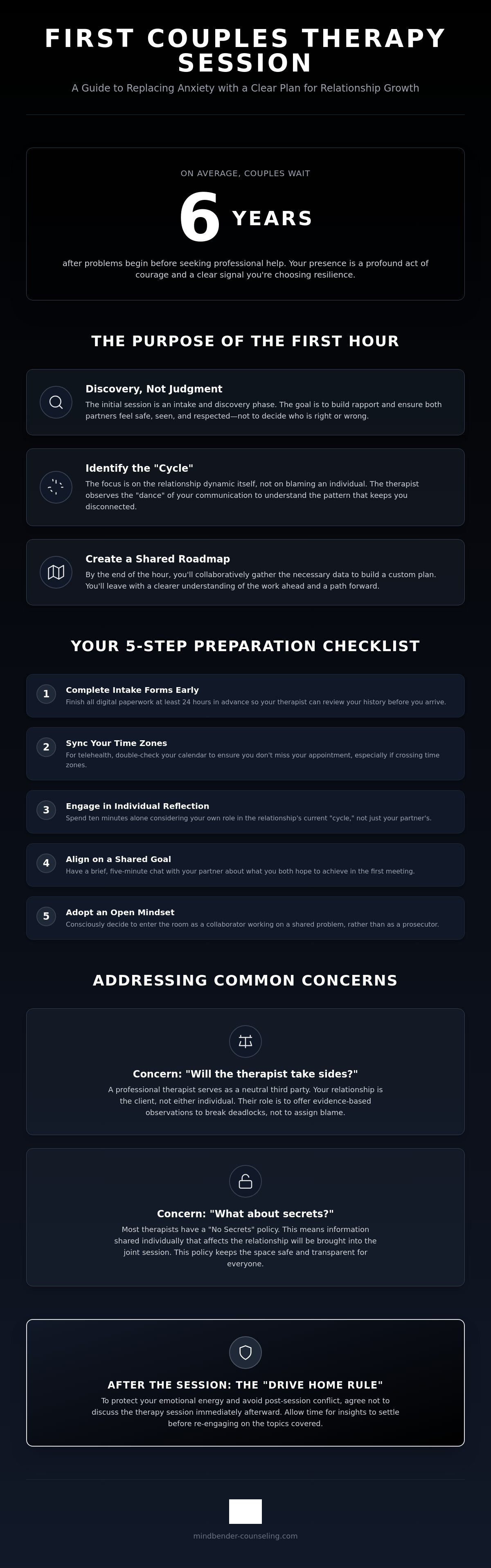
Walking into your first appointment isn't about rehashing every painful moment from the last decade. Instead, think of this initial hour as an intake and discovery phase. Research indicates that, on average, couples wait six years after problems begin before seeking professional support. While that statistic might seem daunting, your presence in the room today is a profound act of courage and a clear signal that you're choosing resilience over stagnation. Couples therapy provides a neutral container where your relationship, rather than any individual person, becomes the focus of care. The primary objective is to build rapport, ensuring both you and your partner feel safe, seen, and respected by the professional guiding your journey.
Why It Feels Different Than Talking to Friends
When you vent to friends or family, they often instinctively take sides to show loyalty. This well-intentioned bias usually reinforces the "villain" narrative and keeps you stuck in the same circular arguments that brought you here. A professional therapist serves as a neutral third party who maintains strict clinical boundaries. They don't offer biased advice; they offer evidence-based observations designed to break your current deadlock. This process relies heavily on the security of private therapy, which ensures your most vulnerable moments remain strictly confidential. This professional distance creates the safety needed for both partners to speak honestly without the fear of social repercussions or judgment from your inner circle.
The Goal: Creating a Shared Relational Roadmap
The first sixty minutes are focused on identifying the "cycle" that keeps you disconnected rather than identifying a "bad guy" in the room. Your therapist wants to observe the "dance" of your communication. One person might pursue while the other withdraws, or perhaps you both go on the offensive. When considering couples therapy what to expect first session, remember that the clock isn't ticking toward a final judgment on your relationship's viability. You're simply gathering the data necessary to build a custom roadmap for your future. The intake session functions as a collaborative diagnostic phase where you and your therapist align on your shared goals. By the end of this hour, you should have a clearer understanding of the work ahead and a sense of calm assurance that a path forward exists.
How to Prepare for Your First Meeting: A 5-Step Checklist
Preparation for your initial appointment isn't about building a legal case against your partner or rehearsing a list of their flaws. Instead, it involves clearing the logistical and emotional hurdles that might otherwise distract you from the work at hand. When researching couples therapy what to expect first session, many people overlook the practical steps that ensure the first hour is spent on growth rather than paperwork. Follow this chronological checklist 24 hours before your session to create a solid foundation for your progress:
- Complete all digital intake forms: Finish these at least a full day early so your therapist can review your history before you arrive.
- Sync your time zones: For telehealth users in Arizona and Texas, remember that Arizona does not observe Daylight Saving Time. Double-check your calendar to ensure you don't miss your window.
- Engage in individual reflection: Spend ten minutes alone considering your own role in the relationship's current "cycle" rather than just your partner's.
- Align on a shared goal: Have a brief, five-minute conversation with your partner about what you both hope to achieve in the first meeting.
- Adopt an open mindset: Consciously decide to enter the room as a collaborator rather than a prosecutor.
Logistics and Paperwork: The "Boring" But Vital Stuff
Maximizing your actual therapy time starts with handling the administrative details beforehand. Digital intake forms often cover your relationship history, previous counseling experiences, and basic medical information. If you're utilizing insurance or managing out-of-pocket payments, verify those details with your provider's office in advance to avoid awkward financial discussions during your session. For those opting for telehealth, choosing a private, quiet space is non-negotiable. Ensure your internet connection is stable and your environment is free from interruptions, which allows you to maintain the emotional focus required for deep work. If you haven't yet secured your provider, you can refer to our guide on choosing the right couples therapist near me for final selection tips.
Emotional Preparation: Aligning Your Goals
It's helpful to remember that you won't solve years of conflict in the first sixty minutes. The Gottman Institute explains that the initial phase is primarily about gathering a thorough oral history and understanding how you interact as a pair. Managing these expectations helps lower the pressure to perform. Briefly discuss with your partner what a "successful" first session looks like to you both. Often, success simply means feeling heard and having a clearer understanding of the next steps. If you feel ready to take this courageous step together, you can reach out to a professional to begin your journey toward lasting connection.
The Anatomy of the First Hour: What Actually Happens?
The first hour follows a methodical, reassuring rhythm designed to lower your stress and build a foundation of trust. It begins with a brief introduction and a thorough review of informed consent, which establishes the legal and ethical boundaries of your work together. This structure ensures that both you and your partner understand the privacy and safety of the therapeutic space before you begin sharing your story. When considering couples therapy what to expect first session, it's vital to realize that your therapist is observing the "how" of your communication as much as the "what." They are watching for the subtle shifts in your tone and the way you respond to each other's emotional needs, as these patterns often hold the key to your relationship's growth.
This observation is a hallmark of the approach at Mindbender Counseling, where we prioritize evidence-based therapy to ensure your time is spent on strategies that actually work. We move beyond surface-level venting to identify the underlying dynamics that keep you stuck. This transition from discussing your history to addressing your current pain points happens smoothly, allowing the therapist to act as a supportive guide through the complexities of your shared experience.
The Intake Interview and History Taking
Expect to share your "origin story"—the narrative of how you met and what initially drew you together. This story often contains the seeds of your relationship's resilience and serves as a reminder of the connection you're working to restore. We also explore your individual family backgrounds and previous relationship patterns, as these early experiences often create the blueprints for how we handle conflict today. This depth of history-taking is essential for individual counseling for anxiety and couples work alike, as it reveals the internal blueprints we bring into our relationships.
Evidence-Based Assessments and Goal Setting
After the history is established, the focus shifts to identifying your core conflict using research-backed frameworks like the Gottman Method or Emotionally Focused Therapy (EFT). These frameworks offer key insights on couples therapy by moving beyond surface-level complaints to the emotional needs underneath. By the end of the hour, we'll draft a preliminary treatment plan together. This roadmap outlines the specific relational goals we'll pursue, giving you a sense of direction and the calm assurance that you aren't just "talking" but are moving toward a measurable improvement in your connection.
Addressing Your Top Concerns: Side-Taking and Secret-Sharing
Entering a room to discuss your most private struggles can feel like stepping into a courtroom. It's the number one fear we hear from new clients: "Will the therapist team up with my partner and tell me I'm the problem?" This anxiety is completely understandable, but professional counseling in Arizona and Texas is built on a foundation of radical neutrality. When you consider couples therapy what to expect first session, you can rest assured that your therapist isn't there to assign blame or declare a winner. Their role is to facilitate a safe space where both voices are heard with equal weight and compassion, ensuring that neither partner feels attacked or ignored.
The Myth of the "Judge and Jury"
In our practice, we view the relationship itself as the client, not either individual person. This shift in perspective is vital because it allows the therapist to stay focused on the health of the connection rather than the perceived mistakes of one partner. Instead of acting as a judge, the therapist works to redirect blame into constructive communication patterns. This is where therapy behavioral therapy plays a crucial role. By identifying and changing the specific interaction patterns that cause distress, we help you build emotional resilience as a unit. We move away from the "who did what" and toward "how can we fix this together."
Confidentiality and Transparency
Healing cannot occur in the shadows, which is why most professional providers utilize a "No Secrets" policy. If one partner tries to share a secret via email or a private phone call outside the session, the therapist will typically bring that information back into the joint space. This transparency is essential for rebuilding trust. While individual therapy focuses on personal growth, relational goals require a shared foundation of honesty. U.S. legal and ethical standards protect your privacy, ensuring that what you share remains within the clinical setting, but the work itself thrives on total transparency between partners. This approach creates the stability needed for true internal progress.
If you're ready to experience a non-judgmental environment where your relationship is the priority, schedule your couples counseling session today and begin building a more secure future together.
Integration: What to Do After the Session Ends
The conclusion of your appointment marks the beginning of the integration phase, a time when the insights gathered in the room start to take root in your daily life. It's common to experience what many professionals call a "therapy hangover," which is a state of feeling emotionally raw, physically drained, or unusually quiet. This is a natural response to the deep emotional labor you've just performed. Understanding couples therapy what to expect first session includes knowing how to navigate these vulnerable hours following the meeting. Instead of rushing to fix everything at once, allow yourself the space to simply exist with the new information you've uncovered.
The "Drive Home Rule" and Immediate Aftercare
One of the most effective ways to protect your progress is to implement the "Drive Home Rule." We strongly advise couples to wait at least 24 hours before "debriefing" the session together. When you leave the therapist's office, your nervous systems may still be heightened, and a well-intentioned conversation can quickly devolve into a fresh argument. By committing to a 24-hour buffer, you give your brain the time it needs to process the experience individually before trying to synthesize it as a pair. Couples should treat the post-session period with extra gentleness, prioritizing individual self-care and avoiding high-stress topics.
During this window, focus on activities that ground you. This might look like:
- Taking a solo walk to clear your head.
- Journaling about your specific feelings without judgment.
- Engaging in a shared, low-stakes activity like watching a lighthearted show or preparing a meal without discussing the relationship.
Evaluating the Fit: Is This the Right Guide for Us?
As you reflect on the hour, it's important to evaluate if the therapist's style aligns with your needs. This isn't about whether the session felt "good," as growth often feels uncomfortable. Instead, ask yourselves three specific questions: Did the therapist maintain neutrality throughout the hour? Did both of us feel heard and respected? Do we feel a sense of quiet confidence in the plan they've proposed? If the answer is yes, you've likely found a sturdy anchor for your journey. Remember that "difficult" doesn't mean "wrong," often, the sessions that challenge your existing patterns the most are the ones that lead to the greatest restoration of balance.
Mindbender Counseling serves as a compassionate facilitator for couples throughout Phoenix and Texas, offering evidence-based methods that turn confusion into a clear roadmap for growth. If you feel a sense of optimism about the path ahead, you can schedule your next therapeutic appointment with confidence. Taking that second step is often where the most significant movement toward a solid internal foundation begins.
Your Path Toward Lasting Connection Starts Here
You now have the practical tools to replace initial anxiety with a clear plan for relationship growth. By reframing the discovery phase and committing to the "Drive Home Rule," you're already treating your partnership with a new level of intentionality. This shift from identifying a villain to understanding your shared communication cycle is where true healing begins. Knowing exactly what to expect in couples therapy what to expect first session allows you to enter the room with your defenses down and your heart open to change.
At Mindbender Counseling, we provide compassionate, non-judgmental care for Arizona and Texas couples through evidence-based techniques tailored to your unique history. Our specialized support focuses on improving communication and resolving conflict, ensuring you have a sturdy anchor as you navigate difficult emotions. You don't have to wait for a crisis to begin building a more resilient foundation. Begin your journey toward a stronger bond; schedule your first session at Mindbender Counseling today. A more connected, stable future is well within your reach, and we're here to guide you every step of the way.
Frequently Asked Questions
How long does the first couples therapy session usually last?
A standard initial appointment typically lasts between 60 and 90 minutes to allow for a thorough intake process. This timeframe ensures that your therapist has enough space to review your history and hear from both partners without making the conversation feel rushed. Establishing this foundation early on helps create a methodical rhythm for your future sessions.
Do we have to talk about our childhoods in the first meeting?
You'll likely touch on your family backgrounds briefly to help your therapist understand the relational blueprints you bring into your current partnership. While the first hour isn't a deep dive into past trauma, identifying early attachment patterns is essential for recognizing how you handle conflict today. This context allows your guide to build a more personalized and effective roadmap for your growth.
What if my partner refuses to speak during the session?
Your therapist is a professional facilitator trained to engage partners who may feel hesitant, anxious, or resistant to the process. Silence is actually a valuable form of data that tells the therapist a lot about your relationship's current "cycle" and defensive patterns. The counselor will use gentle invitations and structured questions to help the quieter partner feel safe enough to share their perspective at a comfortable pace.
Is couples therapy covered by insurance in Arizona or Texas?
Most health insurance plans in Arizona and Texas don't cover couples counseling if the primary goal is general relationship improvement. Insurance providers typically only offer coverage if the therapy is deemed medically necessary to treat a diagnosed mental health condition in one of the partners. It's always a good idea to check your specific policy details or HSA eligibility before your first appointment to avoid financial surprises.
How many sessions will it take before we see an actual difference?
Many couples report a noticeable shift in their communication and emotional connection within 8 to 12 sessions of consistent work. While you may feel a sense of relief after the first hour, lasting change requires time to unlearn old habits and build a new, solid internal foundation. Your therapist will work with you to set measurable goals so you can track your progress toward stability and resilience.
Can we do our first session online via telehealth?
You can absolutely choose telehealth for your initial meeting, provided you have a private space and a stable internet connection. Research shows that online counseling is just as effective as in-person sessions for building rapport and achieving long-term relationship goals. For busy couples in Phoenix or across Texas, this flexible option reduces the friction of seeking help and allows you to begin your journey from a familiar, secure environment.
What should we bring with us to the first appointment?
The most important things to bring to couples therapy what to expect first session are an open mindset and a willingness to be honest with yourself and your partner. You won't need to bring physical documents if you've completed your digital intake forms in advance. Having a few specific goals in mind can help the therapist align their evidence-based approach with what you hope to achieve most.
Is it normal to feel worse after the first session?
It's completely natural to feel emotionally drained or "raw" after your first appointment because you're surfacing feelings that may have been suppressed for years. This experience is often called a therapy hangover, and it's actually a sign that you're engaging in the deep work required for change. Treat yourself and your partner with extra gentleness during the 24 hours following your session as you process the new insights you've uncovered.


