

What if the most effective way to heal wasn't just about talking, but about following a path already proven to work for people facing your exact challenges? Many people hesitate to start counseling because they worry about spending months in sessions without seeing real change. You might feel like your situation is too complex for a standard approach, or perhaps you're simply tired of trying to decode clinical jargon. Understanding what is evidence based therapy can change that perspective by showing you how science and compassion work together to create a reliable foundation for your growth.
We believe that your time and emotional energy are precious. You deserve a treatment plan that offers more than just a listening ear; you need a strategy rooted in clinical success. This guide explores how evidence-based therapy combines rigorous scientific research with deep clinical expertise to provide the personalized, results-oriented support you need. We'll walk through the most effective modern modalities, explain how they address complex problems, and help you find a dedicated provider in Arizona or Texas who can help you restore balance to your life.
Key Takeaways
- Gain clarity on how a research-backed framework ensures your therapy sessions are both safe and effective for your unique challenges.
- Discover what is evidence based therapy by exploring the three essential pillars that balance scientific data, clinical wisdom, and your personal values.
- Learn why these methods are far from "cookie-cutter" and how they actually strengthen the emotional bond between you and your therapist.
- Explore proven modalities like CBT and DBT to help you feel more confident in choosing a path toward emotional resilience and stability.
- Understand how to access personalized, results-oriented individual or couples counseling designed specifically for residents in Arizona and Texas.
Defining Evidence-Based Therapy: More Than Just a Science Term
When you begin your journey toward healing, you want more than a sympathetic ear. You want the assurance that the time and emotional energy you invest will lead to tangible progress. This is the core of what is evidence based therapy. It isn't just a clinical buzzword; it's a disciplined framework for making clinical decisions based on the most rigorous research available today. By choosing this approach, you're ensuring that the techniques used in your sessions have been tested for safety and efficacy in real-world settings. You aren't a test subject; you're a partner in a process that has already helped countless others find their way back to balance.
Evidence-based therapy is a commitment to using what works while honoring the individual. It moves the therapeutic process away from "opinion-based" methods, where a provider might rely solely on their own intuition or outdated training. Instead, it moves toward "results-oriented" care that prioritizes your actual recovery and growth. This approach provides a sturdy anchor in what can often feel like an overwhelming sea of mental health options. It gives you a clear starting point and a reliable way to measure your progress as you move forward.
The Origin of Evidence-Based Practice
The concept of Evidence-based practice didn't start in a therapist's office. It began in the medical field as a way to standardize care and ensure patients received treatments that were proven to be effective. Over time, psychology joined forces with medicine to bring this same level of accountability to mental health. The American Psychological Association (APA) defines this as the integration of the best available research with clinical expertise in the context of patient characteristics, culture, and preferences. This shift toward accountability means you can trust that your care is grounded in something sturdier than a single person's perspective. It represents a modern standard of care where your well-being is backed by a global community of researchers and clinicians.
Why "Evidence" Matters for Your Healing
One of the greatest fears people have when starting therapy is the "trial and error" phase. You don't want to spend months trying different methods only to find they don't fit your needs. EBT significantly reduces this uncertainty. Because these methods have been studied across diverse groups, your therapist can start with a proven roadmap tailored to your specific symptoms. This provides a profound sense of peace of mind, especially for those in Phoenix or across Texas who are looking for reliable local support. You know that the work you're doing is designed to build long-term emotional resilience. It's about constructing a solid internal foundation that lasts long after your final session. You're not just feeling better for an hour; you're learning skills that have been proven to work for a lifetime.
The Three Pillars of EBT: Research, Expertise, and You
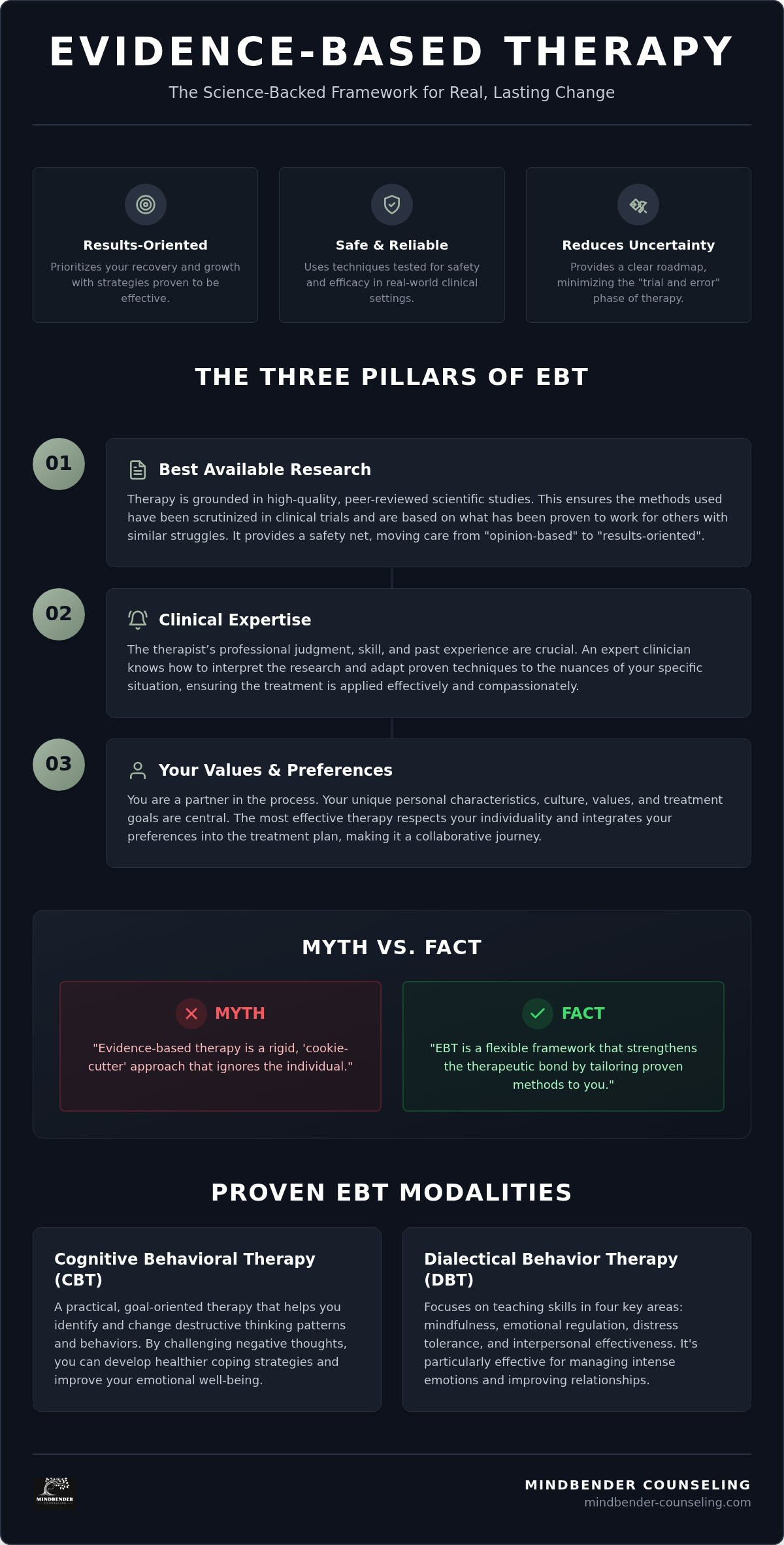
To truly grasp what is evidence based therapy, it helps to visualize a three-legged stool. If any one leg is missing, the entire structure becomes unstable. This "triad" approach ensures that your care isn't just a generic application of a textbook. Instead, it's a dynamic process that balances hard data with human intuition. By integrating these three distinct elements, your counselor provides a high standard of care that is both scientifically sound and deeply personal. It's this balance that turns a standard session into a transformative experience.
Pillar 1: The Best Available Research
The first pillar involves staying grounded in high-quality, peer-reviewed studies. Research provides the map for our journey. In 2026, staying current means more than just reading old textbooks. For instance, the American Psychological Association (APA) recently updated its clinical practice guidelines for PTSD to draw from 15 systematic reviews, a significant expansion from previous years. This level of rigor is what defines Evidence-Based Practice in Psychology. When a therapist utilizes therapy behavioral therapy, they're using methods that have been scrutinized in clinical trials to ensure they actually help people find relief. This research acts as a safety net, ensuring your treatment is based on what has been proven to work for others with similar struggles.
Pillar 2: Clinical Expertise and Judgment
While research provides the map, clinical expertise is the seasoned guide who knows how to read the terrain. A manual alone cannot replace the years of training and professional judgment a skilled therapist brings to the room. Clinical expertise allows a counselor to recognize subtle shifts in your mood or body language that a data point might miss. They adapt proven methods in real time to fit the moment-to-moment needs of your session. This pillar also emphasizes the "therapeutic alliance," which is the trusting bond between you and your counselor. Studies consistently show that this connection is one of the strongest predictors of success, proving that the human element is just as vital as the scientific one.
Pillar 3: Your Unique Client Characteristics
The final pillar is you. Your unique history, cultural background, and personal goals are the most important variables in the equation. High-quality care must honor your values and preferences to be effective. If a treatment plan doesn't resonate with your life experiences, it won't be sustainable. This is why we emphasize a partnership rather than a lecture. For example, when customizing individual counseling for anxiety, a therapist must consider how your specific environment in Phoenix or Texas impacts your stress levels. By weaving your personal context into the clinical framework, we ensure the work feels relevant and empowering. If you're ready to see how these three pillars can support your growth, exploring Evidence-Based Therapy is a gentle first step toward lasting change.
Common Misconceptions: Is Evidence-Based Therapy Too Clinical?
Many people hesitate to seek out research-backed care because they fear it will feel cold or impersonal. When you're trying to understand what is evidence based therapy, you might picture a clinician reading from a script or following a rigid checklist that ignores your unique personality. This is a common myth. In reality, EBT provides a sturdy foundation that allows for deeper, safer exploration. It doesn't replace the human element; it strengthens it by ensuring the work you do together has a proven purpose. By removing the guesswork, you and your therapist can focus on the heart of your experience with greater confidence.
Another frequent misconception is that EBT is a "one-size-fits-all" or "cookie-cutter" approach. This couldn't be further from the truth. Because these methods are designed to be flexible, they actually empower you to have a significant say in your treatment goals. You aren't a passive recipient of care; you're an active collaborator. As noted by the National Institutes of Health on Evidence-Based Psychotherapy, the integration of clinical expertise and patient values is essential for success. This means your history, culture, and personal preferences are always at the center of the process.
The "Robotic Therapy" Myth
Structured modalities like CBT or DBT are often misunderstood as being robotic or stiff. These sessions are actually highly interactive and creative. Think of the structure as a framework rather than a script. Just as a building needs a solid frame to stay upright, therapy needs a reliable structure to help you process difficult emotions. This predictable environment creates the safety you need to be truly vulnerable. It's much easier to open up when you know your therapist has a clear, proven plan to help you navigate whatever comes to the surface.
EBT and Personal Creativity
Therapists who use evidence-based methods don't leave their intuition at the door. They use their professional judgment to adapt proven techniques to your specific needs in real time. Choosing private therapy in a professional clinical setting provides the ideal environment for this balance. It's the one place where scientific rigor meets compassionate, active listening. This combination ensures that while the methods are grounded in data, the delivery is always warm and human. You get the best of both worlds: a therapist who cares deeply and a method that actually works. We've seen that when science and soul meet, the potential for lasting change becomes a reality.
Proven Methods: CBT, DBT, and Beyond for Real Change
Understanding what is evidence based therapy becomes much clearer when you look at the specific methods used in the room. These aren't just theories; they are refined tools designed to address the specific ways our brains and hearts process struggle. By using these proven modalities, your therapist provides a roadmap that has been tested and validated by thousands of successful outcomes. Whether you're dealing with a specific diagnosis or a general sense of being stuck, these methods offer a way forward that is both structured and deeply compassionate.
Several core modalities form the backbone of modern results-oriented care:
- Cognitive Behavioral Therapy (CBT): This method focuses on the connection between your thoughts, feelings, and actions. It helps you identify "thinking traps" that keep you stuck in negative cycles.
- Dialectical Behavior Therapy (DBT): Originally designed for intense emotional regulation, DBT teaches mindfulness and distress tolerance. It's about finding the balance between accepting yourself and working toward change.
- Acceptance and Commitment Therapy (ACT): Instead of trying to eliminate difficult feelings, ACT helps you accept them while committing to actions that align with your deepest values.
- The Gottman Method and EFT: These are the gold standards for relationship health. They focus on de-escalating conflict and rebuilding the emotional bond between partners.
EBT for Individual Growth
Individual growth is most sustainable when you have practical tools to use outside of your weekly sessions. Behavioral therapies are particularly effective for addressing anxiety, depression, and trauma because they provide immediate, actionable strategies. For example, professionals often seek counseling for work stress Arizona to gain research-backed methods for managing high-pressure environments. By focusing on skill-building, these therapies help you develop emotional resilience that lasts. You aren't just talking about your problems; you're learning how to navigate them with confidence and clarity.
Evidence-Based Couples Counseling
When relationships feel strained, "just talking it out" often isn't enough to break deep-seated patterns. Evidence-based couples counseling uses structured frameworks like the Gottman Method to identify the specific behaviors that predict relationship distress. These techniques help partners move away from blame and toward mutual understanding. Many people wonder how does online couples counseling work when using such specific methods. The reality is that the digital format actually supports the structured nature of these interventions, allowing couples in Texas and Arizona to access high-quality care from the comfort of their own homes. If you're ready to strengthen your connection using methods that truly work, we invite you to explore our Evidence-Based Therapy options today.
Choosing Your Path: Evidence-Based Care at Mindbender Counseling
At Mindbender Counseling, we believe that the best results happen when scientific rigor meets a compassionate human connection. We're intentional about who joins our team. We select therapists who don't just understand what is evidence based therapy but prioritize research-backed methods in every session they lead. This commitment ensures that whether you're seeking individual or couples counseling, you're receiving care that is both innovative and rooted in proven success. We act as your professional facilitator, helping you build a solid internal foundation using tools that have been validated by years of clinical study.
Your journey begins with a personalized treatment plan. We don't believe in a one-size-fits-all approach. Instead, we look at your history, your culture, and your specific goals to build a unique framework for growth. During your first session, you can expect a thorough assessment and collaborative goal setting. We'll talk about where you are now and where you want to be. This organized approach creates a sense of order and predictability from day one, which helps to reduce the friction often associated with starting professional services.
Personalized Care in Arizona and Texas
Our practice is designed to serve the unique needs of professionals and families across the Southwest. From the high-pressure environments in Phoenix to the diverse communities across Texas, we understand the specific stressors you face. We offer both in-person and telehealth options to ensure that high-quality care fits into your life, not the other way around. Every session meets strict local standards of care, providing you with the security and reliability you deserve. Whether you're at home or in one of our offices, you'll receive the same steady, unwavering support that defines our practice.
Your Next Steps Toward Wellness
Choosing a therapist is a significant decision. You should feel empowered to verify that your provider uses evidence-based methods. During your initial consultation, don't hesitate to ask questions about their specific therapeutic approach. An expert counselor will be happy to explain how their methods relate to your goals and what the research says about your specific challenges. This clarity helps build the trust necessary for deep, transformative work. It's your journey, and you deserve to know that your guide is using the most effective tools available.
If you're ready to move toward emotional resilience and stability, we're here to guide you. Our team is dedicated to providing the steady support you need to restore balance and find a clear path forward. We invite you to schedule a consultation at Mindbender Counseling to discover how our results-oriented approach can help you create a more fulfilling, stable life.
Embrace a Path Built on Proven Results
Choosing a therapeutic approach is a powerful step toward reclaiming your well-being. You've learned that what is evidence based therapy involves a thoughtful integration of the best available research, clinical expertise, and your own unique values. This framework doesn't just offer a listening ear; it provides a reliable structure that turns your vulnerability into strength and your challenges into opportunities for growth. Whether you're navigating individual stress or seeking to repair a relationship, these proven methods offer the clarity and stability you need to move forward with confidence.
Our licensed therapists at Mindbender Counseling specialize in research-backed individual and couples counseling across Arizona and Texas. We're dedicated to creating personalized treatment plans that honor your cultural context and personal history, ensuring your care feels relevant and supportive. You don't have to navigate this journey alone or wonder if your treatment is effective. We provide convenient access for residents throughout the Southwest, offering both in-person and telehealth options to fit your lifestyle.
Start your journey with evidence-based therapy at Mindbender Counseling and take the first step toward the balanced, resilient life you deserve. We're here to be your steady anchor and your partner in progress.
Frequently Asked Questions
Is evidence-based therapy more expensive than traditional therapy?
No, evidence-based therapy typically costs the same as other forms of professional counseling. While session rates are comparable to industry standards, many people find this approach more cost-effective in the long run. Because the methods are results-oriented and focused on efficiency, you may reach your goals in fewer sessions than you would with less structured approaches. This focus on practical outcomes helps you maximize the value of your investment in your mental health.
How long does evidence-based therapy usually take to show results?
Most individuals begin to notice meaningful shifts in their perspective or behavior within the first 8 to 12 sessions. While every person’s journey is unique, the structured nature of these methods allows for clearer progress tracking from the start. Your therapist will work with you to set specific milestones so you can see exactly how you're moving toward your goals. This predictability helps maintain your motivation as you build a stronger internal foundation.
Can I still talk about my childhood in evidence-based therapy?
Yes, exploring your history is often a vital part of understanding the patterns you face today. While some people worry that research-backed care only focuses on the present, we believe your past provides essential context for your current growth. We look at your childhood experiences through a clinical lens to identify how they shaped your current thought patterns. This allows us to use proven strategies to heal old wounds and build modern emotional resilience.
What is the difference between CBT and evidence-based therapy?
CBT is a specific type of treatment, while what is evidence based therapy refers to the broader category of all scientifically validated methods. Think of evidence-based therapy as an umbrella that covers various proven techniques, including Cognitive Behavioral Therapy, Dialectical Behavior Therapy, and the Gottman Method. When a therapist uses this framework, they're committing to using only the tools that have been rigorously tested and shown to be effective in clinical studies.
Does evidence-based therapy work for everyone?
While no single treatment is a universal guarantee, these methods have the highest probability of success because they are backed by data. Success in therapy often depends on the integration of the three pillars we've discussed: research, clinical expertise, and your active participation. If a specific modality isn't producing the desired results, your therapist will use their professional judgment to adjust the techniques. This ensures your treatment remains aligned with your personal needs and goals.
How do I know if my current therapist is using evidence-based methods?
The best way to find out is to ask your therapist directly about the research supporting their specific approach. A professional counselor should be able to explain the "why" behind the techniques they use and how those methods relate to your treatment goals. You can also ask how they stay updated on the latest findings in the field. This transparency is a hallmark of a high-quality therapeutic alliance and helps build the trust necessary for healing.
Is evidence-based therapy available through telehealth in Texas?
Yes, we provide what is evidence based therapy via secure telehealth platforms to residents throughout the entire state of Texas. This allows you to access the same high standard of care and clinical expertise from the comfort of your own home. Whether you are in a major city or a more rural area, our digital sessions are designed to be just as interactive and effective as in-person visits. This flexibility ensures that professional support is always within reach.
What happens if the "standard" evidence-based approach doesn’t feel right for me?
We prioritize your comfort and personal values above any rigid manual or script. If a specific technique doesn't resonate with you, we encourage you to share that feedback so we can pivot our strategy. The "client characteristics" pillar of our work ensures that your treatment plan is a partnership, not a lecture. We will collaborate with you to adapt proven methods so they feel authentic and supportive of your unique journey toward wellness.


