

The most important step in your mental health journey happens before you even step into an office or log onto a video call. Finding a professional who truly understands your unique perspective is a reciprocal interview, and knowing what to ask a therapist before booking is the key to a successful partnership. With over 23 percent of U.S. adults living with a mental illness as of 2026, the search for support is a shared experience, yet it remains deeply personal. It's natural to feel a sense of hesitation or even fear of being misunderstood when you start this process. You deserve to feel certain that your therapist possesses the evidence-based expertise necessary to help you build a solid internal foundation.
We recognize that the first call often brings a mix of anxiety and confusion over different therapy modalities. This guide will empower you with a concrete list of questions that reveal a provider's true approach and compatibility with your specific goals. We'll show you how to evaluate their responses so you can move forward with confidence. By following this structured path, you'll gain the clarity needed to book your first session with a sense of calm assurance. You're not just looking for a provider; you're finding a guide who will act as a sturdy anchor for your personal growth.
Key Takeaways
- View your initial consultation as a low-pressure, reciprocal interview to ensure the "therapeutic alliance" supports your specific path toward well-being.
- Learn exactly what to ask a therapist before booking to confirm their evidence-based expertise and training align with your primary concerns.
- Gain clear insights into practical logistics, such as session frequency and private therapy rates, to create a sustainable and predictable care plan.
- Evaluate your personal compatibility by observing if a therapist communicates with clarity and makes you feel truly heard during your first interaction.
- Discover a streamlined path to your first session through a structured intake process tailored for professionals in Arizona and Texas.
The Purpose of the Consultation: Why Your Questions Matter
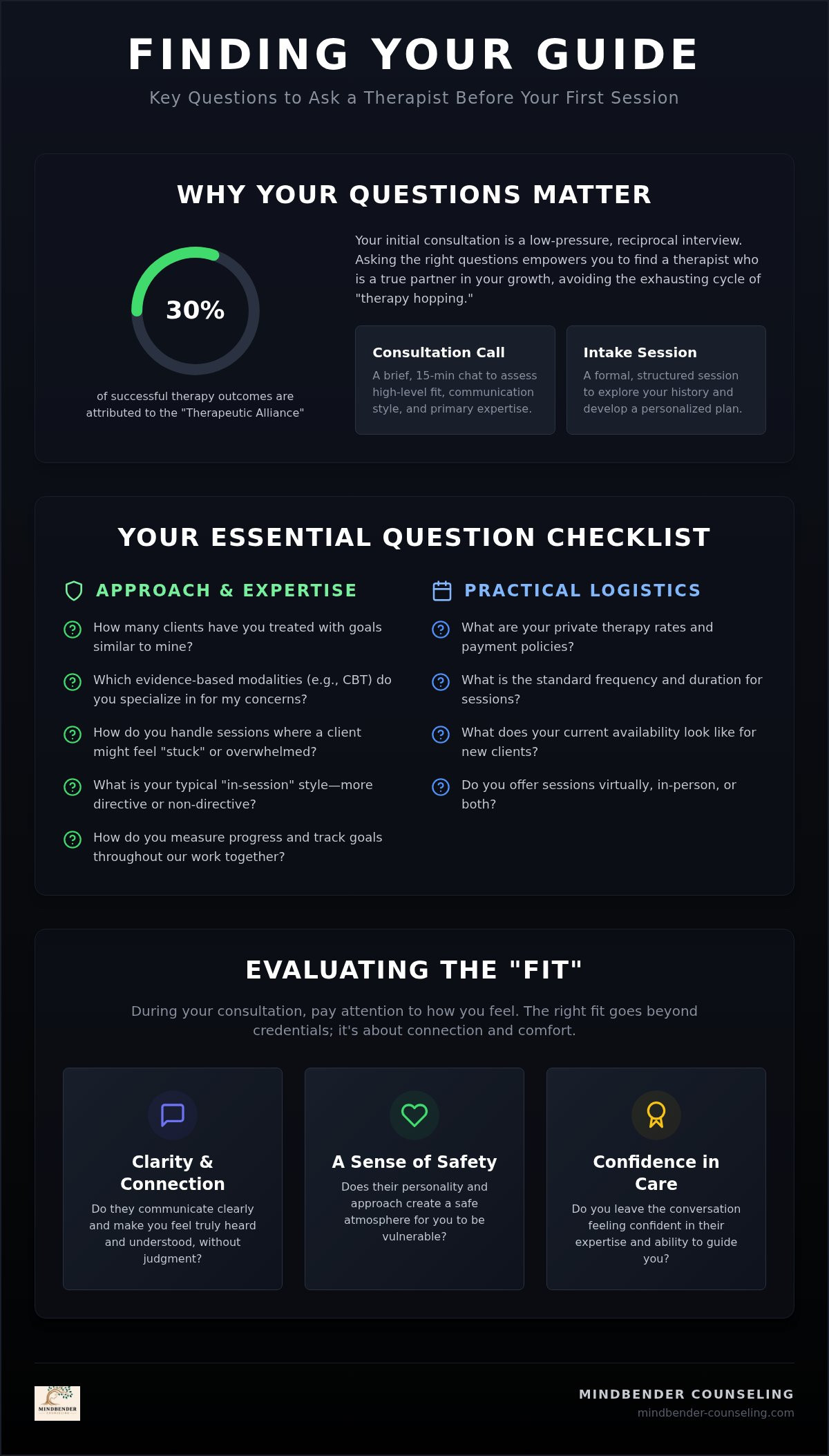
Starting your search for support shouldn't feel like an interrogation. Instead, view the initial consultation as a low-pressure, reciprocal interview designed to build immediate trust. Knowing what to ask a therapist before booking allows you to transition from a passive observer to an empowered participant in your own care. This proactive approach is vital because research consistently shows that the "therapeutic alliance" accounts for up to 30% of successful outcomes. When you prioritize this bond from the start, you create a sense of security that allows for deeper work. You also avoid the exhausting cycle of "therapy hopping," where you start and stop with different providers because the initial fit was never truly verified.
The Psychology of the "Right Fit"
Your comfort level with a provider is a primary driver of clinical progress. If you don't feel heard or understood, the most sophisticated techniques will struggle to take root. Personality alignment creates an atmosphere of safety; it makes it easier to navigate emotional vulnerability without fear of judgment. This is particularly important for professionals in Arizona and Texas who may be balancing high-stress careers with personal growth. By exploring different types of psychotherapy, you can find a style that matches your rhythm. Choosing a therapist who acts as a compassionate guide ensures that your journey toward stability is supported by a sturdy, reliable foundation.
Consultation vs. Intake Session
There is a clear difference between an informal 15-minute consult and a formal clinical intake. A consultation call focuses on high-level logistics and whether the therapist’s expertise in individual or couples counseling aligns with your goals. During this brief window, the therapist is screening for clinical fit while you are assessing their communication style. The consultation serves as a strategic alignment check before the diagnostic work begins. Once you feel certain about the connection, you'll move into a structured intake session. This more formal process involves a deeper exploration of your history and the development of a personalized, research-backed plan. Understanding what to ask a therapist before booking ensures that your first full session is productive and focused on your evolution.
Essential Questions About Clinical Approach and Expertise
Choosing a provider requires looking beyond a friendly face to understand the clinical engine driving your sessions. When you're determining what to ask a therapist before booking, the focus shifts toward specific clinical competence and methodology. You aren't just looking for a listener, but a facilitator for your evolution. This stage of the process ensures that the professional's skills align with the specific internal foundation you wish to build.
Start by inquiring about their history with your primary concern. If you're navigating the complexities of chronic anxiety or the aftermath of infidelity, you need a professional who has successfully guided others through that specific terrain. Ask about their specialized training in cognitive behavioral therapy. This question reveals whether they utilize structured, research-backed tools or rely on a more open-ended approach. You should also clarify their "in-session" style. Some therapists are directive, providing concrete strategies and homework, while others are non-directive, acting as a reflective mirror for your own thoughts. Neither is inherently better, but your personal preference will dictate how supported you feel.
Consider adding these specific queries to your list:
- How many clients have you treated with goals similar to mine?
- Which evidence-based modalities do you specialize in for my concerns?
- How do you handle sessions where I might feel "stuck" or overwhelmed?
Measurable progress is the hallmark of professional care. Inquire about how they measure progress and what indicators suggest you are reaching your goals. Learning what to ask a therapist before booking ensures your time is an investment in tangible change rather than an indefinite commitment. Our specialists at Mindbender Counseling emphasize this transparency to build a bond of mutual accountability from day one.
Understanding Evidence-Based Care
Asking "What research supports your method?" is a valid and vital part of your search. High-quality care relies on proven techniques rather than intuition alone. It's helpful to review authoritative questions to ask a therapist to ensure their answers meet rigorous clinical standards. For individuals seeking individual counseling for anxiety, evidence-based techniques provide a structured roadmap for relief. This differs significantly from general talk therapy, which may lack the specific interventions needed to disrupt cycles of worry and fear.
Questions for Couples and Partners
Relationship work requires a unique set of questions to ensure both partners feel seen and safe. Ask the therapist how they maintain neutrality during heated conflicts. It's essential to know they won't "take sides" but will instead focus on the health of the relationship itself. If you're considering a digital format, ask how does online couples counseling work within their specific framework. You should also address what happens if one partner is more "ready" for the process than the other. A skilled counselor knows how to bridge that gap without making either person feel pressured or ignored.
Practical Logistics: Scheduling, Fees, and Format
While the emotional connection is the heartbeat of your work, the logistical framework provides the skeleton that holds it all together. Understanding the administrative side of care reduces friction and prevents unexpected stressors from interrupting your progress. When considering what to ask a therapist before booking, you should start with the rhythm of your sessions. Most evidence-based approaches thrive on weekly consistency, but some providers offer bi-weekly or on-demand options depending on your current needs and stability. Clarify this early to ensure your schedule can accommodate the commitment required for real change.
Financial transparency is equally essential for a stress-free experience. It's important to inquire about the specific breakdown of private therapy rates and the available payment methods. You'll also want to understand the therapist’s policy on cancellations and how they handle emergency contact between sessions. For those utilizing remote care, asking about HIPAA compliance and the security of their digital platform is a non-negotiable step. Reviewing a comprehensive list of questions for your new therapist can help you cover these smaller but vital details before you commit to a full intake. Knowing what to ask a therapist before booking ensures that you aren't surprised by administrative hurdles later on.
Telehealth vs. In-Person in Arizona and Texas
For high-performing professionals in the Southwest, time is often the biggest barrier to seeking help. Evaluating remote care options can be a game-changer when seeking counseling for work stress Arizona. Telehealth allows you to receive expert support from the comfort of your home or office, provided the therapist is licensed to practice in your specific state. When you prepare for a remote session, consider the privacy of your environment and the reliability of your connection. This ensures the "digital room" feels as safe and focused as a physical office.
Insurance and Superbills
Understanding your insurance coverage can provide immediate peace of mind. Ask your potential therapist if they provide superbills, which are detailed invoices you can submit to your insurance provider for potential out-of-network reimbursement. There's often a significant difference between "in-network" and "private pay" models, particularly regarding the level of individualized attention and the freedom to tailor treatment without insurance-mandated restrictions. Before your first appointment, call your insurance carrier to verify your mental health benefits and ask about your deductible for out-of-network services. This knowledge empowers you to make an informed decision about the investment in your long-term well-being.
Evaluating the "Fit": How to Interpret Their Answers
Gathering your list of what to ask a therapist before booking is a powerful first step, but the true value lies in how you interpret the energy behind their responses. Pay close attention to the delivery and the rhythm of the conversation. Does the therapist offer their expertise with a sense of calm assurance, or do they seem rushed to end the call? A professional who truly values the therapeutic alliance will prioritize your comfort during this initial exchange. They should speak in a way that lowers your defenses and builds immediate trust, using accessible language that resonates on an emotional level rather than hiding behind dense academic jargon.
Inclusivity and cultural competence are vital components of a safe therapeutic space. When you ask about their experience with your specific background, identity, or lifestyle, look for answers that suggest fresh attention and genuine care. This is about more than just checking a box; it's about finding a partner who recognizes the nuances of your journey. Trust your intuition through the "20-minute rule." If you don't feel a baseline of emotional safety or a sense of quiet confidence from the provider within the first 20 minutes of your interaction, it's a strong signal that this particular partnership may not be the sturdy anchor you need for long-term progress.
Red Flags to Watch For
Be cautious of vague or evasive answers regarding credentials, specific clinical experience, or their specialization in individual or couples counseling. A therapist who spends the majority of the consultation talking about their own life and personal philosophy rather than your immediate needs is likely not the professional facilitator you deserve. Additionally, stay alert for any high-pressure sales tactics. If a provider pressures you to book a long-term package or multiple sessions immediately without first presenting a clear, research-backed plan for your intake, they may be prioritizing their business goals over your personal evolution.
Green Flags: Signs of a Wise Guide
A wise guide demonstrates active listening by summarizing your concerns back to you in a way that makes you feel truly heard and understood. They are also transparent about their professional limitations. A high-quality provider will honestly state if a specific issue is outside their wheelhouse and will offer a helpful suggestion for where you might find a better fit. Most importantly, they will offer a structured, logical path for how they intend to help you reach your goals, ensuring you feel supported by proven, reliable methods from the very start. If you're ready to experience this level of personalized, professional care, you can schedule an evidence-based consultation with our team to find your perfect fit.
Booking Your Session: Taking the Final Step with Mindbender
Deciding to start therapy is an act of quiet courage. Once you've determined what to ask a therapist before booking and feel confident in your choice, the final step should be simple and supportive. Our secure online portal serves residents across Arizona and Texas, offering a streamlined way to manage your care from your own home. Before you log in, gather your basic identification and insurance details for the digital paperwork. Having this information ready allows you to move through the administrative phase with ease; it leaves more mental space for your actual growth. This organized approach creates a sense of order and predictability, which helps to build a feeling of security from the very start.
Preparing your mindset for the first 50-minute intake session is just as important as the paperwork. View this initial meeting as a collaborative foundation-building experience rather than a one-sided evaluation. It's a time to expand on the insights you gained when you were learning what to ask a therapist before booking. You aren't expected to have all the answers or to "perform" for your counselor. Instead, arrive with an open heart and a willingness to explore your path toward stability. Therapy is a dedicated space for your personal evolution, and taking this step proves you're ready to prioritize your long-term well-being.
Your First Session Roadmap
The first ten minutes of your intake session are designed to set the stage and ensure you feel grounded. Your therapist will briefly review your digital paperwork and clarify any logistical questions to ensure total transparency. From there, we move into a collaborative goal-setting process where your voice remains central to the treatment plan. Mindbender Counseling remains committed to providing a research-backed, compassionate sanctuary for personal evolution. This structured intake process ensures that both individual and couples therapy sessions are rooted in proven, reliable methods from day one.
Ready to Begin?
Making an investment in your emotional resilience today provides the construction of a solid internal foundation for years to come. We invite you to view our current availability for professionals in the Phoenix and Texas regions through our low-friction scheduling system. You deserve a partner who treats your journey with fresh attention and expert care. Take the final step toward a more balanced and fulfilling life by securing your spot on our calendar.
Schedule your therapeutic appointment with Mindbender Counseling today.
Empower Your Path to Well-Being
Finding the right therapeutic partner is a significant milestone in your personal evolution. By mastering what to ask a therapist before booking, you've transitioned from uncertainty to empowered action. You now understand that a successful outcome depends on a strong clinical alliance and a shared commitment to research-backed methods. This proactive approach ensures that your time and energy are invested in a relationship that offers both stability and measurable progress. You are no longer searching; you are choosing a path built on clarity and trust.
Our team provides compassionate care tailored specifically for Arizona and Texas residents. We utilize evidence-based techniques to support your journey toward lasting emotional resilience. With our secure and easy-to-use digital client portal, the path to your first session is clear and logical. You're ready to move forward with a sense of calm assurance. Begin your journey toward healing; schedule your first session today. You possess the tools to build a solid internal foundation, and we are here to act as your steady, unwavering guide.
Common Questions About the Search for Support
What is the difference between a therapist and a counselor?
As of 2026, both therapists and counselors in the United States must hold at least a master's degree and complete extensive supervised clinical hours for professional licensure. While these titles are often used interchangeably in everyday conversation, "therapist" is a broader term that can include psychologists, social workers, or marriage and family experts. Regardless of the specific title, you should verify that the professional has experience in the area where you seek growth. This ensures you are supported by a guide who possesses deep expertise in evidence-based methods.
Should I ask about a therapist’s personal life or values?
You have the right to ask about a therapist's values or their approach to specific cultural topics that are important to your identity. While a professional maintains clinical boundaries regarding their private life, their worldview can influence the therapeutic bond. Knowing their stance on inclusivity or their experience with diverse populations can help you feel seen and safe. This ensures that the partnership is rooted in mutual respect and understanding from the very first session, allowing for deeper emotional work.
How much does a private therapy session cost in Arizona or Texas?
Rates for private therapy are influenced by geographic location and the provider's level of specialization. In major metropolitan areas across Arizona and Texas, fees often reflect the local cost of living and the complexity of the care provided. You should also consider whether the practice offers superbills for out-of-network reimbursement, as this can impact your total investment. Always verify specific rates during your initial inquiry to ensure the commitment aligns with your financial goals and your path toward stability.
What if I feel awkward asking these questions during the call?
Feeling a sense of hesitation is a common part of the process; most therapists view your questions as a sign of healthy engagement. They are trained to handle these interactions with quiet confidence and will do their best to put you at ease. If you feel overwhelmed, try writing your questions down beforehand to keep the conversation structured. A compassionate guide will appreciate your proactive approach and will work with you to build a sense of tranquility during the initial call.
Can I ask a therapist for a free consultation before I book?
While policies vary between practices, many providers offer a brief discovery call to explore compatibility. This low-pressure interaction allows you to get a sense of their personality and clinical approach before committing to a full intake. You can use this time to ask about their experience with your specific concerns and to ensure their availability matches your schedule. This is a perfect opportunity to use your list of what to ask a therapist before booking to reduce the friction of starting care.
How do I know if a therapist is evidence-based?
A therapist is considered evidence-based if they utilize methods that have been rigorously tested and proven effective through clinical research. When you are deciding what to ask a therapist before booking, inquire about their specific training in modalities like Cognitive Behavioral Therapy or other structured approaches. They should be able to explain how these techniques provide a solid internal foundation for your growth and how they will measure your progress. Look for a professional who prioritizes proven, reliable methods over intuition alone.
What should I do if I don’t like the therapist’s answers?
If a therapist's responses don't resonate with you, it is perfectly acceptable to continue your search. The therapeutic alliance is a primary driver of successful outcomes, so you should never feel pressured to settle for a fit that feels forced or confusing. Trusting your intuition is a vital part of finding a sturdy anchor for your mental health journey. It is better to spend a little more time looking for a provider who makes you feel truly heard and understood from the start.
Is my consultation call confidential?
Every interaction with a licensed professional is protected by strict privacy laws and ethical guidelines. This includes the very first consultation call and any digital paperwork you complete through a secure portal. Your personal information and the details of your concerns remain confidential, creating an atmosphere of safety and reliability. This legal protection is designed to lower your defenses and allow you to speak honestly about your needs without fear of disclosure, mirroring the patient nature of the therapeutic process.


