
What if the most important factor in saving your relationship isn't how long your therapist has been practicing, but the specific framework they use to look at your bond? When you search for a couples therapist near me, the sheer volume of results can feel paralyzing. You likely worry about investing your time and emotional energy into sessions that don't produce real change, or perhaps you fear a therapist might inadvertently take sides during a difficult conversation. These concerns are valid because your relationship is your most significant investment, and you deserve a professional who protects that foundation with expertise and care.
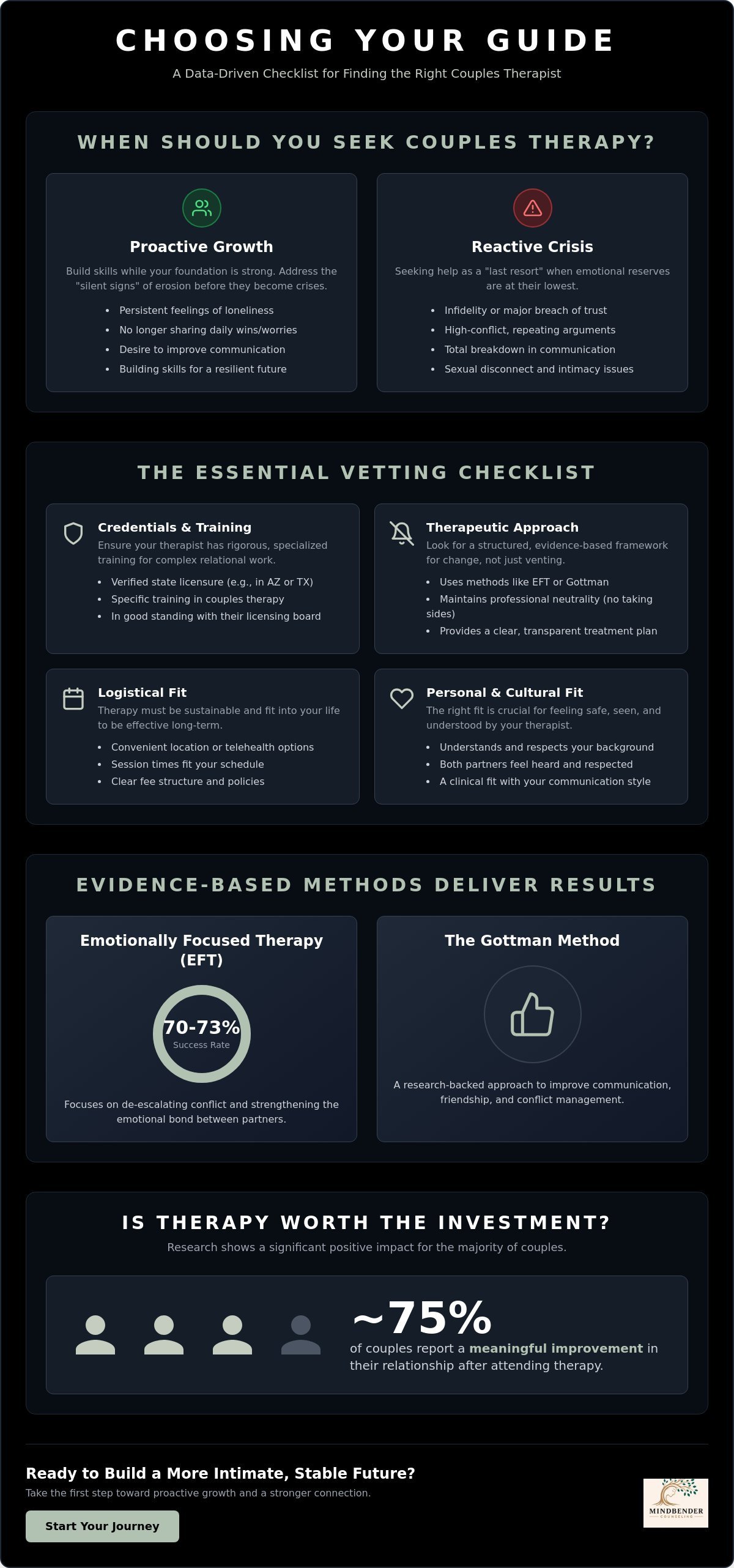
We believe that finding the right support should bring a sense of relief, not more stress. Research shows that approximately 75% of couples who attend therapy report a meaningful improvement in their relationship. This article provides a clear framework for vetting potential therapists, ensuring you find someone who uses evidence-based approaches like Emotionally Focused Therapy, which maintains a success rate between 70% and 73%. By following this comprehensive checklist, you'll gain the confidence to choose a compassionate guide who can help you and your partner build a more intimate, stable future together.
Key Takeaways
- Learn to identify the "silent" signs of relationship erosion, allowing you to move from reactive crisis management toward proactive relational health.
- Use our clinical checklist to verify credentials and find a couples therapist near me who aligns with your values while maintaining professional neutrality.
- Explore how evidence-based therapy methods, such as the Gottman Method, provide a structured, research-backed path to improved communication and friendship.
- Understand the specific licensing standards in Arizona and Texas to ensure your chosen professional has the rigorous training required for complex relational work.
- Prepare for your journey by learning what to expect during the initial assessment phase and how a compassionate, expert fit accelerates your personal progress.
When to Start Your Search for a Couples Therapist Near Me
The decision to search for a couples therapist near me often follows a long period of quiet reflection rather than a single, explosive event. While a major crisis like infidelity or a sudden loss might act as a catalyst, many partners find themselves looking for support when they notice the subtle, "silent" signs of relationship erosion. This might manifest as a persistent feeling of loneliness while sitting in the same room, or the realization that you have stopped sharing your daily wins and worries with each other. Acknowledging that your relationship needs external support requires significant emotional courage. It is an act of hope, signaling that you still believe in the possibility of a stronger, more vibrant connection.
When you begin this search, remember that finding a professional "near you" involves more than just physical proximity or a short commute. It's about finding a clinical fit that feels close to your shared values and communication style. You aren't just looking for an office address; you're looking for a dedicated space where both of you feel seen, heard, and respected. This search is the first step in moving from a state of reactive survival toward a future of intentional, proactive growth.
The "Last Straw" vs. Proactive Growth
Many couples view therapy as a "last resort" to be used only when the relationship is on the brink of collapse. Common triggers for this reactive approach include high-conflict cycles, sexual disconnect, or a total breakdown in trust. However, waiting for a crisis often means you're starting the work when emotional reserves are at their lowest. You can Learn about couples therapy as a historical field that has shifted significantly toward helping people before they reach these breaking points. Starting therapy while your foundation is still relatively stable allows you to build skills without the heavy weight of immediate desperation. Couples therapy is a structured path to relational resilience that focuses on skill-building and understanding, rather than just serving as a place to vent frustrations.
Internal Readiness: Is Your Relationship Ready for Work?
Before your first session, it's helpful to assess your mutual commitment to the process. Therapy isn't a magic fix that one partner performs on the other; it's a collaborative effort that requires both individuals to look at their own contributions to the relationship dynamic. You might have individual goals, such as managing your own anxiety, while also holding shared relationship goals, like improving how you handle financial stress. For those who value confidentiality and a high level of personalized care, choosing private therapy offers a discreet environment for vulnerable growth. This setting ensures that you can explore the deepest parts of your bond with the peace of mind that your journey remains entirely your own.
The Essential Checklist for Choosing a Couples Therapist
Selecting a professional requires a methodical approach to ensure your time and resources are well-spent. When looking for a couples therapist near me, you need a framework that moves beyond surface-level reviews. You want a clinician who balances professional neutrality with active advocacy for the relationship itself. This means they shouldn't take sides; instead, they should challenge both partners to grow. Transparency is also vital. A reliable therapist will provide a clear treatment plan and explain how they structure sessions to ensure you aren't left wondering about the next steps. Verification of clinical licensure is the first non-negotiable step. You should ensure the clinician is in good standing with their state board and holds specific training in relational dynamics.
Logistical compatibility often dictates whether therapy remains a sustainable part of your life. Consider whether the office location or telehealth options fit your busy schedule. Beyond the clock, cultural competency is essential. You need a therapist who understands your specific environment and the unique stressors that impact your community. Finding someone who respects your background while offering expert guidance is key to how to find a competent and effective couples therapist. This ensures the professional you choose is a sturdy anchor for your progress.
Clinical Qualifications and Specializations
A common mistake is assuming that a generalist individual therapist is equipped for the complexities of relational work. Couples therapy involves managing two distinct personalities and the relationship itself. Look for specialized certifications such as Gottman Level 1-3 or Emotionally Focused Therapy (EFT). Sometimes, individual roadblocks can hinder joint progress. In these cases, pursuing individual counseling for anxiety can serve as a powerful adjunct to your shared sessions. It allows each person to build the internal stability needed for relational growth.
The "Vibe Check": Assessing Personal Rapport
Qualifications are the foundation, but personal rapport is the structure that holds the work together. Most professionals offer a brief consultation to help you decide if they are the right couples therapist near me for your specific needs. Use this time to notice if both you and your partner feel equally heard. Red flags include a therapist who seems to favor one person's narrative or someone who uses overly clinical jargon that leaves you feeling disconnected. If you don't feel a sense of calm assurance during this initial interaction, it's okay to keep looking. If you're ready to find a professional who prioritizes this balance, you can explore our approach to evidence-based care to see if we're the right fit for your journey.
Evidence-Based Modalities: Methods That Actually Work
The term "evidence-based" is frequently used in clinical settings, but for partners searching for a couples therapist near me, it represents a promise of reliability. It means the techniques used in your sessions aren't based on a therapist's intuition alone. Instead, they are rooted in decades of peer-reviewed research and clinical trials. This scientific backing provides a sense of security; you aren't just trying things out. You're following a path that has already led thousands of other couples to success. When you understand the "why" behind an intervention, it becomes much easier to trust the process.
The Gottman Method is a primary example of this clinical rigour. It is renowned for its 94% predictive accuracy in determining relationship patterns based on specific communication styles. By focusing on "The Sound Relationship House," this method helps you strengthen the friendship at the core of your bond while learning to manage conflict constructively. Similarly, Emotionally Focused Therapy (EFT) boasts a success rate between 70% and 73%. EFT helps you de-escalate the negative cycles that lead to distance, replacing them with a secure emotional connection. Many clinicians also integrate therapy behavioral therapy principles. These tools help you identify specific triggers that lead to reactive behaviors, allowing you to build the modern emotional resilience needed to face life's stressors together.
Why Method Matters More Than Personality
While having a warm rapport with your clinician is important, a pleasant personality shouldn't be the only reason you choose a couples therapist near me. Effective therapy moves beyond "venting" sessions where you simply recount the week's arguments. Instead, it offers a structured roadmap for progress. Data-driven interventions provide clear milestones, helping you see exactly how far you've come. You can expect to engage in out-of-session exercises or "homework" that translates clinical insights into daily habits. These practical applications ensure that the growth you experience in the office follows you home, creating lasting change. It's about building a toolkit you can use for the rest of your lives.
Individualized Attention Within a Proven Framework
Using a proven framework doesn't mean your experience will be "cookie-cutter." A skilled professional knows how to customize evidence-based tools to fit your unique relationship dynamic. They balance clinical structure with deeply empathetic listening, ensuring you feel supported while you learn. This personalized approach respects your history while providing the objective tools needed for evolution. Evidence-based therapy is the bridge between current conflict and future stability.
Navigating Therapy in Arizona and Texas: Local Considerations
When you search for a couples therapist near me in the Southwest, you're looking for more than a clinical expert. You're looking for someone who understands the unique rhythm of life in high-growth hubs like Phoenix, Dallas, or Austin. The stressors of navigating urban sprawl, long commutes, and the rapid pace of regional development can seep into your relationship, creating tension that feels specific to your environment. A local professional recognizes these external pressures and helps you build a resilient bond that can withstand them. Choosing a therapist within your state also ensures they are intimately familiar with the professional landscape and resources available to you.
The regulatory environment in Arizona and Texas is designed to protect you as a consumer. Both states maintain rigorous standards for mental health professionals, ensuring that anyone holding a license has met strict educational and clinical requirements. In Texas, for example, therapist positions are projected to grow by 14% by 2031, reflecting a significant commitment to expanding access to high-quality care. By choosing a locally licensed professional, you're partnering with someone who has demonstrated a deep commitment to their craft and your well-being.
Licensing and Consumer Protection
It's vital to verify that your therapist is in good standing with the appropriate state regulatory body. In Arizona, this is the Arizona Board of Behavioral Health Examiners, which recently updated its oversight to a new E-Licensing platform as of June 2026. In Texas, the Texas Behavioral Health Executive Council manages these standards. To earn a full LMFT license in Arizona, a professional must complete at least 1,600 hours of supervised direct client contact. Texas requires a total of 3,000 hours of supervised practice. These numbers aren't just statistics; they represent the deep experience your therapist brings to your sessions. Working with a Licensed Professional Counselor (LPC) or a Licensed Marriage and Family Therapist (LMFT) ensures your care meets these high legal and ethical benchmarks.
Telehealth vs. In-Person Care in the Southwest
The vast geography of the Southwest has made telehealth a vital tool for relational health. For busy Arizona professionals or couples in sprawling Texas metros, virtual sessions offer a level of convenience that makes consistent therapy possible. You can access specialized, evidence-based care without the stress of a 45-minute drive through traffic. However, some couples still prefer the grounded feeling of an in-person office. Many modern practices now offer hybrid models, allowing you to alternate between virtual and face-to-face sessions based on your weekly needs. This flexibility ensures your progress remains steady, regardless of your schedule. If you're ready to partner with a team that deeply understands the local landscape, connect with our Arizona and Texas specialists to begin your journey.
Your Next Steps with Mindbender Counseling
Choosing a professional to guide your relationship through its most vulnerable moments is a significant step. At Mindbender Counseling, we understand that your search for a couples therapist near me is driven by a desire for both clinical excellence and emotional safety. Our philosophy is rooted in the belief that every couple possesses the capacity for evolution when provided with the right tools and a supportive environment. We combine deep professional expertise with a compassionate, human-centered approach to ensure you never feel like just another case file. Instead, you're treated as a unique partnership with a specific architecture that deserves individualized attention. This personalized focus allows us to address the root causes of your distress rather than just managing the symptoms.
We recognize that the journey toward relational health requires a steady hand and a clear vision. Our role is to act as a professional facilitator for your growth, helping you navigate the complexities of modern life in the Southwest while keeping your bond at the center of the work. By choosing a path that prioritizes evidence-based methods, you're making a commitment to a future built on stability and mutual respect. We're here to ensure that the process feels organized and predictable, reducing the friction often associated with seeking support.
The Mindbender Experience
The Mindbender experience begins with a low-friction path toward healing. During your initial consultation and assessment phase, we focus on understanding the nuances of your history and the specific goals you hold for the future. This phase isn't just about identifying problems; it's about recognizing the strengths you've already built together. We act as a sturdy anchor during relational storms, providing the quiet confidence and steady support you need to navigate difficult conversations. We move at a pace that respects your emotional capacity, ensuring you never feel rushed through the healing process. This is a gentle invitation to change, offered in a space where both partners feel secure and respected.
Building Your New Foundation
As you move through the therapeutic process, the focus shifts from immediate conflict resolution to the construction of a solid internal foundation. Our interventions aren't just temporary fixes. They're designed to foster long-term emotional growth and a state of calm assurance. You'll learn to replace reactive patterns with intentional communication, allowing intimacy to flourish once again. This transition is essential for creating a relationship that feels like a place of restoration rather than a source of stress. The ultimate outcome is a relationship that doesn't just survive challenges but thrives because of the resilience you've developed together. If you're ready to take the next step toward a more stable and fulfilling bond, we invite you to Schedule a consultation with Mindbender Counseling today.
Taking the First Step Toward Relational Restoration
Finding the right support is a profound investment in your shared future. You now have a clear framework to evaluate clinical qualifications, understand the value of evidence-based methods, and navigate the specific licensing standards in Arizona and Texas. This checklist ensures that when you search for a couples therapist near me, you aren't just choosing a name from a list. Instead, you're selecting a professional who serves as a sturdy anchor for your evolution. By prioritizing clinical fit and proven methodologies, you're protecting your bond and setting the stage for lasting growth.
At Mindbender Counseling, we combine licensed expertise with a compassionate approach tailored to the unique needs of modern couples. Our focus remains on building a solid internal foundation through proven therapeutic interventions that foster long-term intimacy and stability. You deserve a space where your relationship is treated with fresh attention and expert care. Begin your journey toward a stronger bond; schedule a consultation with Mindbender Counseling today to see how we can support your path forward. Your relationship holds the potential for deep, positive change, and we're honored to guide you there.
Frequently Asked Questions
How do I find a couples therapist near me who accepts insurance?
Finding a couples therapist near me who accepts insurance requires a careful review of your specific policy. Most insurance plans don't automatically cover couples counseling because relationship distress isn't considered a diagnosable mental health condition. However, coverage may be available if one partner has a diagnosed condition, such as anxiety, and therapy is deemed medically necessary for their treatment. You should ask potential providers if they can provide a superbill for out-of-network reimbursement.
What is the average cost of couples therapy in Arizona and Texas?
While we don't set industry standards, national data indicates that in-person sessions typically range from $150 to $300. In major metropolitan areas like Phoenix, Dallas, or Houston, these rates can be higher, sometimes reaching $600 for highly specialized care. Online therapy is often a more accessible alternative, with sessions generally ranging between $100 and $250. Many couples view this cost as a vital investment in their long-term emotional stability and family health.
Can we do couples counseling if only one partner is willing to attend?
You can still make significant progress even if your partner isn't ready to begin the process. While joint sessions are the standard for couples work, individual counseling allows you to explore your own reactions and relational patterns. This personal growth often creates a positive ripple effect that shifts the dynamic of the entire relationship. It's a proactive way to build your own internal foundation while keeping the door open for your partner to join later.
How long does couples therapy typically take to see results?
The timeline for progress varies based on your specific needs, but many couples notice a shift in their communication within 8 to 12 sessions. Evidence-based methods provide a structured roadmap that helps you track milestones and stay focused on your goals. Your commitment to out-of-session exercises is often the catalyst that accelerates growth. Consistent effort usually leads to more sustainable changes in how you and your partner connect on a daily basis.
Is telehealth as effective as in-person couples counseling?
Telehealth is proven to be just as effective as in-person sessions for fostering relational growth. Research shows that the clinical bond and the success rates of methods like EFT remain consistent across both virtual and face-to-face formats. Virtual sessions offer the added benefit of convenience, allowing you to engage in deep work without the stress of a long commute. This flexibility often makes it easier for busy couples to maintain the consistency required for lasting change.
What is the difference between a marriage counselor and a couples therapist?
These terms are frequently used interchangeably, but they can reflect different professional focuses. A marriage counselor often focuses on resolving specific conflicts or navigating life transitions like retirement or co-parenting. A couples therapist typically has broader training in psychological dynamics and evidence-based frameworks, allowing them to address deep-seated emotional cycles. Both professionals aim to improve your bond, but a therapist may offer a more clinical approach to your relational architecture.
What should we do if we don’t like the first therapist we meet?
It's perfectly acceptable to move on if you don't feel a strong clinical fit with the first professional you meet. Your search for a couples therapist near me should prioritize a clinician who makes both partners feel equally heard and respected. If you sense bias or feel the therapist's style doesn't align with your goals, trust your intuition. A professional guide should provide a sense of calm assurance that allows you to feel safe during vulnerable conversations.
How do we prepare for our first therapeutic appointment at Mindbender Counseling?
Preparation for your first session involves a simple commitment to honesty and an open heart. You don't need to have a perfectly organized list of grievances or a deep understanding of clinical jargon. Simply arrive ready to share your perspective and listen to your partner with fresh attention. We provide the structure and expertise needed to facilitate the conversation, ensuring that your first assessment feels like a supportive step toward a more intimate future.


