

What if the intrusive thoughts that keep you awake at night weren't absolute truths, but merely patterns you could unlearn? It's exhausting to feel like a passenger in your own mind, especially when traditional talk therapy leaves you wishing for more than just a listening ear. You deserve a path that offers more than passive reflection. You need a strategy that works in the heat of a difficult conversation or during a stressful workday. We understand that the weight of negative thinking can feel like an anchor, but it doesn't have to define your future.
This guide explores how cognitive behavioral therapy serves as a structured, evidence-based bridge between feeling overwhelmed and finding your footing. We promise to show you how to reframe your internal narrative and master your emotions through practical, actionable steps. We will walk through a clear roadmap for personal and relational growth, providing you with the tools to build a more resilient and balanced life. Whether you're seeking individual clarity or better communication in your relationship, a more empowered version of yourself is within reach.
Key Takeaways
- Master the "CBT Triangle" to understand how shifting a single thought can transform your emotional state and daily actions.
- Identify common cognitive distortions that cloud your judgment and learn the art of reframing them for a clearer, more balanced perspective.
- Gain actionable tools through cognitive behavioral therapy to navigate modern stressors like burnout, anxiety, and complex relationship dynamics.
- Demystify the therapeutic process by exploring how structured sessions and collaborative goal-setting create a predictable path toward healing.
- Learn the value of seeking specialized, evidence-based care from licensed professionals who understand the unique needs of residents in Arizona and Texas.
Understanding Cognitive Behavioral Therapy: The Science of Thinking and Feeling
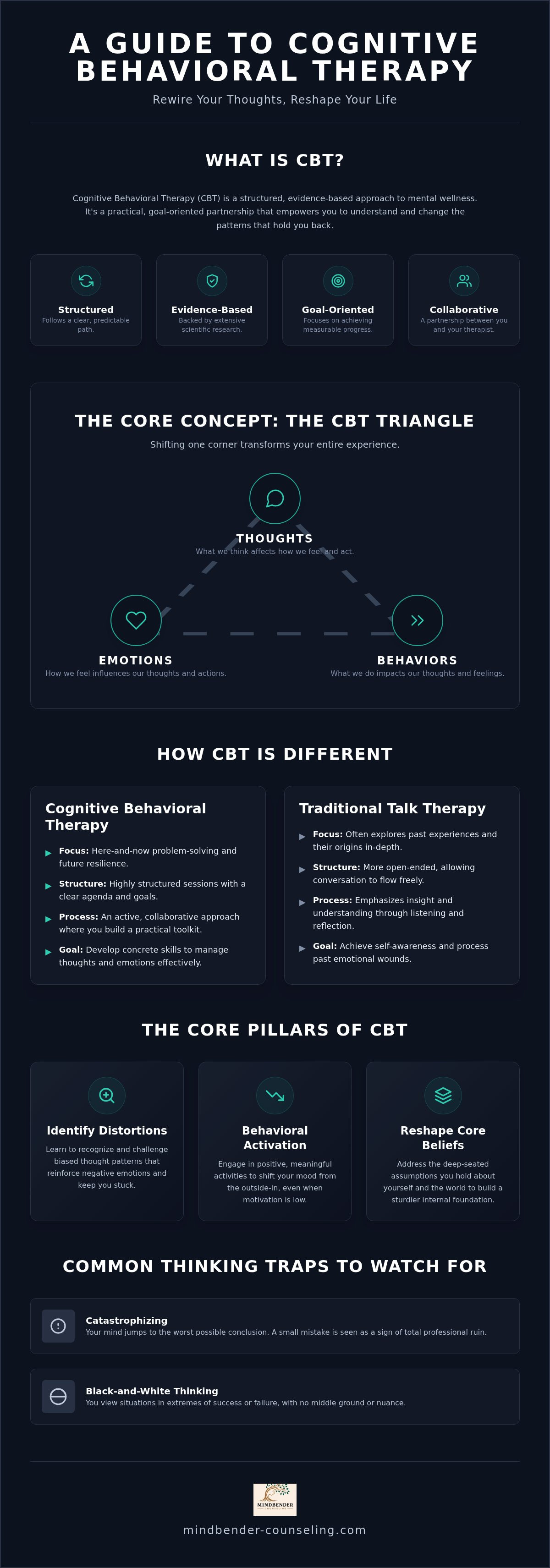
Within the field of clinical psychology, Cognitive Behavioral Therapy stands as the gold standard for cultivating emotional resilience. It isn't just a theory; it's a research-backed methodology that has helped millions move from feeling stuck to feeling empowered. At its heart, this approach relies on the "CBT Triangle," a simple yet profound model showing how our thoughts, feelings, and behaviors are constantly influencing one another. When you change one part of this triangle, the others naturally begin to shift. For example, by adjusting a single unhelpful thought, you can often lower the intensity of a painful emotion and choose a healthier action.
Recent advances in neuroscience have introduced us to the concept of neuroplasticity, which is the brain's remarkable ability to reorganize itself by forming new neural connections. This means your brain isn't fixed in its ways. By consistently practicing new ways of thinking, you can literally retrain your mind to default toward peace and stability rather than anxiety or self-criticism. It is a process of building a new internal foundation, one thought at a time.
Ultimately, cognitive behavioral therapy is a practical, goal-oriented partnership where the therapist and client work as a team to achieve measurable progress.
The Core Philosophy: You Are Not Your Thoughts
Many of us treat our internal dialogue as an absolute truth. However, CBT teaches us that many of our thoughts are simply automated responses, conditioned by past experiences rather than current reality. Learning to see these thoughts as passing mental events rather than facts is the first step toward freedom. By adopting the role of a curious observer, you can create the space needed to choose your response. To dive deeper into how these methods fit into the broader landscape of mental health, you can explore our guide on Understanding Therapy and Behavioral Therapy.
Why CBT is Different from Traditional Talk Therapy
While some forms of therapy focus heavily on exploring the distant past or providing a space for open-ended venting, CBT is distinctively structured and future-focused. It doesn't ignore your history, but it prioritizes here and now problem-solving. You won't just talk about your struggles; you'll develop a concrete toolkit to manage them. This collaborative process respects your autonomy, positioning you as the expert on your own life while your therapist acts as a skilled facilitator for change. It's an active process that turns insights into habits, ensuring that the work you do in the office translates to real-world stability.
The Core Pillars of CBT: Identifying and Reframing Patterns
Healing isn't just about understanding why we feel a certain way; it's about identifying the invisible scripts that run in the background of our daily lives. These scripts often manifest as "Cognitive Distortions," which are biased ways of thinking that reinforce negative emotions and keep us stuck in cycles of distress. According to the American Psychological Association, recognizing these patterns is a vital step in reclaiming your mental well-being. At Mindbender Counseling, our therapists act as steady partners to help you uncover these hidden beliefs with deep compassion and professional expertise.
Beyond just thinking, cognitive behavioral therapy emphasizes "Behavioral Activation." This principle suggests that while we can't always force ourselves to feel better, we can choose to act differently. By engaging in small, meaningful activities, even when you don't feel like it, you can begin to shift a heavy mood from the outside in. This process targets your deep-seated "Core Beliefs," the fundamental assumptions you hold about your worth and the world around you. Reshaping these beliefs creates a sturdier internal foundation for long-term growth.
Common Cognitive Distortions to Watch For
One of the most frequent distortions is "Catastrophizing," where your mind jumps to the worst possible conclusion, such as assuming a single mistake will lead to total professional ruin. "Black-and-White Thinking" is another common trap, where you view situations in extremes of success or failure with no middle ground. In Arizona workplace environments, "Mind Reading" often creates unnecessary friction; you might assume a colleague is judging you based on a short email when they are simply busy. To counter these, we use a simple framework: Catch the thought, Check it against the facts, and Change it to a more balanced perspective.
Developing Your Personal Toolkit of Coping Skills
To make these changes stick, you'll develop a personalized toolkit. "Thought Records" are a primary tool in cognitive behavioral therapy, allowing you to visualize your internal narrative on paper and challenge its accuracy. When anxiety feels acute, grounding techniques provide immediate relief. You might use the "5-4-3-2-1" method to reconnect with your physical surroundings, effectively quieting the mental noise. These practical strategies are especially effective when integrated into Individual Counseling for Anxiety, where your care is tailored to your specific life stressors. If you're ready to start building these skills, connecting with a compassionate therapist can provide the structure you need to move forward with confidence.
Is CBT Right for You? Applications for Individuals and Couples
Cognitive behavioral therapy is often misunderstood as a tool reserved only for severe clinical diagnoses. In reality, it's one of the most effective ways to navigate the common, heavy struggles of modern life, including chronic burnout and persistent anxiety. By understanding how CBT works through the combination of cognitive and behavioral shifts, you can find a path out of the mental fog. This approach isn't just about managing symptoms; it's about building a life that feels sustainable, vibrant, and aligned with your personal values.
A frequent hesitation for those considering relationship support is whether a structured method might feel too clinical. On the contrary, cognitive behavioral therapy provides a compassionate, neutral language that allows partners to express deep needs without the sting of blame. It transforms "You always do this" into a collaborative exploration of "When this pattern occurs, I think X and feel Y." This simple shift reduces defensiveness and creates a safe atmosphere where both people feel seen and respected, turning conflict into a catalyst for connection.
Individual Counseling: Moving from Survival to Thriving
Many professionals in high-pressure hubs across Phoenix and Texas find themselves stuck in a state of constant reactivity. Individual sessions focus on moving you from a "survival" mindset, where you're simply trying to get through the day, to a state of thriving. By mastering self-regulation and personal empowerment, you can protect your mental health against the relentless demands of a rigorous career. If you're feeling the weight of professional expectations, our resources on Counseling for Work Stress in Arizona offer a deeper look at reclaiming your wellness and internal balance.
CBT for Couples: Rewriting the Shared Narrative
In a relationship, couples often find themselves trapped in "circular arguments" that never seem to resolve. These are essentially shared cognitive distortions where both partners are reacting to assumptions rather than what's actually happening in the moment. Through cognitive behavioral therapy, couples learn to identify these loops and implement behavioral changes that restore intimacy and trust. Small, intentional shifts in how you interact can rebuild a foundation of safety more effectively than words alone. For those balancing busy schedules, understanding How Does Online Couples Counseling Work? can be the first step toward a healthier, more connected partnership.
What to Expect in a CBT Session: Your Path to Practical Resilience
Starting therapy can feel intimidating, but the first session of cognitive behavioral therapy is designed to replace that uncertainty with a sense of calm partnership. During this initial meeting, you and your therapist focus on building a "Therapeutic Alliance." This is the foundational bond of trust that makes deep, evidence-based healing possible. You'll discuss your current struggles and set clear, achievable goals for your growth. This isn't a one-sided clinical evaluation; it is a collaborative dialogue where your comfort always dictates the pace of the conversation.
A typical session follows a predictable, reassuring structure to ensure you get the most out of your time. We usually begin with a brief check-in to see how your week has been and review any insights from previous meetings. Next, we set an agenda together, ensuring the topics most important to you are prioritized. The bulk of the hour is dedicated to skill-building, where you'll learn practical strategies to manage your specific challenges. We then wrap up by summarizing the key insights gained. This organized flow creates a sense of security, allowing you to process difficult emotions without feeling rushed or overwhelmed.
The Collaborative Agenda: You Are the Driver
In our practice, you're the expert on your own life. The collaborative agenda ensures that your sessions are always relevant to what's most pressing for you each week. This "no-surprises" approach means you'll always know what to expect and why we're focusing on specific techniques. We also use objective ways to measure your progress so you can see tangible growth over time. Seeing your own evolution builds confidence and reinforces that the work you're doing is creating real, lasting change.
Gentle Practice: Integrating Skills into Your Texas or Arizona Lifestyle
We often reframe the traditional idea of "homework" as "gentle practice." These are simple, between-session tasks designed to bridge the gap between the therapy room and your daily life in Texas or Arizona. For example, you might spend a few minutes tracking a specific trigger during your morning commute or practicing a grounding technique before a high-stakes meeting. These practices aren't about getting a grade; they're about building self-reliance and internal strength. There are no wrong answers or "failing" at therapy. Every experience, even a difficult one, provides valuable data that helps us refine your path toward well-being. If you're ready to experience this structured yet supportive approach, you can schedule an individual counseling session to begin your journey toward resilience.
Choosing Evidence-Based Care in Arizona and Texas
Selecting the right therapist is a significant decision that shapes the trajectory of your healing. You deserve a professional who doesn't just listen, but who also utilizes proven, evidence-based methods to help you achieve lasting change. In Arizona and Texas, the standards for mental health professionals are high. As of August 2026, Arizona requires 3,000 hours of supervised professional experience for psychologist licensure, while Texas requires 3,500 hours. These rigorous benchmarks ensure that your care is rooted in deep clinical expertise and a commitment to professional ethics. Local care is also vital; a therapist who understands the specific economic pressures and cultural nuances of the Southwest can provide more relevant and empathetic support.
Mindbender Counseling acts as a bridge between the precision of clinical science and the warmth of personalized attention. We specialize in both individual and couples applications of cognitive behavioral therapy, ensuring that every intervention is tailored to your specific needs. We recognize that your journey is unique, so we avoid the coldness of one-size-fits-all treatments. Instead, we focus on building a sturdy internal foundation that allows you to face life's challenges with quiet confidence and clarity.
The Mindbender Difference: Compassion Meets Science
Our commitment to your growth is defined by a "wise guide" approach. We prioritize the human connection first, creating an atmosphere of safety and reliability before we begin the work of retraining neural patterns. Whether you are navigating the high-pressure career demands of Phoenix or seeking to heal a strained partnership in Dallas, we focus on both your individual empowerment and your relational health. We don't just provide a service; we act as a supportive partner in your personal evolution, using research-backed techniques to help you restore balance and movement in your life.
Ready to Begin? Your First Step Toward Balance
Taking the first step toward therapy is a profound act of courage and self-care. It marks the moment you decide that your well-being is a priority and that positive change is possible. We have designed our process to be as low-friction as possible because we know that when you're feeling overwhelmed, even small tasks can feel like a mountain. You don't have to carry the weight of intrusive thoughts or communication blocks alone anymore. By choosing cognitive behavioral therapy with a team that values both science and soul, you're investing in a more resilient version of yourself.
Schedule your personalized CBT consultation with Mindbender Counseling today.
Step Into a Life of Emotional Clarity
You have the power to reshape your internal world. By understanding the "CBT Triangle" and identifying unhelpful thinking styles, you've already begun the work of building a more resilient foundation. Whether you are navigating professional burnout or seeking to bridge communication gaps in your relationship, cognitive behavioral therapy offers a clear, actionable roadmap for healing. It's not about achieving perfection; it's about developing the tools to navigate life's stressors with steady assurance.
Our licensed experts in Arizona and Texas provide compassionate, evidence-based therapy tailored to the unique rhythms of your life. We act as a wise guide on your path toward balance, ensuring you never have to navigate these challenges in isolation. Begin your journey toward emotional resilience with Mindbender Counseling today. Your future self will thank you for the courage you show in this moment.
Frequently Asked Questions
What exactly happens during a typical CBT session?
A typical session involves a collaborative check-in followed by setting a specific agenda for the hour. You'll spend most of the time practicing concrete skills to address current challenges, such as reframing a negative thought or practicing a grounding technique. We finish by summarizing key insights and identifying a small, manageable practice for the week ahead. This structured approach ensures every minute you spend in the office translates into practical progress for your daily life.
How long does it take to see results with Cognitive Behavioral Therapy?
Most people begin to notice meaningful shifts in their perspective within 12 to 20 sessions, though the exact timeline depends on your specific goals. Unlike open-ended therapies, cognitive behavioral therapy is designed to be time-limited and focused on results. You'll work with your therapist to set measurable benchmarks early on. This allows you to track your evolution and adjust the strategy as you gain confidence and master new emotional regulation tools.
Can CBT be effective for relationship and marriage problems?
Yes, this methodology is highly effective for relationships because it provides a neutral framework for resolving communication blocks. Partners learn to identify shared cognitive distortions, like assuming the other person’s intent without asking. By changing how you respond to one another’s actions, you can break cycles of blame and restore a sense of safety. It turns conflict into a shared problem-solving exercise rather than a source of persistent emotional distance.
Is CBT better than traditional "talk therapy" for anxiety?
CBT is often considered more effective for anxiety because it focuses on immediate symptom management rather than just exploring the past. While traditional talk therapy provides a space for reflection, this approach gives you a toolkit to use during a panic attack or a stressful meeting. You'll learn to challenge the "what-if" thoughts that fuel anxiety. This active, goal-oriented nature helps many people feel more empowered and less overwhelmed by their symptoms.
Do I have to do homework in CBT, and what if I don’t have time?
Between-session practice is a vital part of the process, but your therapist will always ensure it fits your actual lifestyle. If you're short on time, your practice might be as simple as noticing a specific feeling during your drive or taking three deep breaths before an important call. These exercises aren't about being perfect; they're about bridging the gap between the therapy room and your real-world experiences to build lasting self-reliance.
How do I know if I need individual counseling or couples therapy?
You might benefit from individual counseling if your primary struggles are internal, such as personal anxiety or burnout. However, if your distress mainly arises during interactions with your partner, couples therapy is often the more direct path to healing. Many people find that starting with individual sessions provides the self-regulation skills needed to then engage more effectively in a couples context. We can help you determine the best starting point during your initial consultation.
Is CBT effective for professionals dealing with high-pressure work stress?
CBT is exceptionally helpful for high-pressure professionals because it targets the specific thought patterns that lead to chronic burnout. You'll learn to identify "all-or-nothing" thinking regarding your performance and develop strategies to maintain a healthy work-life boundary. By mastering these self-regulation skills, you can protect your mental well-being against the relentless demands of a rigorous career. It provides the mental clarity needed to stay focused and resilient even in high-stakes environments.
How can I find a qualified CBT therapist in Arizona or Texas?
You can find a qualified professional by verifying their licensure through the Arizona or Texas state boards and looking for a specialization in evidence-based methods. At Mindbender Counseling, our therapists are licensed experts who combine clinical science with a deeply compassionate approach. We serve residents across both states, providing structured cognitive behavioral therapy that respects your unique experience. Reaching out for a personalized consultation is the most effective way to ensure your therapist is a good fit.


