

What if the guilt you feel when saying "no" isn't a sign that you're being selfish, but a symptom of an internal foundation that hasn't yet been built? You've likely spent years prioritizing everyone else's needs while your own emotional reserves run dry. It's exhausting to live in a constant state of people-pleasing, fearing that one firm boundary might collapse your most important relationships. If you feel you've lost your own sense of identity in the process of keeping others happy, professional therapy for setting boundaries can help you reclaim your voice and your peace.
This supportive approach provides the essential tools and emotional resilience you need to establish firm limits without the crushing weight of guilt. We'll explore how evidence-based therapy helps you state your needs clearly and fosters healthier, more balanced connections throughout Arizona and Texas. Through individual counseling services and couples counseling, you can move from a place of emotional exhaustion to one of steady, quiet confidence. This guide walks you through the transformative process of establishing limits that actually bring you closer to the people you love while protecting your own well-being.
Key Takeaways
- Define boundaries as essential tools for protecting your mental energy and preventing long-term emotional exhaustion.
- Discover how therapy for setting boundaries helps you address root causes like family history to build a stronger, more resilient internal foundation.
- Learn to distinguish between physical and emotional boundaries to better protect your personal space and internal state.
- Explore how individual and couples counseling offer distinct paths for reclaiming your autonomy and co-creating a healthier "we" in your relationships.
- Identify the key qualities of an evidence-based therapist in Arizona or Texas to ensure you receive personalized, compassionate care.
Understanding Boundaries: More Than Just Saying No
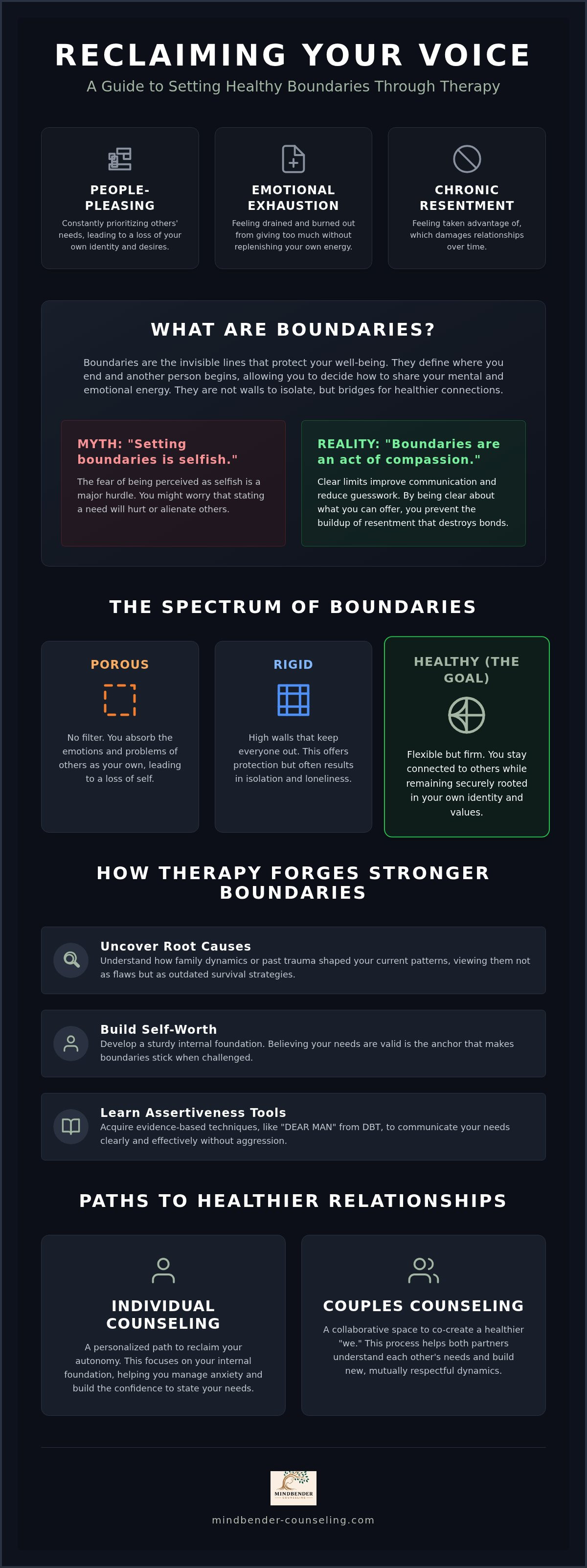
Think of Personal boundaries as a protective container for your well-being. They aren't just rules you impose on others; they're the invisible lines that define where you end and another person begins. When you establish these limits, you're effectively deciding how much of your mental and emotional energy you're willing to share. Without them, your internal space becomes a public thoroughfare, leaving you vulnerable to the whims and needs of everyone around you. Engaging in therapy for setting boundaries helps you identify where these lines have become blurred or non-existent.
The psychological cost of living without these protections is steep. You might find yourself trapped in a cycle of chronic resentment, feeling as though you're constantly being taken advantage of by friends, family, or colleagues. This leads directly to burnout, a state of total exhaustion where you have nothing left to give yourself. Over time, you might even experience a loss of self. You become so focused on accommodating others that you forget what you actually value, want, or need. Viewing this work as a form of private therapy allows you to foster long-term respect for your own time and spirit.
Not all boundaries look the same. Some people build rigid boundaries, which act like high walls that keep everyone out. While this offers protection, it often leads to isolation. Others have porous boundaries, where they have no filter and take on the emotions of everyone else as their own. The goal of evidence-based therapy is to develop healthy boundaries. These are flexible but firm, allowing you to stay connected to others while remaining securely rooted in your own identity.
The Internal Foundation of Boundaries
To set a limit that sticks, you need a sturdy anchor. That anchor is your own sense of self-worth. If you don't believe your needs are valid, you'll struggle to defend them when they're challenged. When you first start practicing these skills, you'll likely encounter the "guilt reflex." This is a natural response when you break old patterns of people-pleasing. It's not a sign that you're doing something wrong; it's a sign that you're growing. A healthy boundary acts as a bridge for genuine connection rather than a wall of isolation.
Common Misconceptions About Being 'Selfish'
One of the biggest hurdles in therapy for setting boundaries is the fear of being perceived as selfish. Many people worry that stating a need will hurt or alienate the people they care about. In reality, the opposite is true. Clear limits improve communication and reduce the "guesswork" that often plagues relationships. In the context of therapy behavioral therapy, we see that boundaries are actually an act of compassion. By being clear about what you can and cannot do, you prevent the explosion of resentment that eventually destroys even the closest bonds.
How Therapy for Setting Boundaries Actually Works
Setting limits often feels like a battle against your own history. If you grew up in an environment where your "no" was ignored or punished, your brain likely learned that boundaries are dangerous. Therapy for setting boundaries works by gently uncovering these root causes, whether they stem from family dynamics or past trauma. It's about understanding that your current struggle isn't a character flaw; it's a survival strategy that no longer serves your adult life. When we address these foundations, we can begin to replace fear with clarity.
The fear of rejection often acts as a massive roadblock to personal growth. This is why individual counseling for anxiety is such a critical component of the process. By managing the physiological "fight or flight" response that occurs when you think about disappointing someone, you create the mental space needed to practice new behaviors. Clinical research, such as the insights found in Boundaries in Clinical Practice, highlights how a structured therapeutic environment allows for the safe exploration of these interpersonal dynamics.
Evidence-Based Techniques for Assertiveness
We use specific, research-backed tools to help you find your voice. One effective method is the "DEAR MAN" technique from Dialectical Behavior Therapy (DBT). This involves learning to Describe the situation, Express your feelings, Assert your needs, and Reinforce why the boundary is beneficial for both parties. Cognitive reframing also plays a vital role. Instead of telling yourself "I'm being mean" when you set a limit, you learn to say "I'm keeping myself safe." Through behavioral therapy, we slowly desensitize the fear of saying no, turning a terrifying prospect into a manageable skill.
The Role of the Therapist as a Wise Guide
Your therapist serves as more than just a listener; they're an objective partner who can spot patterns you might miss. They hold space for the intense discomfort that often arises when you start changing your relationship rules. Together, you'll develop a personalized "boundary plan" for high-stress situations, like holiday gatherings or difficult work meetings. This makes the therapeutic office a safe rehearsal space where you can practice real-world interactions before you face them. If you're ready to start this journey, our team at Mindbender Counseling provides the steady support needed for residents in Arizona and Texas to experience lasting personal evolution.
The Different Types of Boundaries You Can Set
Boundaries are not a one-size-fits-all concept. They cover every facet of your existence, from the space you inhabit to the thoughts you keep. In therapy for setting boundaries, we categorize these needs into distinct areas to help you identify where your foundation might be crumbling. By breaking these down, the process of reclaiming your peace becomes much more manageable and less overwhelming.
Physical boundaries are often the most visible. They involve your personal space, your comfort with touch, and your body's basic needs. It's the right to say no to a hug or to express that you need rest or food without apology. Emotional boundaries, on the other hand, protect your internal state. They involve separating your feelings from the moods of those around you. When you have firm emotional limits, you stop being an "emotional sponge" that soaks up everyone else's stress, allowing you to maintain your own stability even in chaotic environments.
Time and energy boundaries are perhaps the most frequently crossed in our fast-paced culture. These limits involve how you spend your hours and who has access to your labor. Learning to say no to over-commitment is a vital skill for preventing burnout. Similarly, material and financial boundaries define your limits regarding lending money or sharing possessions. Setting these expectations early prevents the resentment that often grows when people feel their generosity is being exploited.
Digital and Workplace Boundaries for Professionals
For professionals in Arizona and Texas, the line between work and home has become increasingly blurred. Establishing "off-clock" hours is essential for mental clarity. This might mean turning off email notifications after 6:00 PM or designating specific times for social media use to combat digital fatigue. A professional boundary is a requirement for sustainable productivity. By communicating these limits clearly to colleagues and clients, you create a culture of mutual respect that protects your long-term career health.
Intellectual and Spiritual Boundaries
Intellectual boundaries involve respecting differing opinions without feeling the need to compromise your core values. You have a fundamental right to your own thoughts and beliefs. When these are ignored or ridiculed, it can lead to emotional manipulation or "gaslighting," where you begin to doubt your own reality. Therapy for setting boundaries provides the resilience needed to stand firm in your truth. By protecting your spiritual and intellectual space, you ensure that your identity remains yours alone, regardless of the pressure to conform to others' expectations.
Navigating Boundaries in Individual vs. Couples Counseling
Choosing the right format for your growth depends on whether you're working on your internal foundation or the dynamics of your partnership. Individual therapy acts as a personal workshop where therapy for setting boundaries helps you focus on your autonomy and self-identity. You explore your own history and learn to recognize the physical and emotional signals that tell you a limit has been crossed. This is where you build the resilience to stand firm in your needs before bringing them into the larger world. It's about constructing that solid internal foundation that allows you to interact with others without losing yourself in the process.
In contrast, couples therapy focuses on co-creating a protective space for the relationship itself. It's not just about two individuals having their way; it's about defining the "we." This collaborative approach ensures that the relationship remains a sanctuary. External pressures often threaten this peace, making it necessary to develop specific coping mechanisms. For instance, utilizing counseling for work stress Arizona can help you develop strategies to prevent professional burnout from leaking into your home life. By setting a clear boundary between the office and the living room, you protect your shared time and emotional energy. Transitioning from individual needs to shared relational values is a methodical process that requires patience and professional guidance.
Boundaries as a Bridge to Intimacy
Many fear that setting limits drives a wedge between partners. In reality, a clear "no" is what makes an honest "yes" possible. By being transparent about your capacity, you prevent the resentment that destroys closeness. Through therapy for setting boundaries, partners learn to support each other's individual limits, transforming rules into a tool for deeper trust and safety rather than distance. This transparency builds a deeper level of trust, as both individuals know exactly where they stand and feel safe expressing their true selves.
Setting Boundaries with Family and In-Laws
Holiday dynamics in Arizona and Texas often challenge even the strongest relationships. A "united front" approach ensures you and your partner agree on limits regarding time, money, and emotional involvement before family pressure mounts. When relatives resist these changes, therapy provides the resilience to handle pushback with calm assurance. Staying rooted in shared values protects your partnership from external guilt and manipulation. You'll learn to stay rooted in your shared values even when others try to pull you back into old, unhealthy patterns.
If you're ready to strengthen your relationship through clear, compassionate limits, our team is here to help. Schedule a session with Mindbender Counseling today to begin co-creating a healthier future together.
Getting Started: Finding the Right Support in Arizona and Texas
Choosing a partner for your healing journey requires more than just a quick search; it involves finding a professional who understands the cultural and clinical landscape of your community. In Arizona and Texas, look for a therapist who holds a current license, such as a Licensed Professional Counselor (LPC), and possesses specific experience in boundary work. The right fit is someone who balances authoritative expertise with deep compassion, creating a space where you feel safe enough to be vulnerable. When you seek out therapy for setting boundaries, prioritize providers who utilize evidence-based therapy, as these research-backed methods offer the most reliable path toward long-term stability.
At Mindbender Counseling, we serve as a compassionate guide through the complexities of your interpersonal dynamics. Our approach is deeply personalized, recognizing that a boundary that works for one person might not be appropriate for another. We act as a sturdy anchor for those feeling overwhelmed by the demands of others, providing the steady support needed to build a solid internal foundation. If you're managing a busy schedule or live in a remote area, you might wonder how does online couples counseling work to facilitate this growth. Telehealth has made these vital services more accessible than ever, with federal and state regulations in both Arizona and Texas supporting virtual care through at least 2027.
Your first session is a low-pressure opportunity to discuss your current limits and where they're failing you. You can expect a focused conversation about your history, your pain points, and your goals for the future. Instead of a cold, clinical intake, we offer a warm dialogue that centers on your unique needs. We'll begin identifying the specific areas where therapy for setting boundaries can provide immediate relief, helping you move from a state of reactive exhaustion to one of proactive peace.
The Path to Emotional Resilience
Engaging in sustained therapeutic work allows you to move from a state of constant overwhelm to a state of calm assurance. This isn't a quick fix, but a methodical evolution of your character and your relationships. As you build emotional resilience, you'll find that the "guilt reflex" fades, replaced by the quiet confidence that comes from living a life that reflects your true values. The long-term benefits include not only better relationships but a deeper, more authentic connection to your own identity.
Scheduling Your Consultation
Taking the first step toward change doesn't have to be a source of stress. We've designed our process to be as low-friction as possible for residents throughout Arizona and Texas. Our commitment is to provide you with the tools needed to reclaim your personal peace and establish the respect you deserve. We invite you to reach out and begin the process of personal healing today, allowing us to support you as you construct a life defined by balance and mutual respect.
Reclaiming Your Peace Through Clearer Limits
Establishing boundaries is more than a social skill; it's an act of self-preservation that rebuilds your internal foundation. You've discovered that these limits don't drive people away. Instead, they create the transparency required for deeper, more resilient connections. Whether you're managing workplace stress or navigating complex family dynamics in Arizona and Texas, professional support provides the sturdy anchor you need to stay grounded.
Through evidence-based therapy, you can transform the guilt reflex into a source of quiet confidence. Targeted therapy for setting boundaries offers a safe rehearsal space to practice assertiveness, ensuring you never have to sacrifice your identity for the sake of others' comfort. This journey toward emotional growth and resilience is a vital step in reclaiming your personal peace and protecting your mental energy.
If you're ready to move from exhaustion to tranquility, our team is here to facilitate your personal evolution with professional individual and couples therapy. Begin your journey toward healthier boundaries with Mindbender Counseling and experience the compassionate, evidence-based care you deserve. You've already taken the first step by being here; the path to a more balanced life is now within your reach.
Frequently Asked Questions
Is therapy for setting boundaries only for people in bad relationships?
No, this work is beneficial for individuals in all types of relationships, including healthy ones. It isn't just a reactive tool for high-conflict situations; it's a proactive way to maintain your autonomy and prevent future resentment. By learning to state your needs clearly, you strengthen your existing bonds and ensure that your interactions remain rooted in mutual respect rather than obligation. It's about building a sustainable foundation for long-term connection.
How do I know if my boundaries are too rigid or too porous?
You can identify your boundary style by observing your level of connection and exhaustion. If you feel isolated and find it difficult to let anyone in, your boundaries may be too rigid. Conversely, if you feel like an "emotional sponge" soaking up others' stress and struggling to say "no," your limits are likely too porous. Healthy boundaries are flexible but firm, allowing for intimacy while protecting your own internal stability and peace.
Can I set boundaries without hurting the other person's feelings?
While you can't control another person's emotional reaction, you can communicate your limits with kindness and clarity. Boundaries are about your own needs and capacity, not about attacking or changing the other person. When you state a limit clearly, you provide the other person with the information they need to interact with you successfully. This transparency actually reduces the long-term hurt caused by hidden resentment and avoids the sudden emotional outbursts that damage trust.
What if the other person refuses to respect the boundaries I set in therapy?
If someone refuses to respect your limits, the focus of therapy shifts toward your own response and consequences. You cannot force another person to change their behavior, but you can decide how much access they have to your time and energy. Your therapist will help you develop the emotional resilience to uphold your limits, even when faced with pushback, ensuring that your well-being remains the primary priority in your life and your future interactions.
How long does it typically take to see progress in boundary-setting therapy?
Progress varies for everyone, but many people feel a sense of relief after just a few sessions of therapy for setting boundaries. Initial improvements often come from simply identifying where your limits have been crossed. Developing the long-term confidence to uphold these boundaries in high-stress situations typically takes several months of consistent work. This steady, methodical process ensures that your new communication skills become a permanent part of your internal foundation and daily life.
Is setting boundaries considered a form of behavioral therapy?
Boundary work is frequently a core component of therapy for setting boundaries using behavioral techniques. It often utilizes Cognitive Behavioral Therapy (CBT) to identify unhelpful thought patterns and Dialectical Behavior Therapy (DBT) to practice assertive communication. By focusing on tangible changes in your daily interactions, this approach helps you desensitize the fear of rejection. It's a practical, evidence-based way to replace old habits of people-pleasing with new, healthier behaviors that protect your personal peace.
Can couples counseling help if only one partner wants to set boundaries?
Couples counseling is highly effective even when only one partner initiates the desire for clearer limits. The therapeutic environment provides a neutral space where both individuals can explore how boundaries improve the relationship's overall health. It helps the other partner understand that boundaries aren't a form of rejection, but a tool for deeper intimacy. Together, you can co-create a "united front" that protects your shared time and emotional energy from external pressures and family demands.
Do I need to live in Phoenix or Texas to access Mindbender Counseling?
You must be physically located in Arizona or Texas to receive services from Mindbender Counseling. Due to state licensing regulations for therapists, we can only provide individual and couples counseling to residents within these specific states. Whether you live in a major city like Phoenix or a rural area, our telehealth options ensure you can access high-quality, evidence-based care from the comfort of your own home. This allows us to maintain the professional standards required by state boards.


