
You sit across from your partner, but the silence between you feels heavy with everything left unsaid. You've had this same argument a dozen times, and even before they open their mouth, you've already predicted their response. It's exhausting to live in a cycle of mind-reading and negative assumptions where every conversation feels like a trap. If you feel unheard or misunderstood, you're not alone. Research indicates that while only 15% of U.S. adults have attended counseling, approximately 75% of those who do report improved relationship satisfaction. Utilizing cognitive behavioral therapy for couples offers a structured way to bridge that gap by focusing on the thoughts and behaviors that drive your interactions.
You deserve a relationship that feels like a sanctuary rather than a source of stress. In this guide, you'll discover how evidence-based CBT techniques can help you de-escalate conflict, rewrite negative patterns, and restore trust in your partnership. We'll look at practical tools to stop arguments before they spiral and provide a clear path toward emotional reconciliation. By understanding your partner's triggers and your own cognitive loops, you can begin the steady work of building a more resilient, lasting connection together.
Key Takeaways
- Learn how to shift your focus from individual blame toward identifying the shared patterns that keep your relationship stuck in conflict.
- Understand how cognitive behavioral therapy for couples uses the "Cognitive Triangle" to reveal how individual thoughts directly shape your shared emotional environment.
- Master practical tools like Thought Records to objectively check reality and de-escalate arguments before they spiral out of control.
- Discover how to use Behavioral Activation to break cycles of neglect by intentionally scheduling meaningful, positive exchanges.
- Gain clarity on finding a licensed specialist in Arizona or Texas who can provide the steady, professional guidance your relationship needs to heal.
What is Cognitive Behavioral Therapy for Couples?
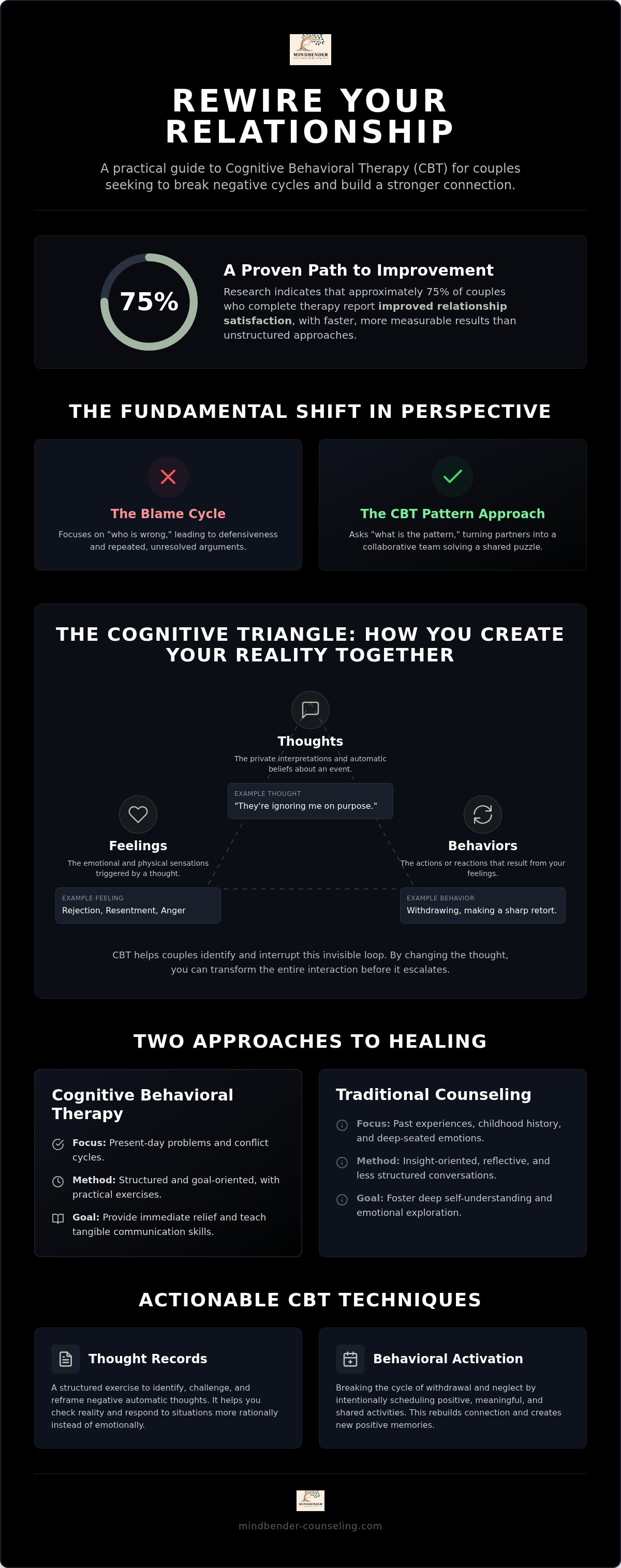
When you enter a therapy room, you might expect to simply vent about the frustrations of your week. However, cognitive behavioral therapy for couples is a goal-oriented and highly structured form of intervention that prioritizes action over mere reflection. It moves away from the exhausting question of "who is wrong" and instead asks "what is the pattern." This shift is vital because it stops the cycle of blame and invites both partners to view the relationship's challenges as a shared puzzle to solve. To understand the roots of this approach, it helps to explore the foundational concepts of What is Cognitive Behavioral Therapy? as a broader psychological framework.
The core philosophy of this method rests on a simple, powerful triangle. Your thoughts influence your feelings, and those feelings dictate your behaviors. In a relationship, this triangle becomes a shared loop. If you think your partner is ignoring you, you feel rejected; that rejection often leads to a defensive or cold behavior, which then triggers a negative thought in your partner. This structured approach helps you identify these invisible cognitive loops so you can intentionally choose a different response.
The Evidence-Based Difference in Modern Counseling
Research consistently supports the effectiveness of structured interventions. Recent data from 2026 shows that approximately 70% to 75% of couples report improved relationship satisfaction after completing therapy. These results often come faster than they do in unstructured talk therapy because the process is data-driven and measurable. You don't just talk about feeling better; you track specific communication milestones. For a deeper look at how these methods foster stability, you can read our guide on understanding therapy and behavioral therapy.
CBT vs. Traditional Marriage Counseling
Traditional marriage counseling often focuses on deep, insight-oriented reflections or exploring childhood histories to explain current friction. While that has value, cognitive behavioral therapy for couples is designed for those who feel "stuck" in high-conflict cycles and need immediate relief. It focuses heavily on current problems and practical solutions. Instead of dwelling solely on why a trigger exists, you learn exactly what to do when that trigger is pulled. This present-focused nature makes it an ideal choice for partners who want a clear, low-friction path toward reconciliation and tangible change in their daily lives.
The Cognitive Triangle: How Your Thoughts Shape Your Relationship
The Cognitive Triangle is a central pillar of cognitive behavioral therapy for couples. It illustrates how your internal dialogue isn't just a private experience; it’s the blueprint for how you interact with your partner. When you experience a thought, it triggers a physiological emotion, which then drives an external behavior. This cycle is explored deeply in professional training such as Enhanced Cognitive-Behavioral Couple Therapy, which highlights how shifting one part of this triangle can transform the entire relationship dynamic. By changing the thought, you naturally alter the emotional response and the resulting interaction.
Consider the "Automatic Thought" loop. A partner might make a neutral comment, like "We're low on milk." If you're already feeling overwhelmed, your brain might interpret this as "They’re criticizing my ability to manage the household." This thought creates a feeling of resentment, leading to a sharp retort. Within seconds, a simple observation has escalated into a major argument. This illustrates "The Gap," the critical space between what your partner actually said and the meaning your brain assigned to it. Learning to pause in that gap is essential for lasting peace.
Environmental factors often prime these negative loops before you even walk through the front door. For professionals in Arizona or Texas, the external environment plays a subtle but significant role. High temperatures, long commutes in heavy traffic, and professional stress can lower your cognitive "window of tolerance." When you're physically drained by the heat or exhausted from the drive home, you're more likely to bypass logical processing and jump straight to defensive, automatic thoughts. Recognizing these external pressures is a key step in our approach to evidence-based therapy.
Identifying Common Cognitive Distortions in Couples
Cognitive distortions are biased ways of thinking that lack objective evidence. In relationships, these often manifest as:
- Mind-reading: You assume you know exactly why your partner did something without asking for clarification.
- Labeling: Instead of seeing a specific behavior, you assign a global character flaw, turning "they forgot the dishes" into "they are lazy and uncaring."
- Catastrophizing: You interpret a single disagreement as a sign that the entire relationship is fundamentally broken or destined for failure.
The Role of Core Beliefs (Schemas) in Partnerships
Beneath your daily thoughts lie core beliefs, or schemas, which are deeply held ideas about yourself and the world. If you carry a belief that you are "unlovable" or "not enough," you might interpret a partner's need for space as a personal rejection. You aren't just reacting to the present moment; you're reacting to a past wound that has been reopened. Relational schemas are the lenses through which we view our partners. By identifying these old wounds, you can begin to see your partner as they truly are, rather than as a reflection of your own insecurities. This awareness creates the foundation for a more compassionate and stable connection.
Practical CBT Techniques to De-escalate Conflict
Moving from the theory of the Cognitive Triangle into daily practice requires a specific set of tools designed to interrupt tension before it becomes a crisis. One of the most effective methods in cognitive behavioral therapy for couples is the shared Thought Record. This tool asks both partners to pause after a disagreement and write down the facts of the situation, the automatic thoughts that arose, and the evidence that supports or contradicts those thoughts. This objective reality checking helps you see that your partner’s behavior might not be the personal attack you initially perceived it to be.
Cognitive restructuring also plays a vital role in transforming your verbal interactions. When we feel threatened, we often resort to "You always" or "You never" statements, which immediately trigger a defensive response. Replacing these with "I feel... when..." statements isn't just about semantics; it's about taking ownership of your emotional experience. While this sounds simple, it's a difficult habit to break after years of reactive communication. Practicing this shift helps you build a bridge toward your partner rather than a wall.
For moments when emotions run too high for logical discussion, we recommend the 20-minute Time-Out rule. When physiological arousal, like a racing heart or shallow breathing, takes over, your "thinking brain" effectively goes offline. Agreeing to step away for exactly 20 minutes allows your nervous system to regulate, provided you spend that time self-soothing rather than ruminating on the argument. This pause ensures that when you return to the conversation, you are doing so from a place of calm assurance rather than reactive heat.
Rewriting the Script: Communication Exercises
The Speaker-Listener technique is a cornerstone of our approach, ensuring that each person feels fully heard before the other responds. You take turns holding a "floor" and paraphrasing what you heard before sharing your own perspective. This prevents the common trap of preparing your rebuttal while your partner is still speaking. To balance the work of conflict resolution, we also encourage a shared Gratitude Journal. Shifting your focus from what is missing to what is present builds the emotional capital needed to weather future storms. These structured exercises are foundational to our couples counseling in Phoenix and across our Texas locations.
Behavioral Experiments: Testing Your Assumptions
Sometimes, the best way to change a thought is through a behavioral experiment. If you believe your partner will react negatively to a specific request, we invite you to "test" that prediction in a controlled way. These experiments allow you to gather new data and challenge long-held assumptions that may no longer be true. In busy Arizona and Texas households where professional demands are high, consistency is key. Using small wins, like a five-minute positive exchange before work, builds the momentum necessary for larger behavioral changes. By intentionally scheduling these positive moments, you break the cycle of neglect and begin the steady process of restoration.
Is CBT for Couples Right for Your Relationship?
Deciding to seek professional support is a significant step, and it’s natural to wonder if a specific method will fit your unique dynamic. Many partners worry that cognitive behavioral therapy for couples might feel too mechanical or clinical for the delicate nature of romance. In reality, these structured techniques act like the foundation of a home. You don't necessarily focus on the foundation while enjoying the comfort of the living room, but without it, the walls eventually begin to crack under pressure. By providing a stable framework for communication, CBT actually creates the safety necessary for spontaneous romance and deep emotional intimacy to flourish again.
Success in a CBT framework is often measured by a tangible reduction in daily distress and an increase in collaborative problem-solving. While every couple’s timeline is different, most begin to see a shift in their interaction patterns within the first few sessions as they implement new behavioral tools. Sometimes, the path forward involves recognizing when individual challenges are spilling over into the shared relationship. If one partner is struggling with a high degree of personal distress, we may recommend a combination of approaches to ensure both the individual and the partnership receive the right level of care.
CBT for Anxiety and Its Impact on the Couple
Individual anxiety often creates "reassurance-seeking" cycles that can exhaust a partner and lead to feelings of resentment on both sides. When one person is constantly looking for certainty and the other feels pressured to provide it, the relationship can become a source of stress rather than a sanctuary. We often integrate individual counseling for anxiety with our couples work to help each person manage their internal triggers. This is particularly relevant for high-achieving professionals in Phoenix, Austin, and Houston who face intense workplace demands and need a clear strategy to leave that stress at the door.
Signs You Should Seek Professional Support
It is helpful to look for the "Four Horsemen" of relationship decline: criticism, contempt, defensiveness, and stonewalling. Cognitive behavioral therapy for couples provides direct counter-measures for these behaviors, helping you catch them before they become permanent fixtures in your home. Seeking help early is significantly more effective than waiting for a crisis to occur, as it allows you to build skills while you still have the emotional energy to invest. Professional intervention is a proactive investment in your future, not a sign of failure. If you are ready to move from conflict to connection, you can schedule a session with an evidence-based therapist today.
Finding the Right CBT Specialist in Arizona and Texas
Choosing a specialist in cognitive behavioral therapy for couples requires more than just checking a directory. You should look for a licensed professional who demonstrates a deep commitment to evidence-based methods. In Arizona, for instance, a Licensed Professional Counselor (LPC) must complete at least 1,600 hours of direct client contact before they are fully licensed. Similarly, Texas requires 1,500 hours of direct experience. These rigorous standards ensure that your guide has the clinical depth to handle complex relational dynamics with steady, unwavering support. When you interview a potential therapist, don't hesitate to ask about their specific experience with structured, goal-oriented interventions.
Beyond credentials, the "therapeutic alliance" is the most critical factor for success. This is the professional bond formed between the therapist and both partners. It's essential that neither of you feels ganged up on or ignored during the process. A skilled specialist facilitates a balanced environment where both perspectives are treated with fresh attention and care. When you find a therapist you both trust, your defenses lower; this makes it much easier to implement the behavioral changes and thought-tracking exercises we've discussed. This alliance acts as a sturdy anchor, providing the safety needed to explore difficult patterns without fear of judgment.
Navigating Relational Challenges in Arizona and Texas
Residents from Phoenix to Dallas face unique environmental and professional stressors that can bleed into home life. Long commutes in the Texas heat or the high-pressure professional environments in cities like Houston and Austin often leave couples with little emotional energy left for each other. We understand these local realities and tailor our approach to fit your specific lifestyle. For many busy professionals, online couples counseling offers a convenient, low-friction way to prioritize your relationship without the added stress of another commute. This flexibility ensures that professional support remains accessible even when your schedule is demanding.
Your Path Forward with Mindbender Counseling
At Mindbender Counseling, we provide a safe and compassionate environment where growth is not just a hope, but a structured goal. Our commitment to cognitive behavioral therapy for couples means your sessions will be focused, research-backed, and personalized to your specific needs. Taking the first step often feels like the hardest part, but it's simply an invitation to begin a new chapter. During your initial consultation, we'll discuss your current challenges and outline a clear, predictable path toward reconciliation. Healing is a process that requires patience and steady movement, and we are here to act as a catalyst for your journey toward a more resilient partnership.
Reclaiming Your Relationship's Future
You have explored how identifying invisible cognitive loops can stop the cycle of constant conflict and restore a sense of peace to your home. By applying practical tools like the 20-minute Time-Out and shared Thought Records, you move away from reactive arguments and toward intentional, compassionate connection. Cognitive behavioral therapy for couples isn't just about fixing what is broken; it's about building a sturdy foundation of mutual understanding and trust that can weather any future storm. This structured approach allows you to see your partner's needs clearly while honoring your own emotional experience.
Mindbender Counseling offers personalized treatment plans led by expert counselors in Arizona and Texas who treat every individual with fresh attention and care. We specialize in evidence-based therapy techniques that help you rewrite negative patterns and restore the emotional safety your partnership deserves. Begin your journey toward a stronger bond with Mindbender Counseling today. Lasting change is possible when you have the right tools and a compassionate guide to lead the way. You don't have to navigate this path alone; your journey toward a more resilient relationship starts with a single, courageous step.
Frequently Asked Questions
How long does CBT for couples typically take to see results?
Most couples begin to notice meaningful shifts in their communication patterns within the first 4 to 8 sessions. Because cognitive behavioral therapy for couples is goal-oriented and highly structured, progress is often more visible than it is in traditional talk therapy. The total duration of your care depends on the complexity of your concerns and how consistently you apply the behavioral tools between your sessions.
Can CBT help if only one partner is willing to change?
Individual changes can positively disrupt a negative relationship loop even if only one person initially engages in the work. While the most significant growth occurs when both partners are committed, changing your own reactions often forces a shift in the overall relationship dynamic. If your partner is not yet ready, starting with individual counseling can help you manage your triggers and develop healthier ways of interacting.
Is CBT effective for couples dealing with infidelity or broken trust?
It is highly effective because it provides a steady, reliable framework to address the intrusive thoughts and defensive behaviors that follow a breach of trust. The structured nature of this approach helps you establish new rules for transparency and rebuild safety without getting lost in endless cycles of blame. This process provides the clarity you need to move toward reconciliation or make informed decisions about your future.
What is the difference between CBT and the Gottman Method for couples?
CBT focuses on the direct link between thoughts and behaviors to solve current problems, while the Gottman Method emphasizes building a "Sound Relationship House" through friendship and shared meaning. Both are respected, evidence-based methods with high success rates. Many specialists integrate these approaches to provide a balanced experience that addresses both practical conflict resolution and long-term emotional intimacy.
How much does couples counseling cost in Arizona and Texas?
Industry data from 2026 suggests that sessions in the U.S. typically range between $150 and $300, with average rates in Texas often sitting around $150. These costs can vary based on the therapist’s specific level of specialization and the length of the appointment. It’s always best to check directly with your chosen provider to understand their specific structure and any available options for care.
Can we do CBT for couples sessions online?
You can absolutely participate in sessions online, and research from 2024 confirms that telehealth is just as effective as in-person therapy for relationship growth. Online sessions offer a flexible, low-friction option for busy professionals in Phoenix, Dallas, or Houston who want to prioritize their partnership without the stress of a commute. This format allows you to engage in cognitive behavioral therapy for couples from the safety of your own home.
Is CBT too clinical for dealing with deep emotional hurts?
While the method is structured, it's designed to be a compassionate way of bringing order to chaotic emotional experiences. By identifying the specific thoughts that drive your pain, you gain a greater sense of agency over your own healing process. This logical approach actually creates a safer environment for discussing deep hurts because it provides you with clear boundaries and tools to prevent conversations from spiraling.
What happens during the first session of CBT for couples?
Your first session is a collaborative assessment where your therapist learns about your relationship history and the specific patterns that feel stuck. You’ll work together to define clear goals and discuss what a successful outcome looks like for both of you. This initial meeting is designed to build trust and ensure that both partners feel heard as you begin the steady work of personal and relational evolution.


