
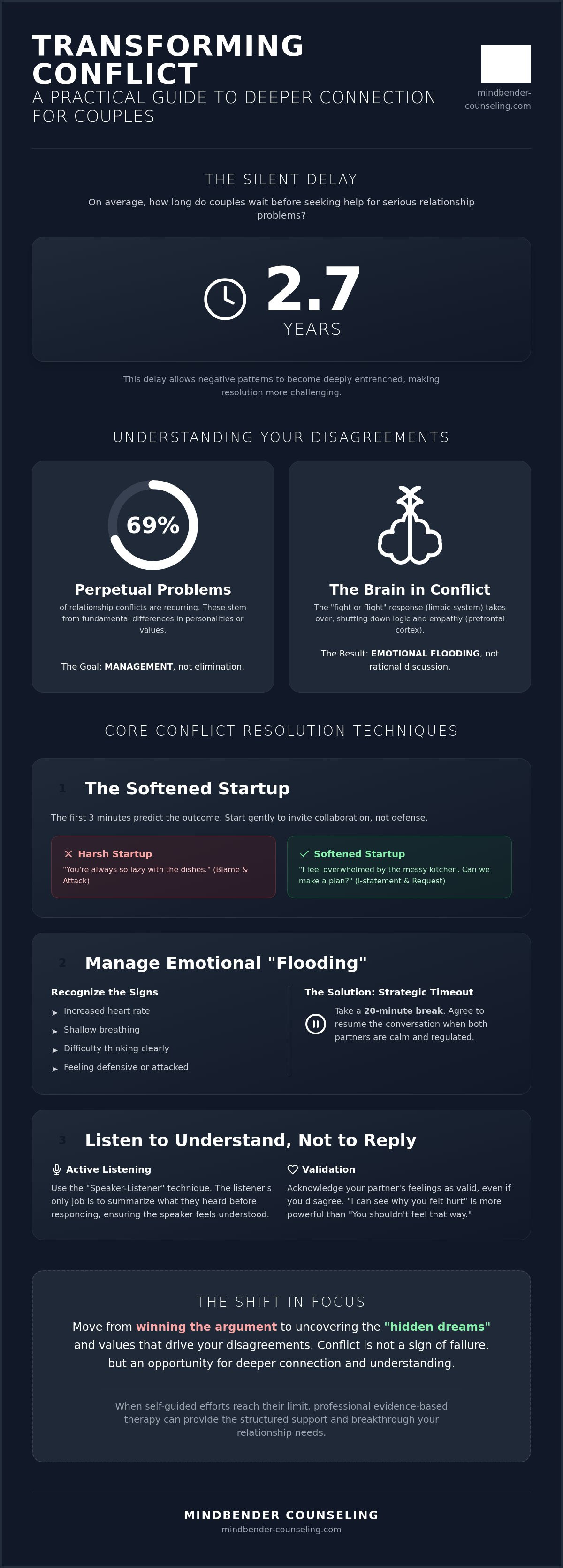
Did you know that the average couple waits 2.7 years after serious problems begin before they seek professional support? That's a long time to spend feeling unheard or trapped in the same recurring arguments. It's naturally exhausting to face "unsolvable" issues that never seem to reach a conclusion. You might even feel a quiet sense of anxiety about your relationship's future when every disagreement feels like a dead end rather than a path to understanding.
This guide introduces research-backed conflict resolution techniques for couples designed to transform these moments of friction into opportunities for deeper connection. We believe that conflict doesn't have to be a sign of failure; instead, it can be the catalyst for a more resilient partnership. By applying these steady, proven methods, you can move from a place of defensive tension to one of calm assurance. We'll explore evidence-based strategies that prioritize emotional safety and provide a structured, low-friction path toward restoring your mutual bond and building a stronger foundation for the years ahead.
Key Takeaways
- Understand that most relationship problems are perpetual and learn how to manage them without causing lasting damage to your bond.
- Master specific conflict resolution techniques for couples, such as the softened startup, to share your concerns without triggering your partner's defenses.
- Identify the physical signs of "flooding" and use strategic timeouts to ensure you only discuss difficult topics when you're both emotionally regulated.
- Shift your focus from winning arguments to uncovering the deeper values and "hidden dreams" that often drive your recurring disagreements.
- Recognize the point where self-guided efforts reach their limit and professional evidence-based therapy can provide the necessary breakthrough for your relationship.
The Nature of Relationship Conflict: Why We Fight
Conflict isn't a sign that your relationship is failing. It's often a sign that you both care deeply about the outcome. When we engage in understanding conflict resolution, we begin to see that disagreements are actually raw data about our needs and values. Healthy conflict involves expressing needs without attacking your partner's character. Toxic patterns, on the other hand, rely on blame and defensiveness, which create distance instead of clarity. By reframing a fight as a request for connection or a call for change, you can start to bridge the gap between you and your partner.
When a fight starts, your brain's limbic system often shifts into high alert. This "fight or flight" response isn't a choice; it's a biological attempt to protect you from a perceived threat. Unfortunately, it also shuts down the prefrontal cortex, which is the part of your brain responsible for logic, reason, and empathy. This is why you might say things you later regret or feel completely unable to hear your partner's perspective. Understanding this physiological shift is the first step in using effective conflict resolution techniques for couples to stay grounded during difficult talks.
Research indicates that 69% of relationship conflicts are perpetual. These are the same "unsolvable" issues that resurface month after month because they stem from fundamental differences in personality or lifestyle. Learning to navigate these recurring themes without letting them erode your foundation is the hallmark of a resilient partnership. It's not about winning; it's about staying connected while you disagree.
The Goal: Management Over Elimination
Many couples believe that a healthy relationship should be conflict-free. This is a counterproductive goal that leads to resentment and emotional distance. Instead of trying to eliminate differences, focus on managing them with curiosity. When you replace defensiveness with a genuine desire to understand your partner's world, you build long-term emotional resilience. Applying conflict resolution techniques for couples allows you to create a safe space where two different people can coexist and thrive together without losing their individual identities.
Common Conflict Triggers for Couples
Arguments often start over surface-level issues like household chores or weekend plans. However, these usually point toward deep-seated attachment needs, such as the desire to feel valued, respected, or safe. External stressors like demanding workloads or financial pressures in places like Arizona and Texas can also bleed into the home, making us less patient with those we love. Finding a peaceful environment to reconnect, such as Maitland Shores RV Park & Resort, can provide the necessary space for couples to focus on their emotional bond. Perpetual problems are defined as ongoing differences in personality or lifestyle that will likely remain part of the relationship's landscape. Recognizing these triggers helps you address the root cause rather than just the symptom.
Core Conflict Resolution Techniques for Daily Use
Daily interactions are the primary training ground for relationship health. Instead of waiting for a crisis to occur, you can implement small, intentional shifts in how you communicate. These conflict resolution techniques for couples act as essential tools to lower tension before it escalates into a full-blown argument. When you approach a disagreement with a specific set of skills, you move from a reactive state to a collaborative one.
Step 1: The Softened Startup
Research suggests that the first three minutes of a conversation almost always predict how it will end. If you begin with a "harsh" opening, such as "You're always so lazy with the dishes," your partner's brain immediately enters a defensive state. A "softened" startup focuses on the specific behavior and how it makes you feel, rather than attacking your partner's character. For example, try saying, "I feel overwhelmed when the kitchen is messy after dinner; could we figure out a plan for the dishes tonight?" This approach invites cooperation rather than resistance.
Step 2: Effective Listening and Validation
Active listening is more than just staying quiet while the other person talks. It requires you to truly absorb their perspective without preparing your rebuttal. The "Speaker-Listener" technique is particularly helpful for high-stakes topics. In this structure, the speaker shares their thoughts while the listener summarizes what they heard before responding. This ensures both parties feel seen and heard, which is often the most important part of any resolution.
Validation is perhaps the most powerful tool in your kit. It involves acknowledging your partner's feelings as valid, even if you don't agree with their logic. You might say, "I can see why you felt hurt when I was late, and it makes sense that you'd feel lonely." This simple act of empathy can dismantle damaging conflict styles like stonewalling or defensiveness. By validating their internal experience, you create the emotional safety necessary for a real solution to emerge.
If you find that these conflict resolution techniques for couples are difficult to implement on your own, you aren't alone. Many partners find that a guided environment helps them break old habits and build new ones. You might wonder how does online couples counseling work and if it could provide the structure you need to move forward. Our team at Mindbender Counseling offers evidence-based therapy to help you practice these communication skills in a safe, professional setting.
Managing vs. Resolving: A Framework for Progress
Progress in a relationship doesn't require the total absence of disagreement. It requires a clear framework to distinguish between situational hurdles and fundamental differences. When you apply conflict resolution techniques for couples, you first determine if the issue at hand is a resolvable problem or a perpetual one. Resolvable issues are usually situational, such as a disagreement over holiday plans or a missed chore. Perpetual problems, however, are rooted in your individual personalities or core values. Understanding which category a conflict falls into allows you to choose the right tool for the job. When you use these conflict resolution techniques for couples, you're not just solving a problem; you're building a bridge of understanding.
Solving Resolvable Issues
Solving situational conflicts involves keeping the conversation narrow. Avoid "kitchen-sinking," which is the habit of bringing up every past mistake when you're frustrated about a current one. Instead, focus on one specific behavior and propose a time-bound solution. For instance, if you're arguing about morning routines, agree to try a new schedule for one week. After that week, check in with each other. Expressing appreciation for your partner's effort during this trial period builds the emotional capital needed for future challenges.
Navigating Gridlock
Gridlock occurs when a conflict feels like hitting a brick wall. You might feel like you're having the same fight for years without any movement. To move from gridlock to dialogue, you must search for the "hidden dream" within the argument. This means looking beneath the surface level to find the underlying hope or value your partner is trying to protect. Gridlock usually signals a core value is being ignored.
Compromise doesn't mean sacrificing who you are. It means identifying your "non-negotiables" while remaining flexible in other areas. A key part of this process is accepting influence. This doesn't mean you always give in. It means you genuinely consider your partner's perspective and look for ways to say "yes" to their needs. By creating a safe space for their influence, you invite them to do the same for you, fostering a sense of mutual respect and internal balance. To complement these efforts with spiritual healing, you can learn more about Vital Village Metaphysical and their professional Reiki sessions. This methodical approach ensures that even when you disagree, your bond remains a sturdy anchor for both individuals.
De-escalation: What to Do When Things Get Heated
There are moments when even the most effective conflict resolution techniques for couples seem to vanish. In the heat of a high-stress disagreement, you might feel your heart racing, your palms sweating, and a sudden inability to think clearly. This state is known as flooding. It's a physiological reaction where your body's survival instincts override your capacity for rational thought. When you're flooded, the conversation is no longer about solving a problem; it's about self-protection. Recognizing these physical signals is the first step in preventing an argument from spiraling into a damaging cycle.
The Physiology of a Fight
When your heart rate climbs above 100 beats per minute, your prefrontal cortex essentially goes offline. This is the part of your brain responsible for logic, empathy, and complex problem-solving. You're left with the limbic system's primal urge to fight, flee, or freeze. Pushing through a heated fight in this state often leads to attachment injuries, which are deep emotional wounds that occur when we feel abandoned or attacked by our partner in a moment of vulnerability. Utilizing tools from therapy behavioral therapy can help you build the emotional regulation skills needed to identify flooding before it leads to a total communication breakdown.
The only effective solution for flooding is a strategic, 20-minute timeout. It takes at least that long for your body to metabolize stress hormones like cortisol and adrenaline. During this break, you must avoid replaying the argument in your head. Instead, focus on self-soothing. Deep breathing, going for a short walk, or listening to a favorite podcast can help reset your nervous system. To see how zero-gravity environments can further support this physiological reset, you can discover Bangkok Float Center and learn about the benefits of specialized floatation therapy. You can only return to the table once you've regained your internal balance and can approach your partner with a sense of calm assurance.
Mastering the Repair Attempt
Repair attempts are the "brakes" of a relationship. These are small, intentional gestures designed to de-escalate tension mid-argument. A repair can be a verbal apology, such as "I'm sorry, I'm being defensive right now," or a non-verbal cue like a gentle touch on the arm or a silly face to break the tension. The success of these attempts relies heavily on your "Emotional Bank Account." If you've built a solid foundation of daily appreciation and kindness, your partner is much more likely to accept a repair even when they're feeling hurt.
If you find that your disagreements frequently reach a boiling point where repairs are no longer effective, it's a sign that you might need a guided environment to heal. At Mindbender Counseling, we offer professional support to help you master these conflict resolution techniques for couples and break free from high-conflict patterns. Schedule a session for couples counseling to start transforming your arguments into opportunities for growth and deeper understanding.
When to Seek Professional Couples Counseling
While practicing conflict resolution techniques for couples at home is a courageous step toward healing, many partners eventually reach a plateau where self-guided efforts feel insufficient. This "point of no progress" doesn't signify that your relationship is beyond repair; instead, it indicates that the underlying patterns have become too deeply entrenched for a DIY approach. Professional intervention provides a neutral, safe space where both individuals can feel seen and heard without the fear of the conversation spiraling into another round of defensive tension. A professional guide acts as a sturdy anchor, helping you navigate the stormy parts of your connection while keeping you focused on your shared goals.
Signs It’s Time for a Professional Guide
A primary indicator that you might need external support is the consistent presence of what researchers call the "Four Horsemen": criticism, contempt, defensiveness, and stonewalling. When these behaviors become the default mode of communication, they act as a wall that blocks any genuine connection. You might also find that "attachment injuries" from the past, or individual traumas that haven't been fully processed, are preventing you from using modern conflict resolution techniques for couples effectively. If you feel like you're constantly walking on eggshells or if the same argument has been repeating for years, exploring private therapy can offer a confidential and structured path forward.
Taking the Next Step in Arizona or Texas
Couples living in the Southwest face a unique set of environmental and professional stressors that can exacerbate relational friction. Long commutes in Houston or Phoenix, the physical drain of the relentless summer heat, and the high-pressure professional landscape in our region often leave partners with very little emotional "margin" at the end of the day. When your internal resources are depleted, even small disagreements can feel insurmountable. Working with a local therapist who understands these specific regional pressures allows for a more personalized therapeutic experience that feels relevant to your daily life.
At Mindbender Counseling, our approach is rooted in evidence-based therapy that respects the unique history of your partnership. We don't just offer generic advice; we provide a methodical, steady framework for growth. In a typical session, you'll find a compassionate facilitator who helps you bridge the gap from "fighting" to "thriving." By combining professional expertise with a deep commitment to your well-being, we help you build the solid internal foundation necessary to restore balance and move toward a future of mutual understanding and joy.
Building a Resilient Future Together
Navigating the complexities of a long-term relationship requires both patience and a specific set of skills. You've learned that conflict isn't a sign of a failing bond; it's often an invitation to understand your partner's deepest needs and values. By recognizing the physical signs of flooding and choosing to lead with a softened startup, you can protect your relationship from the damage of recurring arguments. Implementing these conflict resolution techniques for couples allows you to move past situational hurdles and find genuine meaning even within your perpetual differences.
When self-guided efforts reach their limit, professional support can offer the breakthrough you deserve. Our licensed experts in Arizona and Texas utilize research-backed Gottman and EFT methods to provide compassionate, personalized therapy sessions. We act as a steady anchor while you navigate the path toward emotional stability and mutual respect. You don't have to face these challenges alone. Strengthen your bond with expert couples counseling and start your journey toward a more connected, thriving partnership today. It's possible to transform your arguments into a solid foundation for lasting love.
Frequently Asked Questions
How do I bring up a difficult topic without starting a fight?
Use a softened startup by focusing on your internal feelings and a specific, positive need rather than your partner's flaws. It's helpful to choose a moment when you both have the emotional margin to listen, avoiding high-stress times like the first few minutes after a long workday. By starting gently and taking responsibility for your own experience, you reduce the likelihood of triggering a defensive response in your partner.
Is it normal for couples to have the same argument over and over?
Yes, it's completely normal, as research shows that 69% of relationship conflicts are perpetual and never fully disappear. These recurring fights usually stem from fundamental differences in personality, values, or lifestyle. Instead of trying to "fix" the issue once and for all, focus on establishing a dialogue that respects both perspectives. Understanding this shift in goal helps lower the frustration of having the same conversation multiple times.
What should I do if my partner refuses to use conflict resolution techniques?
Focus on changing your own communication patterns first, as your shifts can often disrupt the negative cycle and invite a different response. You can't force someone else to change, but you can model the behavior you wish to see. If the resistance continues, individual counseling can provide you with the tools to manage your own reactions and decide on the best path forward for your well-being and the relationship's future.
How long should a "timeout" last during a heated argument?
A strategic timeout should last at least 20 minutes to allow your nervous system to return to a baseline state. This is the amount of time it takes for stress hormones like adrenaline to dissipate from your body. Make sure to agree on a specific time to return to the conversation so that the break doesn't feel like abandonment or stonewalling to your partner. Use this time to self-soothe rather than replaying the argument in your head.
Can a relationship survive if we have completely different conflict styles?
Yes, a relationship can thrive with different conflict styles if you both learn to bridge the gap with mutual respect and clear boundaries. The key is to identify where your styles clash, such as one person wanting to talk immediately while the other needs space to process. By negotiating a "middle ground" approach, you can ensure that both partners' needs for safety and expression are met, even if your natural tendencies differ significantly.
Is it too late for couples counseling if we’ve been fighting for years?
It's rarely too late to seek professional support, even if you've been stuck in high-conflict patterns for a long time. Statistics show that over 75% of couples who attend therapy report significant relationship improvement. While long-standing issues take time to untangle, evidence-based therapy provides a structured roadmap to rebuild trust and learn new conflict resolution techniques for couples that can replace old, destructive habits with healthy ones.
What is the difference between "managing" and "resolving" conflict?
Resolving conflict involves finding a final solution for a situational problem, like deciding on a specific holiday plan. Managing conflict applies to perpetual issues that arise from personality differences and will likely remain part of your lives. When you manage conflict, you focus on maintaining emotional safety and mutual understanding rather than finding a "fix," allowing you to stay connected despite your ongoing differences.
How do I know if our conflict has become toxic or abusive?
Conflict becomes toxic when it involves a consistent pattern of power, control, or fear rather than a disagreement between equals. Signs include name-calling, threats, isolation from loved ones, or any form of physical intimidation or harm. If you feel unsafe or find that your partner uses "conflict" as a way to diminish your worth or restrict your freedom, it's vital to reach out for professional guidance to prioritize your safety and well-being.


