

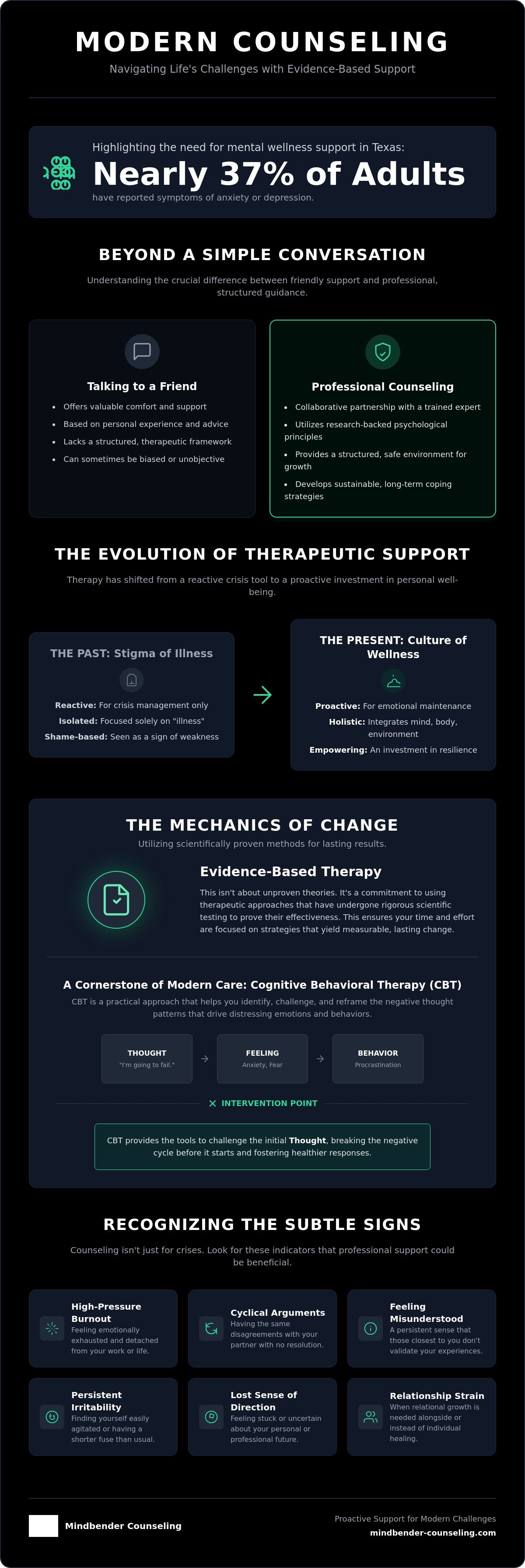
In Texas, nearly 37% of adults have reported symptoms of anxiety or depression, a reality that highlights the growing importance of professional counseling for navigating modern life. You might feel misunderstood by those closest to you, or perhaps you're trapped in cyclical arguments that leave your relationship feeling strained. When high-pressure environments lead to persistent burnout, it's natural to feel like you've lost your sense of direction. You deserve a space where your experiences are validated and your growth is prioritized.
This guide demonstrates how evidence-based tools provide the clarity you need to navigate life's challenges and foster lasting emotional growth. We'll explore how modern therapy helps you develop resilience, improve communication with your partner, and gain the mental clarity required to move forward with confidence. By understanding the modern approach to mental wellness in 2026, you can transition from simply managing stress to building a life of purpose and balance.
Key Takeaways
- Understand how modern counseling goes beyond casual advice to provide a structured, research-backed framework for your personal and professional evolution.
- Discover the "gold standard" of evidence-based therapy and why scientifically tested methods are essential for achieving measurable, lasting change.
- Learn to distinguish between individual healing and relational growth so you can choose the path that best supports your current needs.
- Identify the subtle indicators—like persistent irritability or high-pressure burnout—that suggest you could benefit from professional counseling before a crisis occurs.
- Gain clarity on the intake process and the importance of finding a local provider who understands the unique stressors in Arizona and Texas.
Defining Professional Counseling in the Modern Era
Professional counseling is far more than a simple conversation or a place to vent. It's a collaborative partnership between you and a trained expert, specifically designed to foster mental health, personal wellness, and career growth. While talking to a supportive friend has value, it lacks the structured framework that a clinical setting provides. Professional counseling utilizes research-backed psychological principles to help you navigate specific life challenges and develop sustainable coping strategies that last a lifetime.
By 2026, the perception of therapy has shifted significantly. It's no longer viewed solely as a reactive measure for crisis management. Instead, individuals now see it as a proactive tool for emotional maintenance. Just as you might visit a gym to strengthen your body or consult with Fridman Legal to navigate significant life transitions, you engage in therapy to fortify your mind and spirit. This process empowers you to dismantle personal trauma and clear the obstacles that prevent you from living a balanced, fulfilling life. It's an investment in your internal foundation that pays dividends in every area of your existence.
The Evolution of Therapeutic Support
We've moved away from the outdated stigma of illness and toward a vibrant culture of wellness. In this modern era, therapy integrates clinical expertise with a holistic understanding of well-being. It considers how your environment, digital habits, and physical health all intersect with your mental state. Within this framework, professional counseling serves as a vital bridge between your current challenges and your future resilience. It provides the stability needed to grow through periods of intense change, digital burnout, high-performance pressure in the workplace, or the profound stress associated with legal defense cases, such as those managed by the Law Office of Kevin Bessant & Associates.
The Role of the Professional Counselor
Understanding the role of your guide is essential for a successful journey. While life coaches offer valuable motivation, a licensed therapist brings years of rigorous academic training and clinical supervision to the table. They are experts in counseling psychology, which allows them to address deep-seated patterns and psychological nuances that a coach might miss. This specialized knowledge ensures that the support you receive is both safe and effective, rooted in proven methodologies rather than just anecdotal advice.
Research consistently shows that the therapeutic alliance, the unique bond between you and your counselor, is the strongest predictor of positive outcomes. When you feel understood and respected, your defense mechanisms lower, allowing for genuine progress to take root. If you're interested in how society is embracing this new perspective, explore our guide on Breaking the Stigma: A Comprehensive Guide to Private Therapy in 2026. This connection acts as both a sturdy anchor and a catalyst for your personal evolution, providing the safe space you need to explore your true self.
The Mechanics of Change: Evidence-Based Therapeutic Approaches
Change is rarely the result of a single epiphany. Instead, it's the product of consistent, intentional work within a structured environment. When you engage in professional counseling, you aren't just paying for a sympathetic ear. You're accessing a set of sophisticated tools designed to rewire how you respond to stress and interact with the world. This isn't a mystery; it's a deliberate process built on decades of psychological research.
The core of this transformation lies in Evidence-Based Therapeutic Approaches. These are treatments that have undergone rigorous scientific testing to prove they actually work for specific conditions. By prioritizing these methods, we ensure your time in session is spent on strategies that yield measurable results, rather than unproven theories. This approach respects your commitment to growth by focusing on what has been clinically shown to foster healing.
Modern therapy involves much more than talking. It utilizes cognitive, behavioral, and systemic interventions to address the root causes of your distress. For instance, if you're struggling with high-pressure burnout, a systemic approach might examine how your work environment interacts with your personal boundaries. These interventions provide the "how" of healing, giving you practical steps to take between sessions to reinforce your progress.
Common Methodologies in Modern Practice
Cognitive Behavioral Therapy (CBT) is a cornerstone of modern care. It helps you identify and reframe the negative thought patterns that fuel anxiety or depression, allowing you to regain control over your internal narrative. For those dealing with intense emotional waves, Dialectical Behavior Therapy (DBT) provides the skills needed for emotional regulation and resilience. You can learn more about how these specific frameworks build strength in our guide on Understanding Therapy and Behavioral Therapy: A Guide to Modern Emotional Resilience.
Why 'Research-Backed' Matters for Your Growth
Using research-backed methods ensures both safety and efficacy throughout your journey. When a methodology is data-driven, it provides a predictable roadmap for healing, which often leads to faster and more sustainable results. Evidence-based care is the foundation of professional counseling because it provides a reliable structure for your personal evolution. It transforms the therapeutic process from a vague exploration into a targeted journey toward lasting wellness.
At Mindbender Counseling, we view these frameworks as the "gold standard" for real change. We tailor these proven techniques to your unique story, ensuring you receive personalized care that remains rooted in science. If you're ready to see how these tools can work for you, consider exploring our evidence-based therapy options to begin your path toward a more balanced life.
Individual vs. Couples Counseling: Finding Your Path
Deciding which door to walk through can feel overwhelming when you're already stretched thin. While both paths utilize evidence-based therapy to foster stability, they differ in their primary focus. Individual counseling centers on your internal self, helping you process personal trauma, anxiety, or specific career goals. In contrast, couples counseling treats the relationship itself as the client. It shifts the focus toward the bonds and communication patterns between two people. Your choice depends on whether your current distress feels like an internal weight or a friction between you and your partner.
Statistics from 2023 show that nearly 22% of Texas adults experienced a mental health disorder, often manifesting as internal distress that ripples into their external lives. Whether the pain is solitary or shared, professional counseling provides a structured environment to address these challenges. By identifying the source of your struggle, you can select the modality that offers the most direct path to relief and long-term resilience.
Individual Counseling: A Path to Personal Healing
Personal healing is about creating a solid internal foundation. When you struggle with anxiety, depression, or the weight of high-pressure career stress, one-on-one sessions provide a safe, confidential space for deep self-exploration. These sessions allow you to dismantle the thought patterns that keep you stuck without the influence of outside voices. For many professionals in high-pressure hubs like Phoenix or Austin, this focused attention is the key to regaining mental clarity and a sense of direction. If you're navigating these feelings, you might explore Individual Counseling for Anxiety: Personalized Evidence-Based Therapy in Arizona & Texas to see how tailored support can help.
Couples Counseling: Strengthening Relational Bonds
When arguments become cyclical, it's often a sign that the relationship's communication infrastructure needs an upgrade. Professional counseling for couples moves the conversation past the "who is right" dynamic. It focuses instead on "how we can thrive together." The therapist acts as a neutral facilitator, ensuring both partners feel seen while identifying the systemic triggers that cause conflict. This process isn't about assigning blame; it's about rebuilding the emotional safety required for a partnership to flourish. In 2026, many partners find that digital options offer the flexibility needed for busy schedules. To understand this modern approach, read about How Does Online Couples Counseling Work? The Rise of On-Demand Therapy in 2026.
When to Seek Professional Support: Recognizing the Subtle Signs
You don't have to wait for your world to crumble before seeking support. Many people believe therapy is a last resort reserved for life's most catastrophic moments, but waiting for a total collapse before seeking professional counseling is a common mistake. In reality, the most transformative work often happens when you address the quiet, persistent signals that your internal foundation is under stress. Proactive care prevents minor stressors from evolving into major life disruptions, allowing you to maintain your momentum rather than spending months in recovery.
The signs that you're reaching your limit are often subtle. You might notice a persistent irritability that flares up over minor inconveniences or a gradual loss of joy in hobbies that once felt revitalizing. In your personal life, these indicators often manifest as the "same argument" on a continuous loop or a quiet emotional withdrawal to avoid further conflict. These aren't signs of failure; they're signals that your current coping strategies are no longer sufficient for the weight you're carrying.
The Signs of Emotional Burnout
It's vital to distinguish between a busy week and chronic emotional exhaustion. While a heavy workload is temporary, burnout is a systemic depletion that affects your physical health and professional performance. Chronic stress can lead to physical tension, sleep disturbances, and a clouded sense of judgment. If you're unsure if you've crossed that line, consider these five subtle indicators:
- Dreading the start of your workday despite previously enjoying your role.
- Feeling "on edge" or hyper-vigilant even when you're in a safe environment.
- A growing sense of cynicism or detachment from friends and family.
- Unexplained physical fatigue that doesn't improve with rest.
- Difficulty concentrating on tasks that used to feel intuitive or simple.
Overcoming the 'I Can Handle It' Barrier
Professionals in high-stakes environments across Arizona and Texas often pride themselves on their resilience. You might feel that asking for help is a sign of weakness, but reframing therapy as a strength-based choice is essential for long-term success. Think of it as high-performance maintenance for your mind. Delaying support carries a heavy cost in terms of lost time, strained relationships, and emotional energy. Early intervention is the most efficient way to reclaim your clarity and direction, making professional counseling a proactive choice for high-performers who want to stay at the top of their game.
If you recognize these patterns in your own life, taking a small step now can change your trajectory. You can explore our Individual Counseling Services to see how a personalized, evidence-based approach can help you restore your internal balance and move forward with renewed confidence.
Taking the First Step: Starting Counseling in Arizona and Texas
Beginning your journey with professional counseling is a significant act of self-advocacy. In states like Arizona and Texas, where professional environments are often high-pressure and access to care can be challenging, finding a local provider is essential. A counselor who understands the specific regional stressors, whether it's the intense urban sprawl of Houston or the unique mental health landscape in Maricopa County, can offer more relevant support. By choosing a provider familiar with local regulations, such as Texas's telehealth parity laws or Arizona's 2026 regulatory updates, you ensure your path to wellness is both stable and accessible.
Modern practices understand that your time is valuable. Starting the process shouldn't feel like another burden on your schedule. Streamlined scheduling and flexible digital options make it easier to prioritize your mental health without sacrificing your professional commitments. Remember that therapy is a journey that moves at your specific pace. It's not about reaching a finish line; it's about building a sustainable internal foundation that supports you through every season of life.
What to Expect in Your Initial Session
The first session is primarily an intake, a low-pressure opportunity to see if the therapeutic "fit" feels right. During this time, you'll discuss your personal history and set clear, measurable goals for your well-being. It's a collaborative space where you should feel heard and respected by your individual counselor. This initial dialogue allows your therapist to craft personalized interventions based on your unique life story. By establishing these markers early, you can track your progress and ensure the work remains focused on the outcomes that matter most to you.
Navigating Care with Mindbender Counseling
At Mindbender Counseling, we bridge the gap between clinical expertise and heartfelt support. We understand that residents in Arizona and Texas need flexible, reliable options that fit into demanding lives. Our commitment to evidence-based therapy ensures that your progress is rooted in proven methods while remaining deeply compassionate. If you're navigating the specific pressures of a high-stakes career, you can find additional support in our guide to Counseling for Work Stress in Arizona: A Roundup of Wellness Therapy Resources.
Choosing professional counseling is an investment in your future resilience. It provides a sturdy anchor as you navigate personal and relational evolution, ensuring you have the tools to face life's challenges with clarity. For many, this clarity also involves staying informed about spiritual developments; you can discover Supernatural Bible Change Outreach Int to learn about prophetic alerts and supernatural shifts in 2026.
Cultivating Your Path to Lasting Resilience
Choosing to prioritize your mental wellness is a powerful step toward a more balanced and intentional life. We have explored how modern therapy serves as a proactive bridge to resilience, utilizing proven methods to help you navigate the complexities of digital burnout and relational friction. By recognizing the subtle signs of emotional strain early, you can prevent minor stressors from becoming life-altering disruptions. Investing in professional counseling isn't just about resolving current challenges; it's about building a sturdy internal foundation that supports your future evolution.
At Mindbender Counseling, we provide compassionate, evidence-based therapy tailored to your unique needs across Arizona and Texas. Our team offers professional guidance for navigating modern life challenges, ensuring you feel seen and supported throughout your transformation. Begin your journey toward emotional resilience with Mindbender Counseling today. You have the strength to foster lasting change, and we are here to walk beside you as you reclaim your sense of direction and mental clarity.
Frequently Asked Questions
What is the difference between professional counseling and talking to a friend?
Professional counseling provides a structured, objective environment led by an expert trained in clinical psychological principles. While friends offer valuable emotional support, a counselor uses evidence-based tools to identify deep-seated patterns and facilitate measurable growth. This professional distance ensures the focus remains entirely on your personal progress without the bias or emotional entanglement common in personal relationships.
How do I know if I need individual counseling or couples therapy?
Choose individual therapy if your primary distress is internal, such as personal anxiety, depression, or career-related stress. If your primary conflict exists between you and your partner, couples therapy is the right choice because it treats the relationship itself as the client. If you feel "stuck" within yourself, focus on individual work first to build a solid internal foundation.
Is professional counseling covered by insurance in Arizona and Texas?
Many commercial insurance plans in Arizona and Texas provide coverage for mental health services, though specific benefits vary by provider. In Texas, Senate Bill 670 requires most commercial plans to reimburse telehealth visits at the same rate as in-person visits. You should always contact your insurance carrier directly to verify your copay and ensure your specific provider is within their network.
How long does a typical counseling program last before I see results?
Most individuals begin to experience a shift in perspective or relief from acute symptoms within the first four to six sessions. While deep-seated trauma or complex relational issues may require a longer commitment, professional counseling is a journey that moves at your specific pace. Consistency is the primary driver of success, as it allows you to build a sturdy foundation for sustainable change.
What should I look for when choosing a professional counselor near me?
Prioritize finding a licensed professional who specializes in your specific needs and utilizes evidence-based therapy techniques. Look for a counselor who fosters a strong therapeutic alliance, as feeling heard and respected is the top predictor of successful outcomes. It's also helpful to choose a local provider who understands the regional stressors and regulatory standards in Arizona or Texas.
Can professional counseling help with workplace stress and burnout?
Yes, professional counseling is highly effective for managing workplace stress by providing tools to reframe high-performance anxiety and set sustainable boundaries. A counselor helps you identify the difference between a busy season and chronic emotional exhaustion. By addressing these patterns, you can restore your mental clarity and prevent burnout from derailing your professional performance or personal health.
What happens if I don't feel a connection with my therapist after the first session?
If you don't feel a natural connection after your intake, it's perfectly acceptable and encouraged to seek a different provider. The therapeutic fit is essential for progress, and a professional counselor will understand that not every pairing is the right match. Your comfort and safety are the priority, so don't hesitate to advocate for the support that feels most helpful to you.


