

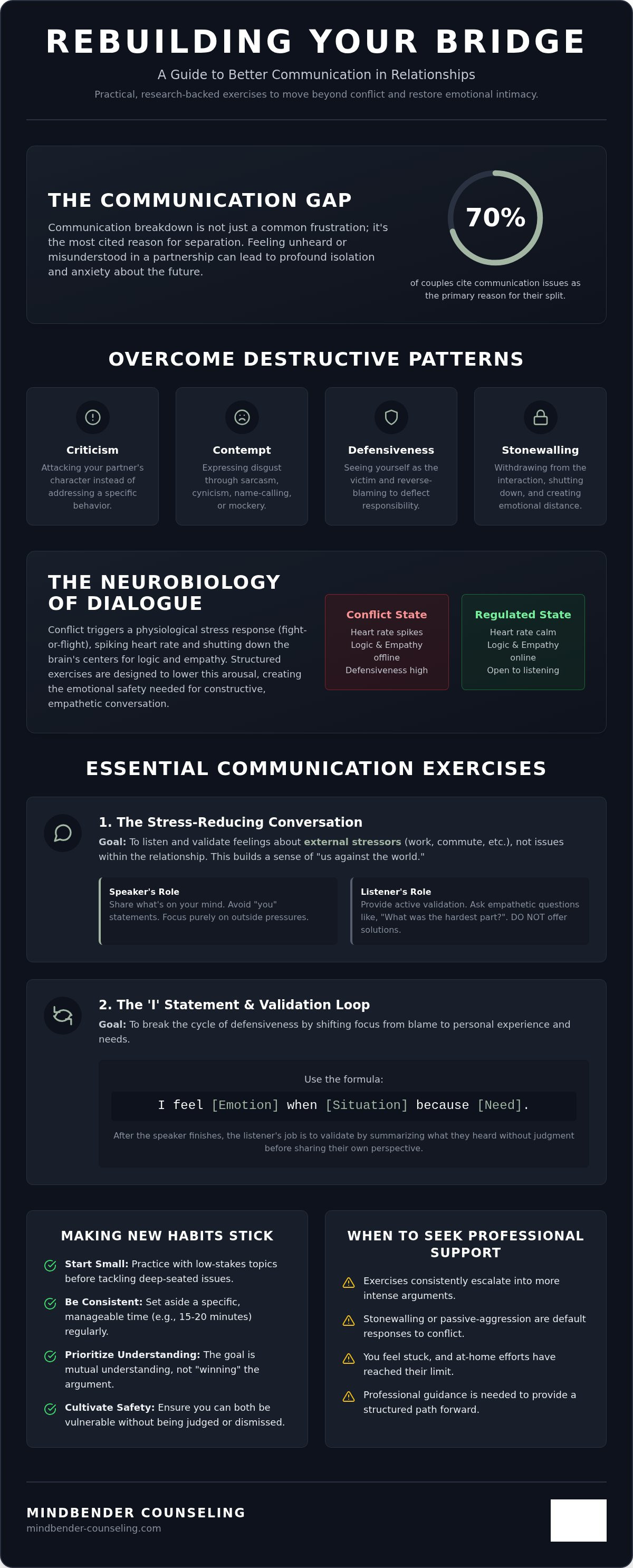
Did you know that nearly 70% of couples who separate cite communication breakdowns as the primary reason for their split? It is incredibly isolating to feel unheard in your own home, especially when every attempt to connect seems to trigger a cycle of defensiveness or a painful wall of silence. If you feel anxious about the future of your partnership, you aren't alone; many couples struggle to bridge the gap between their intentions and their impact.
The good news is that these patterns don't have to be permanent. By utilizing specific couples therapy exercises for communication, you can move past the "Four Horsemen" of conflict and restore the emotional intimacy you deserve. This article provides a practical, research-backed toolkit for 2026 to help you navigate perpetual problems and validate each other's feelings with clarity. We'll explore how to regulate your nervous system during difficult dialogues, establish new habits for connection, and recognize when professional guidance can provide the architectural blueprint for a lasting bond.
Key Takeaways
- Learn how structured interventions can break repetitive cycles of misunderstanding and transform frustrated venting into constructive dialogue.
- Discover five research-backed couples therapy exercises for communication designed to serve as gentle invitations for connection rather than high-pressure demands.
- Understand the neurobiology of conflict to help you and your partner co-regulate your nervous systems when tension rises.
- Gain practical strategies for making these new communication habits stick by starting with low-stakes topics before addressing deep-seated issues.
- Identify the clear signs that indicate when at-home efforts have reached their limit and professional guidance is the most effective path forward.
Understanding Relational Dynamics: Why Communication Exercises Matter
Communication is the heartbeat of any partnership, yet it's often the first thing to falter under the weight of daily life. Many people traditionally viewed couples therapy as a final effort to save a sinking ship. However, a significant trend in 2026 shows that more couples are embracing proactive relationship maintenance. They recognize that waiting for a crisis to occur is far more taxing than building a resilient foundation today. Using couples therapy exercises for communication provides a structured way to interrupt negative interaction cycles before they become permanent fixtures in your home.
These exercises act as a bridge between two different internal worlds. It's essential to understand the difference between venting and constructive dialogue. Venting is often a one-way release of frustration that can leave your partner feeling like a target rather than a teammate. In contrast, constructive dialogue is a collaborative effort where the goal is mutual understanding rather than winning an argument. Before you can engage in this work, you must cultivate emotional safety. Think of emotional safety as the prerequisite for growth; it's the quiet confidence that you can be vulnerable without being judged or dismissed.
The Science of Relational Stability
Research in evidence-based therapy has identified specific behaviors, famously known as "The Four Horsemen," that can accurately predict the future health of a relationship. These patterns, which include criticism and contempt, do more than just hurt feelings. They actually trigger a physiological response in your body. When conflict escalates, your heart rate often spikes, which effectively shuts down the part of your brain responsible for logic and empathy. Structured exercises are designed to lower this physiological arousal, keeping you in a state where you can actually hear what your partner is saying. A relational bid is a single attempt from one partner to another for affirmation, affection, or any other positive connection that builds your emotional bank account.
Identifying Your Communication Gaps
Every couple has unique "gaps" where their connection tends to fray. You might notice signs of breakdown like stonewalling, where one partner completely withdraws, or passive-aggression that masks deeper resentments. External factors often play a larger role than we realize. For those living in fast-paced environments like Phoenix or Dallas, the stress of long commutes and intense workplace demands can follow you through the front door. This localized pressure often leaves you with a "short fuse" when you finally sit down with your partner. Mindbender Counseling emphasizes the importance of individualized attention to help you spot these specific triggers. By understanding how your environment impacts your dialogue, you can use couples therapy exercises for communication to regain your balance and protect your partnership from the outside world.
5 Essential Couples Therapy Exercises for Better Communication
Implementing couples therapy exercises for communication shouldn't feel like a chore or a high-stakes test. Instead, view these tools as gentle invitations to reconnect in a safe, time-boxed environment. By setting a specific duration, such as 15 or 20 minutes, you make the emotional work feel manageable rather than overwhelming. These structured moments prevent the exhaustion that often comes from circular arguments. If you find it difficult to stay on track at home, exploring online couples counseling can provide the professional structure needed to facilitate these sessions effectively.
The Stress-Reducing Conversation
This exercise focuses on venting about external stressors, not the relationship itself. The goal is to listen without trying to fix the problem immediately. The speaker should avoid "you" statements and focus purely on outside pressures, like a difficult manager or a long commute. As the listener, your role is to provide active validation and empathetic inquiry. Ask questions like, "What was the hardest part of that?" instead of offering solutions. This builds a sense of "us against the world" rather than "me against you."
The 'I' Statement and Validation Loop
To break the cycle of defensiveness, use the formula: "I feel [emotion] when [situation] because [need]." This shifts the focus from your partner's perceived flaws to your own internal experience. Once the speaker finishes, the listener uses the "Mirroring" technique, repeating back what they heard before responding. You might say, "I hear you saying that you feel lonely when I work late because you value our evening time together." Remember, validation doesn't mean you agree with every point, but it does mean you respect your partner's reality.
The Weekly Relationship Check-In
Establish a recurring 20-minute "state of the union" meeting. Because 51% of adults in relationships report being distracted by their phones during conversations, it is vital to establish a strict "no-phone zone" for this exercise. Focus on three core questions: What went well this week? Where did we miss each other? How can I love you better in the coming days? This proactive approach ensures that small grievances don't transform into deep-seated resentment over time.
The Softened Startup and Non-Verbal Connection
A "softened startup" involves bringing up a concern without blame or criticism. For example, saying "I'm worried about our chores" is far more effective than "You never help out." To complement this, try a five-minute non-verbal connection exercise. Simply sit in silence and maintain eye contact. This grounding technique helps co-regulate your nervous systems, making it easier to stay calm when you eventually transition into verbal dialogue. If these exercises reveal deeper patterns you're ready to address, our team at Mindbender Counseling is here to support your growth.
Rewiring Your Connection: The Neurobiology of Dialogue
Effective communication isn't just about choosing the right words; it's about managing your biology. When a conversation turns into a conflict, your brain's amygdala often perceives a threat, triggering a "fight or flight" response. This physiological shift effectively shuts down the prefrontal cortex, the area responsible for logic, empathy, and problem-solving. In this state, you aren't actually talking to your partner; you're reacting to a perceived enemy. Understanding this "amygdala hijack" is a cornerstone of evidence-based therapy, as it helps couples recognize that their biological reactivity is often the biggest hurdle to connection.
To counter this, couples must practice co-regulation. This is the process where partners' nervous systems influence each other to maintain a state of calm. If one partner remains grounded, it can help lower the other's physiological arousal. Utilizing couples therapy exercises for communication like the "Softened Startup" serves as a biological safety signal. By approaching a topic with a gentle tone and a focus on your own feelings, you prevent your partner's brain from entering a defensive state. This allows both of you to stay "online" and engaged in the conversation rather than retreating into silence or escalating into an argument.
From Reactivity to Response
Identifying "flooding" is the first step toward better dialogue. Flooding occurs when your body is so overwhelmed by stress that you can no longer process information rationally. Common signs include a racing heart, shallow breathing, or a sudden urge to walk away. When this happens, implement the "20-minute timeout" rule. It takes at least 20 minutes for your body to metabolize stress hormones like cortisol and adrenaline. During this break, don't dwell on the fight; instead, engage in a calming activity like reading or walking. Emotional attunement is a measurable skill for 2026 that involves the ability to accurately sense and respond to your partner's internal emotional state in real-time.
Building a Solid Internal Foundation
Your relationship's health is deeply intertwined with your individual mental well-being. It is difficult to practice relational patience when your own internal foundation is crumbling under stress or exhaustion. Personalized care often involves looking at how individual anxiety or depression might be fueling conflict within the partnership. Prioritizing self-care isn't a selfish act; it's a necessary investment in your relationship's stability. As you pursue personal growth, you become a more resilient partner, acting as a catalyst for positive movement and long-term balance within the relationship.
Successful Implementation: Making Exercises a Habit
When you first begin practicing couples therapy exercises for communication, the experience often feels forced or even slightly awkward. This is completely normal. Much like learning a new physical skill, your brain is building new neural pathways to replace old, reactive habits. It's helpful to view this initial phase as a necessary period of growth rather than a sign that the exercises aren't working. To build confidence, start with low-stakes topics, like planning a weekend outing, before attempting to navigate deep-seated conflicts. This gradual approach allows you to master the mechanics of dialogue without the weight of heavy emotional triggers.
Consistency is far more valuable than intensity. Spending five minutes every day on a simple connection ritual is significantly more effective for your relationship's health than a grueling one-hour session once a month. For those balancing a busy Arizona or Texas lifestyle, finding a "ritual of connection" that fits your schedule is essential. Whether it's a brief conversation over morning coffee or a ten-minute walk after work, these small moments create a steady, unwavering support system for your partnership. If you find that at-home practice continues to feel stuck, you can schedule a session with an expert guide to help refine your technique.
Creating a Safe Space at Home
Timing is everything. One of the most effective ways to ensure success is to avoid the "HALT" moments: Hungry, Angry, Lonely, or Tired. Attempting to resolve a complex issue when your physical or emotional resources are depleted often leads to frustration. Beyond timing, consider your physical environment. Soft lighting, a comfortable seat, and a strict "no-phone zone" send a signal to your nervous system that it is safe to lower its defenses. Establishing ground rules, such as a commitment to no interrupting and no name-calling, provides the structure needed for both partners to feel seen and heard.
Avoiding the Blame Game
Shifting your language from accusation to request is a powerful way to neutralize conflict. When you move from "You always ignore me" to "I would appreciate it if we could talk for ten minutes," you invite your partner into a collaborative space rather than putting them on the defensive. This shift is particularly helpful in addressing the "pursuer-distancer" dynamic, where one partner's push for connection causes the other to withdraw. By focusing on the "we" versus the problem, you reposition yourselves as teammates working together to restore balance, rather than adversaries competing for the last word.
When Exercises Aren't Enough: The Case for Professional Support
While couples therapy exercises for communication are effective maintenance tools, they sometimes reach a natural limit. If you find yourselves trapped in circular fighting where the same argument repeats weekly, or if a heavy blanket of resentment has settled over your home, it's a sign that the roots of the issue go deeper than simple dialogue techniques can reach. It is difficult to remain objective when you are in the middle of an emotional storm. Recognizing that you need more than a worksheet is a sign of strength and a commitment to the health of your partnership.
A licensed therapist acts as a steady anchor, identifying the subtle blind spots that you and your partner are too close to see. These might include unconscious patterns of behavior or emotional triggers that have become hardwired over years of interaction. This professional perspective is particularly crucial for residents navigating the unique pressures of Arizona and Texas, where external stressors can easily mask internal relational fractures. Choosing couples counseling in Phoenix or online across Texas is a meaningful investment in the long-term stability of your entire family unit.
Personalized Therapeutic Interventions
Mindbender Counseling focuses on moving beyond generic advice to provide clinical expertise that addresses your unique history. Generic tips often fail because they don't account for individual attachment styles or the specific neurobiological triggers we explored in previous sections. In a professional couples session in 2026, you can expect a highly interactive and collaborative environment. Your therapist will use research-backed methods to help you co-regulate in real-time, ensuring that you aren't just following a script, but actually rebuilding your internal foundation. This individualized attention allows for a restoration of balance that at-home exercises alone cannot provide.
Your Path to Relational Healing
Taking the first step toward professional support is often the most difficult, yet it offers the most profound relief for your relationship. Scheduling a consultation in Arizona or Texas is a straightforward, low-friction process designed to respect your time and privacy. There is a quiet confidence that comes from knowing you are no longer navigating these turbulent waters alone. You deserve to feel heard, validated, and secure within your partnership. Positive change is not just a hope; it's a tangible outcome when you have a wise and compassionate guide to facilitate your journey toward well-being.
Building Your Resilient Future Together
Creating a lasting connection requires more than just good intentions; it demands the right tools and a commitment to small, daily shifts in how you interact. By integrating couples therapy exercises for communication into your routine, you move from a state of reactivity to one of intentional response. You now understand that managing your nervous system and practicing co-regulation are just as vital as the specific words you choose. Each structured dialogue serves as a brick in a more stable internal foundation for your relationship, helping you weather life's stressors as a unified team.
When at-home practices reveal deeper complexities, remember that seeking professional guidance is a proactive step toward long-term health. At Mindbender Counseling, our expert licensed counselors in Arizona and Texas utilize evidence-based therapeutic techniques to provide personalized care for your unique relationship. You don't have to navigate these challenges in isolation. Schedule a compassionate couples counseling session with Mindbender today.
The journey toward a more intimate and resilient partnership is within your reach. With patience and the right support, you can transform your communication and rediscover the joy of truly being seen and understood by your partner.
Frequently Asked Questions
Do communication exercises really work if we are already on the verge of a breakup?
Yes, these exercises can be effective, but they often serve as a vital diagnostic tool at this stage. If both partners are willing to engage, structured activities help lower the temperature of daily interactions and reveal if there is a sufficient foundation to rebuild. However, when a relationship is in crisis, these tools are most successful when supported by a professional who can safely manage high emotional volatility.
How often should we practice these exercises to see a real difference?
Consistency is more important than duration, so aim for a ritual of connection at least three to five times per week. Even ten minutes of focused, distraction-free dialogue can begin to shift your relational dynamic over time. Research suggests that small, frequent positive interactions are the most effective way to build long-term stability and overcome the negative patterns that often lead to emotional distance.
What if my partner refuses to participate in communication exercises?
You can still make significant progress by focusing on your own side of the communication loop. When you change your responses and manage your own nervous system, it often shifts the entire dynamic of the partnership automatically. Lead by example with softened startups and active listening. If your partner remains resistant, it may be helpful to seek individual counseling to explore your personal boundaries and needs.
How long does it typically take to improve communication in a relationship?
Many couples notice a decrease in immediate tension within two to four weeks of consistent practice. However, deep-seated patterns usually require three to six months of intentional effort to fully rewire your interactions. Relational healing is a methodical process that mirrors the patient nature of the therapeutic process. Focus on incremental progress rather than expecting an overnight transformation in your connection and emotional intimacy.
Are these exercises a substitute for professional couples therapy?
These couples therapy exercises for communication are excellent maintenance tools, but they aren't a substitute for clinical intervention in complex cases. A licensed professional provides the architectural blueprint and identifies blind spots that at-home exercises might miss. If you find yourselves stuck in circular arguments despite your best efforts, professional support offers a structured and safe environment for deeper healing and personalized growth.
Can we do these exercises if we are currently in a long-distance relationship in different parts of Texas?
Absolutely, as these exercises are highly adaptable to video calls and digital platforms. Whether you are in Dallas, Houston, or Austin, you can schedule a dedicated time for a virtual check-in or practice stress-reducing conversations via video. The key is to maintain a focused presence and prioritize your partner despite the physical distance, ensuring your emotional bond remains a sturdy anchor for the relationship.
What is the most important rule for communication during these activities?
The most critical rule is maintaining emotional safety through non-judgmental, active listening. You must prioritize understanding your partner's perspective over proving your own point or winning the argument. This involves active validation and avoiding the urge to fix, interrupt, or criticize. When both partners feel safe enough to be vulnerable, the couples therapy exercises for communication become a powerful catalyst for movement and long-term restoration.
How do we handle it if an exercise triggers a bigger fight?
Immediately implement a 20-minute timeout to allow your nervous systems to de-escalate and return to a calm state. It is common for new exercises to feel awkward or hit sensitive nerves initially. Don't view the conflict as a failure; instead, use it as helpful data to understand your triggers. Once you have both co-regulated and feel secure, you can gently revisit the topic with a softened startup.


