

What if the most effective way to reclaim your calm isn't just by talking about your fears, but by retraining the way your brain responds to them? Many people start their healing journey feeling like therapy is little more than an expensive venting session, leading to the fear that their specific struggle is untreatable. If you've felt confused by clinical acronyms or frustrated by a lack of progress, exploring evidence-based therapy for anxiety can provide the clarity you've been seeking. It's natural to want more than just a listening ear; you deserve a structured approach that produces real, visible change.
This guide demystifies the research-backed techniques that offer measurable relief from persistent worry. You'll learn the "why" behind therapeutic exercises and how to find a structured framework that fits your unique needs. We'll preview the most effective tools for recovery, helping you move from feeling overwhelmed to feeling empowered. By the end of this article, you'll have a clear understanding of how a scientific approach to counseling can help you build a solid internal foundation and restore balance to your daily life.
Key Takeaways
- Understand how evidence-based therapy for anxiety bridges the gap between scientific research and your personal healing journey.
- Discover why structured modalities like CBT and ACT focus on building psychological flexibility rather than just discussing problems.
- Learn to distinguish between the "active ingredients" that drive recovery and general advice that often leads to feeling stuck.
- Identify the phases of a structured recovery plan, from comprehensive assessments to setting measurable goals for your well-being.
- Explore how a personalized approach in Arizona and Texas can transform your therapy experience into a path of steady, visible progress.
The Science of Calm: What is Evidence-Based Therapy for Anxiety?
Seeking help for persistent worry often feels like a leap of faith. You might worry that therapy is just a place to talk in circles without seeing real change. Evidence-based therapy for anxiety changes this dynamic by providing a bridge between clinical research and your personal healing. It isn't a rigid formula, but a framework that ensures the time you spend in session is directed toward specific, proven outcomes. It's natural to want proof that your investment of time and energy will pay off before you begin.
This approach rests on three essential pillars that work together to support your growth. First, it utilizes the best available research to determine which techniques actually reduce symptoms. Second, it relies on clinical expertise to adapt those techniques to your specific situation. Finally, it honors your personal values and preferences. By combining these three elements, therapy becomes a collaborative effort rather than a passive experience. It moves the focus from simply surviving the day to actively building a more resilient life.
Why Scientific Rigor Matters in Mental Health
In the physical health world, we expect a doctor to prescribe a treatment that has been tested and proven. Mental health deserves the same standard. Researchers measure success through standardized symptom reduction scales, tracking how specific interventions lower physical tension or quiet ruminating thoughts. Replicable results give you the confidence that what has worked for others in similar situations can work for you too. Evidence-based practice is the gold standard for modern clinical care because it prioritizes your recovery and ensures your progress is measurable.
Moving Beyond 'Just Talking'
While venting to a friend offers temporary relief, evidence-based therapy for anxiety involves a more structured and intentional approach. Each session has a clear purpose, often focusing on building specific skills to manage triggers in real time. Your therapist acts as a facilitator of change, guiding you through exercises that challenge anxious patterns rather than just listening to them. This structure is what separates clinical progress from general conversation.
By choosing a structured path, you stop just managing your symptoms and start building a foundation for a calmer life. To learn more about how these methods compare to traditional approaches, you can explore our Understanding Therapy and Behavioral Therapy guide. This shift from passive listening to active skill-building is often the missing link for those who haven't found relief in the past.
Proven Modalities: The Most Effective Therapies for Anxiety
Choosing the right path for recovery starts with understanding that evidence-based therapy for anxiety is not a single method, but a toolkit of specialized approaches. Each modality offers a different way to interact with your internal world, ensuring that your treatment isn't just a guess but a targeted intervention. While many options exist, a few "gold standard" methods consistently show the highest rates of success in clinical trials. The science of healing has evolved to provide specific strategies for specific fears, moving away from a one-size-fits-all mentality.
Cognitive Behavioral Therapy (CBT): Rewiring the Thought Loop
CBT is often considered the cornerstone of anxiety treatment. It operates on the principle that your thoughts, feelings, and behaviors are deeply interconnected. When you experience anxiety, your brain often falls into distorted thought loops that amplify fear. Through a process called cognitive restructuring, you learn to identify these patterns and challenge them with more balanced, realistic perspectives.
Beyond just thinking differently, CBT uses behavioral experiments to create lasting change. These are small, safe tasks designed to prove to your nervous system that the things you fear aren't actually as dangerous as they feel. This active, skill-based approach is a key component of Individual Counseling for Anxiety, where you work one-on-one to dismantle the specific triggers holding you back.
Acceptance and Commitment Therapy (ACT): Finding Your Values
While CBT focuses on changing thoughts, ACT takes a different route toward psychological flexibility. It encourages you to coexist with anxious feelings rather than fighting them. This doesn't mean giving up; it means moving toward your goals even when anxiety is present. It shifts the goal from "getting rid of anxiety" to "living a meaningful life."
A vital tool in this process is defusion, which helps you view thoughts as just words or mental events rather than absolute truths. By using mindfulness to stay grounded in the present moment, you can prevent your mind from drifting into a catastrophic future. This shift allows you to focus your energy on your personal values instead of spending it all on an internal battle.
For those who struggle with intense emotional swings, Dialectical Behavior Therapy (DBT) provides additional tools for emotional regulation and distress tolerance. Ultimately, the most effective evidence-based therapy for anxiety is the one tailored to your unique subtype and life experiences. If you're ready to see how these methods can be adapted for your specific needs, exploring Individual Counseling Services can help you find your starting point.
Why Evidence-Based Methods Win: Results You Can Measure
While feeling heard is vital, evidence-based therapy for anxiety offers something more: specific, active ingredients that target the mechanics of fear. Think of it like the difference between a general wellness tip and a precision treatment. General supportive counseling provides a safe space, but EBT provides the tools to actually change how your nervous system reacts. These techniques outperform general advice because they address the root cognitive and behavioral patterns that keep anxiety alive.
A strong bond with your therapist, often called the therapeutic alliance, is a necessary foundation for any successful treatment. However, a good relationship alone isn't always enough to dismantle deep-seated anxiety. You need both a compassionate connection and a proven strategy to see lasting results. By following a research-backed roadmap, you significantly reduce the exhausting trial and error phase that often leads people to give up on therapy before they find relief.
Some worry that a scientific approach might feel cold or overly clinical. In reality, this methodology is deeply respectful of your journey. It honors your time and resources by focusing on what works, ensuring you aren't just spending months talking without a clear exit strategy for your anxiety. It provides a sense of order in the midst of internal chaos, giving you a predictable path toward recovery.
The Power of Data-Driven Progress
Therapists who use evidence-based methods often utilize brief, standardized assessments to track your progress over weeks instead of years. Evidence-based practice allows for precise adjustments based on your real-time feedback during every session. This data isn't just for the clinician; it's for you. Seeing your anxiety scores drop on paper provides a powerful psychological boost, confirming that your hard work is yielding tangible results and that your internal foundation is becoming more stable.
Personalized Science vs. One-Size-Fits-All
Science provides the framework, but your unique life provides the color. A skilled therapist adapts these methods to fit your specific cultural and personal context in Arizona or Texas, ensuring the work feels relevant to your daily life. Your personal values are a core part of the evidence-based triad, meaning the treatment is built around what matters most to you. For more on choosing a path that prioritizes your individuality, see our Private Therapy Guide. This blend of personalized care and clinical rigor ensures that evidence-based therapy for anxiety remains both human and effective.
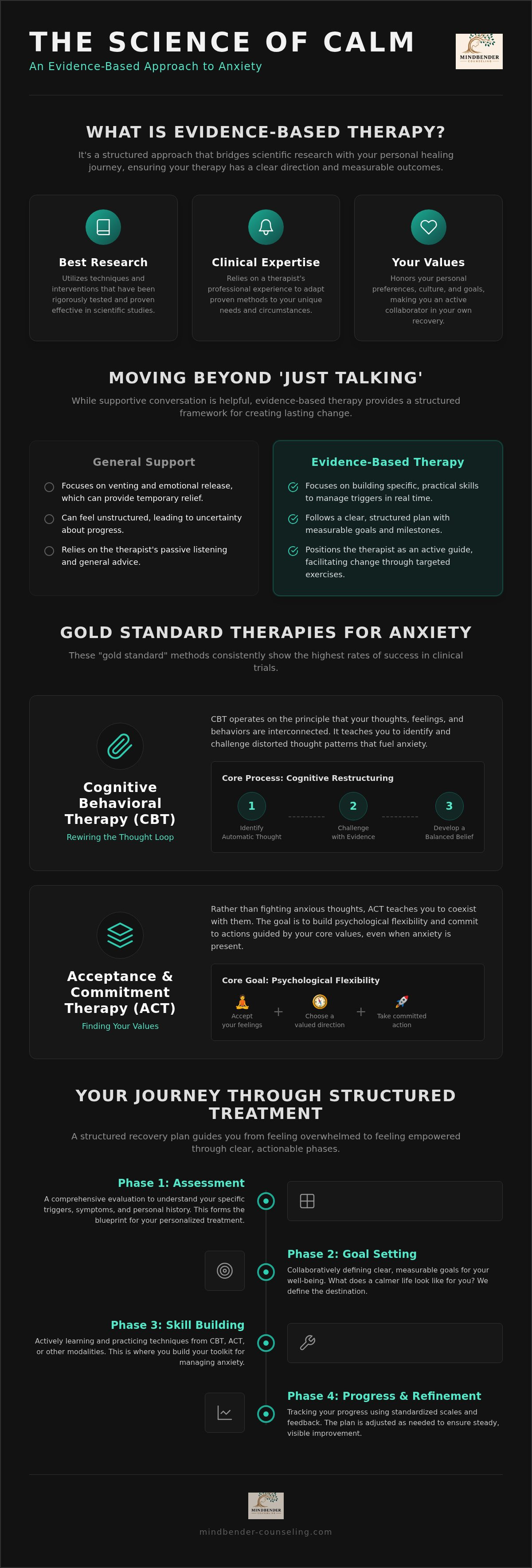
What to Expect: Your Journey Through Structured Anxiety Treatment
Evidence-based therapy for anxiety is a journey with a clear beginning, middle, and end. Unlike open-ended talk therapy, this structured approach moves through four distinct phases designed to build your confidence and resilience. It starts with a Comprehensive Assessment, where you and your therapist identify the specific triggers that spark your internal alarm system. Next, you move into Goal Setting, defining exactly what success looks like for your life in concrete, measurable terms. The third phase is Skill Acquisition, where you learn the mental and physical tools needed to manage symptoms. Finally, Generalization ensures you can apply these new skills to real-world stressors in Arizona or Texas, from high-pressure work environments to complex social situations.
The First Session: Building the Foundation
Your first meeting is about more than just paperwork. During the intake, a behavioral health consultant will ask thoughtful questions about the history of your symptoms and how they impact your daily functioning. You can prepare for your first therapeutic appointment by noting your most frequent triggers or specific physical sensations ahead of time. This initial meeting establishes a sense of safety and professional trust from day one. You'll leave the first appointment with a clear understanding of the path forward, replacing the fear of the unknown with a structured plan for recovery.
The 'Homework' Factor: Growth Between Sessions
Growth happens most rapidly when you apply what you learn between your weekly appointments. Evidence-based therapy for anxiety often involves practice outside the therapy room because consistent repetition helps rewire the brain's response to fear. This might include simple anxiety-tracking logs to spot patterns or five-minute mindfulness exercises to stay grounded during a busy day. These small, daily actions accelerate the healing process and turn clinical concepts into lived habits. Consistent practice ensures that the progress you make in the office translates into a calmer, more balanced life at home. If you're ready to start building these practical tools, you can explore our Individual Counseling Services to find a guide for your journey.
Finding Your Anchor: Evidence-Based Counseling at Mindbender
At Mindbender Counseling, we believe that the most effective healing happens when scientific rigor meets deep human connection. We're committed to providing gold-standard, research-backed care that removes the guesswork from your recovery. Our approach to evidence-based therapy for anxiety is designed to be a sturdy anchor in the midst of internal storms, giving you the stability needed to move forward with confidence. We don't just offer a place to talk; we offer a place to grow, using methods that are proven to build a solid internal foundation.
We've intentionally designed our practice to avoid the coldness of a typical clinical setting. Instead, we blend our professional expertise with a warm, compassionate atmosphere that makes you feel seen and understood. Whether you're seeking individual counseling sessions or looking for support as a couple, our interventions are personalized to your unique life story. This balance of authoritative resource and supportive partner ensures that you receive the highest level of care without feeling like just another case number. You deserve a therapeutic experience that respects your intelligence and honors your emotional journey.
Local Care for Arizona and Texas Residents
Geography plays a significant role in the stressors we face every day. Our licensed professionals in Arizona and Texas understand the specific pressures of the region, from the high-stakes environment of Phoenix work stress to the fast-paced lifestyle of the Dallas-Fort Worth area. We specialize in supporting professionals who need a structured plan to manage their anxiety while maintaining their careers and relationships. To ensure that high-quality care is always within reach, we offer telehealth options that bring our evidence-based therapy for anxiety directly to the comfort and privacy of your home. This flexibility allows you to prioritize your mental health without the added friction of a long commute, making it easier to integrate healing into your busy schedule.
Your Path Forward Starts Here
Your journey toward a more resilient and balanced life doesn't have to be a mystery. We've seen firsthand how a structured, research-backed approach can transform overwhelming worry into a sense of calm assurance. Recovery is a methodical process, and we're here to facilitate every step of your evolution. If you're tired of feeling like your anxiety is untreatable, it's time to try a method that is rooted in proof and delivered with genuine care. We invite you to take that first step toward the peace of mind you deserve. Our team is ready to provide the unwavering support and expert guidance you need to reclaim your calm. Schedule your evidence-based therapy session today and begin the next chapter of your healing journey.
Reclaim Your Calm with a Proven Strategy
Embracing a research-backed approach means you no longer have to guess if your time in therapy is working. By choosing evidence-based therapy for anxiety, you move from passive talk to active transformation. You've discovered how structured modalities provide the specific tools needed to rewire your brain's response to fear. These methods work because they focus on measurable emotional growth rather than just temporary relief.
Our compassionate, professional guides in Arizona and Texas are here to help you navigate this journey with specialized expertise in individual and couples counseling. We offer a structured approach that respects your time and honors your personal values, providing a sturdy anchor for your long-term stability. You don't have to carry the weight of persistent worry alone.
Take the first step toward lasting relief; schedule your evidence-based therapy session at Mindbender Counseling today. Your path to a more resilient and balanced life is closer than it feels. We look forward to supporting your evolution.
Frequently Asked Questions
What is the most effective evidence-based therapy for anxiety?
Cognitive Behavioral Therapy (CBT) is widely recognized as the most effective evidence-based therapy for anxiety due to its extensive research support. It focuses on identifying and changing the thought patterns that fuel fear. Other proven modalities like Acceptance and Commitment Therapy (ACT) also show high success rates by building psychological flexibility. The best choice often depends on your specific symptoms, which is why a personalized assessment is a vital first step in your recovery.
How long does evidence-based therapy for anxiety usually take?
The duration of treatment varies based on individual needs, but many people see measurable progress within 12 to 20 weekly sessions. Evidence-based therapy for anxiety is designed to be structured and time-limited rather than open-ended. Some individuals may require fewer sessions to manage specific phobias, while others with complex anxiety might benefit from longer support. Your therapist will work with you to set clear milestones, ensuring your journey remains focused on your specific goals.
Is evidence-based therapy better than medication for anxiety?
Research indicates that therapy often provides more sustainable, long-term relief compared to medication alone because it teaches you active coping skills. While medication can manage symptoms, evidence-based therapy for anxiety addresses the underlying cognitive and behavioral causes. Many people find success using a combination of both approaches. It's important to consult with a medical professional for medication needs, as Mindbender Counseling focuses exclusively on providing professional individual and couples counseling services.
Can I do evidence-based therapy for anxiety online?
Yes, you can effectively participate in therapy through secure telehealth platforms. Studies have shown that online sessions produce outcomes comparable to in-person care for most anxiety disorders. Mindbender Counseling offers convenient telehealth options for residents throughout Arizona and Texas, allowing you to access high-quality care from your home. This flexibility reduces barriers like travel time or scheduling conflicts, making it easier to maintain the consistency required for lasting emotional growth and stability.
What happens if I don't feel like the 'proven' method is working for me?
If you feel like your progress has stalled, it's essential to share this feedback with your therapist immediately. Evidence-based practice relies on real-time data and your personal values to succeed. Your therapist can adjust the specific techniques used or explore a different modality, such as shifting from CBT to ACT. Healing is a collaborative process, and your therapist acts as a professional facilitator to ensure the structured plan remains relevant to your unique journey.
How do I know if my therapist is actually using evidence-based techniques?
You can identify evidence-based care by the presence of a clear structure and measurable goals in your sessions. A therapist using these methods will often ask you to complete brief assessments to track your progress over time. Don't hesitate to ask about their specific training in modalities like CBT or ACT during your initial consultation. Professional guides who use these techniques will be able to explain the "why" behind every exercise they suggest for your recovery.
Does insurance typically cover evidence-based treatments like CBT?
Most insurance providers cover evidence-based treatments because they are recognized as medically necessary and clinically effective interventions. Since methods like CBT have a high success rate and a clear structure, they are often the preferred choice for insurance-reimbursed mental health services. We recommend contacting your insurance provider directly to verify your specific benefits and coverage levels. This ensures you have a clear understanding of your financial investment before you begin your therapeutic journey toward well-being.
Is evidence-based therapy appropriate for children with anxiety?
Evidence-based approaches are highly effective for children and adolescents when adapted to their developmental stage. Techniques like CBT are frequently used to help younger individuals identify their fears and build resilience through age-appropriate exercises. While Mindbender Counseling focuses on individual and couples counseling for adults, these research-backed methods remain the gold standard for treating anxiety across all age groups. Using proven techniques early in life can help establish a solid internal foundation for long-term health.


