

What if the most effective way to strengthen your relationship isn't to wait until it feels broken, but to treat your partnership like a high-level skill that requires professional coaching to master? When you're considering the potential benefits of couples counseling, it's often because you're tired of feeling unheard during arguments or fearing that the distance between you has become impossible to bridge. You might even feel a sense of anxiety about a therapist taking sides, making the prospect of seeking help feel more daunting than the conflict itself.
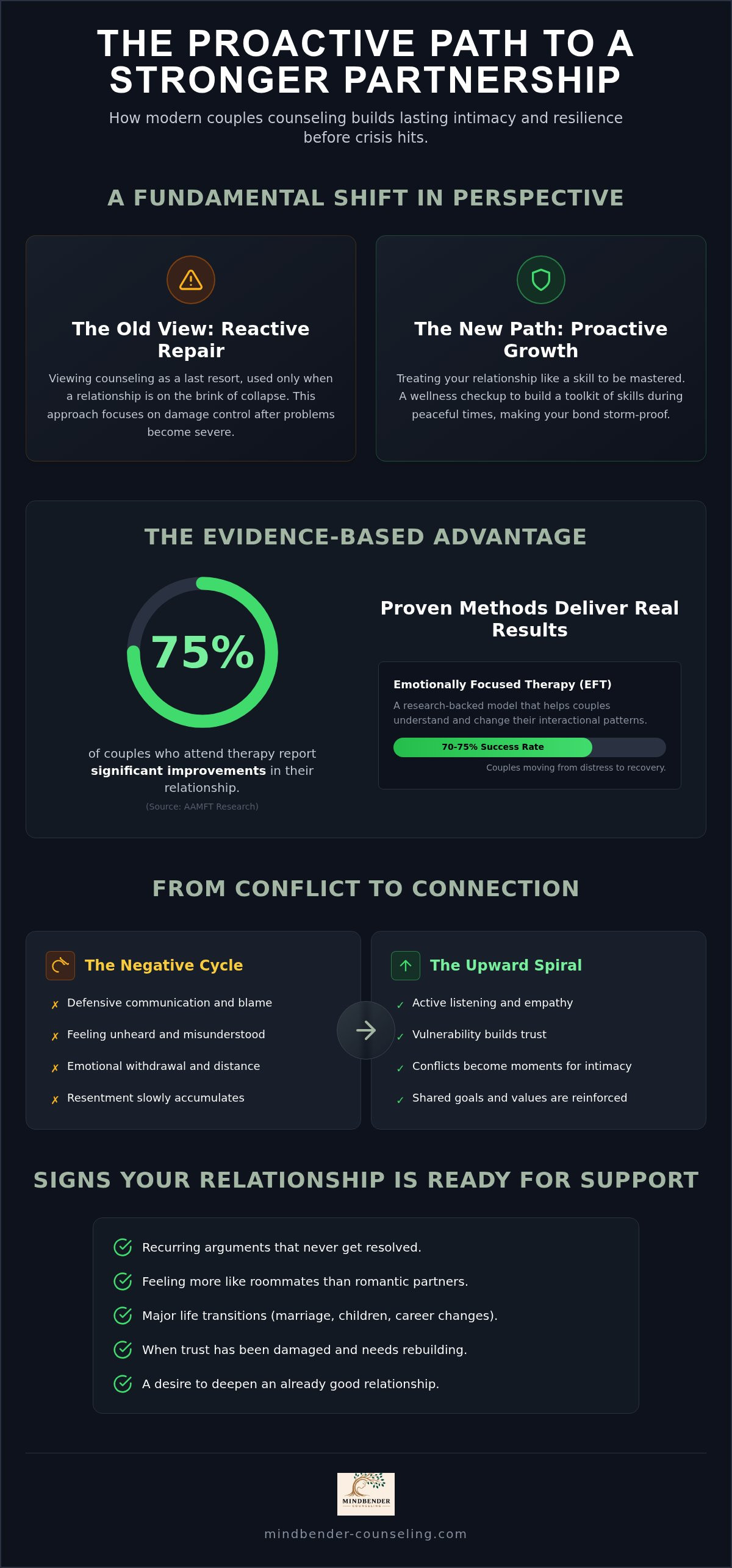
The reality is that professional support extends far beyond simple conflict resolution. Research from the American Association for Marriage and Family Therapy shows that over 75% of couples who attend therapy report significant improvements in their relationship. In this article, you'll discover how professional couples therapy builds lasting intimacy, improves communication, and provides a research-backed framework for a thriving partnership. We'll explore how evidence-based interventions can restore trust and provide you with practical tools to de-escalate arguments. By moving toward a clearer understanding of your partner's needs, you can transform your relationship from a source of stress into a sturdy anchor for your life.
Key Takeaways
- View counseling as a proactive investment in your relationship's health rather than a final attempt to save a failing partnership.
- Explore the core benefits of couples counseling through evidence-based methods that move beyond simple venting to create structured, lasting emotional connections.
- Learn to replace defensive communication with active listening and practical tools that turn recurring conflicts into moments of genuine intimacy.
- Recognize the subtle signs that your relationship is ready for support, allowing you to navigate life's major transitions with a shared sense of purpose.
- Understand how a personalized therapeutic environment helps both partners feel secure and supported throughout the growth process.
Beyond Crisis Management: Why Couples Counseling is a Proactive Investment
Many people view therapy as a last resort, something reserved for relationships on the brink of collapse. This perspective misses the primary benefits of couples counseling, which are rooted in growth rather than just damage control. Think of it as a collaborative process designed to enhance your relational health long before a crisis hits. Instead of waiting for a fire to start, you're learning how to fireproof your home. This shift in perspective transforms the therapist's office from an emergency room into a training ground for a more fulfilling life together.
For a comprehensive overview of couples therapy, one can see it has evolved from simple mediation into a sophisticated field of psychological growth. Challenging the stigma that therapy equals failure is the first step toward a more resilient partnership. When you shift your mindset from "relational repair" to "relational maintenance," you prioritize the long-term vitality of your bond. Early intervention prevents the slow accumulation of resentment, which is often the silent killer of intimacy. By addressing minor irritations early, they don't have the chance to harden into permanent bitterness, allowing you to remain allies rather than adversaries.
The Shift from Reactive to Proactive Care
Consider your partnership's emotional health in the same way you view physical fitness. You don't wait for a heart attack to start exercising; you go to the gym to stay strong. A proactive approach to therapy acts like a wellness checkup for your relationship. It allows you to identify small cracks in communication before they become deep fractures. By building a toolkit of resolution skills during peaceful times, you ensure that you're prepared for the inevitable stressors of life. Proactive counseling is the difference between surviving a storm and building a house that is storm-proof.
Strengthening the Foundational Bond
At its core, a romantic partnership relies on a deep, underlying friendship. One of the most significant benefits of couples counseling is the way it reinforces this core bond. You'll work together to define shared goals and align your values, creating a sense of "we" that can withstand external pressures. This process requires vulnerability and honesty, which is why private therapy offers such a valuable, discreet space for this evolution. In this secure environment, you can explore your needs without judgment, ensuring that your foundation remains steady as you grow both individually and as a couple.
The Evidence-Based Advantage: How Research-Backed Methods Rewire Connection
At Mindbender Counseling, we prioritize evidence-based therapy because your relationship deserves more than just an opinion. One of the most profound benefits of couples counseling is the access it provides to methods that have been rigorously tested and proven to work. Unlike casual advice or unstructured venting, these research-backed interventions follow a predictable path toward healing. They transform the therapy room from a place of circular arguments into a structured environment where real change happens. When you understand the science of connection, you stop guessing how to fix things and start applying tools that actually rewire how you relate to one another.
This scientific approach is particularly helpful when exploring adult attachment styles. Many couples find themselves stuck in repetitive cycles of pursuit and withdrawal without knowing why. By identifying your specific attachment patterns, you gain a compassionate lens through which to view your partner's reactions. This understanding reduces blame and fosters a sense of shared curiosity about your relationship's unique rhythm. Research shows that models like Emotionally Focused Therapy (EFT) help 70-75% of couples move from distress to recovery, providing a reliable framework for lasting stability.
Understanding Behavioral Health in Relationships
Applying therapy behavioral therapy principles to your partnership allows you to look at the specific actions and reactions that drive your daily interactions. Cognitive reframing is a key part of this process. It helps you shift from seeing a partner’s silence as a form of rejection to seeing it as a reflexive need for safety. These evidence-based tools are essential for breaking generational cycles of dysfunction. You aren't just improving your current bond; you're building a new legacy for how your family handles conflict and connection.
The Role of the Neutral Expert
An impartial third party is essential for de-escalating high-conflict cycles that feel impossible to navigate alone. Your therapist acts as a neutral guide who uses data-driven assessments to identify your relationship's specific "choke points." Rather than taking sides, they remain objective and supportive of the relationship itself as the primary focus. This objectivity creates a safe space where both partners can feel truly seen and heard without fear of judgment. If you're ready to experience these shifts firsthand, you can explore our evidence-based therapy options to begin your journey toward a more stable partnership.
Mastering Communication: Turning Conflict into Emotional Intimacy
One of the most practical benefits of couples counseling is the fundamental shift from "talking at" your partner to truly "listening to" them. In the heat of an argument, it's easy to focus on your next rebuttal rather than your partner's perspective. Therapy provides a structured environment where you can slow down and practice active listening. You'll learn to use "I" statements, which allow you to express your needs without triggering your partner's defensiveness. This simple change can turn a potential blowup into a productive conversation about your feelings and needs.
Counseling functions as a safe container for these difficult dialogues. Within this space, you can address the "Four Horsemen"—criticism, contempt, defensiveness, and stonewalling—that often signal relational distress. Your therapist helps you identify these triggers in real-time, offering immediate alternatives that foster connection rather than distance. By mastering these skills in a controlled setting, you build the confidence to handle high-stakes emotions at home. You'll find that you no longer fear the conversation spiraling out of control because you have a roadmap to follow.
Breaking the Cycle of Misunderstanding
Many couples get trapped in cycles of criticism and stonewalling, where one partner pushes for answers while the other retreats into silence. Therapy helps you identify the "feeling under the feeling." For example, an argument about household chores might actually be a conversation about feeling undervalued or alone. When you validate your partner's underlying emotion, you lower their relational defensiveness. This validation doesn't mean you always agree with their point of view. It means you acknowledge their experience as real and important, which is the first step toward a resolution.
Developing a Shared Language
Every couple is unique, which means you need a communication style that fits your specific dynamic. Developing this shared language takes time and patience. Sometimes, individual struggles can impact your ability to engage fully with your partner. For instance, seeking individual counseling for anxiety can provide you with the personal grounding needed to stay present during tough relationship talks. The healthy conflict resolution skills you develop in therapy don't just stay within your partnership. They often spill over into your professional life and other personal relationships, making you a more effective and empathetic communicator in every area of your life.
When to Begin: Signs Your Relationship is Ready for Support
Recognizing the right time to seek help is often the most difficult part of the journey. Many couples wait until they feel they are at a breaking point, but one of the greatest benefits of couples counseling is its effectiveness as an early intervention. You don't need to be in a state of emergency to justify professional support. In fact, addressing small patterns of "roommate syndrome" or repetitive, circular arguments now can prevent significant distress later. When you notice that your conversations have become purely transactional, focusing only on schedules and household logistics, it's a clear indicator that your emotional connection needs fresh attention.
External stressors often bleed into the internal relationship, creating tension that feels personal even when it isn't. Major life transitions, such as welcoming a new child or navigating a significant career change, can strain even the sturdiest foundations. Waiting until things are "bad enough" is a common mistake that often allows resentment to take deep root. Seeking support during these transitions provides you with a neutral space to align your goals and expectations before the pressure becomes overwhelming. This proactive approach ensures that your relationship remains a source of strength rather than an additional burden during times of change.
Identifying Subtle Relational Erosion
Emotional withdrawal is often quieter than a loud argument, but it can be just as damaging. You might notice a lack of curiosity about your partner's day or a tendency to keep your thoughts to yourself to avoid potential conflict. This erosion usually stems from unresolved minor conflicts that have piled up over time, creating a barrier to genuine intimacy. When the silence in a room feels heavy, it is often a sign that a professional facilitator is needed. Therapy helps you clear away this emotional debris, restoring the natural flow of connection and interest in one another.
Navigating Modern Stressors in Arizona and Texas
Living in high-growth areas like Arizona and Texas presents unique challenges for modern couples. High-pressure careers often demand more time than we have to give, leaving little energy for our partners at the end of the day. Resources like counseling for work stress Arizona highlight how professional pressures can impact your overall emotional resilience. Beyond the office, local environmental factors like long commutes in sprawling cities or the physical toll of extreme heat stress can reduce your patience and affect your mood. These external pressures aren't your fault, but they do require specific strategies to manage together as a team.
If you're noticing these signs in your own partnership, you don't have to navigate them alone. You can schedule a session for couples counseling today to begin building a more resilient bond.
The Mindbender Approach: Personalized Couples Counseling in AZ & TX
Mindbender Counseling offers a sanctuary that is both clinical in its precision and deeply human in its delivery. We recognize that the benefits of couples counseling are most profound when the work feels relevant to your actual life. For professionals in the tech hubs of Austin or the corporate corridors of Phoenix, the pressure of balancing high-performance careers with a thriving home life is a specific, often heavy burden. Our approach respects these regional realities, ensuring your sessions are tailored to the cultural and professional landscape you navigate every day. We provide a calm, compassionate environment where you can lower your defenses and focus on the restoration of balance.
Our methodology emphasizes the integration of individual growth within the context of the partnership. We believe that a resilient relationship is built by two individuals who are also committed to their own emotional stability. By fostering this dual growth, we help you transition from individual healing to relational strength. For busy locals in Texas and Arizona, logistical hurdles like long commutes or demanding schedules shouldn't stand in the way of your progress. Learning how online couples counseling works can provide the flexibility you need to access evidence-based care from the comfort of your own home.
A Path Toward Restored Balance
Our commitment to evidence-based stability ensures that your time in therapy produces tangible, long-term outcomes. We focus on creating a sturdy anchor for both partners, providing a sense of security that allows for honest exploration without the fear of judgment. This organized approach reduces the friction often associated with seeking help and creates a predictable environment for change. Taking the first step toward a transformative therapeutic appointment is a gentle invitation to prioritize your partnership. It signals a move away from repetitive cycles and toward a future where your relationship is a source of steady, unwavering support.
Steadfast Support for Your Journey
The practitioners at Mindbender act as wise and compassionate guides who treat every couple with fresh attention and care. Our methodology is structured to move you steadily from an initial acknowledgment of your needs to a clear, actionable path forward. We don't just facilitate conversation; we act as a catalyst for movement and personal evolution. You'll discover that the benefits of couples counseling extend far beyond the sessions themselves, fostering a long-term emotional growth potential that changes how you view yourself and your partner. This process helps you build a solid internal foundation that will serve your relationship for years to come.
Investing in Your Shared Evolution
Choosing to prioritize your partnership is a profound act of courage and foresight. We've explored how moving from reactive damage control to proactive relational maintenance can transform your daily interactions. By utilizing evidence-based methods and mastering the art of active listening, you aren't just resolving current friction; you're building a foundation that can withstand the stressors of modern life. The long-term benefits of couples counseling extend into every corner of your shared journey, providing a sense of security that allows both partners to flourish individually and together.
At Mindbender Counseling, we provide a safe, neutral space for transformative healing. Our compassionate, expert guidance is specifically tailored for Arizona and Texas couples navigating high-pressure environments. You don't have to wait for a crisis to experience the growth your relationship deserves. Begin Your Journey Toward a Stronger Connection with Mindbender Counseling and discover the stability that comes from research-backed care. Your path toward a more vibrant, connected future is ready whenever you are.
Frequently Asked Questions
How long does couples counseling typically take to show results?
Most couples begin to see meaningful shifts in their dynamic within 8 to 20 sessions. The exact duration depends on your specific goals and the depth of the challenges you are addressing together. While some partners feel an immediate sense of relief after the first few visits, building a sturdy internal foundation for long-term stability requires a steady, methodical approach. Your therapist will work with you to create a personalized plan that respects your unique pace.
What if my partner is reluctant to attend counseling with me?
It is common for one partner to feel anxious about a therapist taking sides or focusing solely on blame. You might suggest attending just one session together to experience our neutral, compassionate environment firsthand. This "gentle invitation" often lowers defenses and allows your partner to see the therapist as a supportive facilitator for the relationship. If they still aren't ready, our individual counseling services can help you navigate your own responses within the partnership.
Can couples therapy help if infidelity has occurred?
Yes, evidence-based therapy is highly effective for restoring trust and intimacy after a breach of fidelity. We utilize structured methods like Emotionally Focused Therapy (EFT), which research shows helps 70 to 75% of couples move from distress to recovery. These sessions provide a safe container to process the pain and understand the underlying vulnerabilities that led to the crisis. The goal is to move from acknowledgment of the hurt toward a clear path for transformative healing.
Is couples counseling covered by insurance in Arizona or Texas?
As of August 2026, most health insurance plans in Arizona and Texas do not cover therapy if the primary focus is "relationship issues" alone. Coverage is typically available only if the counseling is deemed a medically necessary part of a treatment plan for a diagnosed mental health condition. We recommend checking with your provider about their specific policies for out-of-network services. Understanding these benefits of couples counseling often involves viewing the sessions as a proactive investment in your long-term well-being.
What is the difference between marriage counseling and couples therapy?
While the terms are often used interchangeably, couples counseling is a broader category that includes any two people in a committed partnership. Marriage counseling specifically focuses on the legal and social framework of a marital bond. Both services at Mindbender Counseling utilize research-backed interventions to foster emotional growth and stability. Whether you are dating, engaged, or married, the core focus remains on building a resilient and healthy connection through personalized, expert guidance.
What happens during the very first session of couples counseling?
Your first session is a structured opportunity for your therapist to understand your relationship's history and your current challenges. You'll discuss your shared goals and identify the specific "choke points" that led you to seek support. This meeting is designed to lower your defenses and build immediate trust with your guide. It sets the stage for a supportive methodology that prioritizes the safety and reliability of your therapeutic environment, ensuring you feel seen and heard from the start.
Can we attend sessions virtually if we have a busy schedule?
Yes, we offer virtual sessions to accommodate the busy professional schedules and long commutes common in Arizona and Texas. Online therapy provides the same evidence-based interventions as in-person visits while offering greater flexibility for your lifestyle. This format ensures that you can prioritize your relational health without the added stress of travel or childcare logistics. It is an innovator's path toward personal evolution that fits seamlessly into your modern, high-pressure landscape.
How do we know if we have found the right therapist for our relationship?
Finding the right fit involves looking for a professional who remains objective and supportive of the relationship as a whole. You should feel that your therapist is an authoritative resource who also treats you with fresh attention and care. Look for practitioners who use proven, reliable methods rather than just offering casual advice. A wise guide will help you feel secure while providing a clear, low-friction path toward your desired outcomes and restored balance.


