

What if the most effective way to heal your heart wasn't just about talking, but about following a roadmap already proven to work for millions of others? It's common to feel a sense of hesitation when you're looking for help. You might worry that therapy will be a series of endless, aimless conversations that never quite touch the root of your anxiety or relationship struggles. You deserve to know that your emotional energy is being invested in a process that actually produces results.
This is where understanding the benefits of evidence-based therapy becomes essential for your journey toward well-being. By choosing care rooted in clinical research, you're opting for a path that's often faster, safer, and more personalized to your specific needs. We'll demystify complex acronyms like CBT and DBT while showing you how research-backed methods provide the steady anchor you need to regain your balance. Discover how these proven scientific methods offer a clear and confident way forward for individuals and couples seeking lasting relief in 2026.
Key Takeaways
- Learn how the "Three-Legged Stool" model balances clinical expertise, scientific research, and your personal values for a more effective therapeutic experience.
- Explore the primary benefits of evidence-based therapy, which include measurable progress and a higher standard of ethical, reliable care.
- Understand how skilled providers adapt proven scientific protocols to fit your individual personality rather than following a rigid, one-size-fits-all script.
- Gain a clear overview of common modalities like CBT and DBT to help you feel more confident in choosing the right approach for your specific goals.
- Find out how to connect with licensed experts in Arizona and Texas who specialize in research-backed individual and couples counseling.
What is Evidence-Based Therapy (EBT)? Beyond the Clinical Jargon
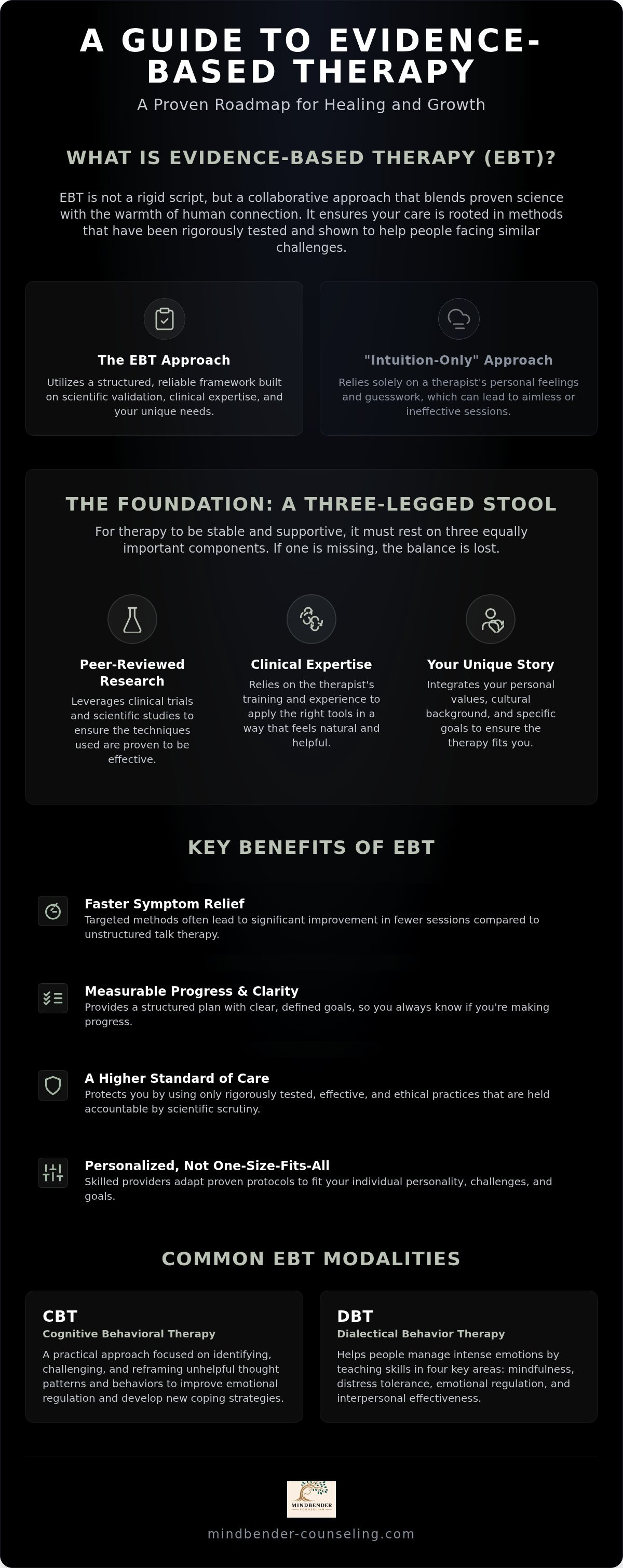
When you're searching for support, the term "evidence-based" can feel a bit clinical or detached. You might worry that your unique story will be reduced to a set of data points. However, the true benefits of evidence-based therapy lie in its ability to blend hard science with the warmth of human connection. At its core, EBT is a collaborative approach that ensures your care is rooted in methods that have been proven to help people facing similar challenges. It's a commitment to your progress that moves beyond guesswork.
To understand the foundation of this care, it's helpful to look at What is Evidence-Based Practice? and how it translates to the therapy room. Unlike "intuition-only" approaches where a therapist relies solely on their personal feelings, EBT provides a structured, reliable framework. It’s a living process; it doesn't stay stuck in old textbooks. Instead, it evolves constantly as new research emerges, ensuring you always receive the most effective interventions available today.
The Three-Legged Stool: How Science Meets Your Story
Think of evidence-based therapy as a sturdy three-legged stool. If any leg is missing, the support becomes unstable. This model allows us to honor both the science and the person in front of us:
- The First Leg: Peer-Reviewed Research. This involves looking at the latest clinical trials and scientific studies to see which techniques consistently help people find relief from symptoms like anxiety or depression.
- The Second Leg: Clinical Expertise. This is your therapist’s professional training and years of experience. It’s their ability to recognize patterns and know how to apply specific tools in a way that feels natural and helpful.
- The Third Leg: Your Unique Story. This is the most important part. It includes your cultural background, your personal values, and your specific goals for the future.
Why "Evidence-Based" is Not a Buzzword
In the mental health field, accountability is vital. You're investing your time and vulnerability into this process, so you deserve to know that your therapist is using tools that actually work. A method only earns the "evidence-based" label after undergoing rigorous testing and scrutiny by independent researchers. This high standard protects you from ineffective or outdated practices. It ensures that your sessions are focused on your growth rather than aimless conversation.
Ultimately, EBT is a professional promise to use the best available tools to help you build a more stable and fulfilling life. One of the greatest benefits of evidence-based therapy is the peace of mind it provides; you can trust that your path to healing is paved with proven results rather than just good intentions.
The Top 5 Benefits of Evidence-Based Therapy for Your Growth
Deciding to start therapy is a courageous act of self-care. It's natural to want reassurance that your investment of time and vulnerability will lead to real change. One of the most significant benefits of evidence-based therapy is the confidence it provides. You aren't just hoping for the best; you're using a framework that has been tested and refined to ensure it actually works. This approach offers a clear sense of direction, helping you move from feeling overwhelmed to feeling empowered.
Faster Symptom Relief and Long-Term Recovery
Time is a precious resource. You want to feel better as soon as possible. Research consistently shows that evidence-based methods often lead to significant improvement in fewer sessions than unstructured talk therapy. By targeting the specific psychological mechanisms that keep you stuck, these techniques help you find relief more quickly. For example, if you're struggling with persistent worry, seeking individual counseling for anxiety through proven modalities like CBT can provide immediate coping strategies while addressing the underlying thought patterns. This focused approach doesn't just patch over symptoms; it helps build a foundation for lasting recovery.
Clarity is a powerful antidote to the confusion often caused by emotional distress. EBT provides a structured treatment plan with measurable goals. You won't have to wonder if you're making progress because you and your therapist will define what success looks like for you. Additionally, this method empowers you by providing concrete tools for your daily life. You'll learn specific skills; such as emotional regulation techniques or communication strategies; that you can use long after your sessions have ended. These aren't just suggestions. They are practical interventions backed by extensive research on the efficacy of EBT that restore a sense of balance to your routine.
Ethical Safety and Predictable Outcomes
Your safety is the highest priority in any therapeutic relationship. Using proven methods is the most ethical way to practice counseling because it prioritizes your well-being over a therapist’s personal preference. It significantly reduces the risk of ineffective or even harmful interventions that can occur in less structured environments. When a therapist follows a research-backed protocol, they're following a roadmap that has been scrutinized for safety and effectiveness.
"Evidence-based care ensures that your vulnerability is met with a methodology that has already helped thousands before you."
This predictability builds a deep sense of trust and security. You can relax into the process, knowing that the path you're on is well-traveled and reliable. If you're ready to start your journey with a supportive partner, consider exploring evidence-based therapy designed to meet your specific needs in Arizona or Texas.
Personalization vs. Protocol: Addressing Common EBT Myths
A common concern people have when they hear about "protocols" is that their sessions will feel robotic or scripted. You might worry that your counselor will spend more time looking at a manual than looking at you. This fear often prevents people from experiencing the true benefits of evidence-based therapy. In reality, a skilled therapist doesn't use a protocol as a rigid script. Instead, they use it as a reliable map. They know the destination, but they let you choose the pace and the scenery along the way.
Is Evidence-Based Therapy Too Rigid?
Let's debunk the myth that EBT is "manualized" to the point of being cold. Protocols are frameworks, not handcuffs. Think of them like the foundation of a house; they provide the strength and stability needed to build something beautiful and unique on top. By having a proven structure, your therapist can actually be more creative and present. They don't have to guess what might work because they have a solid starting point. For a deeper look at how these methods work in practice, you can explore our guide on understanding therapy and behavioral therapy. This foundation allows for a more focused conversation where your specific needs remain the priority.
The Heart of the Matter: Your Relationship with Your Counselor
Science and soul aren't mutually exclusive. Research actually shows that the bond between you and your therapist, often called the therapeutic alliance, is one of the most vital components of successful treatment. In fact, this relationship is considered a key piece of the "evidence" itself. At Mindbender Counseling, we prioritize this connection for our clients in Arizona and Texas. We understand that even the most advanced scientific tool won't work if you don't feel seen, heard, and safe.
One of the primary benefits of evidence-based therapy is that it honors your individuality within a proven system. Your therapist adapts the science to fit your story, not the other way around. This blend of clinical excellence and compassionate care creates a space where you can feel confident in the process while feeling fully supported as a person. It’s about building a solid internal foundation that allows you to move forward with clarity and resilience.
Common Evidence-Based Modalities You Should Know
Understanding the specific tools your therapist uses can help you feel more in control of your healing process. While we've already explored the broad benefits of evidence-based therapy, it's helpful to see how these methods actually look in a real session. These aren't just abstract theories; they're practical strategies designed to help you navigate life's challenges with more grace and stability. In an EBT session, you might notice a more structured flow. Your therapist will likely check in on your goals and offer specific exercises to practice between meetings. It feels less like a random chat and more like a focused workshop for your emotional health.
CBT, DBT, and Beyond: Finding Your Fit
Cognitive Behavioral Therapy (CBT) is often called the gold standard because of its extensive research support. In a CBT session, you'll work with your counselor to identify thought patterns that might be causing you distress. By changing how you think about a situation, you can often change how you feel and react to it. It’s a collaborative, active process that gives you immediate tools to manage your daily life.
Dialectical Behavior Therapy (DBT) focuses on the balance between accepting yourself as you are and working toward meaningful change. You'll learn specific skills for mindfulness and emotional regulation, which are especially helpful for staying grounded during intense moments. For those seeking couples counseling, methods like the Gottman Method or Emotionally Focused Therapy (EFT) provide a research-backed roadmap for relationship health. Instead of just venting about arguments, you'll learn how to rebuild trust using proven relational science. These modalities are frequently utilized in private therapy to ensure every individual receives the highest standard of personalized care.
Questions to Ask a Potential Evidence-Based Therapist
Choosing a provider is an important decision. Don't hesitate to ask questions to ensure their approach aligns with your needs. A compassionate guide will welcome your curiosity and provide clear, honest answers. One of the greatest benefits of evidence-based therapy is the transparency it offers you as a client. Here are a few ways to start that conversation during your first meeting:
- "What specific research-backed methods do you use for my particular concern?"
- "How do you measure progress and success throughout our sessions?"
- "How do you incorporate my personal values and cultural background into the treatment plan?"
If you're ready to find a path that truly works for your unique situation, explore our evidence-based therapy options in Arizona and Texas today.
Finding Compassionate EBT in Arizona and Texas
At Mindbender Counseling, we believe that the best care happens at the intersection of clinical precision and genuine empathy. We choose the evidence-based path because it honors your investment of time and vulnerability. You aren't just another appointment; you're an individual seeking a restoration of balance and a clearer sense of self. By focusing on the benefits of evidence-based therapy, we provide a sturdy anchor for your growth while ensuring that every session is tailored to your specific life circumstances. Our licensed experts across Arizona and Texas are committed to delivering care that is as compassionate as it is effective.
Personalized Care for Professionals and Families
Arizona's professionals often face unique pressures, from the high-stakes corporate environments in Phoenix to the challenges of maintaining work-life harmony in a rapidly evolving economy. Our approach acknowledges these stressors directly, providing a calm space to process and pivot. If you find yourself overwhelmed by professional demands, exploring wellness therapy resources can help you understand how specialized support targets the root causes of burnout and chronic stress. Whether you're a parent in Scottsdale or a professional in Houston or Dallas, we provide the individualized attention needed to foster resilience and emotional strength.
Taking Your First Step Toward Lasting Change
Moving from learning about therapy to actually starting it can feel like a significant hurdle. We've designed our intake process to be as low-friction and supportive as possible to reduce the anxiety often associated with seeking help. It begins with a gentle invitation to share your story, followed by a collaborative matching process with a therapist who aligns with your values. You'll move through a methodical, steady process that respects your pace and honors your boundaries. One of the quiet benefits of evidence-based therapy is the predictability it brings to this early stage; you'll know exactly what to expect as we build your personalized roadmap together.
Reaching out for help is a profound act of courage. It marks the moment you decide that your well-being is worth the effort and that positive change is possible. Our team acts as a professional facilitator for your journey, providing the steady, unwavering support you need to navigate personal or relational transitions. We don't just offer sessions; we offer a partnership in your evolution toward a more stable and fulfilling life. You don't have to carry the weight of anxiety or relationship conflict alone. Let’s work together to construct a solid foundation for the future you deserve.
Your Path to Lasting Emotional Resilience
Choosing a therapeutic approach is a significant step toward the life you want to lead. You've discovered how the benefits of evidence-based therapy provide a structured yet flexible foundation for your growth; ensuring that your time is spent on methods that truly work. These research-backed modalities aren't rigid scripts. Instead, they are personalized roadmaps that respect your unique story while offering the safety of proven results. Whether you are navigating individual work stress or seeking to repair a partnership, you deserve a process that is both efficient and deeply supportive.
At Mindbender Counseling, we combine clinical excellence with quiet confidence to help you build a solid internal foundation. Our licensed specialists in Arizona and Texas are ready to walk beside you as you move toward a more balanced and fulfilling future. Ready to experience the benefits of evidence-based care? Schedule your consultation with Mindbender Counseling today. You already possess the courage to seek a better tomorrow, and we are here to act as a steady anchor for your journey toward well-being.
Frequently Asked Questions
Is evidence-based therapy more effective than regular talk therapy?
Yes, evidence-based therapy is designed to be more targeted and often yields more consistent results than traditional, unstructured talk therapy. While every journey is unique, research indicates that EBT methods lead to more reliable improvements because they use techniques specifically tested for certain conditions. By focusing on proven strategies; you aren't just talking about your problems. You're actively working through them with tools that have a high success rate for others.
How long does it typically take to see results with EBT?
Many clients begin to feel a shift within the first few sessions, though the exact timeline for results depends on your unique goals. Because EBT is goal-oriented and structured, it often provides a more efficient path to relief compared to open-ended approaches. You and your therapist will set measurable milestones to track your progress. This transparency allows you to see the tangible benefits of evidence-based therapy as you develop new skills.
Will my insurance cover evidence-based therapy sessions?
Most insurance providers recognize and cover evidence-based therapy because it meets high clinical standards for effectiveness. However, coverage details depend on your specific plan and provider. It's always a good idea to contact your insurance company directly to verify your benefits for behavioral health services. At Mindbender Counseling, we provide these research-backed sessions to individuals and couples across Arizona and Texas to help you access quality care.
Can evidence-based therapy help with relationship or couples issues?
Yes, research-backed methods are highly effective for resolving communication barriers and strengthening relational bonds in couples. We utilize proven frameworks like the Gottman Method or Emotionally Focused Therapy (EFT) to help partners improve communication and resolve conflict. These approaches don't just facilitate conversation; they provide a scientific roadmap for rebuilding trust and intimacy. By using research-backed techniques, couples can move away from repetitive arguments and toward a more stable connection.
Is EBT suitable for children and teenagers, or just adults?
Evidence-based therapy is suitable for all ages, including children and teenagers, when adapted to their developmental needs. Therapists adapt research-backed protocols like CBT to match a child’s developmental stage and unique personality. These methods help younger clients build a solid internal foundation for emotional regulation and resilience. Whether addressing school-related stress or family dynamics, EBT provides young people with concrete tools they can use throughout their lives to maintain mental health.
What happens if a specific evidence-based method isn’t working for me?
If a specific method doesn't feel right, your therapist will collaborate with you to adjust the approach or explore a different evidence-based tool. EBT is not a rigid script; it is a flexible framework that honors your personal experience. We might explore different research-backed interventions or shift the focus to better align with your evolving needs. Your feedback is a vital part of the process, ensuring your path toward well-being remains personalized.
How do I know if a therapist is truly practicing evidence-based care?
You can identify a research-backed provider by asking them to name the specific modalities they use and how they track your progress. A true EBT practitioner will be able to name the modalities they use, such as CBT or DBT, and explain why those methods are effective for your concerns. They will also prioritize setting clear goals and checking in regularly on your improvement. This transparency builds trust and ensures quality care.
Does EBT require me to do "homework" between sessions?
Yes, many evidence-based methods include between-session practice to help you integrate new skills into your daily life. These aren't school-like assignments; they are gentle invitations to observe your thoughts or try out a new coping strategy in a real-world setting. This active engagement is one of the key benefits of evidence-based therapy, as it allows you to build resilience and see faster results by practicing your tools outside the therapy room.


