

What if the most clinical sounding term in mental health actually led to the most deeply personal and human experience you have ever had? It is common to feel a sense of hesitation when you encounter industry buzzwords, especially if you worry that a science-backed approach might feel cold or robotic. You deserve to know that your time and emotional energy are being invested in a method that truly works. Understanding what is evidence-based therapy is the first step toward finding a path that balances proven results with a compassionate, human touch.
We believe that your healing journey should be grounded in more than just good intentions. This guide will show you how evidence-based therapy blends rigorous scientific research with a therapist's clinical expertise to provide support tailored specifically to your unique story. You will discover how these methods provide a sturdy foundation for growth, why they are particularly effective for both individual and couples counseling, and how you can confidently choose a provider in Arizona or Texas who honors both data and the heart. By the end, you will see that science and empathy do not just coexist; they work together to create a reliable bridge to a more balanced and resilient life.
Key Takeaways
- Define what is evidence-based therapy as a reliable framework that integrates the best available research with clinical expertise and your personal values.
- Understand the journey of therapeutic methods from peer-reviewed studies to the counseling office, ensuring your care is rooted in proven success.
- Identify the most effective modern modalities that help build internal strength and long-term emotional stability.
- Learn how scientific protocols serve as a map rather than a rigid script, allowing for deep empathy and personalized attention in every session.
- Discover practical steps to locate a qualified therapist in Arizona or Texas who specializes in science-backed individual and couples counseling.
Defining Evidence-Based Practice in Psychology (EBPP)
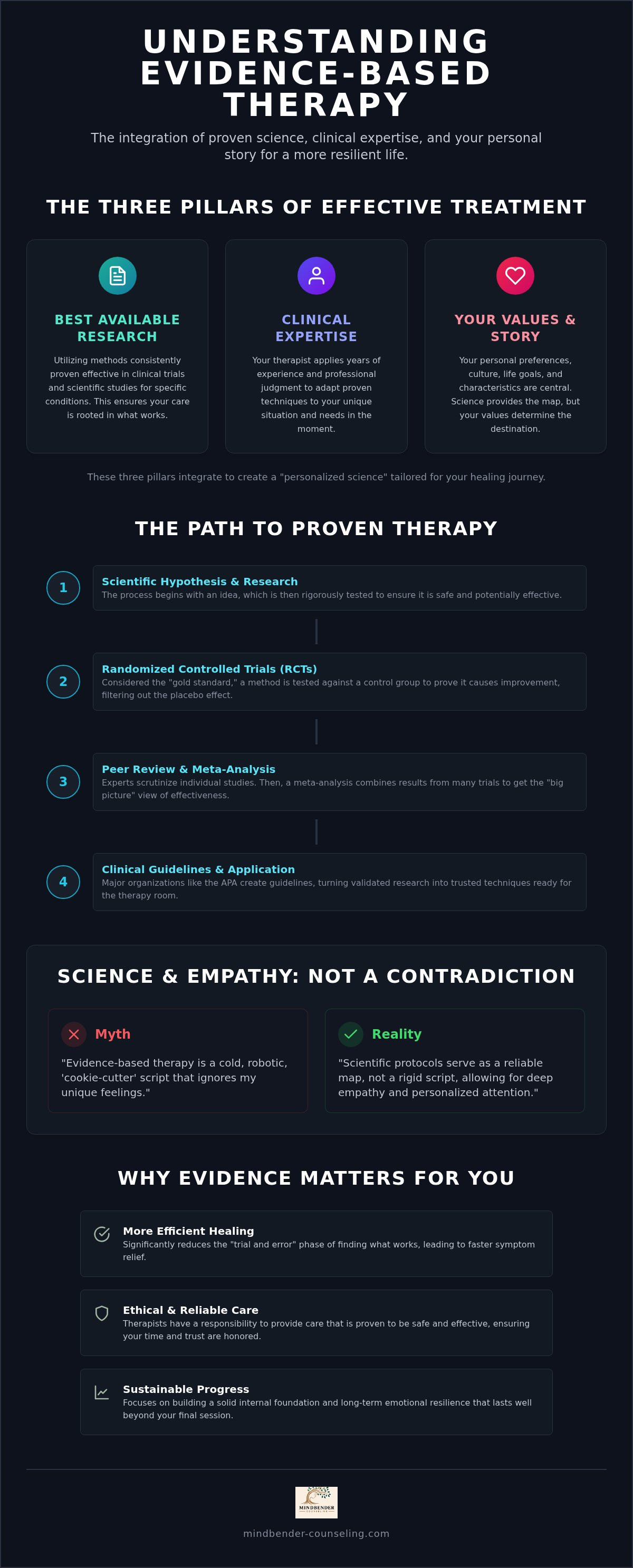
Understanding what is evidence-based therapy begins with a fundamental shift in how we view healing. It is a commitment to your well-being that prioritizes proven results over simple intuition or guesswork. While every therapist brings their own warmth to the room, an evidence-based approach ensures that the techniques they use have been rigorously tested and validated by the scientific community. This movement toward Evidence-based practice ensures that mental health care remains grounded in reality rather than mere theory. According to the 2005 American Psychological Association (APA) policy, evidence-based practice in psychology is the integration of the best available research with clinical expertise in the context of patient characteristics, culture, and preferences. It's essentially a promise that your treatment is built on a foundation of "personalized science."
The Three Pillars: Research, Expertise, and You
To understand how this works in a session, we look at the three pillars that support every effective treatment plan. These elements work together to ensure your care is both high-quality and deeply personal.
- Best Available Research: This involves looking at clinical trials and scientific data to see which methods consistently help people with specific conditions. It's about using what has been shown to work for others in similar situations.
- Clinical Expertise: Your therapist isn't just a researcher; they're a skilled guide. They use years of experience and situational judgment to decide how to apply scientific findings to your specific moment.
- Client Characteristics and Values: This is the most personal piece. Your unique culture, life goals, and personal preferences aren't just acknowledged; they're vital to the process. Science provides the map, but your values determine the destination.
Why "Evidence" Matters for Your Mental Health
Choosing a research-backed path offers more than just peace of mind; it provides a more efficient route to healing. By focusing on methods with a track record of success, we can significantly reduce the "trial and error" phase that often makes starting therapy feel so exhausting. When we use tools designed for your specific needs, you're likely to experience faster symptom relief and more sustainable progress. This is true whether you are seeking Individual Counseling Services or looking to strengthen your relationship through Couples Counseling.
Beyond the results, there's a significant ethical component. Therapists have a responsibility to provide care that's safe and effective. By staying rooted in evidence, we ensure that our work together is always centered on what's best for your long-term emotional resilience. It's about building a solid internal foundation that lasts long after your final session.
How Therapy Becomes "Evidence-Based"
The journey from a scientific hypothesis to a trusted technique in the therapy room is a meticulous and fascinating process. It ensures that when you ask what is evidence-based therapy, the answer is rooted in layers of verification rather than just a therapist's personal preference. This journey begins in peer-reviewed journals, where experts in the field scrutinize every study to ensure the findings are reliable, ethical, and reproducible. It's important to view "evidence" not as a static book of rules, but as an evolving field that grows as our understanding of the human experience deepens.
The Role of Randomized Controlled Trials (RCTs)
To prove a method works, researchers often turn to Randomized Controlled Trials, which are considered the "gold standard" of clinical research. In an RCT, a specific therapy method is compared against a control group to see if the treatment actually causes the observed improvement. This rigorous testing helps filter out the "placebo effect" and ensures that the techniques are safe and effective across diverse populations. By testing these methods with thousands of people from various backgrounds, scientists can confirm that a treatment is truly effective for the people who need it most.
From Meta-Analysis to Clinical Guidelines
While a single study is a great start, a meta-analysis provides the "big picture" view by combining the results of dozens of individual trials. Organizations like the Association for Behavioral and Cognitive Therapies and the American Psychological Association review this massive body of data to create clinical guidelines. These guidelines act as a compass for therapists, helping them stay at the forefront of mental health innovation while remaining anchored in proven methods. This systematic approach reduces the "trial and error" phase of healing, allowing you to move toward your goals with greater speed and clarity.
Modern therapeutic practices also rely heavily on outcome tracking, or measurement-informed care. This involves using brief, regular assessments to monitor your progress objectively throughout your journey. Instead of relying on a vague sense of "feeling better," you and your therapist can see real-time data on your growth. This allows for precise adjustments to your care, ensuring your path toward stability remains on track. If you're looking for a partner in this process, you might consider exploring Individual Counseling Services that prioritize these research-backed results while honoring your unique story.
Common Types of Evidence-Based Therapy Programs
When you explore what is evidence-based therapy, you'll find that it's not a single technique but a vast toolkit of specialized programs. Each method is designed to address specific challenges, whether you're dealing with persistent anxiety, deep-seated trauma, or the weight of grief. The Evidence-Based Practice in Psychology framework allows therapists to select the most effective tool for your unique situation. Many providers use an "integrative" approach, blending several research-backed methods to ensure your care remains flexible and responsive to your progress.
This approach ensures that your healing isn't limited by a rigid script. Instead, it offers a structured path toward resilience. For a deeper look at how these methods differ from traditional talk therapy, you can read our guide on Understanding Therapy and Behavioral Therapy. By using techniques that have been validated in clinical settings, we can help you build a solid internal foundation with greater confidence.
Cognitive Behavioral Therapy (CBT) and DBT
CBT is perhaps the most well-known EBT modality. It focuses on the intricate science of how your thoughts, feelings, and behaviors are interconnected. By identifying and shifting unhelpful patterns, you can gain immediate relief from symptoms and develop long-term coping strategies. Dialectical Behavior Therapy (DBT) is a specialized branch of CBT that emphasizes emotional regulation and mindfulness. It's particularly helpful for those who feel overwhelmed by intense emotions or struggle with interpersonal relationships. These methods are highly effective components of individual counseling for anxiety, providing practical skills you can use every day to regain a sense of balance.
Evidence-Based Approaches for Couples
Relationships require their own set of proven strategies to thrive. Emotionally Focused Therapy (EFT) is a research-backed method that focuses on strengthening the emotional bonds between partners. It helps couples move from repetitive cycles of conflict to a place of secure attachment and understanding. Similarly, the Gottman Method is based on decades of relational research involving thousands of couples. It provides a clear roadmap for building friendship, managing conflict, and creating shared meaning. At Mindbender Counseling, we focus on these specific applications of EBT to help couples in Arizona and Texas foster lasting emotional growth and stability.
Addressing the "Cookie-Cutter" Myth: Science vs. Empathy
One of the most common hesitations people feel when exploring what is evidence-based therapy is the fear that it will feel robotic or impersonal. You might worry that a science-backed approach means your therapist is simply following a script rather than listening to your heart. It is important to understand that in our practice, science is the foundation, not a cage. A clinical manual serves as a reliable map, but you and your therapist are the ones who decide the route based on the unique terrain of your life. Your culture, background, and personal history are not just "factors" to consider; they are the very context that makes the therapy meaningful and effective.
Clinical intuition acts as a vital partner to scientific data. While research tells us what works for most people, your therapist uses their deep experience and situational judgment to sense when to lean into a specific tool and when to hold space for your emotions. This balance ensures that you receive care that is both intellectually rigorous and deeply human.
The Importance of the Therapeutic Alliance
Research consistently shows that the relationship between a therapist and a client is one of the strongest predictors of a positive outcome. Some believe that following a specific protocol might get in the way of this bond, but the opposite is often true. Evidence-based methods actually strengthen the therapeutic alliance by providing clear goals and a sense of transparency. You aren't left wondering what the plan is; instead, you and your therapist work as a collaborative team. Compassion is the delivery system for every intervention we use. Without a foundation of safety and trust, even the most advanced scientific technique loses its power to heal.
Why Flexibility is Built Into the Framework
Flexibility is a core requirement of any high-quality therapeutic framework. A therapist might use a proven protocol for individual counseling, but they will adapt the pace, the language, and the examples to fit your specific life stressors. We utilize a "feedback-informed" model, which means we regularly check in to see how you are feeling about your progress. If a particular strategy isn't resonating with you, we pivot. This approach empowers you to be an active participant in your own healing rather than a passive recipient of care. It honors your autonomy while providing the specialized tools necessary for internal progress.
If you are looking for a compassionate guide who values both your personal story and the reliability of proven results, we invite you to learn more about our Evidence-Based Therapy services.
Finding Evidence-Based Counseling in Arizona and Texas
Locating the right support in vibrant hubs like Phoenix, Dallas, or Austin can feel overwhelming due to the sheer number of options available. However, your search becomes much simpler when you prioritize providers who can clearly explain what is evidence-based therapy and how they apply it to your specific needs. You don't have to guess whether a therapist's style will align with your goals. By seeking out professionals who value scientific rigor alongside personal connection, you ensure that your time and emotional energy are directed toward methods that truly work. It's about finding a partner who offers a sturdy anchor while you navigate the complexities of personal change.
When you begin reaching out to prospective therapists, don't hesitate to ask direct questions about their practice. A qualified provider will welcome your curiosity. Consider asking: "Which specific evidence-based modalities do you use for my primary concerns?" or "How do we integrate my personal values into the treatment plan?" You might also ask how they stay current with the latest research in their field. These questions help you move past clinical buzzwords and find a clinician who is truly dedicated to your long-term internal progress.
What to Look for in a Research-Backed Provider
A reliable evidence-based provider often holds specialized training in proven modalities such as Cognitive Behavioral Therapy (CBT), Dialectical Behavior Therapy (DBT), or Emotionally Focused Therapy (EFT). Beyond their certifications, look for a therapist who emphasizes collaborative goal-setting and consistent progress tracking. They should be able to explain how their interventions lead to specific, meaningful outcomes in your daily life. For professionals in high-pressure environments, it's also helpful to explore wellness therapy resources that complement your clinical work, providing a well-rounded foundation for resilience.
The Mindbender Approach: Science Meets Compassion
Mindbender Counseling serves as a local leader in Arizona and Texas by strictly adhering to the three pillars of evidence-based practice. We don't believe in a one-size-fits-all model. Instead, we integrate the best available research with our deep clinical expertise while keeping your unique story at the center of the room. Whether you are seeking individual growth or looking to improve your relational health through Couples Counseling, our focus remains on fostering sustainable emotional evolution. We provide a calm, assured environment where you can feel safe to explore your challenges, knowing that every tool we use is backed by reliable data.
Choosing a research-supported path is a powerful act of self-care. It's an investment in a future where you feel more balanced, stable, and equipped to handle life's stressors. If you're ready to experience the difference that personalized, science-backed healing can make, we invite you to take the next step by scheduling your first therapeutic appointment with us today. Your journey toward a more resilient life starts with a single, informed choice.
Building Your Foundation for Lasting Change
Healing is a journey that deserves a reliable map. You've discovered how research-backed methods provide a sturdy foundation for both personal growth and relational health. We've explored how these tools are adapted to fit your unique culture and life stressors, ensuring that science never replaces the warmth of human connection. By understanding what is evidence-based therapy, you've moved past clinical buzzwords toward a clearer vision of effective, personalized support.
You don't have to navigate this path alone. Our compassionate team specializes in Individual and Couples Counseling, offering steady support to residents across Arizona and Texas. We are committed to your emotional growth, combining proven techniques with the individualized attention you deserve. When you're ready to move toward a more balanced and resilient life, we are here to act as your facilitator and guide. This structured approach creates a sense of order and predictability, helping you feel secure as you seek professional care.
Begin your journey with evidence-based counseling at Mindbender Counseling. You possess the strength to evolve, and we have the tools to help you build a solid internal foundation that lasts. Your path toward well-being is within reach, and we are honored to walk it with you.
Frequently Asked Questions
Is evidence-based therapy more effective than regular talk therapy?
Evidence-based therapy is a framework for talk therapy that prioritizes methods with a proven track record of success. While traditional talk therapy may focus on open-ended exploration, an evidence-based approach is often more structured and goal-oriented. This focus on results helps reduce the time spent in the trial and error phase, leading to faster symptom relief. It's not about being better than talk therapy; it's about making talk therapy more efficient and reliable for your needs.
Does insurance in Arizona or Texas typically cover evidence-based treatments?
Yes, most insurance providers in Arizona and Texas recognize the value of research-backed care and typically cover evidence-based treatments. This includes major private insurers as well as government programs like Medicare and AHCCCS in Arizona. These organizations often favor evidence-based methods because they're tied to measurable outcomes and proven safety standards. It's always a good idea to verify your specific benefits with your insurance carrier to understand your coverage for Individual Counseling Services or other specialized care.
How long does a typical evidence-based therapy program last?
The duration of a program depends on your unique goals, but evidence-based approaches are generally more time-efficient than open-ended models. Because these methods focus on specific interventions for defined challenges, many clients begin to see significant progress within 12 to 20 sessions. Your therapist will track your growth throughout the process, allowing you both to decide when you've reached a stable foundation. This structured timeline helps reduce the anxiety of feeling stuck in therapy indefinitely.
Can evidence-based therapy help with relationship issues or just mental health disorders?
Absolutely, what is evidence-based therapy includes specialized methods designed specifically for relational health. Approaches like Emotionally Focused Therapy (EFT) and the Gottman Method are rooted in decades of research into how couples connect and resolve conflict. These programs aren't just for mental health disorders; they provide practical tools to strengthen bonds and improve communication. Whether you're seeking individual growth or Couples Counseling, research-backed methods offer a reliable path toward more fulfilling and stable relationships.
What happens if a specific evidence-based method isn’t working for me?
If a specific method isn't resonating with you, your therapist will pivot to a different research-backed strategy that better fits your needs. Evidence-based care is a flexible framework, not a rigid script. We use feedback-informed treatment to monitor your progress in real-time. If the data shows we aren't meeting your goals, we adjust the approach together. This collaborative process ensures that your voice remains the most important factor in your healing journey toward emotional stability.
Is evidence-based therapy suitable for children and teenagers?
Yes, evidence-based methods are highly effective for children and teenagers facing various life challenges. Modalities like Cognitive Behavioral Therapy have been extensively researched and adapted for younger populations to help them manage anxiety, school stress, or family transitions. These programs often involve the family unit to build a supportive environment for the child's growth. By using proven techniques early on, we can help young people develop the emotional resilience they need for a healthy, balanced future.
What questions should I ask a therapist to see if they use evidence-based methods?
You can learn a lot about a provider's approach by asking a few focused questions during your initial consultation. Ask them to explain what is evidence-based therapy in the context of their practice and which specific modalities they use for your concerns. You might also ask how they track your progress over time or how they balance scientific protocols with your personal values. A therapist who values science-backed healing will be happy to discuss these details with you.


