

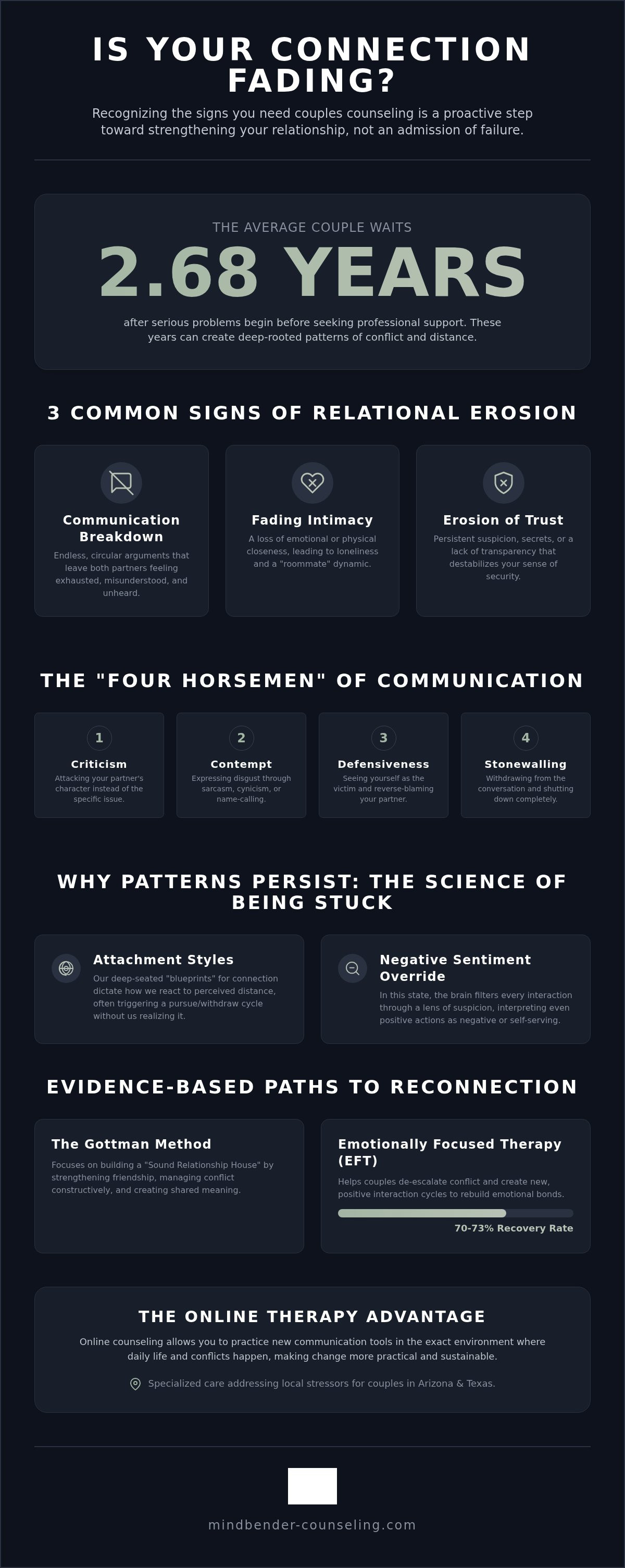
Did you know that the average couple waits 2.68 years after serious problems begin before they finally reach out for professional support? It's easy to dismiss persistent tension as a temporary phase, but those years of waiting often lead to a painful cycle of circular arguments that never reach a resolution. You might feel a growing anxiety about your future together or realize you've started living more like roommates than partners. Acknowledging these signs you need couples counseling isn't a confession of failure. Instead, it's a courageous step toward protecting the foundation you've built together.
We believe that your relationship deserves a methodical, evidence-based approach to healing. In this guide, you'll learn to identify the subtle red flags that suggest your bond requires a professional recalibration. We'll show you how personalized, research-backed online counseling can help you regain clarity and develop actionable tools for better communication. Whether you are seeking support from your home in Arizona or Texas, there is a clear path toward reconnection and steady hope. Let's explore the indicators that it's time to invest in your shared well-being.
Key Takeaways
- Identify the signs you need couples counseling as proactive signals for growth rather than indicators of a failed relationship.
- Explore psychological concepts like attachment styles and Negative Sentiment Override to understand why certain patterns feel impossible to break alone.
- Recognize the unique clinical advantage of online therapy, which allows you to practice new communication skills within the actual environment where your daily life happens.
- Prepare for your first session by shifting your perspective from a focus on past mistakes to a future-oriented commitment to relational healing.
- Understand the value of choosing a specialized, clinician-led practice in Arizona or Texas over high-volume, impersonal therapy platforms.
Recognizing the Shift: 10 Common Signs You Need Couples Counseling
Many people view Couples therapy as a final attempt to save a sinking ship. This perception often causes partners to wait until they're in a state of crisis before seeking help. In reality, modern counseling serves as a proactive tool for relational health. It's about maintenance and growth rather than just damage control. When you recognize the early signs you need couples counseling, you allow yourself the space to repair your bond before the damage becomes structural.
Relational erosion is the gradual loss of friendship and shared meaning. This process often manifests as "roommate syndrome," where you share a mortgage and a schedule but lack emotional connection. You might feel lonely even while standing in the same room as your partner. We can categorize these red flags into three distinct areas:
- Communication barriers: Frequent circular arguments that leave you feeling exhausted and unheard.
- Fading intimacy: A lack of physical or emotional closeness that creates a sense of isolation within the home.
- Erosion of trust: Persistent suspicion or a lack of transparency that destabilizes your sense of security.
The "Four Horsemen" of Communication
Research identifies four specific communication patterns that predict relationship instability with startling accuracy: criticism, contempt, defensiveness, and stonewalling. These behaviors don't just happen in person; they often creep into our digital lives. You might notice a sharp, critical tone in a text message or a partner "ghosting" a difficult conversation by simply not replying for hours. These aren't just bad habits. They are biological signals that your connection requires a methodical recalibration to restore safety and respect.
Local Stressors in Arizona and Texas
Living in the Southwest brings unique pressures to a partnership. The grueling Phoenix commute or the vast Texas urban sprawl can drain your emotional reserves before you even walk through the front door. When you spend hours in traffic, your "quality time" often becomes a period of recovery rather than connection. Seasonal stressors, such as the intense summer heat that keeps families indoors for months, can lead to cabin fever and increased household friction. These environmental factors often fuel the recurring arguments that serve as signs you need couples counseling. Addressing these stressors within your specific lifestyle helps you build a more resilient foundation together.
The Science of Connection: Why Relational Patterns Persist
Understanding why we get stuck in the same arguments requires looking beneath the surface of the conflict. Most repetitive disagreements are rooted in our attachment styles, which are the internal blueprints for how we seek closeness and respond to perceived distance. When one partner pulls away and the other pursues, it isn't just a lack of communication. It's a biological response to a perceived threat to the relationship. Identifying these deep-seated signs you need couples counseling allows you to address the root cause rather than just the symptoms of the friction.
Over time, a distressed relationship can fall into a state called Negative Sentiment Override. In this psychological state, the brain begins to filter every interaction through a lens of suspicion. Even neutral or positive gestures from your partner are seen as slights or hidden agendas. While you might feel tempted to vent to friends or family to find relief, this often reinforces your negative perspective. A friend's validation, while well-intentioned, lacks the clinical distance needed to see the "dance" between you and your partner. A therapist acts as a methodical guide, observing the patterns from the outside to help you deconstruct the cycle.
Evidence-Based Modalities Explained
We rely on research-backed methods to provide a sturdy anchor for couples in crisis. Two of the most effective approaches are the Gottman Method and Emotionally Focused Therapy (EFT). Research indicates that EFT has a recovery rate of 70% to 73% for couples in distress. These frameworks move beyond simple "communication tips" to create lasting change. To learn more about how these structures support growth, you can read our guide on Understanding Therapy and Behavioral Therapy: A Guide to Modern Emotional Resilience. These proven tools help you move from reactive fighting to proactive connection.
The Biological Impact of Conflict
Chronic relationship stress isn't just an emotional burden; it has a measurable impact on your physical health. When you are in a state of constant conflict, your body stays flooded with cortisol, the primary stress hormone. This keeps you in a perpetual "fight or flight" loop, making it physically impossible to have a calm, rational conversation. Professional intervention is often necessary to teach partners the art of physiological soothing. Learning how to lower your heart rate and calm your nervous system during a disagreement is a vital skill. If you feel your body physically reacting before the words even start, these are clear signs you need couples counseling to restore internal and relational peace. You can begin this journey by exploring evidence-based therapy options tailored to your unique needs.
Addressing the Signs Remotely: Why Online Therapy is a Clinical Advantage
While some assume that a digital screen creates distance, online therapy actually offers a unique clinical advantage known as ecological validity. When you identify the signs you need couples counseling, the goal is to improve your relationship in the places where you actually live, work, and love. Practicing new communication skills in your own living room, rather than a sterile office, ensures that these tools translate directly to your daily life. It's a methodical way to ground your progress in reality. Recognizing the early signs you need couples counseling is the first step, but choosing a format that supports your lifestyle is what ensures long-term success.
Video technology also allows a therapist to observe your natural environment. Seeing how you interact in your shared space provides valuable context that an office setting simply can't replicate. Additionally, many couples experience the "online disinhibition effect." This phenomenon often makes it easier to discuss vulnerable or difficult topics, facilitating breakthroughs faster than in-person sessions might allow. It creates a sense of safety that encourages you to speak your truth with more clarity and less fear.
Convenience as a Catalyst for Consistency
In states like Arizona and Texas, the "commute barrier" is a significant hurdle to consistent care. Navigating the I-10 in Phoenix or the sprawling highways of Houston can turn a one-hour session into a three-hour ordeal. Online therapy removes this friction, making it easier to maintain the steady rhythm required for healing. It also provides a "neutral digital ground" for high-conflict couples, reducing the tension that can arise from traveling to an unfamiliar location together. For a deeper look at the mechanics, you can explore How Does Online Couples Counseling Work? The Rise of On-Demand Therapy in 2026. This accessibility ensures that your journey toward well-being isn't derailed by logistical stress.
Maintaining Privacy and Calm Assurance
Your home is your sanctuary, and discussing hard truths within that safe space can significantly lower your defenses. Modern, HIPAA-compliant platforms provide a secure, clinical environment that protects your privacy while maintaining a sense of calm assurance. In a digital frame, a skilled therapist ensures that both partners feel equally seen and supported. This balanced approach creates an atmosphere of safety, allowing you to focus entirely on your internal progress and the restoration of your bond. It's a supportive, empathetic way to build a solid foundation for your future.
From Recognition to Restoration: Preparing for Your First Session
Once you have identified the signs you need couples counseling, the next step is a gentle invitation to growth rather than a confession of failure. It's natural to feel a mix of vulnerability and relief as you prepare to address the foundation of your partnership. We encourage you to approach this transition with quiet confidence. Research from the American Association for Marriage and Family Therapy shows that over 75% of couples who undergo counseling report a significant improvement in their relationship. This data serves as a sturdy anchor for your hope as you begin this methodical process of restoration.
Choosing a therapist is a collaborative effort that requires alignment with your shared goals. You aren't looking for a judge to decide who is right or wrong; you're seeking a professional facilitator for your journey toward well-being. Individual readiness is just as important as your relational goals. When both partners arrive with a spirit of curiosity and a willingness to explore their own internal progress, the therapeutic process moves forward with much greater fluidity and effectiveness.
Setting the Physical and Mental Stage
Transitioning from the high-pressure demands of daily life in Arizona or Texas to a therapeutic space requires intentionality. We recommend the "10-minute buffer" rule. Take ten minutes before your session to disconnect from technology, breathe deeply, and center your thoughts. This brief period of physiological soothing helps you move out of a reactive "fight or flight" state and into a mindset of calm assurance. It's a simple yet powerful way to ensure you're emotionally present for the work ahead.
Creating a "sacred space" within your home is equally vital for a successful virtual experience. Choose a room where you won't be interrupted by children, pets, or work notifications. Check your internet connection ahead of time to reduce the friction of technology glitches. A successful virtual session thrives in a quiet, well-lit room where both partners feel physically comfortable and emotionally secure. This environment allows you to focus entirely on each other and the guidance of your therapist.
Defining Shared Goals
If you're speaking with a skeptical partner, frame the decision as an investment in the relationship's future rather than a critique of the past. Explain that the relationship is the "client," and the therapist's role is to help that client thrive. Your initial assessment sessions are designed to create a personalized intervention plan that respects your unique history. Sometimes, the stress within a couple is fueled by personal challenges. This is why we prioritize individual counseling for anxiety when personal internal pressure begins to erode the couple's shared stability. Clear goals might include:
- Developing actionable tools for de-escalating conflict.
- Restoring a sense of emotional safety and trust.
- Transitioning from "roommate syndrome" back to an intimate partnership.
If you are ready to move from recognition to restoration, you can schedule your initial consultation with our team today to begin your path toward reconnection.
Mindbender Counseling: Personalized Relational Care in Arizona & Texas
Mindbender Counseling isn't just another algorithm-based matching service found on a massive therapy app. We are a boutique practice deeply rooted in the communities of Arizona and Texas, led by clinicians who prioritize personalized, research-backed interventions. While large platforms often focus on high-volume matching, our approach centers on the quality of the therapeutic relationship and the restoration of balance within your home. We act as a sturdy anchor for couples navigating the complexities of 2026, providing the calm assurance needed to lower defenses and build immediate trust.
Working with a clinician-led practice means you receive individualized attention from experts who understand that your relationship is unique. We don't rely on generic advice; instead, we utilize proven methods to facilitate your internal progress. By choosing a practice with deep local roots, you ensure that your therapist understands the cultural and lifestyle nuances that shape your daily interactions. This personalized care creates an atmosphere of safety and reliability, allowing you to focus on the possibility of positive change.
Local Expertise for Southwest Lifestyles
Understanding the regional context of the Southwest is vital for successful therapeutic outcomes. The specific pressures of life in the Sun Belt, from the exhausting commutes in Phoenix to the sprawling urban landscapes of Texas, impact how you and your partner relate to one another. We help you Break the Stigma surrounding mental health, framing private therapy as a high-value asset for your life and career. By focusing on long-term stability rather than quick fixes, we help you build a foundation that can withstand both internal and environmental stressors.
Your Next Steps Toward Healing
Reaching out for support shouldn't be a source of additional friction in an already stressful time. We've designed a low-friction process for scheduling an initial consultation, ensuring that you can access care without unnecessary hurdles. When you contact us, you can expect a professional and compassionate response within 48 hours to discuss your needs and set a path forward. Our methodical approach creates a sense of order and predictability, helping to reduce the anxiety often associated with seeking professional services.
Identifying the signs you need couples counseling is a courageous act of hope. It signals a desire to protect what you've built and a willingness to evolve together. If you've noticed these signs you need couples counseling in your relationship, don't wait for a crisis to take action. A methodical, supportive path toward reconnection is ready for you. Begin your journey toward a stronger bond today and discover the possibility of lasting relational healing.
Investing in Your Shared Future
Recognizing the shift from emotional connection to persistent conflict is the first step in protecting your relationship's foundation. By understanding the biological and psychological patterns that keep you stuck, you can move toward a more methodical way of relating to one another. Acknowledging these signs you need couples counseling isn't a sign of weakness; it's a courageous commitment to the long-term health of your partnership. At Mindbender Counseling, we provide a sturdy anchor for couples in Arizona and Texas through evidence-based methods like Gottman and EFT. Our personalized care plans focus on your internal progress and relational stability, ensuring that every session provides actionable tools for reconnection.
You don't have to navigate these challenges alone. We invite you to schedule your initial consultation with a Mindbender specialist today. Taking this low-friction step allows you to move from a place of uncertainty toward a future filled with calm assurance and mutual respect. Your path to restoration and a deeper bond begins with a single, hopeful decision. We are here to act as your wise guide, supporting you as you build a stronger, more resilient life together.
Frequently Asked Questions
Is online couples counseling as effective as in-person therapy?
Yes. Research indicates that online therapy provides outcomes comparable to in-person sessions. It offers a unique clinical advantage called ecological validity; you practice new communication skills in your actual living environment rather than a sterile office. This format reduces barriers like travel time, which often leads to more consistent session attendance and faster progress. Many couples report feeling more comfortable discussing vulnerable topics from the safety of their own homes.
How do we know if our relationship "signs" are serious enough for therapy?
If you are searching for signs you need couples counseling, your intuition is already signaling a need for growth. You don't need a major crisis like infidelity to benefit from professional support. Proactive therapy addresses "roommate syndrome" or circular arguments before they lead to structural damage. Seeking help early is a methodical way to strengthen your bond and prevent the average two year wait that many couples endure.
What if my partner refuses to attend counseling with me?
You can begin your own journey through individual counseling services if your partner isn't ready. Focus on your own internal progress and the patterns you bring to the relationship. Often, when one partner changes their own "dance" steps, the other is naturally invited to move differently. This individual work builds a solid foundation and can eventually serve as a gentle bridge for your partner to join the process later.
How do we handle technology or internet issues during a session?
We recommend a brief check of your connection ten minutes before your session begins. If a glitch occurs, your therapist will have a clear protocol, such as switching to a phone call or a secondary secure platform. These minor disruptions are handled with calm assurance to ensure your time remains productive. Having a backup plan reduces the friction often associated with digital services and maintains the flow of your healing.
Are our digital sessions private and HIPAA compliant?
Every session is conducted through a fully HIPAA compliant platform to ensure your absolute privacy. Unlike standard video apps, these clinical tools use high level encryption to protect your data and conversations. We maintain the same rigorous confidentiality standards as an in person office. This secure environment allows you to speak your truth with the security that your personal journey remains private and protected at all times.
How long does the couples counseling process typically take?
The length of the process varies based on your unique goals and the complexity of your patterns. Some couples find clarity and tools within 12 to 20 sessions; others choose longer term support for deep seated attachment work. We focus on research backed methods like EFT, which often leads to measurable changes in how you handle conflict. Each plan is personalized to ensure you move at a pace that feels steady and reassuring.
Does insurance in Arizona or Texas cover online couples therapy?
Most insurance plans in Arizona and Texas do not cover couples therapy for "relationship distress" alone. However, coverage may be available if one partner is being treated for a diagnosable condition like anxiety or depression. We recommend contacting your provider to verify your specific telehealth benefits. Understanding these logistics early helps you plan your investment in your shared well being with clarity and confidence.
What makes Mindbender different from a large therapy app?
Mindbender is a boutique, clinician led practice that prioritizes personalized care over high volume matching. Unlike large apps, we offer deep roots in the Arizona and Texas regions and use specific evidence based techniques like the Gottman Method. You work with a dedicated specialist who treats you with fresh attention rather than an anonymous provider. This approach provides a sturdy anchor and a more reliable path toward identifying the signs you need couples counseling.


