

What if the ceiling you've hit isn't a lack of talent or effort, but simply the limit of your current internal architecture? It's a common experience to feel like you're drifting through life without a clear sense of purpose, even when your professional life appears successful to everyone else. You might notice repetitive patterns in your relationships that hinder your progress or find it difficult to balance career achievements with a sense of internal peace. Integrating therapy for personal growth into your routine allows you to shift your focus from merely managing stress to actively optimizing your internal world.
You likely already believe that your potential is greater than your current reality, yet the path forward often feels obscured by old habits. We'll show you how evidence-based therapy provides the tools to bridge that gap, helping you build a life that's deeply aligned with your core values. This isn't about fixing what's broken; it's about refining your foundation to support your highest aspirations and long-term stability.
This article provides a clear roadmap for your personal evolution. You'll learn how to improve your emotional intelligence, refine your communication skills, and ensure your daily actions finally match your vision for the future.
Key Takeaways
- Understand how to transition from a medical model of fixing problems to a wellness model focused on personal optimization.
- Discover the specific behavioral tools used in therapy for personal growth to identify and dismantle the limiting beliefs that act as invisible ceilings on your potential.
- Learn why you don't need to be in crisis to benefit from professional support, reframing therapy as essential psychological maintenance for high-performing individuals.
- Gain a practical framework for conducting a life audit to define clear, growth-oriented goals that align your daily actions with your deepest values.
- Explore how personalized therapeutic interventions can provide a structured roadmap for your long-term emotional evolution and internal peace.
Beyond Symptom Reduction: What is Therapy for Personal Growth?
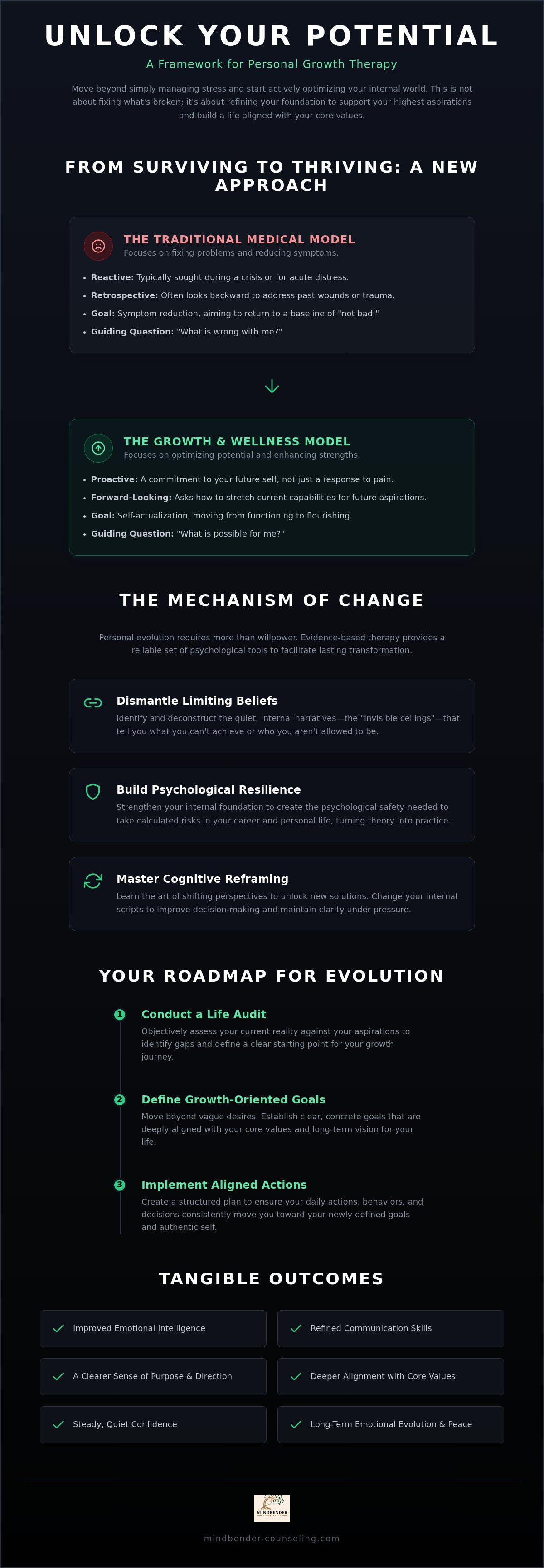
Therapy for personal growth is a proactive commitment to your future self. While many people associate the therapist's office with crisis management, this modern approach focuses on optimization rather than repair. It moves away from the traditional medical model, which seeks to identify and fix what's broken, and moves toward a wellness model designed to enhance your existing strengths. You aren't just seeking to feel "less bad"; you're seeking to live better.
This shift is deeply rooted in humanistic psychology, where the focus remains on your capacity for self-determination and evolution. Instead of asking "What is wrong?", you begin to ask "What is possible?". Common catalysts for this journey include significant career shifts, the quiet realization that you've reached a plateau, or a persistent desire for a life that feels more meaningful. Unlike traditional talk therapy that might wander without a destination, therapy for personal growth is goal-directed, methodical, and focused on your long-term evolution.
The Difference Between Healing and Expanding
Healing often involves looking backward to address past wounds or resolve old traumas. Expansion looks forward. It asks how you can stretch your current capabilities to meet your highest aspirations. These two paths often intersect during individual counseling, where you might clear away old emotional debris to make room for new internal structures. Self-actualization becomes the primary objective, helping you move from simply functioning to truly flourishing in every area of your life.
Why High-Functioning Adults Seek Growth Therapy
Even the most successful professionals encounter a plateau where their previous strategies no longer yield the same internal satisfaction. You might've achieved every societal marker of success but still feel a sense of misalignment. This specialized counseling provides an objective, professional sounding board to help you navigate these complex seasons. It allows you to peel back the layers of societal expectations to find your authentic values. When your daily actions finally align with those values, the sense of drifting disappears, replaced by a steady, quiet confidence and a clearer sense of purpose.
The Mechanism of Evolution: How Evidence-Based Therapy Sparks Change
Personal evolution requires more than just willpower; it requires a reliable set of psychological tools. By engaging in therapy behavioral therapy, you gain access to proven methodologies that facilitate lasting transformation. These evidence-based approaches offer a predictable structure for your development, ensuring that your progress isn't left to chance. Understanding how psychotherapy works helps demystify the process, revealing that growth is often the result of dismantling the "limiting beliefs" that act as invisible ceilings on your potential. These are the quiet, internal narratives that tell you what you can't achieve or who you aren't allowed to be.
Building a solid internal foundation is the next step in this journey. When you strengthen your psychological resilience, you create the safety needed to take calculated risks in your career and personal life. This is where therapy for personal growth shifts from theory to practice. You're not just discussing ideas; you're constructing a more robust version of yourself. If you're ready to start this construction, exploring individual counseling services can provide the personalized support you need.
Cognitive Reframing as a Tool for Success
Cognitive reframing is the art of shifting perspectives to unlock new solutions. When you're operating in high-pressure environments, your brain often defaults to familiar, stress-induced thought patterns. By intentionally changing these scripts, you improve your decision-making and maintain clarity when others might feel overwhelmed. Your internal self-talk directly dictates your sense of personal agency. If your inner dialogue is supportive and objective, your confidence naturally stabilizes, allowing you to lead with more authority and less anxiety.
Values-Based Living and Behavioral Activation
The process begins by identifying your core values, such as integrity, creativity, or connection. Many professionals feel a sense of "drifting" because their daily habits have become disconnected from these essential truths. Behavioral activation bridges this gap by helping you intentionally schedule actions that reflect what you actually care about. This alignment significantly reduces "cognitive dissonance," the uncomfortable tension felt when your life doesn't match your values. As your daily actions and long-term values come into harmony, you'll experience a profound sense of balance and internal peace. This is the true power of therapy for personal growth.
The Wellness Stigma: Overcoming the 'Not Sick Enough' Objection
One of the most persistent barriers to starting therapy for personal growth is the belief that you aren't "sick enough" to deserve professional help. You might feel that because your life is functional, your career is stable, and your relationships are intact, you should leave the therapist's chair for those in crisis. This perspective views therapy only as a reactionary measure for repair. However, staying "fine" often comes with a hidden cost: the quiet stagnation of your potential. When you settle for merely being okay, you miss the opportunity to truly thrive.
Choosing private therapy provides a confidential, non-judgmental space specifically for high-achievers who must maintain a facade of strength in every other area of their lives. It's a place where you can finally drop the mask. In this context, therapy is framed as mental coaching or psychological maintenance. It's an investment in your internal architecture, ensuring that the foundation is strong enough to support your next level of growth without cracking under pressure.
Therapy as Proactive Maintenance
Think of your mental well-being like your physical fitness or financial planning. You don't wait for a heart attack to start exercising, and you don't wait for bankruptcy to hire a CPA. According to the American Psychiatric Association on Psychotherapy, this process improves self-awareness and strengthens coping mechanisms, which are essential for long-term stability. By addressing small misalignments and subtle patterns now, you effectively prevent major burnout later. You don't need a clinical diagnosis to benefit from the objective, expert insight that a therapist provides. It's about refining your mental clarity before a crisis forces your hand.
The Role of Vulnerability in Professional Growth
In the modern workplace, emotional intelligence (EQ) has become the primary driver of leadership success. Therapy builds the empathy and self-regulation skills required to lead teams effectively and navigate complex interpersonal dynamics. For professionals in high-growth hubs like Phoenix or Austin, the pressure to perform is constant and often isolating. Resources like counseling for work stress Arizona help you manage these unique regional pressures while maintaining your internal peace.
By embracing the vulnerability required in a therapeutic setting, you develop a more authentic leadership style. This internal work translates directly to better communication, stronger professional relationships, and a more resilient presence in the boardroom. Therapy for personal growth isn't a sign of weakness; it's a strategic advantage that allows you to lead with both heart and logic.
Preparing for Your Journey: Setting Growth-Oriented Goals
Begin your journey by conducting a quiet audit of your current life satisfaction. Look beyond the surface level of career success or social status. Ask yourself where you feel a sense of expansion and where you feel constricted. This clarity is the first step in therapy for personal growth, as it helps you move from a vague desire for change to a specific vision for your future. When you enter your first session, be explicit about your desire for evolution. Instead of simply saying you want to feel better, try saying you want to build your capacity for leadership or deepen your emotional connection with those you love. Communicating these growth goals clearly allows your therapist to act as a more effective guide for your specific path.
Measuring your progress in this work requires looking for qualitative shifts in your mood and behavior rather than just the absence of symptoms. You might notice that you're making decisions with more clarity or that you're recovering more quickly from setbacks. It's vital to remember that personal evolution is rarely a straight line. It requires patient, steady effort and a willingness to stay with the process even during periods of plateau. If you're ready to define your own roadmap for change, consider reaching out for individual counseling services to begin your audit with professional support.
Step 1: Identify Your 'Growth Edges'
Your "growth edges" are the specific boundaries where your comfort zone ends and your potential begins. These often manifest as areas where you feel a sharp sense of hesitation or a subtle urge to pull back. Common examples include setting firm boundaries with demanding family members, speaking up in high-stakes professional meetings, or allowing yourself to be truly vulnerable in an intimate relationship. Identify the patterns of avoidance that keep you safe but stagnant; these are your primary targets for development. By leaning into these edges, you expand your capacity for authentic living.
Step 2: Define Success Beyond Symptom Relief
True therapeutic success is the increased capacity to handle life's inherent complexities with a sense of internal grace. In the context of therapy for personal growth, we prioritize "approach goals"—the meaningful outcomes you want to move toward—rather than "avoidance goals" that only focus on escaping pain. This proactive stance keeps you motivated and provides a sense of agency over your evolution. Between-session reflections or small "homework" assignments help you integrate these new insights into your daily reality, ensuring that the work you do in the office translates into a more aligned and purposeful life.
Personalized Evolution with Mindbender Counseling
Mindbender Counseling serves as a wise and compassionate guide for individuals in Arizona and Texas who are ready to move beyond their current limits. We recognize that seeking therapy for personal growth is a significant investment in your future self, much like any high-level professional development. Our practice remains rooted in evidence-based methods, providing a sturdy anchor that ensures your evolution is both measurable and sustainable. By choosing to work with us, you aren't just managing symptoms; you're actively constructing a more robust internal foundation. Through our individual therapy sessions, we move past the surface of daily stressors to address the core patterns that influence your long-term success. For those navigating life with a partner, our Couples Counseling services foster relational growth and a renewed sense of shared purpose, ensuring both individuals flourish within the relationship.
A Supportive Partner for Arizona and Texas Professionals
Busy professionals often find it difficult to prioritize their internal world amidst the demands of a high-stakes career. We offer convenient telehealth services across Arizona and Texas to ensure that personalized care fits into your schedule without adding unnecessary friction. Our team possesses a deep understanding of the local cultural and professional dynamics, from the rapid growth in Phoenix to the evolving corporate landscapes of Austin and Dallas. We invite you to view this process as a gentle but powerful invitation to change. By dedicating time to your psychological maintenance, you'll develop the emotional intelligence and self-regulation skills needed to lead with greater clarity. Our approach provides the stability you need to explore new possibilities while remaining grounded in proven, reliable methods that support your unique journey toward balance.
Taking the First Step Toward Your Best Self
Starting your journey shouldn't feel like another burden on an already crowded to-do list. We've designed a low-friction path to scheduling your first appointment, allowing you to begin your evolution with ease and confidence. The steady, reassuring rhythm of the Mindbender approach mirrors the patient nature of the therapeutic process itself, giving you the space to grow at a pace that feels secure. As you engage in this work, you'll notice your daily actions beginning to align more closely with your deepest values. Imagine a version of yourself that operates with complete clarity, navigating both professional challenges and personal relationships with a sense of quiet assurance. That future self is within reach, and we are here to act as a professional facilitator for that movement. Take this moment to prioritize your internal progress and build the foundation for a life that truly reflects your highest potential.
Your Path to Lasting Alignment
Choosing to engage in therapy for personal growth marks the beginning of a deliberate shift from simply managing life to actively mastering it. You've seen how evidence-based tools like cognitive reframing and values-based living provide the mechanism for this evolution, helping you dismantle the limiting beliefs that once felt like permanent ceilings. By reframing mental health as proactive maintenance, you're no longer waiting for a crisis to justify your progress. Instead, you're building a sturdy internal foundation that supports your highest professional and personal aspirations.
At Mindbender Counseling, we provide the expert guidance in evidence-based therapy required to navigate this journey with confidence. Our team offers personalized care for Arizona and Texas residents, delivering compassionate, professional support specifically tailored for high-functioning adults. Whether you're seeking to refine your emotional intelligence or align your daily actions with your deepest values, we're here to act as your steady anchor. Begin your journey of personal evolution with Mindbender Counseling today. You possess the potential for profound change, and the roadmap to your best self is ready when you are.
Frequently Asked Questions
Do I need a mental health diagnosis to start therapy for personal growth?
No, a clinical diagnosis isn't required to begin therapy for personal growth. While traditional models focus on treating specific disorders, growth-oriented therapy prioritizes your long-term evolution and internal optimization. You can seek professional support simply because you want to improve your emotional intelligence or align your daily actions with your core values. This proactive approach treats mental wellness as a continuous journey of refinement rather than a reactionary response to a crisis.
How is growth-oriented therapy different from life coaching?
Therapy differs from life coaching by utilizing regulated, evidence-based methodologies to address the deep-seated psychological patterns that influence your behavior. While coaching often focuses on external goals and accountability, a therapist helps you identify the "limiting beliefs" and internal architecture that might be holding you back. This clinical foundation ensures that the changes you make are rooted in a stable psychological framework, providing a more comprehensive path toward lasting personal evolution.
Can couples counseling help with personal growth if only one partner is interested?
Yes, engaging in couples counseling can significantly impact your personal growth even if your partner is initially hesitant. Relationships function as systems; when you change your communication patterns and emotional regulation, the entire dynamic must shift in response. By focusing on your own relational health and boundaries, you create a catalyst for movement within the partnership. This work often provides a sturdy anchor for your individual development while simultaneously improving the relationship.
What are some common goals for personal growth therapy?
Common objectives include refining your leadership style, mastering the art of setting healthy boundaries, and increasing your overall emotional intelligence. Many individuals also focus on resolving repetitive patterns in their relationships or finding a greater sense of internal peace amidst professional success. The specific goals are always personalized to your unique "growth edges," ensuring that your time in therapy for personal growth leads to a life that feels authentic and deeply meaningful.
How long does it typically take to see progress in personal growth therapy?
The timeline for seeing progress varies based on your specific objectives, but many people notice qualitative shifts in their perspective within eight to twelve weeks of consistent sessions. Initial changes often manifest as improved decision-making or a greater sense of clarity during high-pressure situations. Lasting transformation is a non-linear process that requires patient, steady effort. Your therapist will help you track these subtle behavioral shifts to ensure you're moving toward your long-term vision.
Is therapy for personal growth covered by insurance in Arizona or Texas?
Insurance coverage for therapy in Arizona and Texas typically depends on "medical necessity," which often requires a formal mental health diagnosis. If your primary focus is purely self-improvement without a qualifying condition, you may need to pay out-of-pocket. However, many professionals view this as a strategic investment in their long-term stability and career performance. It's always best to verify your specific plan's benefits regarding outpatient mental health services before beginning your journey.
What should I look for in a therapist if my primary goal is self-improvement?
Look for a professional who specializes in evidence-based therapy and demonstrates a clear focus on the wellness model of care. You want a guide who treats every individual with fresh attention while maintaining the seriousness required for deep psychological work. It's helpful to find someone who understands the unique pressures of your professional environment. A therapist who acts as a sturdy anchor and a catalyst for movement will best support your journey toward self-actualization.
How do I know if I'm ready for a deep dive into personal growth?
You're likely ready for a deep dive into personal growth if you feel a persistent sense of "drifting" despite having achieved traditional markers of success. This readiness often appears as a desire for deeper meaning or a realization that your current internal strategies have hit a plateau. If you're curious about what's possible beyond your current comfort zone, you've already taken the first step. This internal nudge is a gentle invitation to begin your evolution.


