

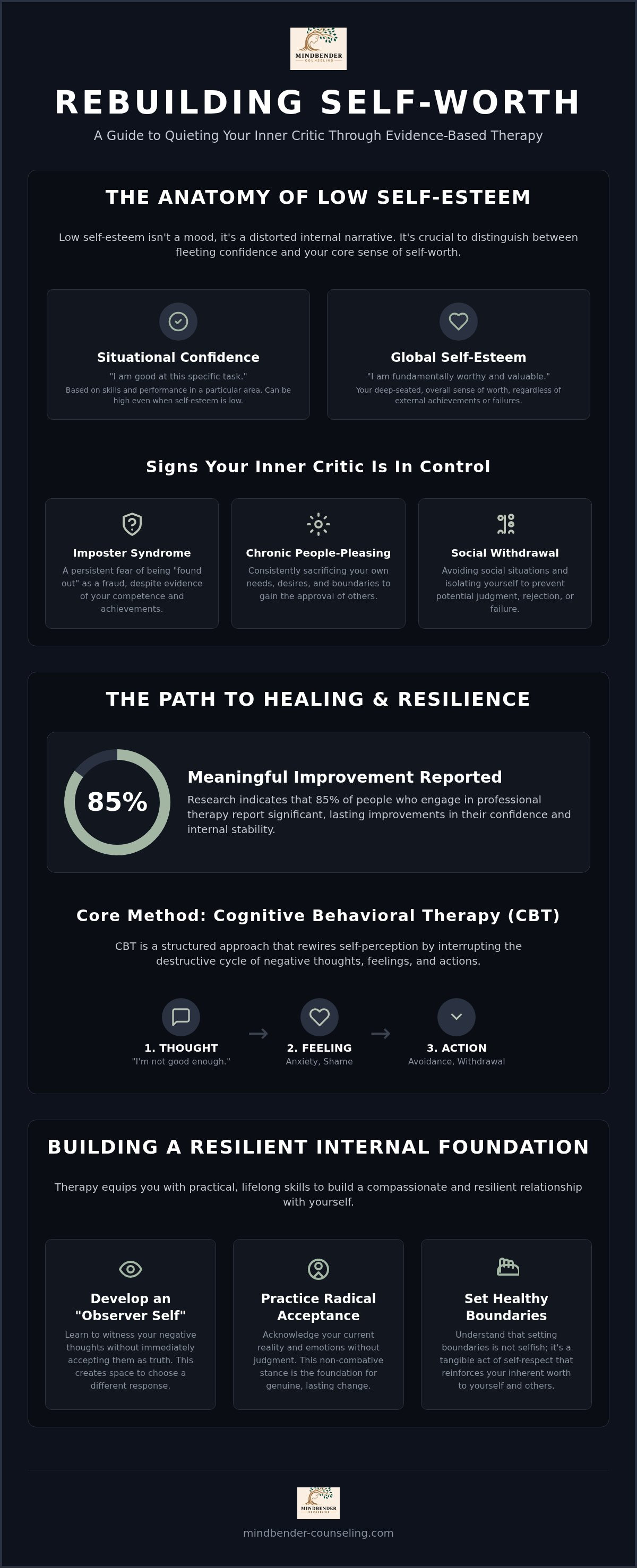
What if the harshest voice you hear every day isn't a reflection of the truth, but simply a habit your mind learned to protect you? For many, the persistent feeling of not being good enough creates a heavy shadow, making social settings feel like minefields and boundaries feel nearly impossible to set. You may feel as though you're stuck with this inner critic forever, but it's vital to recognize that self-worth is a cognitive skill that can be professionally rebuilt. Engaging in therapy for self-esteem offers a structured way to reclaim your narrative and quiet the noise of self-doubt. In fact, research indicates that 85% of people who seek professional support report meaningful improvements in their confidence and internal stability.
In this guide, you'll discover how evidence-based therapy provides the tools to dismantle low self-esteem and build a resilient, compassionate relationship with yourself. We will explore the specific methodologies that help silence the inner critic, allowing you to move through the world with a sense of calm assurance. By shifting your internal dialogue, you'll learn to develop the emotional resilience needed to thrive in both your personal and professional life. This journey is about more than just feeling better; it's about constructing a solid internal foundation that supports your long-term growth.
Key Takeaways
- Learn to distinguish between temporary situational confidence and the deep-seated internal narrative that defines your global self-esteem.
- Discover how evidence-based therapy for self-esteem utilizes Cognitive Behavioral Therapy to help you identify and dismantle the cognitive distortions fueling your inner critic.
- Understand the "blind spot" problem and why an objective therapeutic alliance is often necessary to see through long-standing patterns of self-doubt.
- Gain practical skills for developing an "Observer Self," allowing you to witness negative thoughts without immediately accepting them as truth.
- Explore how to set healthy boundaries as a tangible act of self-respect, helping you navigate social and professional settings with calm assurance.
Understanding the Anatomy of Low Self-Esteem
Self-esteem isn't just a fleeting mood; it's the foundational internal narrative that dictates how you interact with every person and opportunity you encounter. While situational confidence allows you to perform specific tasks well, global self-esteem represents your deep-seated sense of worth. When this foundation is shaky, you might experience a high cost in your daily life, ranging from chronic avoidance of new challenges to an exhausting cycle of perfectionism. Understanding the psychology of self-esteem is the first step in recognizing that these feelings aren't facts, but rather the result of "core beliefs" that act as a distorted filter for your reality. These filters color every success as a fluke and every failure as a permanent character flaw.
The Childhood Roots vs. Adult Reinforcements
Your baseline for self-worth often begins with early messages from caregivers or peers. These formative experiences create a mental script that you carry into adulthood. However, your current environment plays a significant role in reinforcing these patterns. High-stress workplaces or competitive social circles can trigger dormant insecurities, making you feel as though you're constantly falling short. This is often sustained by "confirmation bias," where your inner critic obsessively tracks every mistake while dismissing genuine praise as a fluke or a polite lie. You don't just feel inadequate; you actively look for evidence to prove it.
Signs Your Self-Esteem Needs Professional Support
Recognizing when your internal dialogue has become destructive is essential for growth. You might notice "imposter syndrome" creeping into your career, where you live in constant fear of being "found out" despite your achievements. This often pairs with chronic people-pleasing, as you sacrifice your own needs to secure the approval of others. When negative self-talk begins to manifest as physical fatigue or a desire for social withdrawal, it's a clear signal that your internal foundation needs attention. You don't have to carry the weight of these distortions alone.
Seeking therapy for self-esteem provides a safe, structured space to dismantle these heavy narratives. By choosing therapy for self-esteem, you aren't just talking about your problems; you're actively rewiring the cognitive habits that keep you small. Individual counseling services offer a way to examine these core beliefs with a compassionate expert who can help you identify the relational friction and professional stagnation that low self-worth causes. This process allows you to uncover the resilient, capable person who has been hidden behind the critic's shadow for too long.
How Evidence-Based Therapy Rewires Your Self-Perception
Evidence-based therapy for self-esteem isn't just about sharing feelings; it's a structured, research-backed framework designed to produce measurable changes in how you perceive your worth. By utilizing evidence-based self-esteem therapy techniques, you're engaging in a process that leverages neuroplasticity. This is the brain's remarkable ability to reorganize itself by forming new neural connections. When you consistently practice new ways of thinking, you physically strengthen the pathways associated with self-compassion while allowing the "critic" pathways to weaken over time. You don't have to fight your mind alone.
While change is the goal, Dialectical Behavior Therapy (DBT) introduces the vital concept of "radical acceptance." This means acknowledging your current reality without judgment. It creates a stable foundation where you can stop fighting your emotions and start understanding them. When you accept where you are right now, you actually gain the power to move forward. This balanced approach ensures that your growth is rooted in self-compassion rather than self-criticism. By choosing therapy for self-esteem, you're investing in a methodology that prioritizes long-term stability over temporary relief.
CBT: Dismantling the "Inner Critic" Logic
Cognitive Behavioral Therapy (CBT) operates on the understanding of the "Thought-Feeling-Action" cycle. For example, a single critical thought can trigger a wave of anxiety, leading you to withdraw from a social event. By interrupting this cycle early, you prevent the spiral before it gains momentum. You'll learn to spot common distortions like all-or-nothing thinking, where you believe you're a total failure because of one mistake, or "should" statements that impose unrealistic demands on your behavior. Cognitive restructuring is the process of replacing biased thoughts with balanced evidence.
The Power of Personalized Therapeutic Interventions
A "one size fits all" approach rarely works for deep-seated self-worth issues because your internal narrative is shaped by your specific life experiences. Whether you're dealing with professional imposter syndrome or relational anxiety, integrating your unique history into individual counseling ensures that the healing is targeted and relevant. Progress in therapy is often measured by the shift from intellectual understanding to emotional belief. You might know logically that you're capable, but therapy helps you feel that truth in your bones. If you're ready to begin this work, exploring Individual Counseling Services can provide the expert guidance needed for this personal evolution.
Therapy vs. Self-Help: Why Professional Support is Essential
While self-help books and motivational podcasts offer valuable insights, they often reach a plateau when faced with the "blind spot" problem. Your mind is naturally designed to protect its existing worldviews, even if those views are painful. This internal shielding makes it incredibly difficult to identify your own cognitive distortions without an objective, professional guide. A licensed counselor acts as a mirror, helping you see the patterns that remain invisible to you. By engaging in therapy for self-esteem, you move beyond the surface level of building self-esteem and begin the work of deep structural change.
The therapeutic alliance is perhaps the most critical component of this journey. It's not just about advice; it's about the relationship itself. This connection models a secure, healthy bond where you can practice vulnerability without the fear of judgment. This professional partnership provides the accountability and structure needed to turn temporary inspiration into long-term integration. When the "backlash" of growth occurs, which is that natural resistance your mind feels when you start to change, your therapist provides the expertise to navigate those fears safely. You're never left to manage the emotional weight of transformation alone.
The Limits of Positive Affirmations
Many people try to "fake it until they make it" by repeating positive affirmations. While well-intentioned, this approach can sometimes backfire, leading to increased internal shame when your current reality doesn't match your words. Shallow affirmations often focus on the "branch" of the problem, whereas evidence-based therapy addresses the "root." By uncovering the underlying causes of your self-doubt, you achieve results that feel authentic and earned rather than forced. This depth ensures that your confidence isn't just a mask, but a genuine reflection of your internal state.
Safety and Stability in the Therapeutic Process
Exploring deep-seated insecurities can feel like heavy lifting, and it's easy to become overwhelmed without the right support. A professional session serves as a sturdy anchor, allowing you to explore difficult emotions while remaining grounded. This controlled environment ensures that your self-discovery leads to healing rather than re-traumatization. Choosing a path rooted in private therapy standards guarantees a high level of confidentiality and personalized care. This dedicated focus allows you to process your journey at a methodical, reassuring pace, ensuring that every step forward is built on a foundation of genuine stability.
Practical Skills: What You Will Learn in Self-Esteem Counseling
Engaging in therapy for self-esteem moves you from passive observation to active skill-building. One of the first tools you'll develop is the "Observer Self." This involves learning to notice your thoughts as they arise without immediately accepting them as objective truths. Instead of being consumed by a thought like "I'm failing," you learn to say, "I am noticing a thought that says I'm failing." This small shift creates the space necessary to choose a different response. You'll also explore values-aligned living, which focuses on building a life that reflects your authentic desires rather than the "shoulds" imposed by society or early caregivers. When your actions match your values, your internal sense of stability naturally strengthens.
Boundary setting is another core skill taught in this process. Many people view saying "no" as a selfish act, but in the context of self-worth, it's a vital act of self-respect. You'll learn to replace the biting voice of the inner critic with a "Compassionate Mentor" voice. This internal guide offers the same kindness and perspective you would give to a dear friend. By practicing these self-compassion techniques, you begin to build an internal foundation that can weather external criticism or temporary setbacks. Over time, these practices turn therapy for self-esteem into a blueprint for a more confident life.
Mastering the Art of Assertive Communication
Assertive communication is the middle ground between being a "doormat" and being confrontational. Passive communication leaves you resentful, while aggressive styles damage connections. Assertiveness allows you to protect your time and emotional space with clarity and kindness. In your sessions, you might script difficult conversations to ensure you're speaking from a place of calm assurance. Each time you state your needs clearly, you build a layer of self-trust that eventually becomes a permanent part of your identity. You're not just changing how you talk; you're changing how you value your own voice.
Self-Esteem and Relational Health
Your internal sense of worth is the silent partner in every relationship you have. Low self-esteem often fuels "anxious attachment," where you constantly seek reassurance to soothe a fear of abandonment. Interestingly, your progress in individual sessions directly impacts couples counseling outcomes. When you value yourself, you stop deflecting love and start receiving praise as a valid reflection of who you are. This shift breaks the cycle of insecurity and allows for deeper, more secure bonds. If you're ready to move from self-doubt to self-assurance, our team is here to help. You can start your journey today by scheduling Individual Counseling Services tailored to your unique personal evolution.
Finding Your Voice: Self-Esteem Therapy in Arizona and Texas
The mental health landscape in Phoenix and the broader Arizona and Texas regions is as dynamic as its residents. Successfully reclaiming your self-worth requires a professional who isn't just an expert in clinical modalities, but one who also understands the specific community stressors you face every day. Whether you're dealing with the fast-paced growth of the tech hubs in Austin or the professional demands of the Phoenix metropolitan area, your internal foundation needs to be sturdy. Engaging in therapy for self-esteem allows you to build that strength within a local context that feels relevant, supportive, and accessible.
Personalized Care for Arizona and Texas Professionals
High-pressure careers in the Southwest often lead to a specific type of burnout where your self-worth becomes tied solely to your professional output. This creates a cycle of exhaustion that can feel impossible to break without an objective guide. Telehealth has become a vital tool for busy professionals, offering a flexible way to access counseling for work stress in Arizona and Texas without the added burden of a long commute. Choosing a therapist who is rooted in evidence-based methods and understands local licensure standards ensures that your care is both high-quality and legally sound.
Mindbender Counseling provides tailored sessions for individuals and couples across Arizona and Texas. We recognize that the challenges faced by a professional in Houston may differ from those in Scottsdale, and our approach reflects that individualized attention. By focusing on your unique history and current environment, we help you dismantle the "not good enough" narrative that often thrives in competitive professional landscapes. This personalized focus is what turns a standard session into a catalyst for genuine personal evolution.
Your Path to Emotional Resilience Starts Here
Viewing therapy as a sign of weakness is a misconception that often prevents people from reaching their full potential. In reality, seeking support is a strategic investment in your future. Healthy self-esteem acts as the engine for better relationships, career growth, and long-term peace of mind. When you value yourself, you're better equipped to set the boundaries we discussed earlier and move through the world with a sense of calm assurance. This is the long-term ROI of therapy for self-esteem: a life built on a foundation of resilience rather than doubt.
Your initial consultation at Mindbender Counseling is designed to be a safe, welcoming introduction to this process. During this first meeting, we'll focus on your unique goals and discuss how evidence-based methods can be applied to your specific situation. This organized approach reduces the friction often associated with starting therapy, allowing you to move forward with confidence. We invite you to schedule a session today and begin the methodical work of silencing your inner critic and finding your authentic voice.
Reclaiming Your Internal Narrative
Building a resilient relationship with yourself is one of the most profound shifts you can experience. As we've explored, self-worth isn't an inherent trait you're simply born with; it's a cognitive skill that you can intentionally develop through evidence-based methods. By learning to identify the "blind spots" of your inner critic and replacing them with a compassionate mentor voice, you create a solid foundation for both personal and professional growth. This journey allows you to move from a place of chronic self-doubt to one of calm, steady assurance.
Investing in therapy for self-esteem provides you with more than just temporary relief; it offers a structured path toward permanent change. Our team at Mindbender Counseling combines wise, professional clinical guidance with specialized care for Arizona and Texas residents. You deserve a life where your internal dialogue supports your ambitions rather than undermining them. Begin your journey toward lasting self-worth with Mindbender Counseling today. Your evolution is a process of small, methodical steps, and we're here to act as a sturdy anchor for every one of them. The future you're building is worth the effort.
Frequently Asked Questions
How long does it typically take to see results in therapy for self-esteem?
Many individuals begin to notice subtle shifts in their internal dialogue within the first four to eight weeks of consistent sessions. While symptom relief can occur early, the process of dismantling deep-seated core beliefs often requires several months of dedicated work. Your progress depends on the complexity of your history and your engagement with the tools provided. The goal is to move at a pace that allows for genuine integration rather than just temporary relief.
Is low self-esteem considered a mental health diagnosis?
Low self-esteem is not a standalone clinical diagnosis in the DSM-5, but it's often a core feature of other mental health conditions like anxiety or depression. Think of it as an internal metric that influences your overall emotional health and resilience. While it isn't a formal diagnosis, it's a significant focus in therapy for self-esteem because of how deeply it impacts your daily functioning and relationships. Addressing it can alleviate many related psychological symptoms.
Can therapy help with imposter syndrome at work?
Therapy is highly effective for managing imposter syndrome by helping you identify the cognitive distortions that lead you to minimize your achievements. You'll learn to examine the evidence of your successes objectively rather than dismissing them as luck. By building a more accurate internal narrative, you can navigate professional settings with a sense of calm assurance. This process turns the fear of being found out into a solid foundation of earned self-trust.
Will I have to talk about my childhood in every session?
You won't have to talk about your childhood in every session, though understanding the roots of your self-perception is often helpful. Modern evidence-based methods balance exploring past influences with developing practical, present-day skills. We focus on how those early messages impact your current life and provide tools to change your immediate responses. This approach ensures that while you respect your history, you remain focused on your personal evolution and future growth.
What is the difference between self-esteem and self-confidence?
Self-confidence refers to your belief in your ability to perform specific tasks, while self-esteem is your overall sense of personal worth. You might feel highly confident in your professional skills but still struggle with a low sense of global self-worth. Therapy for self-esteem addresses the deeper narrative of who you are rather than just the performance of what you can do. Building both creates a balanced foundation for navigating social and professional landscapes with resilience.
How do I know if my therapist is the right fit for my self-esteem issues?
Finding the right fit involves looking for a professional who makes you feel safe, seen, and supported. You should feel a sense of therapeutic alliance, where you can be vulnerable without fear of judgment. It's helpful to ask about their experience with self-worth issues and their use of evidence-based methods. Trust your intuition during the initial consultation; a good therapist acts as a wise guide who respects your pace while encouraging movement.
Can couples counseling help if only one partner has low self-esteem?
Couples counseling can be incredibly beneficial even if only one partner struggles with low self-worth, as it impacts the relationship's overall health. Insecure attachment or a fear of judgment can create friction that affects both individuals. Working together allows the partner to learn how to offer supportive, healthy reinforcement while the other builds their internal foundation. This collaborative approach fosters a secure bond and improves communication for the entire relationship.
Is online therapy as effective as in-person sessions for building self-worth?
Research indicates that online therapy is just as effective as in-person sessions for building self-worth and emotional resilience. Virtual sessions provide a high level of accessibility and comfort, allowing you to engage in deep work from a space where you already feel secure. This convenience often leads to more consistent attendance, which is a key factor in seeing long-term results. Telehealth ensures that your journey toward well-being isn't hindered by logistical barriers or commute times.


