

You're sitting on the sofa, heart racing, wondering if this first hour will just be another expensive argument where a stranger picks sides. It's a common fear that keeps many couples from seeking the help they need. You want more than a referee; you want a path forward that actually works. It's natural to feel overwhelmed by clinical terms while worrying that your specific struggles are too deeply rooted to fix. Understanding evidence-based couples therapy techniques can replace that anxiety with a sense of structured, professional guidance.
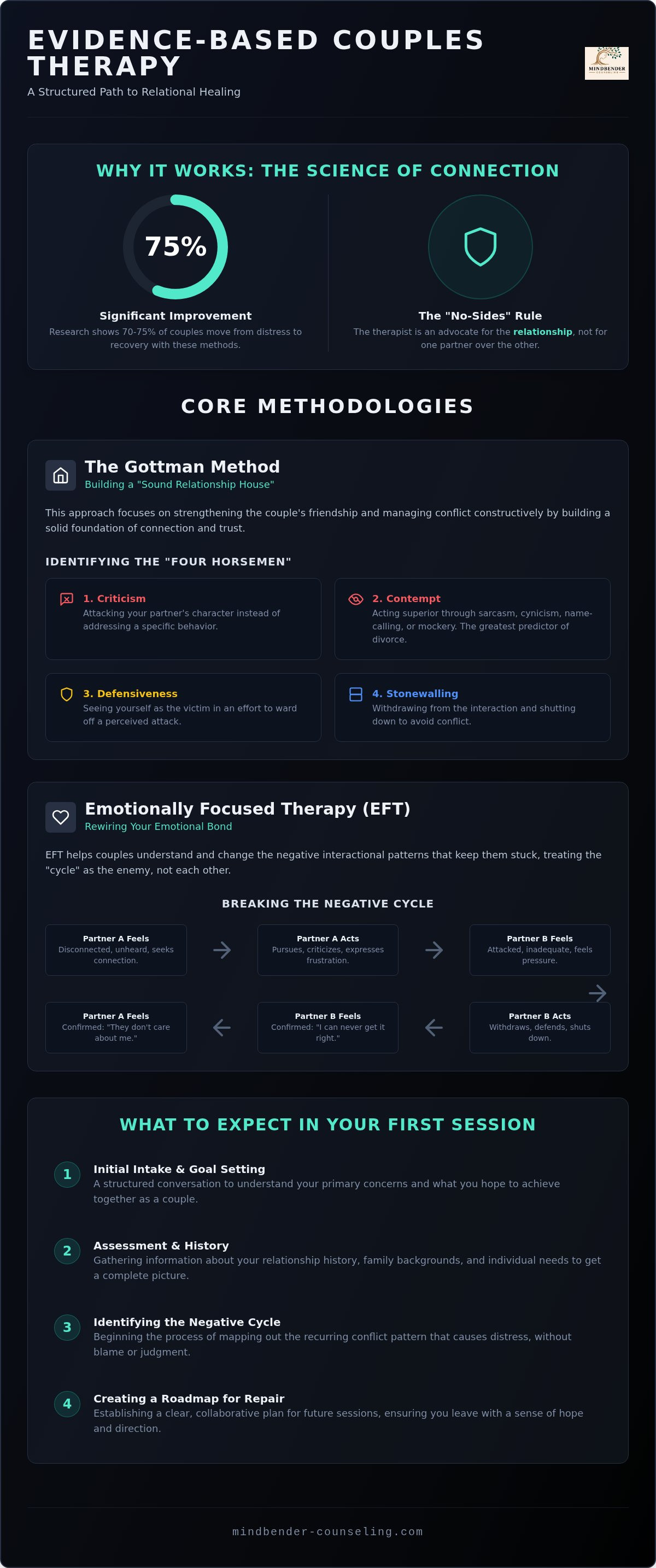
This guide explains how research-backed methods transform recurring conflict into genuine connection and exactly what your first hour of counseling will look like. We'll demystify the process, provide tools to stop escalating arguments immediately, and lay out a clear roadmap for your relationship's restoration. Research indicates that 70 to 75 percent of couples who undergo these specific interventions report significant improvement, moving from distress to recovery. You don't have to navigate this alone; a steady, methodical approach can help you build a solid foundation for the future.
Key Takeaways
- Discover how evidence-based couples therapy techniques provide a structured framework that moves beyond venting to create measurable progress in your relationship.
- Learn the practical differences between the Gottman Method’s focus on friendship and EFT’s approach to rewiring emotional responses.
- Identify specific tools like conflict mapping to break repetitive cycles and values clarification to align your shared long-term goals.
- Understand exactly what happens during the first hour, from the initial intake to the assessment of your family history and individual needs.
- Gain a clear roadmap for your relationship repair by moving from a state of crisis toward a foundation of lasting stability.
Understanding Evidence-Based Couples Therapy Techniques
Entering a therapist's office for the first time can feel like walking into a storm. You're likely carrying a heavy load of frustration, hurt, and perhaps a bit of skepticism. This is where evidence-based couples therapy techniques make a profound difference. Rather than relying on a therapist's personal opinion or "gut feeling," these methods are built on a rigorous blend of clinical expertise, decades of peer-reviewed research, and your unique values as a couple. This structured approach is designed to lower your defenses immediately. When you know there's a proven map for the journey, the initial anxiety of being judged or misunderstood begins to fade.
One of the most vital components of this structure is the "No-Sides" rule. In traditional arguments, we're often looking for a winner and a loser. In an evidence-based setting, your therapist doesn't advocate for one partner over the other. Instead, they're a fierce advocate for the relationship itself. This creates a secure environment where neither of you feels like the "problem." We shift the focus from individual blame to pattern recognition. You'll learn to see the repetitive cycles that trap you, treating the cycle as the enemy rather than each other.
The Science of Relational Success
The history of clinical research in marriage counseling has evolved from simple observations to sophisticated data-driven models. Pioneers in the field spent decades tracking thousands of couples to identify exactly what separates "masters" of relationships from "disasters." Today, we use assessments that provide a clearer, more objective picture of your dynamic than intuition ever could. This scientific foundation supports the therapeutic alliance, which is the collaborative bond between you and your therapist. This alliance serves as the essential foundation for every successful outcome you'll achieve together.
Why "Evidence-Based" Matters for Modern Couples
While friends and family mean well, their advice often lacks the objectivity and depth required for long-term repair. Professional counseling relies on understanding therapy and behavioral therapy to address the root causes of conflict. Methods like Emotionally Focused Therapy provide a predictable path through emotional chaos. These proven strategies ensure that your sessions aren't just expensive referee meetings, but structured opportunities for growth. By choosing methods backed by science, you're investing in a stable internal foundation that can weather future challenges with grace.
The Core Methodologies: Gottman, EFT, and Cognitive Interventions
When you begin your journey toward healing, it helps to understand that evidence-based couples therapy techniques are more than just conversation starters. They are precision tools designed to dismantle old hurts and build something sturdier in their place. Modern therapy relies on several core methodologies that have been tested over decades. These include the Gottman Method, which focuses on the structural health of your friendship, and Emotionally Focused Therapy, which looks at the deep emotional bonds that keep you connected. Cognitive Behavioral Couples Therapy (CBCT) and Integrative Behavioral Therapy also play vital roles by helping you challenge negative thought patterns and find a healthy balance between making changes and practicing radical acceptance of one another.
The Gottman Approach: Friendship as a Foundation
The Gottman Method uses the metaphor of a "Sound Relationship House" to describe a healthy partnership. One of the first techniques you might encounter is the creation of "Love Maps." This involves deeply learning your partner's inner world, including their dreams, worries, and daily stressors. By maintaining these maps, you ensure that your friendship stays current even as life changes. Your therapist will also help you identify the "Four Horsemen": criticism, contempt, defensiveness, and stonewalling. Recognizing these behaviors in real time prevents arguments from escalating into damaging territory. The ultimate goal is to help you "turn toward" your partner's bids for connection rather than turning away, creating a steady stream of mutual support. Exploring these evidence-based therapy options is the first step toward reclaiming your partnership's peace.
Emotionally Focused Therapy: Healing the Bond
Emotionally Focused Therapy (EFT) operates on the belief that most relationship distress stems from a perceived loss of connection. A primary technique used here is "Cycle Mapping." This process helps you identify the repetitive dance where one partner pursues while the other withdraws. By seeing this cycle as an external problem, you can stop blaming each other and start working as a team. EFT creates a safe space for you to express vulnerable needs, such as the fear of being abandoned or the need to feel valued. If you're curious about how these methods translate to a virtual setting, you might wonder how does online couples counseling work in a practical, day-to-day sense. Whether in person or online, EFT focuses on rewiring your emotional responses to foster a more secure and lasting attachment.
Mapping the Cycle: How Techniques Address Common Relationship Pains
Professionals in Arizona and Texas often balance high-stress careers with complex personal lives, making the home a place where tension can easily simmer. When you're dealing with burnout or the fast pace of cities like Phoenix or Austin, evidence-based couples therapy techniques provide the necessary structure to keep your relationship from becoming another source of stress. These methods aren't about winning an argument; they're about understanding the mechanics of how you interact. By using conflict mapping, you can identify the exact "trigger" that starts a repetitive argument, allowing you to see the pattern before it takes over your evening. This shift from blame to observation is essential for long-term peace.
Other practical tools include values clarification and softened startups. Values clarification acts as a compass for couples facing major life transitions, ensuring your parenting styles or career moves align with a shared vision rather than causing friction. For partners who feel constantly criticized, softened startups offer a way to initiate difficult conversations without triggering a defensive response. These techniques are personalized for your specific lifestyle, providing a steady anchor when external pressures feel overwhelming.
Breaking the "Pursue-Withdraw" Loop
Evidence-based therapy is particularly effective at identifying the "dance" partners get stuck in. In many relationships, one person seeks connection through intensity while the other retreats to find safety. This pursue-withdraw loop can feel like an endless cycle of frustration. To interrupt this, we use the Speaker-Listener technique to slow down volatile conversations. This method ensures that each partner feels truly heard before a response is even formed. Because the therapist maintains a position of neutrality, they can point out these damaging patterns without shaming either individual, helping you both step out of the loop and back into connection.
Rebuilding Trust After Infidelity or Betrayal
Trust recovery requires more than just time; it requires specific, structured phases that move your relationship from crisis toward reconciliation. Clinical research emphasizes that transparency and atonement are essential steps in this journey. These aren't just suggestions; they are research-backed requirements for healing a broken bond. During this sensitive time, evidence-based couples therapy techniques provide a safe framework to discuss the "why" and "how" of the betrayal. It's often helpful to remember that individual counseling for anxiety can support this process, providing a private space to manage the emotional weight of betrayal while you work on the relationship together.
From Theory to Practice: What These Techniques Feel Like in Session
Walking into a counseling session shouldn't feel like entering a courtroom where a judge decides who is right. At Mindbender Counseling, we cultivate an atmosphere of calm assurance from the moment you arrive. We move quickly past the "who did what" phase of your arguments. Instead, our focus shifts to a more productive question: "how can we fix this together?" This is where evidence-based couples therapy techniques move from clinical theory into the lived experience of your relationship. You'll find that the structure of the session actually lowers your heart rate, providing a safe container for difficult conversations.
One of the most powerful parts of the process is the "Aha" moment. This occurs when a specific clinical technique reveals a hidden emotional trigger that has been driving your conflict for years. Perhaps you realize that your partner's silence isn't a sign of apathy, but a learned response to feeling overwhelmed. These insights aren't accidental; they're the result of a precise assessment process that looks at your family history and individual goals to understand the unique internal foundation you each bring to the table.
The First 60 Minutes: A Step-by-Step Breakdown
Your first hour follows a methodical rhythm designed to build trust and clarity. We begin with brief administrative housekeeping to ensure all your questions about the process are answered. From there, we move into a "Relationship History" interview. This conversation allows us to hear the story of how you met and where the cracks began to form. It's a vital tool for creating a treatment plan that respects your past while looking toward your future. By the time the session ends, you'll have a "Treatment Roadmap" in hand. This plan ensures you leave the office with a sense of order and a clear understanding of the steps we'll take together.
Managing Escalation in the Room
It's natural for emotions to run high during the intake process. If a conversation begins to spiral, your therapist will use "interruption" as a therapeutic technique. This isn't meant to be dismissive; it's a way to keep the space safe and prevent you from falling into the same damaging loops you experience at home. This de-escalation process is a core part of evidence-based couples therapy techniques, helping you both stay regulated enough to actually hear one another. Remember that conflict in the room isn't a failure. It's a diagnostic opportunity that allows your therapist to see your dynamic in real-time. If you're ready to move from crisis to growth, you can schedule your first session for evidence-based therapy and begin building a more stable future today.
Personalized Relational Growth with Mindbender Counseling
Your relationship is a unique ecosystem. While the challenges you face might feel universal, the way you experience them is deeply personal. At Mindbender Counseling, we don't believe in a one size fits all approach to healing. Instead, we focus on personalized therapeutic interventions that respect your individual history while applying evidence-based couples therapy techniques to restore balance to your partnership. Our goal is to move you beyond the immediate crisis and toward a state of internal progress. By building a solid internal foundation together, you can transform recurring conflict into a meaningful, long term connection.
Choosing to seek help is a significant step toward personal evolution. We act as a professional facilitator for your journey, providing the steady, unwavering support you need to navigate difficult emotional terrain. Whether you're looking to repair trust or simply want to stop the same argument from repeating every weekend, our structured methodology offers a clear, low friction path forward. We prioritize your privacy and comfort, ensuring that the process of private therapy feels like a secure investment in your shared future.
Finding Your Path in Phoenix and Texas
Couples in the Southwest face a specific set of environmental and professional pressures. From the high stakes corporate environments in Phoenix to the fast paced growth of Texas cities, external stress often bleeds into the home. We understand this local landscape and how it impacts your relational health. Our practice is uniquely positioned to support counseling for work stress Arizona professionals, helping you decouple career anxieties from your romantic bond. Think of your first session as a gentle invitation to begin your evolution in a space that truly understands your lifestyle.
Your First Appointment: Ease and Accessibility
We've designed our intake process to be as straightforward and reassuring as possible. You don't need to worry about navigating complex jargon or feeling judged. We focus on creating a sense of order and predictability from the very first phone call. Our commitment to evidence-based couples therapy techniques means you're receiving care that is rooted in proven, reliable methods. We treat every couple with fresh attention, acting as a sturdy anchor as you move toward a more stable and joyful partnership. The first step is often the hardest, but it's also the most important. Connect with Mindbender Counseling to begin your journey.
Your Path to Lasting Connection
Moving from repetitive conflict to a state of stable growth requires more than just good intentions; it requires a proven map. By understanding evidence-based couples therapy techniques, you can replace the fear of judgment with a structured plan for repair. You've learned how the first hour of counseling focuses on identifying damaging cycles and building a foundation of friendship and emotional safety. This methodical approach ensures that your sessions are productive and grounded in research rather than clinical jargon or personal bias.
Mindbender Counseling provides expert care for Arizona and Texas couples within a compassionate, non-judgmental environment. We offer evidence-based methods tailored to your specific relationship needs, acting as a steady anchor during times of change. This personalized attention helps you restore balance and foster internal progress. You don't have to navigate these challenges alone; a wise guide can help you find your way back to each other. Your bond matters. Your evolution as a couple starts with a single, low-friction step toward healing.
Begin your journey toward a stronger bond; schedule your first session today.
Frequently Asked Questions
Do we have to talk about our childhood in the first couples session?
No, the first session focuses on your current relationship history and immediate goals. While your family background provides context for your internal foundation, the priority is understanding your present dynamic. We use evidence-based couples therapy techniques to map your current cycle of conflict rather than spending the entire hour on the distant past. This structure helps you feel more secure and focused on immediate repair.
How long does a typical first session of couples therapy last?
A standard initial session typically lasts between 50 and 60 minutes. This timeframe allows us to complete administrative housekeeping and conduct a thorough relationship history interview. It's a methodical pace designed to gather essential information without making you feel rushed. By the end of this hour, we aim to provide a clear treatment roadmap so you know exactly what to expect in the weeks ahead.
What if my partner refuses to speak during the session?
It's common for one partner to feel hesitant or overwhelmed during the first appointment. Your therapist is a professional facilitator who knows how to create a safe, low-pressure environment for both of you. We use gentle invitations to encourage engagement rather than high-pressure demands. If one partner is quiet, we focus on the patterns of the relationship itself, ensuring everyone feels seen and respected without being forced into a defensive position.
Is couples therapy covered by insurance in Arizona or Texas?
Coverage varies significantly depending on your specific provider and plan. While some insurance companies in Arizona and Texas offer mental health benefits, they often require a formal diagnosis for one individual. You should contact your insurance company directly to verify your out-of-network benefits or health savings account eligibility. We recommend checking these details before your first appointment to ensure a smooth, predictable path forward for your care.
Will the therapist tell us if we should break up?
No, your therapist acts as a wise guide rather than a judge who makes major life decisions for you. Our role is to provide the clinical expertise and evidence-based couples therapy techniques you need to make your own informed choices. We focus on restoring balance and fostering growth. Ultimately, the decision to continue or end the relationship remains with you, while we provide the tools to navigate that journey with clarity.
What should we bring with us to our first appointment?
You don't need to bring any physical documents other than your identification and any insurance information you wish to discuss. The most important thing to bring is an open mind and a willingness to explore new ways of connecting. We provide all the necessary assessment tools and materials. If you have specific goals or concerns written down, feel free to bring those to help us personalize your therapeutic interventions from the start.
Can we do our first session online if we live in different parts of Texas?
Yes, online couples counseling is a highly effective and convenient option for partners in different locations. We provide secure, research-backed digital platforms that allow you to engage in therapy from the comfort of your own spaces. This accessibility ensures that distance isn't a barrier to your relational growth. Studies show that online sessions produce outcomes comparable to in-person meetings, offering a steady anchor for couples across Texas and Arizona.
How do we know if the therapist is taking sides?
Evidence-based methods rely on a "No-Sides" rule, where the therapist advocates for the health of the relationship itself. If you feel one person is being favored, it's a valuable diagnostic opportunity to discuss that feeling openly. A professional therapist maintains a position of neutrality to point out damaging patterns without shaming either partner. This balanced approach creates a sense of safety and reliability, ensuring that both individuals feel heard and supported.


