

What if the very sessions meant to set you free have become just another loop in your cycle of rumination? It's a heavy burden to feel like your entire life revolves around the next appointment, or to find yourself constantly analyzing past traumas without ever feeling truly resolved. You might find it difficult to distinguish between the hard work of healing and a new, subtle form of mental fixation. While seeking evidence-based therapy for obsessive thoughts is a vital step toward recovery, there is a delicate balance between utilizing professional support and developing a dependency that keeps you stuck in a reflective loop.
We understand that the path to stability can feel overwhelming, but you don't have to remain a permanent resident in your own recovery. With obsessive-compulsive patterns affecting up to 3% of the global population, finding a way out of the cycle is a priority for many. This guide will help you identify the signs of therapeutic obsession and provide clear criteria to judge your own progress. You'll discover practical behavioral tools to reduce daily rumination and learn how to reclaim a sense of personal independence. By shifting your focus from the process of therapy to the practice of living, you can build a solid internal foundation that lasts long after the session ends.
Key Takeaways
- Identify the subtle signs that your healing process has become a new form of mental fixation so you can refocus on genuine progress.
- Explore how evidence-based therapy for obsessive thoughts uses structured tools like Exposure and Response Prevention to disrupt intrusive cycles.
- Learn to distinguish between a healthy commitment to your growth and a dependency that keeps you tethered to the therapy room.
- Gain a practical framework of grounding exercises that you'll use to manage rumination and regain control in the moment.
- Discover how personalized interventions help you build a sturdy internal foundation, allowing you to navigate life with lasting independence.
Defining Therapy Obsession: When Support Becomes a Fixation
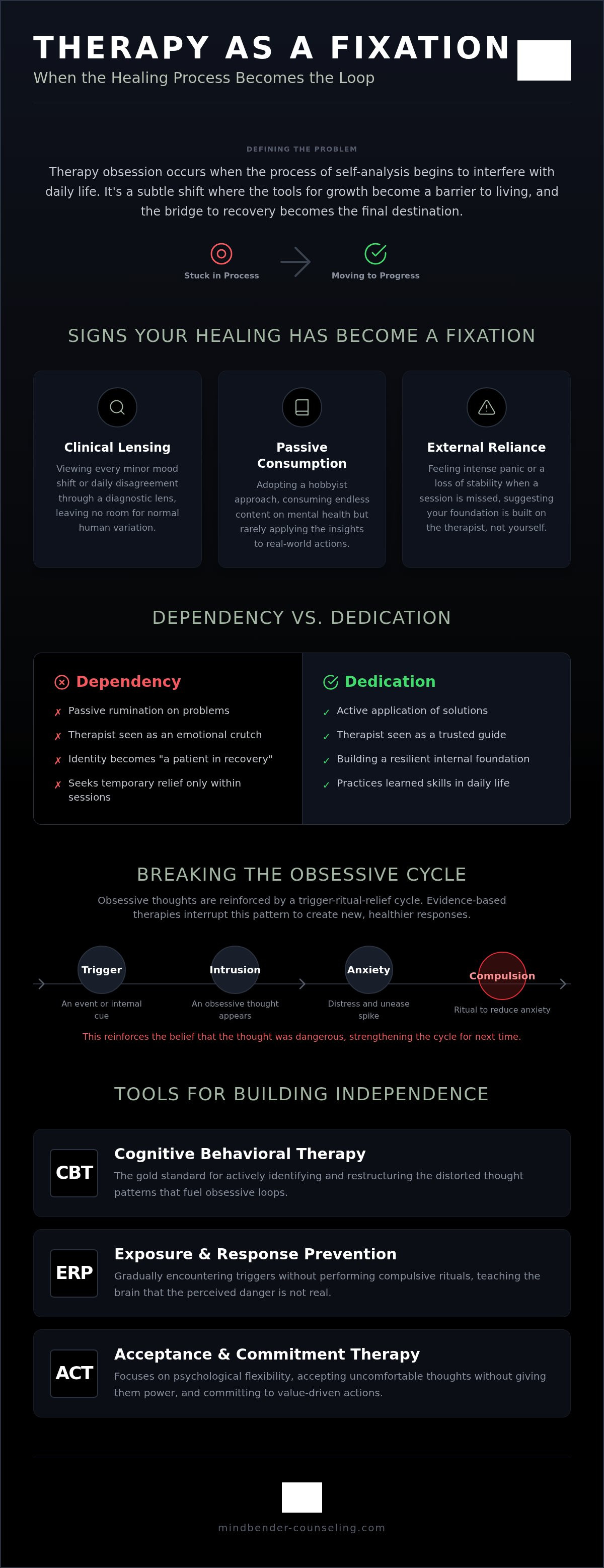
Therapy is designed to be a bridge to a healthier, more independent life, but sometimes the bridge itself becomes the destination. We define therapy obsession as a state where the process of self-analysis begins to interfere with your daily functioning rather than improving it. It is a subtle, often well-intentioned shift. You might find yourself preparing for your next session for days or replaying your therapist’s words so frequently that you miss out on the beauty of the present moment. Therapy obsession is the point where self-reflection stops being a tool for growth and starts being a barrier to living.
The Two Faces of Obsession in Therapy
Distinguishing between clinical patterns and therapeutic dependency is essential for your progress. On one side, we have clinical obsessions, which often involve Understanding Intrusive Thoughts and the significant distress they cause. For these patterns, evidence-based therapy for obsessive thoughts is the gold standard; it provides structured, reliable ways to break the loop. On the other side is process dependency. This occurs when the identity of being a patient or someone in recovery becomes a psychological comfort zone. Instead of active healing, you might find yourself in a state of passive ruminating, where you are simply thinking about your problems instead of applying the solutions you've worked hard to learn.
Signs You Might Be Over-Identifying with Your Diagnosis
It's easy to let a diagnosis become a lens through which you view every interaction. This over-identification can actually stall the work of evidence-based therapy for obsessive thoughts by making a diagnosis feel like an unchangeable part of who you are. Watch for these specific signs in your own journey:
- Viewing every daily disagreement or minor mood shift through a strictly clinical or diagnostic lens, leaving no room for normal human variation.
- Adopting a hobbyist approach to your mental health, where you consume endless content and podcasts but rarely apply those insights to real-world actions.
- Feeling a sense of intense panic or a loss of stability when a session is missed or rescheduled, suggesting your foundation is built on the therapist rather than your own internal strength.
Your brain’s reward system plays a role in this cycle. The validation and safety found in a clinical session can be deeply soothing. When you receive empathy for your struggles, your brain may hook onto that feeling, seeking the session itself as a form of temporary relief. The goal is to move beyond seeking relief in the room and start using the sessions to build a resilient life outside of them. Recognizing this loop is the first step toward regaining your true mental independence.
The Role of Behavioral Therapy in Managing Obsessive Patterns
When managing intrusive patterns, Cognitive Behavioral Therapy (CBT) stands as the gold standard for breaking obsessive loops. It's not just about talking through your feelings; it's about active, structured change that builds a solid internal foundation. Within this framework, Exposure and Response Prevention (ERP) offers a compassionate way to face fears. By gradually encountering triggers without performing the usual rituals, you teach your brain that the perceived danger isn't real. This Evidence-Based OCD Treatment focuses on building tolerance for uncertainty rather than seeking temporary relief through compulsions.
Building on this, individual counseling for anxiety targets the root of intrusive thoughts by helping you understand why your mind clings to specific stressors. Acceptance and Commitment Therapy (ACT) adds another layer of strength by focusing on psychological flexibility. It invites you to accept the presence of uncomfortable thoughts without giving them the power to dictate your choices. You learn that a thought is just a thought, not a command or a reflection of your character. This combination of tools forms the backbone of effective evidence-based therapy for obsessive thoughts.
How CBT Rewires the Obsessive Brain
The obsessive brain often operates in a trigger-thought-ritual cycle. An intrusive thought occurs, anxiety spikes, and you perform a ritual to lower that stress. This ritual, whether it's a mental check or a physical action, actually reinforces the fear. Through evidence-based therapy for obsessive thoughts, you learn to sit with emotional discomfort. You discover that you don't need to fight the thoughts; instead, you can observe them with a sense of detachment, much like watching clouds pass in the sky. This transition from combatant to observer is where true healing begins. We focus on these specific actions to help you achieve long-term stability:
- Identifying the specific triggers that start the rumination loop.
- Developing the courage to delay and eventually stop compulsive responses.
- Replacing mental rituals with grounded, present-moment awareness.
Personalized Approaches for Arizona and Texas Residents
Tailoring these tools to the rhythms of life in Arizona and Texas means acknowledging the specific professional and social pressures found in our communities. Whether you're balancing a career in the Austin tech scene or navigating family life in the Phoenix East Valley, your therapy should reflect your actual environment. A one size fits all approach often fails because it ignores the unique stressors of your daily life. Working with a therapist who understands these regional contexts allows for more personalized therapeutic interventions. We tailor these proven methods to your specific lifestyle and relational goals, ensuring the work we do together translates into real-world stability. If you're ready to build a more resilient foundation, our team at Mindbender Counseling is here to provide individual counseling services that prioritize your long-term independence.
Dependency vs. Dedication: Is Your Relationship with Therapy Healthy?
Distinguishing between being dedicated to your growth and being dependent on the process is a vital part of long-term stability. While evidence-based therapy for obsessive thoughts demands consistency, it shouldn't become a substitute for your own decision-making power. Healthy dedication is the commitment to apply session insights to your life between appointments. When you view therapy as a training ground rather than a permanent refuge, you build the internal foundation needed to navigate stressors on your own.
It's natural to develop strong emotional feelings for your therapist, a concept often called transference. You might feel a deep sense of safety or even an intense need for their approval. However, a skilled therapist remains a wise guide who eventually works themselves out of a job by empowering you toward self-efficacy. Their goal is to act as a sturdy anchor until you've constructed your own, ensuring that your progress is measured by your life outside the clinical room. True healing isn't about finding someone to lean on forever; it's about learning how to stand firmly on your own two feet.
Red Flags of Therapeutic Dependency
Dependency often creeps in quietly, masking itself as "doing the work." You might notice an inability to make even minor life decisions without consulting your therapist first. Some individuals find themselves withholding information or exaggerating symptoms because they fear that showing too much progress will end the support they've come to rely on. If you're prioritizing therapy sessions over essential social, familial, or professional commitments, it's time to evaluate if the process has become another form of the very obsession you're trying to manage. This shift from active participation to passive reliance can stall the benefits of evidence-based therapy for obsessive thoughts.
Hallmarks of Healthy Therapeutic Dedication
Healthy engagement with your recovery looks like active participation in your own rescue. This includes the consistent implementation of behavioral strategies and homework between sessions. You'll also find yourself setting clear, time-bound goals for personal growth, much like understanding how does online couples counseling work to ensure you're moving toward measurable milestones. As you gain these tools, you'll experience increased self-reliance and a quiet confidence in managing emotional triggers independently. This transition from needing a guide to becoming your own facilitator is the ultimate mark of therapeutic success. You're not just attending sessions; you're actively building a life that no longer requires them.
Practical Steps to Break the Cycle of Intrusive Thoughts
While evidence-based therapy for obsessive thoughts provides the structural blueprint, the real construction happens in the quiet moments of your daily life. Healing isn't found in a single breakthrough during a session; it's built through the small, consistent choices you make when an intrusive thought strikes. You have the power to change your relationship with your mind by practicing specific, actionable protocols that foster immediate relief and long-term resilience.
One of the most effective ways to manage acute rumination is the 5-4-3-2-1 grounding technique. When your mind begins to spiral, immediately pause and identify five things you see, four things you can touch, three things you hear, two things you can smell, and one thing you can taste. This process forces your brain to switch from internal distress to external sensory input, effectively hitting a "reset" button on your nervous system. To further limit the reach of rumination, try establishing a "Worry Window." Dedicate exactly 15 minutes a day, perhaps at 4:00 PM, to engage with your obsessive thoughts. If a thought appears outside this window, gently remind yourself that it has a scheduled time later, allowing you to stay present in your current task.
The Observe, Label, Release Technique
To break the loop of intrusive patterns, you must learn to identify a thought without attaching immediate judgment or fear. When a distressing thought arises, don't try to push it away or argue with it. Instead, label it objectively. Say to yourself, "I'm having a thought about safety," or "This is a rumination loop." By labeling the thought, you create a psychological distance that reduces its emotional power. Once labeled, you can release it by redirecting your focus toward a values-aligned action, such as finishing a work project or calling a friend. This process is a core component of therapy behavioral therapy, helping you build the emotional stamina to observe your mind without being controlled by it.
Building a Life Outside the Diagnostic Lens
True independence comes from cultivating an identity that isn't defined by your mental health journey. It's helpful to engage in hobbies and social circles that have nothing to do with self-improvement or clinical analysis. Whether it's joining a local hiking group in Phoenix or starting a woodworking project in Austin, these activities provide a space where you are simply a person, not a patient. Practice radical presence in daily tasks; when you are cooking, focus entirely on the scent of the spices and the texture of the vegetables. Additionally, set firm boundaries on "therapy talk" with loved ones. Limiting these conversations ensures your relationships are built on shared joy and connection rather than a constant cycle of processing. If you're ready to move beyond analysis and toward active living, you can reach out to Mindbender Counseling to start your journey toward mental independence.
Compassionate Care: Personalized Support at Mindbender Counseling
At Mindbender Counseling, we view our role as a supportive partner in your journey toward mental independence. We don't believe therapy should be a lifelong dependency; instead, we see it as a vital season of growth where you build the skills necessary to navigate life's challenges on your own. By utilizing evidence-based therapy for obsessive thoughts, we help you construct a solid internal foundation that allows you to eventually walk away from the clinical room with quiet confidence. For residents across Arizona and Texas, this means receiving care that respects your local context while focusing on the restoration of your internal balance.
Our approach is rooted in the belief that you are the primary architect of your own well-being. We act as wise guides and professional facilitators, providing the steady anchor you need while you develop your own strength. We've seen that the most effective healing happens when a client feels seen and spoken to personally, which is why we favor individualized attention over a one size fits all methodology. We're committed to helping you move from a state of feeling overwhelmed to one of calm assurance and predictability.
Why a Personalized Approach Matters for Obsession
Generic mental health advice often falls short when you're dealing with the complexity of intrusive thoughts or the subtle pull of therapeutic dependency. A personalized approach is essential because it addresses the unique root causes behind your specific patterns. By moving beyond surface-level suggestions to structured, research-backed counseling sessions, you gain a partner who treats your journey with fresh attention and care. We invite you to explore private therapy that respects your individual pace and honors your need for privacy. This tailored method ensures that every intervention acts as a catalyst for your personal evolution rather than just a temporary fix.
Getting Started with a Purpose-Driven Appointment
Scheduling your first session is a clear, low-friction action toward building long-term resilience. When you choose a therapist at Mindbender Counseling, you can expect a process focused on self-efficacy and the practical application of behavioral tools. We'll work together to identify the specific hurdles keeping you stuck in rumination and provide a structured path forward. Whether you're navigating the professional pressures of Austin or seeking stability in Phoenix, our goal is to help you restore a sense of tranquility. We encourage you to take this first step toward a balanced, resilient life in AZ or TX. We're here to provide the unwavering support you need until you're ready to navigate your world with complete independence.
Reclaiming Your Mental Independence
Healing is not a destination where you remain tethered to a provider; it's the process of constructing your own internal foundation. By learning to distinguish between healthy dedication and therapeutic dependency, you've already taken a significant step toward lasting stability. You now have the tools to observe intrusive thoughts without judgment and the grounding techniques to manage acute rumination in your daily life. Utilizing evidence-based therapy for obsessive thoughts provides the structure you need, but your commitment to applying these insights outside the session is what creates true change.
At Mindbender Counseling, we act as wise guides for residents across Arizona and Texas, offering personalized interventions that respect your individual pace. We prioritize evidence-based methods that empower you to become your own facilitator of well-being. It's time to shift your focus from the cycle of analysis to the practice of living a balanced, resilient life. Our compassionate approach ensures you have a sturdy anchor while you build the strength to navigate the world on your own terms.
Begin your journey toward emotional independence with Mindbender Counseling.
You possess the strength to move beyond the loop and into a future defined by your own choices.
Frequently Asked Questions
Can you be addicted to therapy or obsessed with your therapist?
Therapeutic dependency can occur when the process becomes a primary comfort zone rather than a tool for growth. This often manifests as an intense focus on your therapist's approval or a feeling of panic when a session is missed. While evidence-based therapy for obsessive thoughts is designed to build independence, some individuals find themselves stuck in a loop of seeking validation. Recognizing this shift early allows you to refocus on building your own self-efficacy.
How do I know if I am over-pathologizing my normal emotions?
You're likely over-pathologizing if you view every minor mood shift or daily frustration through a strictly clinical lens. Normal human variation includes sadness, anger, and worry; these aren't always symptoms of a disorder. If you find yourself constantly searching for a diagnosis to explain every feeling, it might be time to step back. Healthy recovery involves accepting a full range of emotions without needing to label them as medical issues every time.
What is the difference between healthy rumination and a clinical obsession?
Healthy rumination is usually a temporary period of reflection focused on solving a specific, tangible problem. In contrast, a clinical obsession involves intrusive thoughts that feel out of your control and lead to significant distress or rituals. Evidence-based therapy for obsessive thoughts helps distinguish these by looking at the impact on your daily life. If a thought loop prevents you from working or connecting with others, it has likely crossed into clinical territory.
How long does it take for behavioral therapy to help with intrusive thoughts?
Many people begin to notice a shift in their perspective within 8 to 12 weeks of consistent engagement. However, the exact timeline depends on the intensity of your patterns and your commitment to practicing tools outside of sessions. Behavioral therapy focuses on gradual progress rather than an overnight fix. By building a solid internal foundation, you'll find that your ability to manage intrusive thoughts grows stronger with each month of dedicated, personalized work.
Is it normal to think about therapy every day between sessions?
It's normal to reflect on insights from your session, but it becomes a concern if therapy talk dominates your internal monologue every day. Thinking about your growth is productive; obsessing over the process is not. If you're mentally rehearsing your next appointment for hours, you might be slipping into a dependency loop. Try setting boundaries on your reflection time to ensure you're living your life rather than just analyzing it in your head.
What should I do if I feel like my therapist is encouraging my dependency?
If you feel your provider is fostering reliance rather than resilience, it's important to address this directly in your next session. A professional facilitator should always be working toward your independence. You might ask for more structured homework or clearer, time-bound goals for your treatment. If the therapist resists your move toward self-efficacy, it may be time to seek a provider who prioritizes your long-term growth and helps you build a sturdy foundation.
Can couples counseling help if one partner is obsessed with relationship perfection?
Couples counseling can provide a safe space to address the anxiety behind perfectionism. Often, the drive for a "perfect" relationship stems from a fear of conflict or abandonment. A therapist can help both partners set realistic expectations and develop healthier communication patterns. By shifting the focus from perfection to genuine connection, couples in Arizona and Texas can build a more resilient and authentic bond that survives the natural ups and downs of life.
How do I bring up my fear of therapy obsession with my counselor?
Bringing up this fear is a brave step toward true healing. Simply tell your counselor that you're worried about becoming too dependent on the process or the sessions themselves. You can explain that you want to ensure your work together is building your independence rather than creating a new fixation. A wise guide will welcome this conversation and help you adjust your treatment plan to focus more on real-world application and personal self-reliance.


