

What if the most transformative part of your mental health journey isn't just the act of sharing your story, but the specific, scientific framework used to process it? Many people step into a counselor's office fearing that therapy is a one-size-fits-all conversation or feeling overwhelmed by clinical labels they don't quite understand. It's common to worry that "just talking" won't be enough to create the profound shift you're seeking in your daily life. You deserve a path to healing that feels as unique as your own history and utilizes effective individual therapy techniques tailored to your specific needs.
This guide clarifies the mechanics behind modern therapeutic methods so you can move past the confusion of acronyms and find a method that truly resonates with your personal struggles. We'll explore how evidence-based approaches provide a sturdy foundation for lasting emotional balance and internal progress. By understanding these diverse styles, you'll feel empowered to ask your therapist about their specific approach, ensuring your care is a collaborative and intentional partnership. Whether you're in Arizona or Texas, discovering the right therapeutic match is the first step toward restoring your sense of stability and moving forward with quiet confidence.
Key Takeaways
- Learn why modern therapy has evolved from general conversation into a series of structured, evidence-based interventions designed for measurable progress.
- Demystify common clinical frameworks to understand how specific individual therapy techniques like CBT and DBT create a solid foundation for mental clarity.
- Explore the vital connection between your mind and body to see how somatic approaches help release tension and restore internal balance.
- Discover how a personalized assessment process ensures your therapeutic journey is tailored to your unique goals rather than a standard template.
- Gain the confidence to partner with a compassionate guide in Arizona or Texas who prioritizes your individual path to long-term well-being.
What Are Individual Therapy Techniques and Why Do They Matter?
Individual therapy techniques are the specialized, structured tools that counselors use to facilitate meaningful change. They aren't just conversation starters; they're blueprints for emotional recovery. Think of them as the bridge between feeling stuck and finding a new way forward. These techniques provide a clear path for identifying patterns and building the skills necessary for a more balanced life.
In the past, many viewed Psychotherapy as a vague process of "just talking." Today, the field has shifted toward evidence-based intervention. This means your sessions are guided by clinical frameworks that ensure both your safety and your measurable progress. These frameworks act as a safety net, ensuring that the care you receive is grounded in what actually works. We define evidence-based therapy as a purposeful combination of clinical expertise and your unique personal values.
The Evolution of Modern Counseling Methods
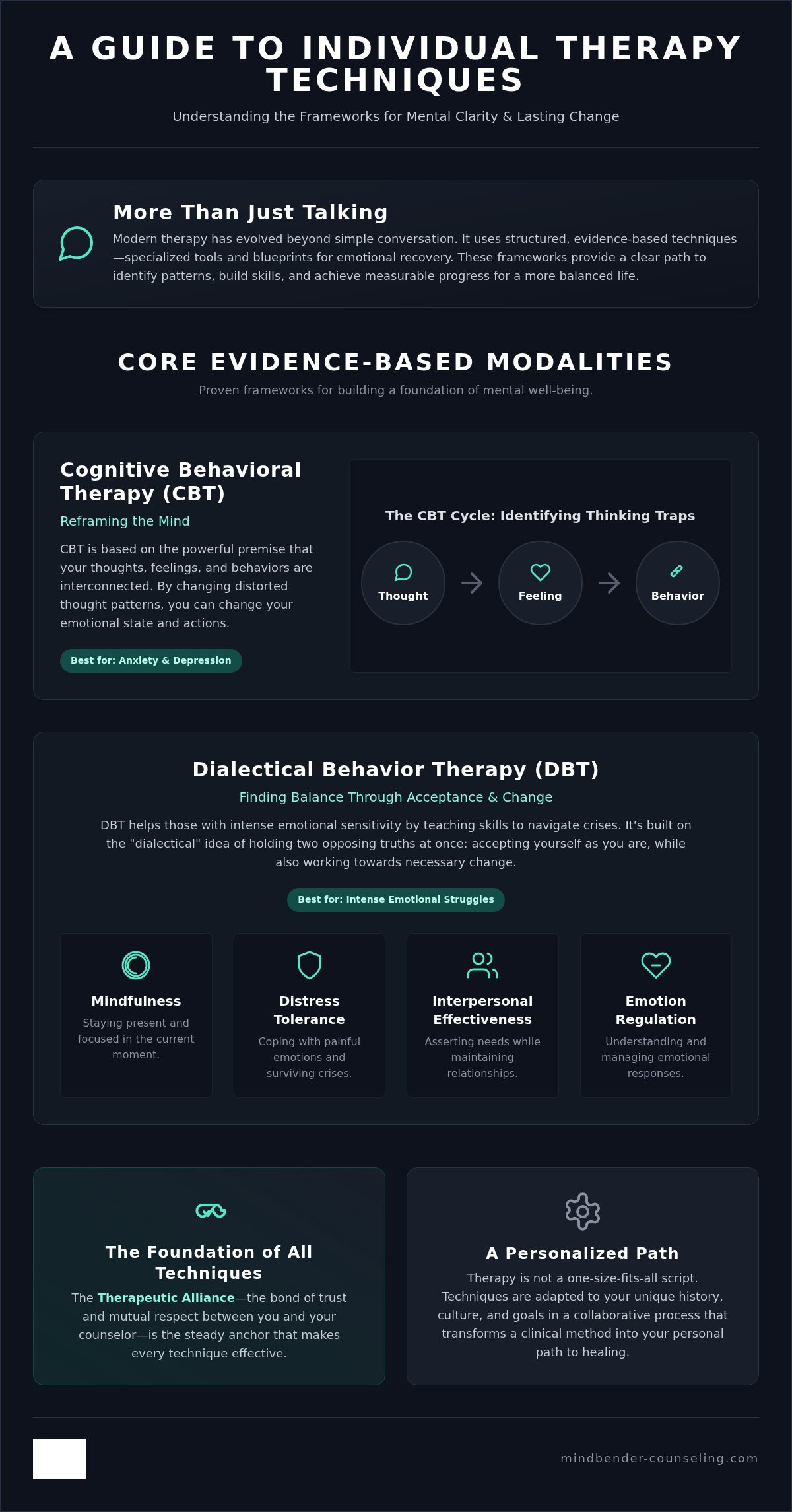
Counseling has traveled a long road. It started with early psychoanalysis, which often lasted years and focused heavily on the distant past. Modern behavioral science has refined this process. Today's individual therapy techniques are designed to be goal-oriented and time-efficient, helping you find relief sooner. They focus on the present while respecting the past. Despite these technical advancements, the "therapeutic alliance" remains the essential foundation. This is the bond of trust and mutual respect between you and your counselor that makes every other tool effective. It is the steady anchor for your growth.
Personalization: Moving Beyond One-Size-Fits-All
A technique that helps someone manage social anxiety might not be the right fit for someone processing complex trauma. Therapists don't just follow a script. They adapt standard protocols to meet your specific needs and life circumstances. This flexibility is what makes modern care so powerful. Your history, your culture, and your current environment all play a role in how a counselor in Arizona or Texas applies a specific method. Your feedback on what feels helpful or what feels disconnected is essential to the individual therapy techniques used in your care. This collaborative approach transforms a clinical method into a personalized path toward healing and internal balance.
Core Evidence-Based Modalities: CBT, DBT, and Beyond
When you seek professional support, you want to know that the methods used are backed by rigorous research and proven results. Understanding Core Evidence-Based Modalities allows you to engage more deeply with your own healing process. These frameworks aren't just theories. They are structured systems designed to help you regain control over your life. By using specific individual therapy techniques, counselors can target the root causes of distress rather than just addressing the symptoms.
Cognitive Behavioral Therapy (CBT): Reframing the Mind
Cognitive Behavioral Therapy is often considered the gold standard for treating anxiety and depression. It operates on a simple but powerful premise: your thoughts, feelings, and behaviors are all interconnected. If you can shift a distorted thought, the emotional weight often follows. Counselors use tools like cognitive restructuring to help you identify "thinking traps" that keep you stuck in negative cycles. Another common tool is exposure therapy, which allows you to face fears in a safe, controlled environment. This process builds confidence and reduces the power that avoidance has over your daily life.
Dialectical Behavior Therapy (DBT): Finding Balance
For those who experience intense emotional struggles, Dialectical Behavior Therapy offers a path toward stability. It was originally developed to help people with high emotional sensitivity and is built on four essential pillars. These include mindfulness, distress tolerance, interpersonal effectiveness, and emotion regulation. The term "dialectics" refers to the practice of holding two opposing truths at once. For example, you can accept who you are right now while simultaneously working toward necessary change. This balance helps you navigate crises without feeling completely overwhelmed by your feelings.
Beyond these primary styles, Acceptance and Commitment Therapy (ACT) is another powerful tool for building psychological flexibility. Instead of fighting difficult thoughts, you learn to acknowledge them and move toward your core values. This is part of a broader understanding of behavioral therapy that prioritizes modern resilience. These methods provide the internal foundation you need to handle life's challenges with steady assurance. If you're ready to find a method that resonates with your personal struggle, our team provides Individual Counseling Services in Arizona and Texas that are tailored to your unique journey.
Somatic and Mindfulness-Based Approaches to Healing
While traditional talk therapy provides vital insights, many people find that their body still holds onto stress long after the mind has processed the events. This realization has led to a growing emphasis on the mind-body connection in modern clinical practice. Incorporating somatic and mindfulness-based individual therapy techniques allows for a more holistic approach to recovery. These methods don't replace cognitive work; instead, they complement it by addressing the physical sensations that often accompany emotional distress. By bridging the gap between thought and sensation, you can achieve a deeper level of healing that feels both stable and sustainable.
The Role of Mindfulness in Individual Counseling
Mindfulness is the practice of maintaining a non-judgmental awareness of the present moment. In a clinical setting, this isn't just about meditation. A therapist might invite you to notice the physical sensation of your feet on the floor or the rhythm of your breath when a difficult topic arises. These grounding exercises help you stay present rather than becoming lost in overwhelming memories or future worries. For instance, a therapist might use a "5-4-3-2-1" technique to engage your senses, pulling your focus away from internal chaos and back to the safety of the room. This real-time awareness is a cornerstone of individual counseling for anxiety, as it helps break the cycle of panic before it escalates.
Somatic Techniques for Trauma and Stress
Sometimes "talking it out" isn't enough for deep-seated stress because trauma often lives in the nervous system rather than just the conscious mind. Somatic Experiencing is a framework that addresses this by focusing on bodily sensations rather than just the narrative of what happened. Specialists use individual therapy techniques such as body scanning to identify areas of physical bracing or "pendulation" to help you move safely between states of high activation and states of relative ease. Pendulation involves a rhythmic shift in attention from a place of discomfort to a place of strength within the body. This helps you build the capacity to tolerate difficult emotions without becoming flooded. Somatic techniques help regulate the nervous system directly, providing a way to release stored energy that cognitive processing might miss.
It's important to understand that these are professional clinical tools, not just simple relaxation exercises. While Cognitive Behavioral Therapy (CBT) focuses on the logic of our thoughts, somatic techniques address the physiological responses that often bypass logic entirely. By integrating both, you create a sturdy foundation for internal progress. This dual approach helps you move toward a state of quiet confidence where your physical and emotional selves are in harmony.
How Therapists Select the Right Technique for Your Needs
The process of selecting the right clinical approach isn't a matter of chance. It's a deliberate, collaborative effort between you and your counselor to find the most effective path forward. While the various individual therapy techniques we've discussed offer powerful tools for change, their success depends on how well they align with your specific history and goals. This matching process ensures that your time in session is purposeful and leads to the meaningful, long-term outcomes you deserve.
The Assessment: Understanding Your Unique Story
Your journey begins with a comprehensive intake session. Counselors in Arizona and Texas use this time to listen deeply to your history, current challenges, and what you hope to achieve. This isn't just about gathering facts; it's about identifying the underlying patterns that suggest which modalities will be most effective for you. For example, if you struggle with intrusive thoughts, a cognitive-focused approach might be the starting point. If you experience physical symptoms of stress, somatic tools may be prioritized. You should feel encouraged to be honest about what has or hasn't worked for you in the past. This transparency allows your therapist to refine their approach from day one, building a foundation of trust and safety.
Once the assessment is complete, your therapist develops a treatment plan. Think of this as a roadmap for your healing. It outlines the specific individual therapy techniques that will be used and sets clear, achievable milestones. This plan isn't a rigid contract; it's a living document that evolves as you grow and gain new insights.
Tracking Progress: Knowing When a Technique is Working
Progress in therapy isn't always a straight line, but it should be observable. Therapists often use "outcome measures" or regular verbal check-ins to gauge how well a specific technique is serving you. You might notice subtle shifts before big breakthroughs. These signs of growth often include:
- An increased ability to bounce back from daily stressors.
- Clearer boundaries in your personal and professional relationships.
- A reduction in the intensity of physical symptoms like tension or fatigue.
- Feeling more empowered to handle difficult emotions without becoming overwhelmed.
If progress stalls, it doesn't mean you've failed or that therapy doesn't work. It simply means it's time to adjust the strategy. A skilled therapist will recognize when a technique has reached its limit and will collaborate with you to switch to a different modality. The ultimate goal is always your autonomy and well-being. If you're ready to begin this personalized process, you can explore our Individual Counseling Services to find a guide who will work alongside you every step of the way.
Personalized Care at Mindbender Counseling in Arizona & Texas
At Mindbender Counseling, we believe that the most effective healing happens when scientific rigor meets deep empathy. Our philosophy is rooted in providing expert-led care that treats you as a whole person rather than a collection of clinical symptoms. By skillfully integrating various individual therapy techniques, our therapists create a supportive environment where you can explore your challenges with safety and clarity. We don't believe in rigid, one-size-fits-all protocols. Instead, we use our clinical expertise to weave together the right threads of CBT, DBT, or somatic work to suit your unique internal landscape and promote lasting emotional balance.
This integrative approach ensures that your treatment plan is as dynamic as you are. If a specific cognitive tool doesn't resonate, your therapist has the experience to pivot toward a more experiential or body-based method. This flexibility is a hallmark of our Evidence-Based Therapy. It allows for a steady, unwavering support system that acts as both a sturdy anchor and a catalyst for your personal movement. We treat every individual with fresh attention, ensuring that your path toward well-being is paved with methods that are proven to work for your specific struggle.
Serving the Arizona and Texas Communities
We are proud to provide local accessibility for those seeking individual therapy in Phoenix or across the diverse landscape of Texas. Choosing a local practice means working with a professional who understands the specific regional stressors you face every day. Whether it's the unique pace of life in a growing metropolitan area or the cultural nuances of the Southwest, our team is deeply embedded in these communities. This local insight allows us to provide more relevant, grounded support that reflects your actual lived experience. You can learn more about our commitment to accessible care in our private therapy guide, which explores how we are working to break the stigma surrounding mental health in 2026.
Your First Step Toward Change
It's completely normal to feel a sense of hesitation or nervousness when considering your first session. Taking that initial step requires a great deal of courage, and we are here to make the process as smooth and low-friction as possible. When you reach out, our team handles your inquiry with the utmost discretion and compassionate care. We'll guide you through a simple intake process to match you with a therapist whose expertise and personality align with your specific goals. This initial contact is the start of a collaborative partnership dedicated to your growth.
Think of this journey not as a temporary fix, but as a vital investment in your future self. By mastering effective individual therapy techniques today, you are building the foundation for a more resilient, balanced life tomorrow. Scheduling your first appointment is a clear path toward the restoration of your internal peace and the construction of a solid internal foundation. We invite you to take this step with us, knowing that steady, professional support is ready to meet you exactly where you are.
Embracing Your Path to Lasting Balance
Finding the right approach to mental wellness shouldn't feel like a mystery. You now understand that effective healing is built on a foundation of structured, evidence-based interventions that honor both your cognitive patterns and your physical sensations. From the mental reframing of CBT to the nervous system regulation of somatic work, these diverse individual therapy techniques offer a clear roadmap for navigating life's most complex challenges. By prioritizing a collaborative relationship with your therapist, you ensure that your care remains as dynamic and unique as your own story.
Mindbender Counseling acts as your expert guide through this transformative process. We provide compassionate care tailored to the specific life circumstances of residents in Arizona and Texas. Our experienced therapists are dedicated to your stability and long-term progress, offering a steady anchor as you move toward a more resilient version of yourself. Begin your journey toward personal growth with Mindbender Counseling today. You have the strength to build a solid internal foundation, and we are ready to support you every step of the way.
Frequently Asked Questions
What is the most effective individual therapy technique?
There isn't a single technique that works for everyone; effectiveness depends on your specific goals and history. Research suggests that the quality of the therapeutic relationship is often the strongest predictor of success. However, certain individual therapy techniques like CBT are highly effective for depression, while somatic work may be better for trauma. Your therapist will help you determine which evidence-based method aligns with your unique needs.
How long does it take for these techniques to start working?
Many people begin to notice subtle shifts in their perspective or emotional regulation within the first 4 to 8 sessions. While deep-seated patterns may take longer to transform, evidence-based methods are designed to be goal-oriented and efficient. Your progress depends on the complexity of your concerns and your level of engagement between sessions. Consistent attendance helps build the momentum necessary for lasting change and internal stability.
Can a therapist use more than one technique at a time?
Yes, most modern counselors use an integrative approach that combines multiple individual therapy techniques to address different aspects of your well-being. A therapist might use cognitive restructuring to handle intrusive thoughts while incorporating mindfulness for immediate grounding. This flexibility allows your treatment plan to evolve as you grow. It ensures that every session remains relevant to your current emotional state and long-term goals.
Is CBT better than DBT for anxiety?
Neither is objectively better, as both are proven to reduce anxiety symptoms through different mechanisms. CBT focuses on identifying and changing the specific thought patterns that fuel worry. DBT is often more helpful if your anxiety is accompanied by intense emotional swings or a need for better distress tolerance. Your counselor will assess your symptoms to decide which framework provides the most sturdy foundation for your recovery.
Are these therapy techniques covered by insurance in Arizona or Texas?
Most insurance plans in Arizona and Texas cover evidence-based therapy when it's deemed medically necessary for a mental health condition. Coverage varies significantly between providers and specific plans. It's best to contact your insurance carrier directly to verify your behavioral health benefits. Some clients prefer a self-pay model to ensure a higher level of privacy and to avoid the requirement of a formal diagnosis for their records.
What should I do if a specific therapy technique feels uncomfortable?
You should immediately share your feelings with your therapist so they can adjust the approach. Therapy can be challenging, but it should never feel unsafe or overwhelming. A skilled counselor will value your feedback and may slow the pace or try a different modality that feels more supportive. Your comfort and sense of safety are the most important factors in the success of any clinical intervention.
Do I need a diagnosis to benefit from individual therapy techniques?
You don't necessarily need a formal diagnosis to gain value from therapeutic tools. Many people seek counseling to improve their relationships, navigate life transitions, or build better stress-management skills. While insurance companies often require a diagnosis for reimbursement, the techniques themselves are useful for anyone looking to increase their emotional resilience. Therapy is a proactive investment in your personal growth and overall mental clarity.
How do I ask my therapist which techniques they are using?
You can simply ask, "What is your clinical approach, and how do these techniques help with my specific goals?" Most therapists are happy to explain their methodology and the evidence behind it. Understanding the "why" behind an exercise can actually make the process more effective. Open communication about the methods used helps build a stronger partnership and ensures you feel empowered throughout your healing journey.


